
Recounting the Capitol Insurrection and 2021's Best Stories
Season 50 Episode 1 | 26m 46sVideo has Closed Captions
Recounting the Capitol Insurrection and 2021's Best Stories | Episode 5001
A sit down with 14th District Michigan Congresswoman Brenda Lawrence to recount how it felt to be inside the Capitol during the Jan. 6 insurrection nearly one year later. Plus, a reflective view on 2021; all the great guests, stories and more. Bringing back conversations around the COVID-19 vaccinations, George Floyd, Derek Chauvin, Black’s women’s leadership in the church and more.
Problems playing video? | Closed Captioning Feedback
Problems playing video? | Closed Captioning Feedback
American Black Journal is a local public television program presented by Detroit PBS
Recounting the Capitol Insurrection and 2021's Best Stories
Season 50 Episode 1 | 26m 46sVideo has Closed Captions
A sit down with 14th District Michigan Congresswoman Brenda Lawrence to recount how it felt to be inside the Capitol during the Jan. 6 insurrection nearly one year later. Plus, a reflective view on 2021; all the great guests, stories and more. Bringing back conversations around the COVID-19 vaccinations, George Floyd, Derek Chauvin, Black’s women’s leadership in the church and more.
Problems playing video? | Closed Captioning Feedback
How to Watch American Black Journal
American Black Journal is available to stream on pbs.org and the free PBS App, available on iPhone, Apple TV, Android TV, Android smartphones, Amazon Fire TV, Amazon Fire Tablet, Roku, Samsung Smart TV, and Vizio.
Providing Support for PBS.org
Learn Moreabout PBS online sponsorship- Just ahead on American Black Journal.
It's been a year since the US Capitol was under siege by rioters.
Michigan Congresswoman Brenda Lawrence is here to talk about that attack and its impact on our democracy.
Plus, we'll take a look back at some of our memorable interviews in 2021.
Stay right there.
American Black Journal starts now.
- From Delta faucets to Behr paint, Masco corporation is proud to deliver products that enhance the way consumers all over the world experience and enjoy their living spaces.
Masco, serving Michigan communities since 1929.
- Support also provided by the Cynthia and Edsel Ford Fund for journalism at Detroit Public TV.
- The DTE foundation proudly supports 50 years of American Black Journal in covering African-American history, culture and politics.
The DTE foundation and American Black Journal partners in presenting African-American perspectives about our communities and in our world.
- Also brought to you by AAA, Nissan foundation, Impact at Home UAW Solidarity Forever, and viewers like you.
Thank you.
(upbeat music) - Welcome to American Black Journal.
I'm Stephen Henderson.
January 6th will mark one year since the US Capitol was stormed by a mob of Donald Trump supporters who were trying to stop the certification of president Joe Biden's 2020 election victory.
Since then, hundreds have been charged, and lawsuits have been filed in connection with the rioting.
Michigan Congresswoman Brenda Lawrence was one of the lawmakers who were inside the Capitol when the assault took place.
I spoke with her about that frightening experience and where things stand one year later.
So I want to go back in time a little bit to talk to you about two really pivotal things that have happened just in the last 14 months.
Let's start with the presidential election in 2020, in November.
And this really crazy reaction that we saw to the idea that we were just counting votes in the city of Detroit.
It was very badly interrupted by, by a bunch of really angry citizens who believed that, that there was fraud going on.
Talk to me about what your reaction was to that, and again, sort of how we build from there to some of the things that would happen later.
- TCF, and what happened here on the hill, and the Capitol was not the America I know.
I was raised by a Southern woman who lived through the civil rights and Jim Crow laws who took her right to vote as one of the most precious gifts of being an American.
I was taken by the hand every election day to stand next to my grandmother as she voted so she could teach me and she would constantly say, this is what will protect your rights and freedoms in America, and as an American citizen, you must vote.
And so we call it the big lie to see criminal behavior and to see just people who are misinformed to the point where we saw an attack on our democracy.
And that's what all of this summed up to be: an attack on democracy, which is so unacceptable, so disappointing.
And it's just not the America that I know and I love.
- Yeah.
So on January 6th at the US Capitol, you were there while this mob, - Yes.
this insurrectionist mob was trying to interrupt the official counting of votes in the presidential election.
Let's go back to that day for a second and just talk about what that was like.
- So Stephen, (laughing) one of the things that just really stood out as I try to suppress this memory is the words from the Sergeant at arms: They're headed our way.
I had not seen TV.
I know they had whisked out Nancy Pelosi.
So I figured something was really serious.
And they said they had locked the doors and they said, they're headed our way, find shelter, someplace to protect yourself.
And it was, you know, it was surreal.
Then they told us, put on the gas masks.
And I didn't even know under the seat that we sit on all the time to vote in the Capitol chambers were gas masks.
So I'm trying to put on this gas mask and then you hear this banging at the door and it's vibrating, 'cause the door is locked and it is a mob, you can hear them screaming and they're banging on the door and I'm looking around saying, oh my God, am I going to die today?
What in the world is happening?
And then the Capitol police came in, and this is the point I want everyone to understand, because whether you're a Democrat or Republican listening to my voice, at that point, Capitol police came in with their guns drawn and said, everybody exit this way.
So it was the opposite end of the chamber.
So the chamber has about six or eight doors that you can get into to come on the floor.
And it was the opposite end.
Their guns are pulled and they're telling everybody move, move, go, go, go!
And Democrats and Republicans, so this is the point I want everyone to understand.
This was not a partisan moment.
And I tell people it's probably the most nonpartisan moment I've seen on the hill lately, where Democrats and Republicans were literally running down the back staircases and hallways to get to some place of safety.
We were literally running.
'Cause I had to grab my hand, one of my, one of the staff because she was older and she wasn't able to run.
And I just pulled her, said, we gotta go.
We gotta go.
And so, to think about what this was all about, it was about our democracy.
It was about counting the votes and a person who did not want to leave office.
So because he did not want to leave, he was going to create a riot.
He was going to disrupt this democracy, and he encouraged violence.
And that person was Donald Trump.
- Yeah.
So I want to talk about the role of race in all of this.
And it's something that even as we are watching the hearings on the hill take place to try to assign culpability for what happened, there's not a lot of talk anymore about the racial motive and the racial context for all of this.
There's a reason, for instance, that the protestors showed up at the TCF center in Detroit.
And not, for instance, in places like Farmington or Farmington Hills, where, - Or Livonia.
- Or Livonia, where votes flipped even more than they did in Detroit between 2016 and 2020.
There's a reason that this attack on the Capitol, was about the idea of African-American votes and counting African-American votes.
I want to give you a chance just to talk about why we're still, some 50 some years after the passage of the voting rights act, why we're still dealing with this.
- It's been said publicly and behind closed doors.
If that crowd had looked different, if it had been the typical black lives matter, young, multicultural children, young people, rather, if it had been predominantly people of color, African-Americans, with the patience and tolerance that we saw that day, the hesitation to use armed weapons to stop the riots.
There was one shot fired, and it was, you know, it was, I don't ever want a police officer to use violence unnecessarily, but I also want our laws or policies in this case, my democracy, protected.
And you saw just a mob of angry, just overexcited mob, just out of control.
And you had all of these armed police officers begging them to stop.
Don't, you know, no, you can't do that.
You know, there was a lesson to be learned here.
Lives were not lost, excessive violence was not used.
And that I know for a fact, and you know, people say, you don't know that, I do know, because I've seen it in history time and time again, when there are mobs of people of color, black people, the result of law enforcement is totally different.
- Yeah.
I also want to give you a chance to talk about what's going on now, which is that you see a lot of supporters of the former president, Donald Trump, trying to gain access to or control over the mechanisms of democracy, running for posts where they would be able to get to certify or not certify votes, running for secretary of state in places where they would hope to set the rules for election.
What should we be making of that, and what should we be doing to protect democracy?
This is not just about some sort of partisan aim.
As you point out, this is about the democracy itself and whether it actually works and whether people can have faith in it.
I'm not sure how we are supposed to push back against what's happening.
- So Stephen, isn't it ironic that we only have a conversation about democracy working when it doesn't work for you?
- Right.
(laughing) - But these, I have some of my colleagues who are supporting these bills and laws and that same democracy they're attacking is the democracy that resulted in them winning their seat, time and time again.
And let's be very clear.
Zero audit, zero investigation has returned results of any fraud.
It isn't there.
Even these rogue investigators who went into different states to find the corruption has not found it.
So when you talk about, we want to change the laws of democracy, be careful America, because this is just scratching away at the foundation of the American democracy.
The one that we have taunted around the world that others look at, and you saw when President Biden now goes and talks to other countries about humanity and about values and about democracy, some are laughing in his face.
You need to fix your own home ground first, before you come talk to us.
And it's sad to me, and it's at times it makes me very angry that we in America, based on partisan misinformation will destroy something that has made us a great country that we are.
And I, you know, I say this often Stephen, I love America, even though she didn't always love me back.
This great country has given me opportunities for whether you are rich or whether you're poor.
It has looked after its old and taken care of the young.
It has done so many great things, but yet still you have the audacity because you did not win the election to assemble this mass destruction of our democracy.
It's not right.
It infuriates me, and you know the same at the same breath, we'll turn around and say the pledge of allegiance.
Think about what you're saying.
I pledge allegiance to this country, to our democracy, to protect it.
When I take an oath as a member of Congress, I said that I'm going to serve and protect.
It's a very difficult time right now in America.
- Okay.
Congresswoman Brenda Lawrence, it's always great to catch up with you.
- Great to catch up with you.
I want to say happy holidays to everyone.
Please be safe.
We have a new variant out there.
Keep those masks on.
Please get vaccinated, and Stephen to you and your family, may God bless you and give you all the desires of your heart, and that we'll have a better 2022.
- Yeah, can't get much worse.
(laughing) And to you too now.
Thanks.
- Take care.
- Of course, that capital insurrection was just one of the major stories last year.
We also saw the nation's first black and first female vice president take office, and hundreds of millions of Americans rolled up their sleeves to get a COVID-19 vaccine.
We discussed these topics and so much more here on American Black Journal.
Here's a brief look back at some of our conversations.
The vaccine is this light at the end of the tunnel, but we're still in the tunnel.
We're far from that light.
I worry that we're not acting that way, that we're rushing to get back to life as it was before.
Restaurants are about to open next week, and they're sending back their kids to school in person.
For African-Americans, I keep saying this is especially dangerous.
We can't afford another spring and summer like we had last year.
Kerry I'm going to start with you.
- That wasn't a topic of this morning show.
And I was surprised to find out that there's many African-Americans really, they are ready.
They just want more information on the vaccines.
They will take the vaccine if in fact they are provided with, they want their questions answered.
The truth is African-Americans simply want to make sure that we're receiving the same quality health care that everybody else is receiving.
And if we are, they are going to roll their sleeves up and take the shot when it's their turn, just like everyone else, they just need their questions answered.
And I think that, you know, the medical community, especially the African-Americans in the medical community are doing a great job of trying to push that information out to the black community to say, don't believe the hype, don't believe the conspiracy theorists, go get the shot when it's your turn.
- I do want to talk a little about the Chauvin trial, and what's next there.
You've made a sentencing recommendation in Chauvin's case and you've got more trials.
You have more officers.
- Yeah, we do.
We have them, and they're all, and they're tough, and we're gearing and we're working hard on it.
I have to say to everybody listening to your show, the three defendants remaining are presumed innocent until proven guilty.
I want to be very clear.
They have a right to a fair trial, impartial jury.
And I stand by that as a prosecutor, I'm not a minister of punishment, I'm a minister of justice.
So I stand on that.
So that's coming up and I'm not going to be able to speak that much about those three, that's happening on August 23rd.
When it happens, the world will know, but as it relates to Mr. Chauvin, yeah, in Minnesota law, the second degree unintentional murder, which is the top count he was convicted, carries with it, a guideline sentence of 150 months.
And then in Minnesota, you do two thirds, right?
So it works out to a hundred months, which is about eight years inside, and then you do the rest on supervised release.
I would, we are arguing and we have argued and we are arguing now that there are aggravating factors in this case.
One is that Derek Chauvin wasn't trusted with the power, prestige and esteem of the police department.
He was a person of trust and authority and used it in a way to effective murder.
So that is more, that drives us in the direction of greater level of accountability and culpability.
He, George Ford was particularly vulnerable.
He was in a prone position, hands behind his back.
There has been testimony that George Floyd had fentanyl in his system.
That, in my mind doesn't make it worse.
It makes it worse for Chauvin.
It makes him more vulnerable, in greater need of care and concern by people who have rendered him helpless.
- Reverend Watson, the leadership role that we see also changing and emerging for black women.
Talk about what's driving that change right now.
- I believe that certainly black women in ministry with spiritually rooted women, the reason that there's such political change in the air right down nationally.
There would not be a president Joe Biden, help me somebody if there were not for black women.
Black women, all over Atlanta.
One of my mentors was in Atlanta, and she told me directly, how she ushered 60 black women, church women, into the rural areas of Georgia who were assigned to get people in rural areas of Georgia to the polls to vote.
And that has transformed this country.
And the reason we are all receiving a stimulus right now, because of those black church women.
- Shaun Robinson, welcome to American Black Journal, and welcome home to Detroit.
- Thank you, Stephen.
I love being a part of anything my city is doing anytime I get to visit in person or virtually, I'm in.
So thank you so much for having me.
- Yeah.
So of course you've had a really, really remarkable career in Hollywood, but this new work is kind of a different turn.
- So, first of all, I actually started my career in Detroit.
WGPR, channel 62 long, long time ago.
But most people who know me nationally know me from Access Hollywood, where I spent 16 years covering the red carpet, interviewing, you know, all the celebrities in Hollywood.
And I started thinking towards the end of that period, what I wanted to do, what I wanted the next or additional chapter to look like.
And I knew that I wanted to be a content creator, to produce content.
And, you know, as journalists, we're really producers at heart because we've had to, you know, produce our own stories many times, coming up the ranks and we had to have a vision for our stories.
And so a friend of mine who worked at essence magazine at the time, this was back in 2016, told me about a galley of this book, "Lust," that he received.
It had not reached the store shelves yet.
It had just, the galley came to his desk, and he said, Shaun, it's written by author Victoria Christopher Murray, she's writing each of the seven deadly sins.
And the first one, "Lust," is about to come out.
You should call her and option the entire series.
And so that's what I did.
I knew Victoria.
So I called her up and optioned these books.
And I kind of pitched them around town.
I knew that I wanted to make them into movies, and it was, you know, a year of really pitching.
And then what happened was Bishop T.D.
Jakes did a partnership with Lifetime, who I had also pitched the books too.
And he, through his producing partner called me up and said, Shaun, you remember those books that you pitched to us about a year ago?
Do you still have them?
And I said, yeah.
And he said, well, Bishop T.D.
Jakes would like to executive produce them with you for Lifetime.
And I was like, uh yeah.
Okay.
(crowd yelling) - It made me very happy to be from Detroit because Detroit support me so well, I couldn't do it another away because I love the feeling.
I love the feel, I love the emotion that Detroit put into everything for me.
They showed me how to, what it was like to be a champion in Detroit.
And once I learned what it was like to be a champion in Detroit, it's just a wonderful thing.
It was a great feeling.
- So I didn't really know that much about boxing except for Muhammad Ali.
Because when I started high school, he won the Olympics.
He got the gold medal in 1960.
So that's what got me aware of boxing as a sport.
I followed his career because I thought he was so interesting.
And then when I got involved with myself in boxing, working with Tommy Hearns in the Kronk gym in 1978, I was impressed at how much I thought Thomas Hearns reminded me of Muhammad Ali.
His slick moves, his dominance in the ring, his personality, although he wasn't making up poems and rhymes, I could see a similarity in their greatness.
- I really want to talk to you about the role that gospel music plays, A, in your church, which has this incredibly rich history because of Aretha Franklin being in the choir there as a child, and of course growing up in that church.
But I also just want to talk about it more broadly and the role that the music plays in our states, in Detroit, and in the black community.
- Well, certainly if you are a student of history, you know that the slaves only made it by singing.
My grandmother taught me the same thing.
She would give me a task, I would hate doing it.
I was standing there crying, trying to get through, and she said listen, get you a song.
If it's just in your heart, even if it doesn't come from your lips, sing that song and you'll be through before you know it, and singing is a great a reliever.
It helps us to escape the agony of life in many ways.
But Roy Jones said, the only difference in the gospel and the blues was that one, you called on your baby, the other you called on God, but the hope was the same, you would find relief in doing so.
- That's going to do it for our first new show of 2022.
Thanks for watching.
We look forward to another year of taking on important conversations in the African-American community.
You can check out past episodes at americanblackjournal.org, and you can connect with us on Facebook and on Twitter any time.
Happy new year, we'll see you next time.
- From Delta faucets to Behr paint, Masco corporation is proud to deliver products that enhance the way consumers all over the world experience and enjoy their living spaces.
Masco, serving Michigan communities since 1929.
- Support also provided by the Cynthia and Edsel Ford fund for journalism at Detroit Public TV.
- The DTE foundation proudly supports 50 years of American Black Journal in covering African-American history, culture and politics.
The DTE foundation and American Black Journal partners in presenting African-American perspectives about our communities and in our world.
- Also brought to you by AAA, Nissan Foundation, Impact at Home, UAW Solidarity Forever, and viewers like you.
Thank you.
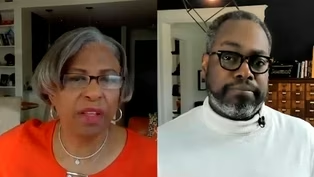
Video has Closed Captions
Clip: S50 Ep1 | 13m 3s | Brenda Lawrence Shares her Experience from the Capitol Insurrection | Ep 5001/Seg 1 (13m 3s)
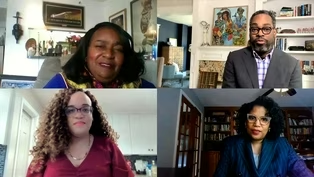
Looking Back at 2021’s Best Guests and Stories
Video has Closed Captions
Clip: S50 Ep1 | 9m 46s | Looking Back at 2021’s Best Guests and Stories | Episode 5001/Segment 2 (9m 46s)
Providing Support for PBS.org
Learn Moreabout PBS online sponsorship
- News and Public Affairs

Top journalists deliver compelling original analysis of the hour's headlines.

- News and Public Affairs

FRONTLINE is investigative journalism that questions, explains and changes our world.












Support for PBS provided by:
American Black Journal is a local public television program presented by Detroit PBS