
Redistricting Drama and Pandemic Polling
Season 6 Episode 8 | 27m 15sVideo has Closed Captions
Drama ensues with redistricting maps and polls show reactions to the pandemic response.
Drama surrounds new maps released by Utah’s Independent Redistricting Commission as the FDA prepares to authorize COVID vaccines for young children, and polling shows how Utahns think officials are handling the pandemic. Meanwhile, shake ups in Utah’s legislative leadership could have a major impact on the next legislative session.
Problems playing video? | Closed Captioning Feedback
Problems playing video? | Closed Captioning Feedback
The Hinckley Report is a local public television program presented by PBS Utah
Funding for The Hinckley Report is made possible in part by Cleone Peterson Eccles Endowment Fund, AARP Utah, and Merit Medical.
Redistricting Drama and Pandemic Polling
Season 6 Episode 8 | 27m 15sVideo has Closed Captions
Drama surrounds new maps released by Utah’s Independent Redistricting Commission as the FDA prepares to authorize COVID vaccines for young children, and polling shows how Utahns think officials are handling the pandemic. Meanwhile, shake ups in Utah’s legislative leadership could have a major impact on the next legislative session.
Problems playing video? | Closed Captioning Feedback
How to Watch The Hinckley Report
The Hinckley Report is available to stream on pbs.org and the free PBS App, available on iPhone, Apple TV, Android TV, Android smartphones, Amazon Fire TV, Amazon Fire Tablet, Roku, Samsung Smart TV, and Vizio.
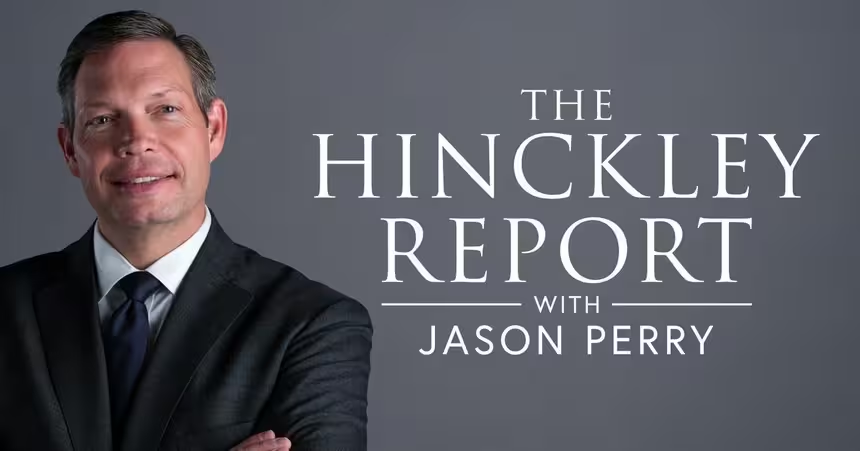
The Hinckley Report
Hosted by Jason Perry, each week’s guests feature Utah’s top journalists, lawmakers and policy experts.Providing Support for PBS.org
Learn Moreabout PBS online sponsorship♪♪♪ male announcer: Funding for the Hinckley Report is made possible in part by the Cleone Peterson Eccles Endowment Fund.
Jason Perry: Tonight on "The Hinckley Report," drama ensues and tempers flare within Utah's Independent Redistricting Commission.
As a nation prepares to roll out covid vaccinations for young children, recent polling shows whether Utah parents will get in line.
And shake-ups in legislative leadership could have a major impact on Utah's next legislative session.
♪♪♪ CC BY ABERDEEN CAPTIONING 1-800-688-6621 WWW.ABERCAP.COM Jason Perry: Good evening and welcome to "The Hinckley Report."
I'm Jason Perry, Director of the Hinckley Institute of Politics.
Covering the week we have Glen Mills, anchor with ABC4 News; Emily Means, reporter for KUER; and Dennis Romboy, editor and reporter for the Desert News.
Thank you for being with us this evening.
Wow, so much happening at the local level and politics, ramifications we felt immediately in some cases and into the next general election, also, which will be very interesting, but there's gonna be a little bit of a theme today, too, on some things.
Resignations, we've seen a few of them, and I want to talk about.
And Glen, let's go to you first, because we had a very high profile resignation in the House this week.
Representative Francis Gibson the majority leader in the House resigned his position.
It's a powerful position, talk about that just for just a moment.
Glen Mills: Yeah, it's like we're seeing the great resignation play out in Utah politics now, just like we're seeing it play out with people leaving their jobs across the country since the start of the pandemic.
This is very significant, though, 'cause as you mentioned, it is the second most powerful Republican in the house stepping down.
He is citing family and career, which likely is the reason for most of that, but I think there's potentially more to that as well.
When he took a look at the landscape, maybe he didn't feel like he was going to be able to go where he wanted to go when you're in leadership.
Obviously, the goal is to become the speaker of the house, the most powerful position.
I do believe Speaker Wilson is going to run again, so he probably took a look at that and maybe that had some consideration in with that as well, but here we are in front of a very crucial time, and the number two Republican in the House is heading out, and it's going to shake things up.
However, I think we're going to for the most part see people just move up in those leadership positions, so it will remain pretty stable from what we've seen in the last couple of years.
Jason Perry: Emily, are we going to see much of a shake up, or is that just kind of the case, people who are next in line they'll just move up, 'cause there are elections to be held?
They still have to run for these spots.
Emily Means: I think like Glen said that makes a lot of sense, and when you look at leadership, though, and you look at majority leadership in the legislature, it's mostly men.
There's only one woman in leadership in the legislature, and that's Ann Millner in the Senate.
In the House there are none, so one name that I've heard floated around his Representative Candice Pierucci, and she's been described as kind of a rising star in the state GOP, so for me I look at this as kind of a way for the Republicans in the legislature to bring in a new perspective, perhaps, and even though she's not currently in leadership, maybe this is the time to elevate her to some level.
Jason Perry: A lot of people doing calculations right now, and she's definitely one of them that's looking at the too.
Dennis, it's interesting on the timing of all this also, because the word on the street is we may have a special session somewhere around November 9th on redistricting, and these elections will happen right before that.
Dennis Romboy: Yeah, there are some big issues that the legislature is facing that could come up really quickly here in November.
To have our leadership shake up, I don't know if has a huge impact.
The Republicans are still in control of the House and the Senate, they'll drive the agenda, and you're right, we have redistricting coming up and also the Dixie name change might be on that agenda as well.
Jason Perry: I want to get to that Dixie name change in just a moment, but Dennis what you're talking about this and another very interesting resignation from Representative Christianssen from West Jordan just last night.
Dennis Romboy: Yeah, this happened late Thursday night as you probably recall.
He had a--well, it was part of the committee and hearing a couple of weeks ago that was a lot of misinformation about about the election here in Utah and wanting to do a forensic audit of the 2020 election in the state.
That obviously drew the ire of the governor and lieutenant governor.
Lieutenant governor oversees elections in this state.
They were frustrated by that meeting and just the perception that gives that there might have been something wrong with the election here in Utah.
The elections here have been safe and fair for a long time, even with all the mail-in, the you know, the voting process that we use here in the state.
Jason Perry: Glen, what do you make of this?
Because what Dennis was talking about was very real, the response to his presentation to the judiciary committee was very quick, from the governor, lieutenant governor, even people in his own party went right after this idea for an election--a forensic election audit.
What do you make of that, kind of that context with his decision?
And it wasn't just a resignation just from the legislature either, he's also quitting his employment.
Glen Mills: Yeah, I don't actually know why he's also quitting his employment, but he made a pretty clear as to why he's stepping aside from the legislature, and he said when he came into this he expected attacks on himself, but he says at this point they've gone too far, to his wife and to his family, and that's why he's ready to step aside.
I will point out one other thing, though, even prior to him picking up this election mantle, you know, he was in some controversial positions before as well with women's rights and pro-life legislation.
You might remember when every female lawmaker in the Senate walked out in protest, including Republicans that was on his bill that would require a woman to get an ultrasound prior to having an abortion.
So this isn't the first time he's come under controversy.
This has been something that's coming along over the years.
Emily Means: I just want to talk about that hearing at the judiciary with the election audit.
I had asked one of the leaders of that committee why they were even entertaining this idea.
It has been proven that there's nothing wrong with our elections here in Utah and largely throughout the country, and this legislator said to me this is just something that one or two legislators is interested in pursuing.
I'm assuming one of them being Steve Christiansen.
Phil Lyman was also presenting at that committee hearing, so I mean, it shows that they don't necessarily have the support of the rest of the legislature at least on that issue.
Dennis Romboy: It'll be interesting to see if Phil Lyman does pick this up or some other the legislature wants to continue to push this issue and pursue that audit.
Jason Perry: We haven't heard from him.
Dennis Romboy: I do think as you pointed out, though Jason, there's not a lot of appetite even from within his own party to carry this on any further.
Jason Perry: Interesting to see how this ripples through and what the ramifications were, 'cause I think we'll still hear some of these issues going forward.
But Dennis, you brought it up, so let's talk about that's something no less controversial, the name change for Dixie.
We have a proposal on the table now that the legislature has to consider.
Dennis Romboy: Utah Tech University, yeah, I'm not sure if it has a real ring to it or not, but yeah, the legislature will have to consider.
The legislature's the only body that can name universities here in the state, and so this will be up to them.
There is a small group of opposition.
You probably noticed the commercials on TV aimed at lawmakers asking them not to change the name of Dixie State, which has been around for a long time.
So, yeah, this is a controversy that has actually been few decades in the making.
Jason Perry: It's true, Emily talk about this for a second because what Dennis mentioned is true.
I'm not sure I would have anticipated actual commercials being produced and put out there about whether or not this name be changed, but this is a very real issue in that community down south, and it's gonna rest on the legislature to make the ultimate decision.
Emily Means: Right, listen, I don't have TV, so I haven't seen the commercials, but yeah, like Dennis said, this is an issue that has been simmering for a long time in Utah, and I was looking back at some articles over the years, and the issue is that Dixie has racist connotations, it has ties to the Confederacy.
Jeanetta Williams from the NAACP spoke out against it last legislative session, so that was just this year, and it seems like there's time for a change, but you know, the legislature asked that there be a more extensive public input process.
That's what they wanted, and it seems like that's what they've gotten, and this is the conclusion that the board of education has come to.
Jason Perry: Let's talk about the state of Utah sort of on the National stage here too.
It's a story that you are following closely, Glenn, which is interesting is we've actually had representatives of the state of Utah in Washington D.C. this last week trying to land the Republican National Convention.
Talk about that for a minute, saw you breaking some of the story.
Glen Mills: Yeah, so the Utah Republican Party teaming up with Visit Salt Lake to make that bid.
A delegation representing those organizations was in D.C. earlier this week making a pitch which is the preliminary set to the site selection committee to bring that here to the state of Utah.
I've spoke with many people that were there.
They felt very confident and good about the direction that is heading.
There are still some steps, they need to get, you know, some of the other state leaders on board to make sure that they can get behind this and have what they need to pull this off, but those who are supporting this feel really good about our capitol city's suitability to host this convention, which would obviously bring tons of people and tons of money into the local economy.
But they point to the fact that we have hosted a successful Olympic games, the hospitality that people experienced when they're here, and really one of the key missing links was the convention hotel, which will be done in time to host the 2024 convention.
Now, a lot of people are feeling good about that, but we know also that obviously Utah's not a swing state.
We tend to see those rise above where Republicans can try to make some ground or Democrats for their convention.
However, because of the fact that one: The convention hasn't been held west of the Mississippi since 1996, and Republicans feel like they can bring the convention here to Utah and show off what they've been able to do here in the state, so people are feeling pretty good about it at this point.
My understanding is there are six other cities in the running to make a bid as well, and the final request for proposal is still a few weeks out, so we could see more cities coming in and trying to get that as well.
Jason Perry: It's interesting, Emily, because regardless of someone's politics, one of the arguments is that this is good for the economy, it's good for the state of Utah, but what do you think--or at least what are you hearing?
Because one of the points Glen just made is true is our elected officials--those who are trying to land this deal--are saying there is sort of a Utah perspective.
We're not really a swing state, we're not gonna bring a ton of, you know, really votes to a certain person that's going to throw them over the top but, there's still a Utah way, there's a Utah approach for the Republicans anyway that make it so Utah is the ideal place for that kind of event.
Emily Means: That's interesting, I don't really understand honestly why we would host the RNC here.
I guess to Glen's point, we've hosted some other major events.
We also hosted the vice presidential debate last year, so that's one thing that kind of put us out there on the national stage, but for me the way I'm holding this in my head, we are still struggling.
The Republican party is still kind of struggling with its identity, and if we look at the state GOP and the leadership there, very much Trump supporters.
Our governor on the other hand, not so much.
He's spoken out against Trump.
So I can see that perhaps getting in the way of Utah hosting the convention, just having our leadership not be the most vocal Trump supporters, while our state GOP is, so.
Dennis Romboy: Think about it, if Donald Trump runs for President 2024, I mean that-- we would be the epicenter of that event.
You know, Mitt Romney may or may not be around at that point in time.
I mean, there's potential for fireworks there, obviously.
Jason Perry: That's true.
Emily Means: More booing, perhaps.
Glen Mills: And one other point I'll make to that, if it were Trump to get the nomination, that may make sense to bring the convention to the state of Utah, because this is a place he struggled and maybe they would see that as an opportunity where he could gain more support in a Republican state in which he struggled in both 2016 and 2020.
Emily Means: But he still took the state.
Jason Perry: He did still win the state, that's true.
Glen Mills: Right, but he still came in much lower than what you would expect a Republican candidate to come in here in the state of Utah, especially as an incumbent.
Jason Perry: Well, let's talk about how these officials are doing in the state is Utah, because it does give a glimpse of what might becoming, and Dennis, a poll that the Hinckley Institute just did with the Desert News that we've been talking about this we kind of put this in context.
So tell us how this this works with Biden's approvals in particular, 'cause in Utah it's very interesting, 32% of Utahns approve, and 65% disapprove of the job of the president.
That is a pretty serious slide, not just in the state of Utah, but it sort of mimics the slide that he's having nationwide.
Dennis Romboy: Yeah, I think there was a short honeymoon period even here in Utah.
Early on I think he was in the 45% range or something like that when he first came into office.
A lot has transpired around the country and around the world since that time, obviously the chaotic withdrawal from Afghanistan, the ongoing pandemic, the mandate for large businesses to vaccinate their employees, a whole host of issues, I think, contribute to his slide not only here in Utah, but nationally, but it's more pronounced here in Utah, 65% of people disapproving of his job, but that's a high number.
Jason Perry: It really is, Emily, and what kind of implications does that have, 'cause we've just been talking about how that's gonna impact this next election cycle off-term and then the next general election.
Emily Means: Probably none here for Biden in Utah.
We didn't vote for Biden as a state.
I wonder, also, if those numbers, the polling numbers here in the state have anything to do with Bears Ears and the Biden administration restoring the national monuments, maybe that plays into it as well.
Jason Perry: You're adding another big issue to the ones that Dennis just listed.
I mean, any one of these things on their own starts to have an impact on someone.
You put them all together and it certainly does start to impact-- Dennis Romboy: The federal spending plans as well.
I don't think a lot of Utahns are hip on spending trillions of more dollars on social programs.
Although the infrastructure measure I think has some traction here and some support, but the other, probably not much.
Jason Perry: One of the things we were interested-- Glen Mills: And also--I'll just chip in real quick.
A lot of voters when it comes to the president are looking at how the economy is impacting them.
Everyone's feeling the impact of inflation right now.
Prices are going up the grocery store, at the gas pump, pretty much everything we pay for, and I think that contributes a lot to that approval rating as well.
Jason Perry: It does.
One of the items we were looking at also in this poll was handling the covid pandemic, and it's interesting for President Biden, even on this, Emily, this the number, 41% of Utahns approve, but it's gone up to 55% of your tongues disapprove of the handling of the pandemic from the Biden administration.
Emily Means: I don't know, honestly, honestly, the pandemic has been a blur for me, and as a reporter especially it's just, we get the report every single day about the state covid numbers, and I don't know, I think maybe people are just kind of tired of it.
And I know, we can't does blow past this.
Obviously, this is something we're still dealing with, but certainly fatigue and talking about it and hearing from Biden about it, and I mean, that's my best guess.
Jason Perry: Well, let's see how it compares to what's happening with our own Governor Cox on his approvals, Dennis.
So in this poll we did together, he's at 55% approval and 26% disapproval, pretty much a steady state for him all the way back to January.
Dennis Romboy: Yeah, I think he's kind of been an even-handed governor so far.
I don't think people have a lot to complain about with his performance.
The economy here in Utah is good overall, but we're facing the same kinds of issues with--that Glen just mentioned nationally with gas prices and grocery store prices.
But I think the governor has been able to navigate all of that and has been steady, like I said, for the most part.
Jason Perry: Certainly seems to be true, and in terms, Glen, the last thing on this, too, because we also asked this question of how Utahns fell he has handled the pandemic, and he's at 58% approval in the state, 31% disapproved, but his numbers of state high even there.
So some of this fatigue I think Emily was talking about is true, but he's been able to stay pretty steady in that.
Glen Mills: Yeah, I mean, I think there's no doubt about it, it's just tough to lead in a pandemic.
You're just not going to win with some people, and I would have to think that he has to take a look at that number and be pretty happy with it.
Jason Perry: Yeah, it's true, no one wins in a pandemic.
Dennis Romboy: He's pushed back a little bit on Washington and on the White house with the vaccine mandate for businesses and that kind of thing, so that probably helps him too.
Jason Perry: So, can we talk about another resignation?
So, Emily, I know you were covering this, all of you were, so I can't wait to get your insights onto this.
But our Independent Redistricting Commission, they've submitted three maps officially, and before there's a vote on those three maps another high profile resignation from that committee.
Emily Means: So much drama with the redistricting commission this week.
We saw former Congressman Rob Bishop resign from the committee right in the middle of the meeting.
He said that the commission was to metro-centric, meaning five of the seven commissioners lived along the Wasatch Front, and he thought that meant it would lead to maps that didn't include-- congressional maps that didn't include both rural and urban areas of the state in each district.
So he was pretty upset about that, and he left.
And almost immediately after House Speaker Brad Wilson, who appointed Bishop to the commission put out a statement saying I totally agree with Bishop, this solidifies my concerns about the commission as well, so it wasn't a great way to start the week.
And not only that, but the week before, the commission is set to present its maps to the legislature.
Jason Perry: Couple key components to this, too, and Dennis, I wanna get your statement.
The first part that Emily just talked about is true, there's still this disagreement with some about whether or not we're going to carve the state up like a pizza or we're gonna start to carve out some places that maybe you have a Democratic stronghold or more donut than pizza.
We've talked about that on the show, but that is the heart of a lot of this controversy and why congressman--this former Congresswoman Bishop resigned.
Dennis Romboy: Yeah, and before that, I mean, the funniest part to me was that he wore shorts to the meeting knowing that he'd have to drive home that night-- Emily Means: He drove all the way all the way to the meeting to resign.
Dennis Romboy: From Brigham City to resign and then wore shorts so he could drive home comfortably.
Yeah, you know, but that's been every 10 years I think we--it's the same argument, how do we divide the state up when the populace is here in the Salt Lake, along the Wasatch Front and more spread out in the rural, how do we divide that up fairly, and this is an issue every 10 years, and I don't know that they've gotten it right yet.
I think this commission was supposed to offer some good alternatives, but again, the decision rests with the legislature.
They can decide how to carve up these congressional districts however they want to.
Jason Perry: So, Glen, that's I guess part two of the big discussion here, too, is who should decide this?
And that's something that Congressman Bishop was talking about, but Speaker Brad Wilson, but members legislature, too, what the argument coming from them was the people who should decide are the people who are accountable to the voters themselves.
Explain that argument a bit.
Glen Mills: Yeah, so Speaker Wilson made that clear in his statement, but he's been saying that all along, and their argument is that, you know, they're up for election every two years, in the Senate every four years.
So they argue that they are the ones accountable to the people.
Supporters of the Independent Redistricting Commission will argue that this is a way you can hold lawmakers accountable by taking this independent review of the districts and taking a look at whether lawmakers accept that or reject it.
Now, one thing I'll say is, as we know, this is an advisory committee.
They don't have any binding authority, and I've never got the sense from day one that the legislature was going to end up adopting one of the maps as it came from this commission.
I always have talked, heard from sources and lawmakers that they believe in the end that one of those maps would not be adopted as the official plan.
Emily Means: Yeah, I just want to add I talked with a political scientist about this drama, and that's what it looks like to us, right?
But like Glen said, the commission's only role is an advisory one, right?
So it says, hey, we took all this public feedback, we adjusted our maps based on that public feedback, here legislature, do what you want with them, we hope you'll take them, but what Bishop's resignation does and Wilson's statements that perhaps the commission may need to be revisited.
What that does is undermine public support in the commission, and that's really all it had going for it, because its whole goal is to recommend these maps that the public gave feedback on.
And also, just a reminder, this is something that the people of Utah voted for.
The majority of voters in the 2018 election voted for this as a ballot initiative, and this is something they wanted to see built.
So, true, yes, the legislature makes the final decision, but the question is what is the commission's role in that, and how much power will they have after Bishop's resignation?
Jason Perry: It's interesting to see these various maps that are being submitted and worked on right now, 'cause of course our congressional delegation watching these very closely to see what that decision finally is.
I want to talk about a Senate race for just a moment if we can, because we've done some polling on this, of course.
Our senators aren't as worried about these these lines here, but some some brand-new polling that kind of gives us, Dennis, for the very first time a view of what's happening in Mike Lee's Senate race.
He has two Republican challengers right now, so some polling results that no one has seen yet, but I want to talk about this for a second.
If the election were held today, these are Republicans who said they're going to vote or they're going to affiliate and vote, Mike Lee's sitting at 53%, Becky Edwards at 7%, Ally Isom 2%, with 6% saying not sure yet, and 32% percent saying don't know, and 6% saying, well, maybe some other Republican.
Dennis Romboy: Yeah, and that's a fair amount that don't know, but it's early on, but even as early as it is it shows that Ally Isom and Becky Edwards have a lot of ground to cover before the primary election, and these were likely GOP primary voters that we sampled, and Mike Lee has a--he's popular among the Republican base here in the state, and these other two candidates, they're just not well known yet.
They have an opportunity to become known, but they have a lot to overcome, especially with the base that he has.
Both of them are gonna gather signatures, they'll be on the ballot, there will be a primary election, but yeah, they have some ground to make up.
Jason Perry: Glen, talk about this make up here, because what Dennis just talked about is right, it's hard for a challenger in any event when you have an incumbent, but they didn't--in our poll, when you just talk about these Republicans, Mike Lee with that particular group is sitting at 61% approval with just Republicans.
Glen Mills: Yeah, that's a lot of ground to make up.
What I'll add to this conversation is this, I think the consensus is that if both Ally and Becky make the primary ballot, there's no way Senator Lee doesn't come out on top of that.
If one of them makes the ballot, it could be potentially a tighter race, and I wouldn't be surprised if down the road-- I don't know at what point--the two of them come together and decide which one of them will remain in the race and which one of them won't.
That would not surprise me one bit if we saw that happen.
Jason Perry: One more interesting thing in our poll that I wanna make sure we talk about today us interesting is we're about to get some approval from our federal oversight committees about letting children become vaccinated.
So, Emily, very interesting in this poll, 'cause we asked Utahns with children will you get the vaccine.
This is the kids 5 to 11 years old, and the interesting number was 21% of those surveyed who have children said they're going to wait to see, 18% said they will not be getting this vaccine.
It's very interesting, particularly considering it's not a partisan question at least what our poll is saying.
Emily Means: I wonder what they're waiting to see.
When I last checked the vaccination stats for the state, we're at like less than 60% for the entire state.
Obviously, we have a lot of young Utahns tons here.
So if people in this age range, 5 to 11, are able to get vaccinated saying if their parents vaccinate them, I have a feeling we'll make up a lot of ground on that.
And something that I have seen from parents is, you know, children are vulnerable.
It's not just older folks who have who are immunocompromised.
There are children who are also immunocompromised, and this will be a huge game changer for that.
Dennis Romboy: Twenty percent of all the new cases are children right now, and half of those are children ages 5 to 10, so they are getting sick, you know.
Jason Perry: We'll watch this one closely, and we're gonna have to make some decisions soon, some of these parents.
Thank you very much for your great comments this evening.
And thank you for watching "The Hinckley Report."
This show is also available as a podcast on PBSUtah.org/HinckleyReport or wherever you get your podcasts.
Thank you for being with us, we'll see you next week.
♪♪♪ ♪♪♪

- News and Public Affairs

Top journalists deliver compelling original analysis of the hour's headlines.

- News and Public Affairs

FRONTLINE is investigative journalism that questions, explains and changes our world.












Support for PBS provided by:
The Hinckley Report is a local public television program presented by PBS Utah
Funding for The Hinckley Report is made possible in part by Cleone Peterson Eccles Endowment Fund, AARP Utah, and Merit Medical.