VPM News Focal Point
Refugees | March 03, 2022
Season 1 Episode 2 | 26m 46sVideo has Closed Captions
Thousands of Afghan refugees settled in Virginia last year; where are they now?
Thousands of Afghan refugees settled in Virginia last year; where are they now, and how has the state adjusted? Explore the reality of refugee life in the state and visit a culturally cognizant food pantry in Chesterfield County.
Problems playing video? | Closed Captioning Feedback
Problems playing video? | Closed Captioning Feedback
VPM News Focal Point is a local public television program presented by VPM
The Estate of Mrs. Ann Lee Saunders Brown & Dominion Energy
VPM News Focal Point
Refugees | March 03, 2022
Season 1 Episode 2 | 26m 46sVideo has Closed Captions
Thousands of Afghan refugees settled in Virginia last year; where are they now, and how has the state adjusted? Explore the reality of refugee life in the state and visit a culturally cognizant food pantry in Chesterfield County.
Problems playing video? | Closed Captioning Feedback
How to Watch VPM News Focal Point
VPM News Focal Point is available to stream on pbs.org and the free PBS App, available on iPhone, Apple TV, Android TV, Android smartphones, Amazon Fire TV, Amazon Fire Tablet, Roku, Samsung Smart TV, and Vizio.
Providing Support for PBS.org
Learn Moreabout PBS online sponsorship>>Angie Miles: The assault on Ukraine has stunned, angered, and moved Virginians to action.
We'll hear from those in our communities who have the most at stake.
Many thousands of refugees from Afghanistan who fled their country are settling in here in Virginia.
We find out what they have to say about being here.
And about their loved ones who are still a world away.
And we'll meet a woman who turned the sadness of scarcity into a determination to make sure others have enough to eat.
Production funding for VPM News Focal Point is provided by Dominion Energy, dedicated to reliably delivering clean and renewable energy throughout Virginia Dominion Energy Actions Speak Louder The estate of Mrs. Ann Lee Saunders Brown and by Angie Miles: Thank you for joining us for VPM News Focal Point, I'm Angie Miles.
In this program we'll consider how the Russian invasion of Ukraine is impacting Virginians.
We'll hear from Afghan refugees who found safety in Virginia but are still facing uncertainty and fear.
And we'll learn about a Latino woman whose work is making a way for her community.
First, here's a quick snapshot of stories statewide.
In Fairfax, a federal judge has handed a victory to affirmative action opponents ruling that the school system's new admission's policy, unfairly discriminates against Asian students.
In Virginia Beach, the non-profit Operation Blessing had spent months stockpiling supplies for Ukraine anticipating a Russian incursion.
The volunteers have mobilized and invite you to visit their website to learn how to support those efforts.
In Richmond, Governor Glenn Youngkin has urged decisive action to support Ukraine.
He's ordered a review of state contracts to see if taxpayer dollars are flowing to Russian companies.
And he's urged the Virginia Retirement System and university endowments to immediately divest of any Russian holdings.
In Norfolk, dozens of demonstrators assembled to show support for Ukraine after the first Russian attack.
Among them was Tania Skorokhod, a Ukrainian graduate student at Old Dominion University.
Her hometown was invaded by the Russian military.
She says her loved ones spent most of the week huddled in a basement.
She is urging the world to take action to help Ukraine.
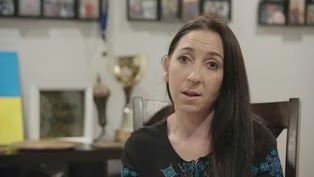
Angie Miles: Alexandra Blagova is one of nearly 24,000 Virginia residentsof Ukrainian descent.
Ukrainians worldwide have been desperate to find ways to help and to connect with their loved ones in the embattled country.
While most Virginians follow the story through news reports, some are seeing war through the eyes of their loved ones who are under attack.
Keyris Manzanares brings us their stories.
>>Alexandra Blagova: That's what I'm afraid of.
That there will be no home.
>>Keyris Manzanares: Alexandra Blagova hasn't been able to sleep since Russia invaded Ukraine.
She remembers the exact moment she heard the news.
>>Alexandra Blagova: My auntie from Kyiv, she called me.
It was four in the morning and she said that there is a war started.
>>Keyris Manzanares: During this agonizing time, Blagova says she's become closer to her friends and family as they work to help people in Ukraine.
Blagova says they feel survivors' guilt because while they are safe in the United States, their loved ones fear for their lives.
>>Alexandra Blagova: I'm feeling pain, helpless, 'cause all of my family members, friends, classmates, teammates are in Ukraine for the most part.
(telephone ringing) >>Keyris Manzanares: Alex Misiats ... Hello mom ... >>Keyris Manzanares: A Virginia Commonwealth University math professor has been calling his mother six times a day.
She lives in a city in central Ukraine.
>>They are killing people.
They're killing civilians, women, and children.
They're destroying houses.
>>Keyris Manzanares: Misiats says the Russian army is not showing strength by bombing civilians.
>>Alex Misiats: They're showing their weakness.
They're showing that they cannot do anything but destroy houses.
They cannot destroy people's will.
>>Judy Twigg: And here it is again.
>>Keyris Manzanares: VCU political science professor Judy Twigg says Ukraine did nothing to provoke a war and that this is an act of aggression from Russia's president Vladimir Putin.
>>Judy Twigg: We're now in the midst of this heavily armed conflict in which there are battles taking place simultaneously in Ukrainian rural villages, small cities.
There's shelling happening now pretty much constantly in the large cities of Kharkiv to the east and the capital of Kyiv.
>>Keyris Manzanares: Blagova fears that if Ukraine doesn't receive support, the violence will spread across Europe.
>>Alexandra Blagova: Ukrainians right now, friends of mine, family members, they all fighting not only for Ukraine.
They're fighting for entire world.
>>Keyris Manzanares: The war will make a global impact, including here in Virginia, says Professor Twigg.
>>Judy Twigg: Russia is a major oil exporter.
Those oil supplies have been disrupted.
We're already seeing oil approaching, if not over a hundred dollars a barrel, we'll start to see that at the gas pumps sooner rather than later.
>>Keyris Manzanares: How can Virginians best support the people of Ukraine right now?
>>Alexandra Blagova: I would like people to understand that it's real.
There's blood, there's a war.
There's children dying.
>>Keyris Manzanares: Professor Twigg says Virginians need to be: >>Judy Twigg: Thinking about what Ukraine represents to our democracy and our way of life.
Angie Miles: Several groups across Virginia are helping Ukrainian refugees.
That includes the Richmond office of the International Rescue Committee.
They're running a crisis campaign.
Visit vpm.org/focalpoint to learn more.
During this crisis Ukrainians have been fleeing to nearby countries as refugees.
Virginia has had its own experience with a refugee crisis in recent months when thousands of Afghans fled their country after the US withdrew.
We asked Virginians how they feel about refugee assistance.
Our Keyris Manzanares shares their responses in our "People of Virginia" segment, Keyris.
>>Keyris Manzanares: Thanks Angie, more than 75,000 Afghans found refuge in the United States in 2021 as the Taliban seized power.
And more than 5,000 are now living in Virginia.
Here's what current residents think about the refugees' arrival here.
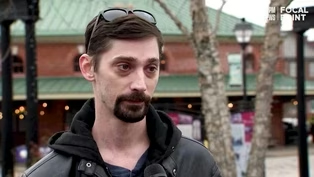
>>Cherron Gravely: I feel like we should honestly feel honored that they feel safe enough to come to us for help, so we should definitely try to help them out.
>>Nick Adair: Any refugees should have to go through a nationalization process while here.
It only makes sense just because any immigrant that you know necessarily isn't a refugee would have to, you know, get nationalized to come here and be a citizen.
So I think that, you know, they should have to do the same thing.
>>Chris Andrick: They're refugees from their state.
They're not refugees from the human race.
So be compassionate.
Welcome them with open arms.
Teach them the way of our land and learn something about the way of their land.
Keyris Manzanares: And we'd like to hear from you.
After you watch today's stories, please share your thoughts on our website at vpm.org/focalpoint, Angie.
>>Angie Miles: Thank you, Keyris.
It has been more than six months since the exodus from Afghanistan began.
Virginia has now resettled more Afghan refugees than any other state, except for Texas and California.
We wanted to know what's happened to those refugees and we discovered that they want to know what can be done for their loved ones who didn't make it out.
>>Angie Miles: They're beginning to settle in, but it's been a long journey to Virginia from Afghanistan.
(gun fires) August, 2021, >>Angie Miles: These young Afghan men say they didn't want to leave their home, but they knew anyone who'd worked with the fallen government or had allied with the United States was in danger.
Even now, they hide their identity to protect loved ones they left behind.
>>Angie Miles: After three days at Kabul Airport, they finally started the journey to the United States, to one of several intake points.
In Virginia, there were three: Fort Pickett, Quantico, and Fort Lee.
These men described the relief of arriving at Fort Lee in late August.
>>Angie Miles: U.S. Congresswoman Abigail Spanberger visited new arrivals at Fort Pickett in September.
She says everyone went through a vetting process that included medical checks for COVID-19.
Resettlement partners like the International Rescue Committee that contract with the US State Department say this influx has been like nothing they've seen in recent history.
They try to reunite people with their relatives already living in the United States.
>>Harriet Kuhr: Here in Charlottesville, >>Harriet Kuhr: we've received more people in three months than we have ever resettled in a whole year.
We said we could take 250 people.
We have like, 327.
We're like way over what we thought.
And we actually, something we don't like to do, but we had to start even turning away relatives.
>>Angie Miles: Even though community support has been unprecedented, we're told the needs are still great.
Zoe York's company is among those who've been donating, partnering with Commonwealth Catholic Charities.
York says the Afghan people are kind and appreciative in spite of the trauma they've endured.
>>Zoe York: And after everything that they have been through that we all know about, for them to have the kindness of spirit and generosity that they have towards us, it's really amazing.
And I think people should know that.
>>Abigail Spanberger: I think we have, you know, generations worth of examples: Vietnamese refugees, Cambodian refugees, Sudanese refugees, Bosnian refugees.
And those are communities that frankly are vibrant communities right here in the Central Virginia area.
People who escaped the Holocaust came to Richmond, made the greater Richmond area their home, and really invested in the community.
This is a land of opportunity.
It's a safe, secure place.
And hopefully, this generation of evacuees will be just as prosperous as we've witnessed others.
>>Angie Miles: For these young Afghans and for thousands more who've come here, they aren't willing just yet to give up hopes for reuniting with those they left behind, or hopes of one day realizing the dreams they still hold for their native Afghanistan.
Angie Miles: These two men are among those imploring the United States and the international community to do more for those left behind.
Here, aid agencies say, transportation and housing are still critical needs.
You can find connections to help through our website.
Angie Miles: Government funded resettlement agencies in Virginia often partner with houses of worship to help support refugees.
The ADAMS Center in Sterling, Virginia has helped hundreds of people, including a family, still traumatized by the violence they witnessed when they escaped Afghanistan in 2021.
And a warning, some of our footage may be difficult to watch.
(crowd fleeing) (sirens blaring) (gunshot bangs) (Diba: speaking in foreign language) (crowd chattering) (Diba: speaking in foreign language) (Elyas: speaking in foreign language) (Nilo: speaking in foreign language) (Hurunnessa Fariad: speaking in foreign language) >>Hurennessa Faraid: My name is Hurunnessa Fariad.
I was born in a Kabul, Afghanistan.
It's very personal having come to this country as a child refugee when this whole nonsense in Afghanistan started, makes me feel that I have a lot to give back because I was one of the privileged ones to come here at a very young age.
From the ones I've talked to, It's definitely been traumatic for many reasons.
They've left their family behind, they've left their home behind, they're in a place they don't speak the language, they don't know the culture.
And on top of that, they really don't know what to expect.
And I think that's quite scary if you look at it from a human perspective.
(speaker speaking in foreign language) >>Hurunnessa Fariad: ADAMS Center stands for the All Dulles Area Muslim Society.
We're pretty much the second largest mosque in the United States and the largest one here in the Northern Virginia, DMV area.
We serve about 25,000 Muslims that come through our doors but we're also a community center as well, where we have social service department.
We have an education department.
We have our youth department and outreach, interfaith, the Imam's department as well.
So we've tried to give a holistic approach and the holistic needs of the community.
(crowd chattering) So we have a couple of different coalitions of Afghans and organizations that are working together to fill the needs of the bases here in Virginia.
We've even sent some trucks to Texas as well.
I think Virginia has definitely a great team in getting the supplies to different places.
So definitely clothes are an issue, closed toe shoes 'cause a lot of them came with just flip flops.
Hygiene products, undergarments, things you and I would probably just take for granted.
But think about it, they just, most of them came with just the clothes on their back.
You guys came for prayer, Since you're off of school?
I have a lot of contacts with in the Jewish community, in the Christian community.
So I'm tapping into them because they're emailing me, asking me, what can we do?
I'm like, okay, you're gonna do the clothes drive.
So we're going to Dulles Auto Shop, my friend Saleem owns a place.
Round one of our clothes drive where we collected over 1,100 coats, almost all of them came from the Christian community in Maryland.
This is really big, long.
>>Saleem Sultani: I came here in this country, zero dollar in my pocket.
I went through all those hardship and everything, (Arabic phrase) by the grace of God, whatever I have is all because of the love of my own community people.
As much I can, I will do my best.
This is not a lot.
This is just a space, but I wish I can do a little bit more.
>> Hurunnessa Fariad: I'm tapping into different resources that I have and connections that I have with people who aren't Muslim, who aren't Afghan, but want to help.
And I think that resonates so beautifully when we think about our faith and all of us, whatever that may be that this aspect of serving humanity and serving those that are in need is such a big component of our faith that everybody wants to help.
So I'm giving them that opportunity.
And I love the fact that they're so forthcoming.
(crowd murmuring) >>Kristyn Peck: Lutheran Social Services has been providing services to refugees for more than 70 years.
In recent months, most of those that we're serving are Afghan allies.
We've started serving Afghans who were evacuated prior to the US withdrawal from Afghanistan, and then following the fall of Kabul.
We went from serving during the former administration, about 500 refugees in our refugee program every year to serving 500 a month.
And so this has been a significant scale up for us.
Many of the Afghans we're serving right now, they still don't have an employment authorization document, so they're not able to legally work.
They certainly don't have a long term pathway to legal status.
And so they need immigration attorneys and they still will have to apply for immigration status such as asylum.
And so I think one of the challenges is that the clock on the government provided programs starts ticking regardless if those documents are in place but it's just not realistic to expect someone to be self-sufficient [in] three months when they're not even getting the documents that allow them to be eligible for employment until they've been here for six weeks to three months.
And so that's one of the big challenges.
>>Hurunnessa Fariad: When I see my people come here who want a better life who may not know the system, but they're good people.
They have good hearts and they want a better life for their family, I can see myself in that.
And ADAMS has done an amazing job collecting funds to help these families and reuniting them was such an honor for me to be honest with you, to see them hug each other and cry.
And I had to hold my tears back because it was just so beautiful to see people come to another country in the midst of chaos and not be together.
I feel more content knowing that the mother who just had the baby has an aunt living with her who can help her with the baby because sleepless nights are not fun.
(chuckles) (Diba: speaking in foreign language) >>Hurunnessa Fariad: She came here with her nephew and niece on the premise of helping the niece get on the plane.
She ended up getting on the plane too.
And she talked to her husband and said, is it okay?
And he said, yeah, go.
Maybe if you go, you can call us and we can come.
But that's not how, it's not gonna happen overnight.
(Elhama: speaking in a foreign language) (Elyas: speaking in foreign language) Angie Miles: This family has recently moved into a shelter apartment owned by a local social services organization.
They're still trying to find jobs, learn English, and enroll the young man in school.
Angie Miles: Approximately 10% of Virginians struggle to put enough food on the table.
And the pandemic has made the problem worse.
Sometimes helping others is easier when we understand cultural differences, such as the foods people like to eat.
Our Keyris Manzanares brings us the story of a Dominican-born Virginian who's known what it's like to be hungry.
And she is providing relief to the areas Latino community in a culturally sensitive way.
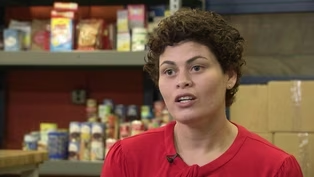
(Truck driving) (music) (Natasha Lemus: speaking Spanish >>Natasha Lemus: Waymakers Foundation came from a preaching that I was listening to.
I have always said that there is a way to a problem, to a solution.
No matter what it there is a way.
But I have noticed that I don't do that by myself.
There's always people with me.
So that's when I say, well, we find a way and we have "makers," so everyone that comes in here and pitches in your time are "waymakers," they're making ways for others.
My parents migrated me to the United States at the age of eight.
I always wanted to empower myself just because of the financial crisis that I always saw my family going through.
Economically in my country, I was okay, but when I came here, it was a little different.
I had more responsibilities, I had to become a babysitter.
And I had to hear a lot of discussions of we're short on rent, we have to pay the car, oh the car's not working or we don't have money for this.
It was never really in front of us, but everything echoes behind the walls of the house.
It happened with me when I opened Waymakers, when I started providing certain products that were more just directly to the Latinos.
When I used to ask for donations, they're like, well, if they need it, they'll eat what there is.
And I was like, no, everybody eats differently.
That's what we're all from different countries, different tastes.
You know, diversity involves culture.
You know, what you eat, what you listen to, everything's different.
If my mom could come, if I can go back to I was eight or nine, and my mom will walk in to a food pantry or food bank that will provide plantains, that will provide beans, that will provide a papaya, that will provide anything like that, I'm pretty sure my mom would have saved $150, $200, that week, and could have paid the light bill on time.
My experience for generations, just not just me but anyone else born after, before, I think have experienced almost the same.
When you are from a different country and coming to get a resource as essential as food, picking up something that you're not accustomed to eating.
We have carambola, which is star fruit.
Plantains.
Papaya.
Cilantro.
Onions, potatoes, oranges, green bell peppers.
[speaking Spanish] We have fresh meats, chicken, pork, beef.
I think in any Latino family, depending on where you're from, you can make something out of that.
Dignity to me is to be served equally.
When I serve food here, I feel like I serve it with dignity because anything that it's in here I will take it back home and use it for myself and give it to my kids.
[speaking Spanish] Angie Miles: If you'd like to share feedback with us on this story or on others we've covered, we would love to hear from you.
Reach us at vpm.org/focalpoint.
That's our show.
We thank you for joining us and we will see you next time.
Production funding for VPM News Focal Point is provided by Dominion Energy, dedicated to reliably delivering clean and renewable energy throughout Virginia Dominion Energy Actions Speak Louder The estate of Mrs. Ann Lee Saunders Brown and by
Video has Closed Captions
Clip: S1 Ep2 | 40s | Virginians comment on efforts to resettle Afghan refugees across the state. (40s)

Afghans refugees resettle in Virginia, build new lives
Video has Closed Captions
Clip: S1 Ep2 | 8m 11s | Thousands of Afghan refugees found safety in Virginia but still face uncertainty and fear. (8m 11s)
Afghans share the trauma of leaving loved ones
Video has Closed Captions
Clip: S1 Ep2 | 3m 56s | What is life like for the thousands of Afghan refugees now living in Virginia? (3m 56s)
Serving food to central Virginia’s Latino community
Video has Closed Captions
Clip: S1 Ep2 | 3m 5s | Food bank takes culture into account when serving the local Latino community. (3m 5s)
Video has Closed Captions
Clip: S1 Ep2 | 3m 6s | Alexandra Blagova is one of nearly 24,000 Virginia residents of Ukrainian descent. (3m 6s)
Providing Support for PBS.org
Learn Moreabout PBS online sponsorship
- News and Public Affairs

Top journalists deliver compelling original analysis of the hour's headlines.

- News and Public Affairs

FRONTLINE is investigative journalism that questions, explains and changes our world.












Support for PBS provided by:
VPM News Focal Point is a local public television program presented by VPM
The Estate of Mrs. Ann Lee Saunders Brown & Dominion Energy