
Relish Presents: Taste and Renewal
8/22/2026 | 26m 40sVideo has Closed Captions
From the kitchens of Alex Roberts + Chef Lachelle Cunningham
Two chefs find inspiration for the future by building on the wisdom of the past. Chef Alex Roberts relies on lessons learned and the strength of his team to keep his longstanding restaurants thriving. And Chef Lachelle Cunningham puts an ancestral tradition at the heart of her personal healing journey and uses food to educate and impact others.
Problems playing video? | Closed Captioning Feedback
Problems playing video? | Closed Captioning Feedback
Relish Presents is a local public television program presented by Twin Cities PBS
Relish Presents: Taste and Renewal
8/22/2026 | 26m 40sVideo has Closed Captions
Two chefs find inspiration for the future by building on the wisdom of the past. Chef Alex Roberts relies on lessons learned and the strength of his team to keep his longstanding restaurants thriving. And Chef Lachelle Cunningham puts an ancestral tradition at the heart of her personal healing journey and uses food to educate and impact others.
Problems playing video? | Closed Captioning Feedback
Where to Watch Relish Presents
Relish Presents is available to stream on pbs.org and the PBS app.
Providing Support for PBS.org
Learn Moreabout PBS online sponsorship- When I became a chef, I said I want to impact people through food.
- So we got our sauce here.
It was about learning what made something authentic, learning how to make something taste a certain way.
I wanted to know how to do it.
I felt that I had to learn how to do it.
- It's as much about the ingredients as it is about the story, as it is about the process.
- I love always getting into the food and tinkering with it.
I love that process of evolving a recipe or coming up with a new one.
Closer.
- We can impact our families, our communities, and we can impact the world, and that's healing.
(Knife chopping sounds) One of the hardest times to run a restaurant is after you win a big award.
♪ Best chef, best something, or four stars -- people have their own idea of what that means, and so they bring their idea of what that means into your restaurant.
I've never believed in the word "best" when it comes to food.
I just find it to be untrue.
What I might like is different than the person sitting next to me What I commit to is excellence.
I'm Alex Roberts, raised in Minneapolis, trained in New York City, and operate Restaurant Alma, Alma Provisions, Brasa Rotisserie, and Brasa Catering.
- Uh, yeah.
To be honest, I just started cooking when my parents divorced and my dad was not a very good cook.
So at a pretty young age, maybe eight, nine years old, I started helping make dinner.
Cooking became kind of something that I had in my back pocket.
If I was over at a friend's house, I'd be making the family brunch for letting me come to the cabin or something like that.
My first job was a dishwasher at 15.
One day someone didn't show up to cook and the chef asked me if I could boil pasta, cook some rice, something like that.
I said, "Yeah, I can do that."
The next day I showed up at work and they said, "Hey, you're not a dishwasher anymore, you're a cook."
And I said, "Great."
I love that.
It's so good.
I'm gonna get another bite.
[ Crunching ] Restaurants are dynamic.
I probably wouldn't do this if I was just cooking by myself.
For me, it's the community of people.
Every person you work with, if you get to work with them long enough, you'll find that they have a talent that exceeds your own.
And so, for me, it's really about getting to know people, to see what their potential might be, and then to commit to having a culture that's dedicated to learning and development and growth.
What's up, Eric?
How's it going?
At times, I think I see potential in people that they don't first see, and so sometimes it's about helping a person see those skills and those talents they have.
Happy birthday, Albert!
I believe that our values around how we treat people is the secret to our longevity.
(upbeat music) Alma will be 27 this year, which is just a remarkable timeline for any restaurant.
Some people say we're institution or a standard bearer.
Some people say we're like a dinosaur.
I'm not sure what's true, but it feels fresh to me.
We change the menu all the time.
We've gone from being just a small restaurant to adding a cafe and small hotel.
My business partner and partner in life, my wife Margo, runs Alma Provisions, our retail store and small cafe, and does all the floral and retail line for Alma.
We met here in this building in the cafe space, which was formerly a coffee shop.
Alma is a seasonally inspired restaurant based on change, focused on tasting menus and fine dining.
Brasa Rotisserie is a kind of meat and three-style place focused on American Creole cooking.
It's grown from one small location to four plus catering.
It's built on the staples, proteins, sides, family style.
The focus on Brasa is less about change and more about consistency.
[music] At Alma, we're always seeking to do something appropriate to our season.
[music] [Chef Maggie] We got our first watercress in today, actually.
They thought they weren't going to have it, so we have this beautiful watercress.
- So look at that green.
We have a lot more dialogue about food.
Wow.
Little details of the menu and sourcing and all those things.
This is so good.
Oh my God.
- We're gonna use all this root vegetable, make a really beautiful toast with it.
- Maggie Whelan, also known as Chef Marge, is our executive chef at Alma.
We have been working together for over 16 years.
- We're gonna dress it with this great watercress to kind of bridge that gap until we can get radishes in from the farm.
- Potential, potential, potential is kind of how I would see her.
- Beautiful parsnip puree.
- You know, when you have someone who's working for you for like a year and they're asking tons of questions about dishes and how they're made and ask if they could be involved with specials, you see that spark.
- You just kind of like give each vegetable its own texture.
- Aha!
- Yeah, there you go.
And then, anchovy, which are right here.
We like to tear them up a little bit.
You just kind of drape them across.
- Nice.
- Little bits of silver.
- She just worked her way up, executing every step of the way.
- God, that's nice.
- Being a chef is my training.
I didn't go to business school.
I went to cooking school.
I've learned to run a business, but it was kind of like my part-time job to learn outside of the kitchen.
Despite the CEO title that takes so much of my energy and time these days, I still love to cook more than anything else.
And so being a chef is kind of the lens in which I do everything.
This is just like the classic for me, yellow rice and red beans, slow cooked greens, some yuca with a little bit of our signature green sauce, and then slow roasted pork.
It's got lime and garlic and some oregano.
I say Brasa is not a dining place, Brasa is an eating place.
It's a place you can count on to come in, have a great plate of food, and get back to your life.
Growing up, we ate rice and beans, but I hadn't learned about Caribbean cooking yet.
Some of the West African influences of making a sofrito and really making, like, a delicious sauce with the beans.
This is a raw Caribbean-style sofrito with green pepper, onion, garlic, cilantro, a little bit of oregano.
Not too different from New Orleans style, except this is going to be more of a Spanish-Caribbean influence.
I've got family roots in Louisiana.
As a cook back in my teen years, I was trying to learn how to cook that food.
We've got to get that raw out of those peppers.
My parents didn't have those recipes.
They weren't passed down, but I was seeking it.
Smoked tomato, and then we'll add some peas.
I moved to New York City when I was 21 to pursue professional cooking.
Living in New York, that food was around me, with my friends, coworkers, a lot of Puerto Rican people, Dominicans, and people from a lot of backgrounds.
A friend's mom would cook for me every time I came over.
Take our rice here, fresh cilantro.
Yellow rice, red beans, little bit of slow roasted meat, maybe some plantains, and I just fell in love with it.
And so it really kind of became the foundation for what Brasa is.
Alright, more tasting to do.
I'm working with Chef Christina to R&D a couple of possible dishes.
- The smoke doesn't come out as much as I thought it would.
- That's something I love doing.
I love always getting into the food and tinkering with it.
I love that process of evolving a recipe or coming up with a new one.
Closer.
- Yeah.
- Chef Christina is our catering and commissary chef.
And so she really, along with our crew, is like this kind of heartbeat of about half the recipes that come into every Brasa store.
We've been talking about doing a mofongo style dish.
I'm gonna deep fry pieces of the yuca with a little bit of our pork to make that pork crispy and the yuca crispy before I mash it with some of that garlic oil.
Garlic in here, some salt.
- Yep.
- I have one of those American stories which is my great-grandfather left New Orleans because he passed for white.
He had a brother that did not pass for white.
Their mother was the daughter of a freed slave.
They were not Creole people technically, but they lived in the Creole neighborhood where they would be accepted.
This should be good.
Hopefully we got the right ratio.
And so I don't know, why did I pick that food?
Why was I drawn to it?
It should be kind of starchy and hold together.
Certainly not about taking credit.
So we got our sauce here.
It was about learning what made something authentic.
To be honest, just learning how to make something taste a certain way.
Want to try?
- Nice, yeah.
- I wanted to know how to do it.
- It's good.
- I think it's worth pursuing.
- Uh-huh.
I think it's great.
- People have been asking me to make mofongo for like, 17 years or something like that.
18 years.
- Nice.
- Thanks.
- It's a hit.
- A kitchen is like a party.
The most boring party is when everybody is like, the same.
But if you get a party with everybody from school, or young and old, and from different backgrounds, now you're having a good party.
That's what a better kitchen's like.
When you have a kitchen that has people from different backgrounds, different perspectives, you have a better environment for learning and for doing things in creative ways.
[Chef Maggie] The dish that we're changing today is halibut because it just came in season in Alaska.
I'm gonna fire this fish in clarified butter and just try seeing how these different crusts work out for us.
♪ - Early on at Alma, I was involved in creating all menus and would decide on the recipes and kind of slide them over to people to say, "Here's where we're starting."
Now, all these years later, it's reversed.
Marge will essentially decide, and she kind of slides it my way.
- This halibut dish is inspired by these delicious seaweed chips I ate every morning in Japan.
They're super umami, really crispy potato chips with like little bits of seaweed on them, salty.
- Mm, really good.
Sometimes it might just be the outline of the menu, and sometimes she might be doing some R&D and have me taste something.
- And we have the first spring spinach available from Hidden Streams.
Came with the watercress this morning.
- Oh, cool.
- Yeah.
- So it's a little more delicate.
- Yep.
- As a kid, there was a huge garden in the back and I didn't like it.
My dad would ask me to turn the compost or go pick some tomatoes for dinner or dig up some carrots.
My twin brother and I would call them dirt carrots 'cause they tasted a little more earthy than the ones from the supermarket and we didn't prefer it.
As a kid, I didn't really get it, but after going to New York and starting to go to green markets as part of my job, all of a sudden I realized, "Oh, that's part of me."
Like, I know more than I realize.
And it's something I started to, like, really value as part of what I do as a chef.
The year I opened up Alma, my dad decided to try organic vegetable farming as a way to make a living.
He grew the most amazing German garlic that had huge cloves and just peeled, like, without any effort.
So we always have a little garlic out here.
From the time he was 68 to about 83 years old, we were sourcing vegetables from him at Alma and Brasa, too.
- We source food from farmers that take care of their animals and their land and their water, and that can make you really feel good about what it's doing for the world around us.
- We have our spinach here.
We're gonna use this butter sauce to kind of season the spinach, dress it, and then-- - Oh, that's a good smell.
- Smells good.
- This is an industry that is in small margins and you never feel that secure.
You know, the reality is it's competitive.
People can be fickle with their interests and tastes and where they go.
And so, you know, I think even for a restaurant of our tenure and our track record, it never feels certain.
- We should probably check our fish.
- Will we get it crusty back up on top to finish?
- We will, yeah.
- Restaurants are not for the faint of heart.
It requires endurance.
- I'm going to get it ready to plate here.
- It requires intensity.
Alright, first halibut of the year.
We have come close to losing our business a couple of times, doing negative numbers and having losses where you think, if this keeps going much longer, we're not going to have a business at all.
I've been there a few times and so I never forget what that feels like.
Never take it for granted.
- I'm super excited for this dish.
- That being said, when you have 26 years, you think, "Oh, I can get to a 27th."
You should be proud of that.
It's so good.
Tonight's the night.
Live tonight?
- Tonight.
Yep.
Good thing we like it.
[MUSIC PLAYING] - This healing journey called me.
I didn't call it.
(laughing) The reason why I am on this healing journey is, hmm, because I'm really trying to figure out my why.
How I got here.
Who I am.
I'm looking as deep as my DNA.
I'm trying to look at the cells.
I'm trying to look at the microorganisms, okay, of what makes up Lachelle.
And food is a huge part of that.
It's the vehicle by which I arrived to this healing journey.
I want to impact people through food, but it's like that saying when you're on an airplane, you have to put your oxygen mask on first before you can help anyone else.
And that's why.
I am Chef Lachelle Cunningham.
Do not capitalize the C. People love to capitalize it for some reason.
When I was a child, I used to play, and the way I played is the things I do now.
So I used to play like I was making salads on the front step.
I used to pretend I was a teacher.
I used to pretend I ran a business, and now I'm doing it for real.
I have a few different hats that I wear.
Mainly, I run my company, Healthy Roots Institute, where we teach cooking classes, culinary arts, as well as food business education.
I also run a local urban farm called Frogtown Farm in St.
Paul, as well as a commercial kitchen called City Food Studio in South Minneapolis on 38th and Chicago, also known as George Floyd Square.
(gentle music) I've really been reflecting on what I want my practice to be when it comes to healing.
What is my daily practice, my weekly practice, monthly, yearly, and so on.
Greens have so many healing properties.
They provide a lot of mineral content.
They kind of get things moving, if you know what I'm saying.
I am making one of my favorite comfort soul food meals, black-eyed peas, collard greens, and cornbread.
In black households across America, we have a tradition to make collard greens and black-eyed peas on New Year's.
It's supposed to represent prosperity.
The black-eyed peas being the coins, and the greens kind of representing the money or the dollars, and stewing those and consuming those is part of the ritual.
When it comes to my healing journey, I'm focusing on three things.
One is who I am through my ancestry down to my DNA.
Second is about healing my mind, body, and spirit, doing some yoga or some meditation.
And third is my food, my gut health, what I'm eating, what I'm drinking, and how is that food medicine for my body.
(soft music) So my ancestors being enslaved, somehow they figured out that they should store seeds on their body.
They would braid them into their hair.
Not only did my ancestors bring over the seeds, they brought over their food ways.
They brought over their knowledge.
They brought over their ingenuity of how to make these humble peas into something magnificent.
You know, we're layering in our flavors so that when everything goes into the pot, the flavor is just going to be delicious.
If I just threw all these vegetables in the pot and just boiled it, it would be good.
I can season it to taste and make it taste good.
But the development of cooking down the onions first, then adding the celery and kind of layering in the flavors and letting them develop is really important.
It's as much about the ingredients as it is about the story, as it is about the process of getting them on that plate.
I add the garlic last because garlic has a lot of sugar in it and it will burn.
My ancestors were trying to coax out nutrition out of their meals.
One of the things that they did was make potlikker or potlikka as the ancestors called it.
Potlikker is a broth.
It is the broth that's created at the bottom of the pot when you make greens or beans or black eyed peas or any of those things.
It is nutrient-dense.
It is full of flavor.
It's easy on the stomach.
My ancestors, they would often have the babies, elders as well, eating it with cornbread.
It's a drink, it's a beverage, it's a soup, it's a broth.
It's life-giving.
Just goodness.
That potlikka is so delicious.
It's so nutritious.
And it's just so full of healing.
The creaminess of the black-eyed peas is like a really great comforting texture.
Tastes like a grandmother's warm embrace.
I mean, what else do you need?
How my food is grown is really important to me.
That's why I like to go to my local co-op or farmer's market.
A lot of times the food is going to be organic and I'm going to know exactly who grew it, you know, who raised the animals.
I mean, I can barely decide because the greens are just popping.
I think traditions really matter because when I think about traditions, I think about legacy.
I think I'm going to grab a little bit of collard greens.
Being a conduit of those traditions, so we can learn from the past.
We can learn good and bad things from the past.
And I think that that gives us insight and wisdom that's really important.
Having them be a little bit more flimsy isn't necessarily bad.
My mom always taught me that the best greens come after the first frost, and it kind of wilts the leaves a little bit, and they cook down a little bit better as well.
I love to incorporate other greens.
I love throwing in dandelion.
Lately, I've been doing a lot with bok choy.
These ones look like some little bug ate, which is good.
If bugs thought it was good, then, you know.
Oh, they got the chili lime roasted seaweed snacks.
I can't not grab those.
Well, what a lovely blessing.
Hello.
- [Seitu] My, my, my.
- [Lachelle] Last time I saw you, we were at Farm Aid.
- [Seitu] That's right.
What you doing in here?
- You know I'm about to get some vittles and cook up some stuff with some friends.
- What you cooking?
- Well, it's all about the potlikker.
It's all about the potlikka.
So we're going to be making a hot pot with some veggies, some greens, some sweet potatoes.
- [Seitu] Where are you doing it?
You doing it up the street?
- At my kitchen.
- [Seitu] Yeah.
Okay, fantastic.
You are our celebrity chef.
I mean, really.
[Lachelle] I'm inspired every day by my community, by people around me, by so many other leaders in my local community.
For real, for real.
- [Seitu] My love to your mother and father.
- Absolutely, thank you.
If I really want to have great impact and change, then I need to share and pass that on and be that conduit to the next generation.
[- Cashier] How are you doing today?
- [Lachelle] I'm good, how are you?
- Good.
- There's something healing about that.
There's something calming about that.
- [Cashier] What are you making with the lions mane?
- I'm gonna smoke those with greens and sweet potatoes.
- [Cashier] I'm not a big fan of mushrooms, but-- - I'm gonna cook 'em down so they'll have a nice, meaty texture.
- Oh, nice!
[soft jazz music] - [Lachelle] One of my favorite things out of all the things I do is just to get in the kitchen and cook with people.
I've been, like, craving hot pots, and I was like, "How can I make this hot pot myself?"
Yeah.
But, like, soulful, with a little razzle-dazzle, as I like to say.
My students, honestly, are big inspirations to me.
Drez, I need you to slice our onions.
Kojo, I'm going to have you pick a few leaves of each type of green and just slice them really thin.
We're taking this delicious chicken stock that Cecka put together, which is actually like the base of our potlikker for this dish.
So let's go.
My favorite thing to cook is anything that makes a person change their mind about an ingredient.
I brought some prickly ash, which is kind of like a local Szechuan.
And then I got some fire cider, so this is going to give it some heat.
I have a vision that we can impact people through food right in George Floyd Square.
- [Cecka] How much garlic you want?
- [Lachelle] Maybe like a whole head.
There's no garlic haters.
- No.
- People don't think about healing when they think about being an entrepreneur.
They don't think about that as a potential healing of yourself.
- Here you are, Chef.
- And that's what we do at Healthy Roots Institute.
We teach people how to cook.
- Why do you do the avocado oil instead of like EVOO?
- I only use extra virgin olive oil for raw applications, like salad dressings, finishing oil at the end of a dish.
I like to use avocado oil for cooking, like high heat, sauteing, just has a higher heat oil so it doesn't smoke.
We help aspiring professional chefs or chefs that want to hone their craft.
And then we also help food businesses really develop.
Pour them right on top of there.
There's like all of that back of the house nuts and bolts.
We're going to bring the broth right here.
All the aromatics smell so good.
I got distracted.
What was I talking about?
But at the end of the day, it's all healing, right?
Oh yeah, yummy.
And now we can empower ourselves economically and we can impact our families, we can impact our communities, and we can impact the world.
And that's healing.
All right, you all ready to try this stuff?
- Yes.
- Food is healing on so many levels.
Look at this.
- Take a little scoop of that.
- When we sit down at a table, we can talk at a different level than when that food isn't there for some reason.
I don't know what the food is doing, but it's kind of like an equalizer.
- Mm, yeah.
- There's a piece of fellowship in there, and I think that's actually where the healing is most potent.
- I think that fireside vinegar did give it that lime flavor I was looking for.
- You see, every time I'm just gonna show you how you just gotta trust me.
(laughing) When I became a chef, I said, "I wanna impact people through food."
And now, I feel like on this healing journey, I'm really learning what I really meant by that.
'Cause I thought it was, "Oh, I'm gonna feed people.
"They're gonna love my food so much.
"It's gonna impact them."
You know, all these different levels, nutritionally, it's emotional, it can be spiritual, ceremonial.
But what I'm really excited about when it comes to impacting people is that people will feel empowered to heal themselves.
That's why I continue to do this work every day.
[MUSIC]
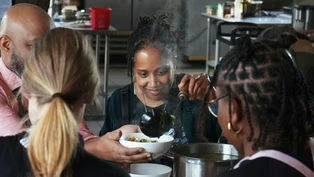
Preview: Relish Presents - Taste and Renewal
Video has Closed Captions
A preview of Relish Presents: Taste and Renewal (30s)
Providing Support for PBS.org
Learn Moreabout PBS online sponsorship

- Food
Christopher Kimball’s Milk Street Television
Transform home cooking with the editors of Christopher Kimball’s Milk Street Magazine.








Support for PBS provided by:
Relish Presents is a local public television program presented by Twin Cities PBS