
Remembering Author and Activist Gloria Steinem
Clip: 9/3/2026 | 8m 30sVideo has Closed Captions
Much of her life as an advocate was spent on the road, speaking at colleges, rallies and marches.
Gloria Steinem, the celebrated author and activist who became one of the most visible symbols and potent voices of the U.S. women’s movement and a fierce advocate for feminist causes for over six decades, has died. She was 92.
Problems playing video? | Closed Captioning Feedback
Problems playing video? | Closed Captioning Feedback
Chicago Tonight is a local public television program presented by WTTW
WTTW video streaming support provided by members and sponsors.
Remembering Author and Activist Gloria Steinem
Clip: 9/3/2026 | 8m 30sVideo has Closed Captions
Gloria Steinem, the celebrated author and activist who became one of the most visible symbols and potent voices of the U.S. women’s movement and a fierce advocate for feminist causes for over six decades, has died. She was 92.
Problems playing video? | Closed Captioning Feedback
Where to Watch Chicago Tonight
Chicago Tonight is available to stream on pbs.org and the PBS app.

WTTW News Explains
In this Emmy Award-winning series, WTTW News tackles your questions — big and small — about life in the Chicago area. Our video animations guide you through local government, city history, public utilities and everything in between.Providing Support for PBS.org
Learn Moreabout PBS online sponsorshipFeminist activist Gloria Steinem, who helped inspire a generation of women to demand empowerment and culture change has died.
Steinem appeared here on Chicago tonight.
A number of times here she is talking about the status of the women's movement over a number of years.
If you were to step back.
>> And look, and I assume that you would see.
women's movement or feminist movement is having its.
Cycles and ups and downs.
Where would where would you see it today?
Where is it?
>> Well, if we sort of pull back to a mountain top >> I >> it's important to say historically that even in this rather young country, there was a first wave for 2.
Humanize or undercut the race CAS systems.
That was the abolitionist suffragist way that 250 years.
And it really was enormously.
I made huge change because succeeded in defining.
Everybody is a human being as opposed to simply white males who had been the only citizens and everybody else was possessions before.
So that we got a legal identity.
Now we're trying to get legal and social equality.
I figure by all historical precedence, least 150 years and there may be waves after that in this second wave where we now are we're maybe 15, 20 years into it and we have.
Achieved changed consciousness if he will I mean, when now we know that women's position racial, you systems on are not natural.
Which is a big step for.
We used to think that biology dictated them are God or somebody.
And now we know could be different.
And the majority of people say it should be different.
That's never happened in history.
But all that means is now the next step is upon us.
And the next step.
The logical result of this majority change is 2 things.
One we're making.
We're ready to make institutional change to really change the way we work.
hours, the patterns that how people get paid, how we raise our kids.
We're beginning to do that.
And the second thing is we have a backlash because now were taken seriously.
It's not a joke anymore.
It is a majority change.
And the old groups whose power depended.
On race, whatever are up in arms.
And even though they're in the minority, they may win.
I where is it written that the majority has to win?
>> Well, you've been watching even watching all involved from this particular vantage point.
Anyway, for 30 years, MS magazine was founded.
Think officially in 1972.
So even at this first for some time how would you assess the progress that women have made in these decades?
>> I think the important assessment is in the minds and hearts your listeners because each person experiences this in a different way.
But if I risk generalization, it would be that we have advanced hugely in consciousness.
We now understand that that place of women is not.
Due to biology or God or fried or something.
It is political and it can change.
And that's a huge difference.
That consciousness change.
And we have made him very important symbolic victories achieving legislation, which is more than advancing toward equal pay.
We haven't yet achieved equal pay.
But people agree with the principle when we have the principal now.
Well, that what other areas.
>> I'm sorry you Well, I think that that we've we we know that we can move forward and we have move forward substantially.
>> We have, for instance, demonstrated that women can do what men can do.
But we haven't really moved towards men doing what women do.
>> So now it is what is that that women raising children and taking care of the home and so on.
And the whole point is that that all human beings can do all of these things.
And it's very important for children and for men that man nurture children as much as women do.
>> Where is the movement right now?
The women's movement?
I mean, is it stronger or weaker?
Is it more relevant, less relevant?
No, it's it's stronger than it's ever And it's certainly it's more relevant in an interesting way.
>> Which is that we are now finally beginning to see the connections.
I think in the beginning it was it was presented as discrete separate, you know, now we're beginning to understand that the biggest indicator of militarism and violence in society is whether or not violence has been normalized at home.
Now we we haven't absorbed this yet and our academics because the study of family forms and childbearing is, quote, unquote, feminine.
And the study of governance and foreign policy is sort of masculine.
And every time I go on a campus and I speak on campus is a lot I say, OK, tell me, is there one course in which these are connected and I've yet to discover one, which is too bad because this dictates that one.
And you know so and we're beginning to better understand the connection among and between movements.
So so we see, you know, sometimes on campus, people will say to me, well, why are the same people against contraception analyst being >> the reason is because they feel strongly that any expression that can't and in conception is wrong.
>> I talked to students, female students all the time.
And I can't tell you how many times I've heard a young woman say on post feminist, you know, that's or it's too radical.
>> All of which leads me wonder if the movement is in fact, a strong as you believe it.
Well, I mean, just at the level of public opinion polls, there are there are many more young feminists than older feminists.
So it's a little bit different when you ask them on a piece of paper and then when you ask them in public because Russia, Lynne, about all these folks have demonized the word feminist and there are other words, woman, a stand You know, there are all kinds of other words, but there's also another truth, which is that women's pattern of generally speaking, not everybody, but is is the reverse of man's that is women are more conservative when we're young and gets steadily more activist and radical.
Whereas men are more radical and rebellious when they're young and get steadily more conservative because endgame power with age.
Women lose power with age.
Do we take that to mean that you are more radical you haven't been?
Oh, yes.
Less right >> Well, I I mean.
I don't know about the mellow part because I do it perspective.
A long-term perspective does mellow you out a little bit because you realize that it's a it's not going to be revolution tomorrow, but I certainly hope that I'm more radical radical means going to the root.
It doesn't mean violence.
You know, so I hope that I now much better understand that dividing us into masculine and feminine in and into who eats in who cook sent into, you know, normalizing that young.
It's what digs a trench in our brains and makes us except race except class except other divisions and as a feminist and as an activist is your glass half full or half empty.
You optimistic about what we're going to see in the next decade or the next?
Well, look hope is a form of planning.
so I definitely feel hopeful.
It's important to be skeptical because otherwise we waste our energies, but I wouldn't remove thing pessimistic because that would mean you had had defeated myself.
But I have I have in front faith that we will get to the place where we are regarded as
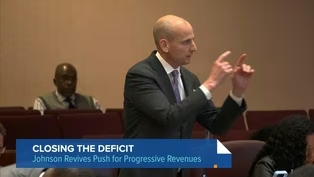
Chicago Faces $882M Budget Gap in 2027
Video has Closed Captions
That is 23% smaller than the $1.15 billion deficit that confronted city officials last year. (3m 28s)
Plans to Redevelop Ford City Mall Into Industrial Facility Raises Concerns
Video has Closed Captions
Developers want to transform the site into a warehouse and distribution facility. (9m 10s)
Providing Support for PBS.org
Learn Moreabout PBS online sponsorship New Episode
- News and Public Affairs

Top journalists deliver compelling original analysis of the hour's headlines.
 New Episode
- News and Public Affairs

FRONTLINE is investigative journalism that questions, explains and changes our world.

 New Episode
 New Episode
 New Episode
 New Episode
 New Episode
 New Episode


 New Episode
Support for PBS provided by:
Chicago Tonight is a local public television program presented by WTTW
WTTW video streaming support provided by members and sponsors.