
Renaming PTSD, George Shirley, Bumpy Cake, Weekend events
Season 8 Episode 19 | 26m 46sVideo has Closed Captions
A push to rename PTSD, opera tenor George Shirley, Sanders Bumpy Cake and weekend events.
Three Vietnam veterans from Southeast Michigan are pushing to rename Post Traumatic Stress Disorder. African American opera tenor George Shirley reflects on his trailblazing music career. Learn about the history of the Sanders Candy brand before the company’s beloved Bumpy Cakes go out of stock. Plus, Peter Whorf and Cecelia Sharpe share the events they recommend you check out this weekend.
Problems playing video? | Closed Captioning Feedback
Problems playing video? | Closed Captioning Feedback
One Detroit is a local public television program presented by Detroit PBS
Renaming PTSD, George Shirley, Bumpy Cake, Weekend events
Season 8 Episode 19 | 26m 46sVideo has Closed Captions
Three Vietnam veterans from Southeast Michigan are pushing to rename Post Traumatic Stress Disorder. African American opera tenor George Shirley reflects on his trailblazing music career. Learn about the history of the Sanders Candy brand before the company’s beloved Bumpy Cakes go out of stock. Plus, Peter Whorf and Cecelia Sharpe share the events they recommend you check out this weekend.
Problems playing video? | Closed Captioning Feedback
How to Watch One Detroit
One Detroit is available to stream on pbs.org and the free PBS App, available on iPhone, Apple TV, Android TV, Android smartphones, Amazon Fire TV, Amazon Fire Tablet, Roku, Samsung Smart TV, and Vizio.
Providing Support for PBS.org
Learn Moreabout PBS online sponsorship- [Narrator] Coming up on "One Detroit" we'll examine the efforts to encourage military Veterans to seek treatment for post-traumatic stress plus African American opera singer George Shirley talks about his trailblazing career.
Also ahead, we'll get the scoop on the story behind one of Detroit's sweetest brands.
And, there's a lot happening in Metro Detroit this weekend and beyond.
We'll share some ideas for your free time.
It's all coming up next on "One Detroit".
- [Announcer] From Delta faucets to Behr Paint, Masco Corporation is proud to deliver products that enhance the way consumers all over the world experience and enjoy their living spaces.
Masco, serving Michigan communities since 1929.
Support for this program is provided by the Cynthia & Edsel Ford Fund for Journalism at Detroit Public TV.
- [Announcer 2] The DTE Foundation is a proud sponsor of Detroit Public TV.
Among the state's largest foundations committed to Michigan-focused giving, we support organizations that are doing exceptional work in our state.
Visit DTEFoundation.com to learn more.
- [Announcer] Nissan Foundation and viewers like you.
(soft upbeat music) - [Narrator] Just ahead on this week's "One Detroit" the first African American tenor with the Metropolitan Opera shares his story of becoming an opera singer, plus the history of Sanders and its famous sweet treats, and Peter Whorf and Cecelia Sharpe of 90.9 WRCJ have a list of entertainment choices in Metro Detroit this weekend and beyond.
But first up, Veterans Day is this Saturday and we're focusing on one of the major challenges facing Veterans today: post-traumatic stress.
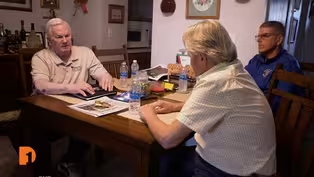
Two Vietnam Vets from Michigan are working to change how the nation views and treats the mental health of Veterans.
"One Detroit" Senior Producer, Bill Kubota, has the story.
(soft upbeat music) - [Narrator] Williamston, population 3800 20 miles east of Lansing.
Kent Hall, Vietnam Vet and Community Leader has another meeting tonight.
- How you doing?
- Good, how are you?
- [Narrator] He served on city council.
Now he chairs the parks and rec committee.
- Motion to excuse McGee and Wolf.
- Kent nominated me for mayor in 2016 and we've had, the friendship has blossomed ever since.
- You've cut through the bureaucracy sometimes to make good happen.
It's for the betterment of the community.
- Do you know the two most important days of your life is the day you were born and the day you figure out why.
I figured out my why and it's what I'm doing.
And it feels good.
- [Narrator] Hall's why, helping Veterans cope with post-traumatic stress.
His group Honor for All, led by another Vietnam Vet, Tom Mahany.
Now Hall's story starts in Linden, near Flint High School class president, top athlete, a champion pole vaulter.
It was the 1960s.
In college, he had a shoulder injury that needed surgery.
- I lost my deferment by dropping out for one semester.
They snatched me right away.
- [Narrator] In the army, he spent time in Europe.
The back end of his tour?
Vietnam.
- I never saw so many mortars and explosives go out.
It was like it was fire all around.
- [Narrator] Post-traumatic stress, Hall didn't know he had it.
The term didn't even exist yet.
In Linden, he finished college, worked, became a city councilman, an upstanding citizen, so everyone thought.
- I was about 40 years old when I just couldn't take it anymore.
I mean, I had three beautiful kids, I had a beautiful wife and I didn't wanna live anymore.
So I started Suicide by Cop.
- [Narrator] Hall made the news in 1986.
They called him the jogging bandit.
Former star athlete turned bank robber.
- I robbed 13 banks with a toy gun, but they called me the jogging bandit 'cause I didn't run away, I just come on and catch me.
Well, the first one was right in Grand Blanc and the second one might've been Grand Blanc.
They were all Michigan National Banks until the one in Ohio.
- [Narrator] Michigan National?
Hall didn't like them.
- They gave me a hassle about a car loan.
(Hall laughing) - [Narrator] For that, six and a half years in federal prison.
- I was an elder in the church.
I was a councilman in the city of Linden.
In fact, the night before my arrest, I was re-ordained as an elder in the Presbyterian Church there.
- [Narrator] Hall rebuilt his life, eventually moving to Williamston.
Hall's Honor for All partner, Tom Mahany, he's got a story, too.
He lives in Royal Oak, a stone mason, artist, as a child destined for the US Military Academy.
But Mahany was conflicted about Vietnam when he was a cadet at West Point.
- I was reassigned to the infantry when I was released from West Point.
And I was released from West Point because I had different views of what Vietnam was and what we should be doing about it.
And that was in '68.
And I spent the next year and a half in the Army.
- [Narrator] When Mahany got back, he headed to Washington.
Unhappy with the US taking the war to Cambodia, he joined another hunger striker at the Capitol.
He'd hold other hunger strikes by himself more recently against the Stop-Loss Policy during Iraq and Afghanistan, forcing soldiers to keep serving long past their scheduled release dates.
And he spoke about the high suicide rates among Veterans.
- Suicides keep going.
The battle stops, but the suicides keeps going.
- [Narrator] It's estimated as many as 22 Veterans will kill themselves each day.
- Your brother-in-Law, right, was?
- Yeah, my brother-in-law.
He committed suicide back in the '80s.
- But that was part of your motivation too, right?
- Yeah, well I saw what it did to my sister and her two little boys.
You know?
- So how long were you actually on that hunger strike?
- 29 days.
- [Narrator] Mahany in Washington, a one-man lobbyist for Veterans' mental health.
- I take him a new letter every day.
Try to get somebody to listen.
And it was finally Carl Evans' office that listened.
- See, I've never heard this story before.
- No.
- Don't really get into each other's personal, you know.
- I like to talk about what's gonna happen instead of what happened 'cause most of what happened wasn't that good.
- This is the Honor for All Trail and it's all been approved by City Council, the Parks Commission and the Planning Commission.
- These are tulips.
- [Interviewer] These are tulips.
- These are tulips and these are daffodils.
- [Narrator] Big plans, more work needed at Williamson's Memorial Park on the banks of the Red Cedar River.
With a section dedicated to Veterans, hope is someday a national monument, too.
- But that's what this park is all about.
You gotta work something out.
You can come here and work it out, or at least work on working it out.
- [Narrator] Still a bigger project, dealing with that term, PTSD, post-traumatic stress disorder.
Psychiatrist, Frank Ochberg, Medical Advisor for Honor for All, he ran Michigan's Department of Mental Health and helped define PTSD as a diagnostic term in 1980.
- What we based it on, it had a lot to do with the Vietnam War.
It also had a lot to do with women and what women were very concerned about at the time.
- [Narrator] Amongst them, were second wave Feminist leaders like Gloria Steinem who tied sexual assault and domestic violence to traumatic stress.
- I saw it as the two genders coming together to define something worthy of putting, not just in the psychiatric dictionary, but the General Medical dictionary.
- [Narrator] The mission changed the term PTSD to PTSI, post-traumatic stress injury and get that in the diagnostic manual, the DSM.
So all can know the problem is not their fault.
It's an injury to be treated like any other injury, as you would say, a broken leg.
- Well, if I admit to having post traumatic stress disorder, I'm disordered, so I'm not gonna admit it.
And if I'm not gonna admit it, then I'm not gonna get treatment for it.
This is a file containing all the resolutions from all the states starting back in 2014.
- [Narrator] PTSI, Mahany has been working on this for 11 years, collecting resolutions from Michigan, then 46 other states in both chambers of Congress.
- And it's going to lessen their guilt and it's gonna cut down on suicides.
Okay, that's it for the crocuses.
- [Narrator] Tom Mahany, Dr. Frank Ochberg and Kent Hall have helped change some minds, but they want to change a lot more.
- So it's getting there, but it's not getting there quickly enough.
So I don't wanna show you my graphic here: PTSI not PTSD.
- [Narrator] In Chicago, Dr. Eugene Lipov treats traumatic stress.
He shows the trauma is visible in brain scans and says he can prove the name change can help.
- So I did a survey, which I published in 2023, and presented American Psychiatric Association, the body that controls the naming.
Turns out, yes, if you change the name, the stigma will get better.
- I think now we have the evidence to change it.
I think when we do change it, there will be a celebration that we've done the right thing.
- [Narrator] The American Psychiatric Association confirms the PTSI proposal is now under initial evaluation by the DSM Steering Committee.
Perhaps the change is coming soon, driven in part by a little nonprofit in Williamston, Michigan.
- We have a wall of honor there and all the people on the wall of Honor died in action.
And we're here to honor them today.
But there's another bunch of people that might have died years later, even at their own hands, possibly.
And those are the victims of post-traumatic stress issue.
And they deserve honor.
It's as though that sniper's bullet took years or months or whatever to actually strike, and the hell they went through before they got there.
- [Narrator] And the Honor for All activists point out that post-traumatic stress not only affects war Veterans, but it touches many others, including first responders and victims of domestic violence and sexual assault.
Let's turn now to an African American history maker right here in Metro Detroit.
Renowned operatic performer.
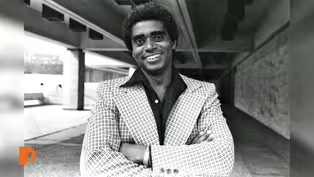
George Shirley was the first Black tenor to join the Metropolitan Opera in 1961.
He also holds other firsts as an African American musician and educator.
Contributor Cecelia Sharpe of 90.9 WRCJ sat down with Shirley for a conversation about his remarkable career.
(soft upbeat music) - I am here with Professor George Shirley, the first African American member of the Army Chorus, the first African American to teach music in Detroit public high schools, the first African American male tenor to sing leading roles with the Metropolitan Opera, and the list goes on.
Let's rewind time just a little bit.
Professor Shirley, you really didn't have plans to be an opera singer.
You are about to get married and teach music in Detroit public schools.
And then what happened?
- Well, the army happened, the draft happened.
My life was set, my dreams were fulfilled.
And we were planning on getting married in August of 1956.
We got a letter from Uncle Sam in about March or April, 1956 saying basically, you're going to be married to me.
In June, the word went out that the army was going to create a singing organization to be attached to the United States Army Band in Washington DC.
The band had been formed in 1934 or '35, and it had never had a Black member.
So I decided to go in as a bandsman.
So I went into the army playing euphonium.
- How did you really matriculate into the world of opera?
- So along with two other members of the band who were not that happy with that prospect, both of them were white, we decided to take a leave of absence and go to Washington and audition for the chorus.
Conductor of the Chorus, a fellow named Samuel LaBoda, he was a Captain, he was second in command of the Army band.
And my two colleagues sang their auditions.
And LaBoda, who was very direct, a really incredible man, he said, well, thank you very much for coming.
We won't be able to use you.
And I thought, oh.
My turn came and I sang.
And he said, can you wait a few minutes after I finished?
I said, yes sir, and he disappeared into the command room.
A few minutes became at least a half hour.
And I'm sitting there thinking it's the same old stuff.
Same (Professor Shirley groans).
So he finally came out and he said, well, we decided that we would like to have you join us if it's what you really want.
I found out years later that Sam LaBoda had to go all the way to the Pentagon to get me in.
That was America.
- Tell us about the value of equality, music education at the elementary level on up through high school.
- I didn't, I mean, I'd been singing ever since I was five years old with my parents in church in Indianapolis.
And then we came here and encountered my, one of the greatest systems of public school music education in the country in Detroit.
And for me it's a primal force in educating people.
It doesn't mean that someone who has profited by studying music is going to become a necessarily a professional musician.
But it means that the brain has been trained in certain ways that can be used, activated in professions that have nothing to do, per se, with music.
There are people who are CEOs of companies who are excellent musicians.
I mean, Einstein was a musician.
I mean, it's, so you're taking away something that is essential, really essential in helping to grow the brain.
- You've taught at universities, you're teaching, you're a distinguished professor at the University of Michigan, but you also have a vocal competition that started about 11 years ago.
- I have a former student, Louise Topin.
She and I came up with this idea of a vocal competition focused on the art songs and the classical compositions of African American composers.
It has grown over the years to include university students, still has high school level and it has become international.
The University of Michigan School of Music Theater and Dance is now going to house this competition and it's a dream come true.
The music, the so-called classical music of Black composers has not really been made as accessible and has not been taught to the degree that it should be.
And that's being changed now at Michigan, at the School of Music.
And it's open to all ethnicities 'cause music belongs to everyone.
I don't care what you look like.
If I can sing Italian to Italians or French to the French or German to the Germans or anything else, then everybody has a right to sing the works of African American composers.
I don't take credit for having been given the gift of song.
I had nothing to do with that.
I don't remember asking the intelligence that created me, can I be a singer?
Can I be an opera singer?
Can I be a teacher?
I don't have, I was given the gift and I was also given the work ethic to develop the gift.
(Professor Shirley singing in a foreign language) (operatic music fading) - [Narrator] And you can see George Shirley perform at the Musical Voices of Alpha Event on Sunday, November 12th at the Marygrove Conservancy.
Turning now to a Detroit original, Sanders Chocolate and Ice Cream Shop.
The iconic brand made headlines recently when it announced its famous bumpy cake could be out of stock by the end of the year due to a production issue.
The history of Sanders was chronicled in a Detroit public TV documentary "Detroit Remember When: made in the Motor City" with host Eric Smith.
(soft upbeat music) - If we acted up in Montgomery Wards while my mom was shopping, we didn't get across the street to Sanders.
- And you know, Sanders was a real big deal with my parents.
And once in a while, if you're really good, you could go to one.
- Sanders, well, what's always, for me, it's Saunders not Sanders.
- Sanders or Saunders, it doesn't matter because it's, a cake is a cake.
- [Narrator] Detroit's premier cake and candy maker had stores and lunch counters all over Metro Detroit reaching its peak in the 1960s.
- Mom worked.
One of the jobs she had was at Sanders Bakery on Woodward Avenue at Highland Park.
- The biggest treat we would have would be to go pick her up from work.
And we'd get there early.
They had this double chocolate cake that was like, to die for.
- I remember skipping high school at Notre Dame High School.
Don't tell the priests that.
But I did 'cause I'd walk over to Eastland Mall and go to the Sanders and get the chocolate malts, which were so fantastic over there.
They're still fantastic today, but then, it just seemed better when you skipped school to do it.
(playful music) - [Narrator] And to think a guy named Fred started it all 140 years ago.
- His real name is Fred Sanders Schmidt.
He didn't wanna be a baker 'cause his father was a great baker and he didn't wanna compete with him.
- [Narrator] The story really begins in Chicago, where Fred, born in Germany, grew up.
As a young man, he traveled back to Europe to train as a master confectioner.
- When he came back, he started his first store in Chicago under Fred Sanders, so not to compete with his father.
- [Narrator] After the Great Fire of 1871, Fred came east and Chicago's loss was Detroit's gain.
- He was very successful very quick.
In fact, he was way ahead of his time.
And some say he created the ice cream soda.
He was one of the larger confectioners in the Midwest.
- [Narrator] His pavilion of sweets opened up on Woodward Avenue and became an instant Detroit landmark.
His candy making machines were powered by motors that were made by Thomas Edison and repaired by a young fellow named Henry Ford.
Let's say he ran a finely tuned organization.
- Sanders used to have a school.
So if you worked in one of their ice cream parlors, they had 60 ice cream parlors at one time in the Metro Detroit area, you had to go through a school.
- [Narrator] The school actually showed legions of Detroit women the proper do's and don'ts of good customer service.
- They were literally sent home if they weren't dressed appropriately.
And they have the uniforms they had to wear.
- [Narrator] And the lunch counter became a Detroit tradition.
- My big, big day was to go downtown with my friends and go to Sanders and stand behind people's chairs three people deep while you waited for your seat.
- You look down the line to see who was closest to being finished, and you stand behind him.
And you keep looking at him, telling 'em like basically, hurry up and eat.
- Can you imagine trying to sit there and eat your lunch or your sundae while people were standing behind you, but you just ignored them?
- [Narrator] In 1913, Fred created his most iconic concoction, the bumpy cake.
- He wanted to pay homage to his father before he died.
His father was a great baker, he was a great confectioner.
So what he did is combine the two with a ganache over a devil's food cake with buttercream, and that's how the bumpy cake was started.
- [Narrator] We can even give Fred's company credit for Sweetest Day here in Detroit.
- It became kind of a chocolate and gift card kind of a holiday, which is very similar to Valentine's Day but at a different time of year.
- [Narrator] Sweetest Day remains an October tradition big right here in Detroit and in Cleveland where it started 90 years ago.
Today some of Detroit's favorite confections are making a comeback.
Morley Chocolates is rejuvenating Fred's product line.
And opening up stores all over again, they've also brought back the great debate.
- Half of the people, including my in-laws, do not, they say Saunders.
- You say Sanders, I say Saunders.
I almost say it was a family thing.
You said it the way your your parents did.
- And believe, me it was Sanders, not Saunders.
- It's actually Saunders, I'm sure, but I say Sanders 'cause of my folks are from Tennessee.
- You know, to us either is right.
As long as you are talking about Sanders, Saunders, and you're a fan, we love it (playful music fades) - [Narrator] From Motor City Comic-Con to "Mrs. Doubtfire, The Musical" there's a lot happening in Metro Detroit as we get closer to the holiday season.
Peter Wharf and Cecelia Sharpe from 90.9 WRCJ have the rundown in today's "One Detroit Weekend".
- Hey Peter, this is my favorite time of the week because I get to sit down and talk with you about all of the great events coming up for the weekend.
So what do you have for us?
- Well, Motor City Comic-Con is coming to Detroit to the Suburban Collection Showplace starting tomorrow, and it runs through the 12th.
You can see some of your favorite actors buy from some incredible artists and crafters.
There's even an escape room.
- Ooh, I like escape rooms.
That's really cool.
Well, did you know there's a new exhibition coming up at the Cranbrook Art Museum?
It's entitled "Skilled Labor: Black Realism in Detroit".
And it's co-curated by artist Mario Moore.
It features 20 contemporary artists who all have ties to Detroit.
It focuses on exploring the representation of the Black body in both personal and cultural context.
- Now tomorrow the Michigan Philharmonic is presenting "La Mer" at St. Kenneth Church in Plymouth.
The music celebrates the sounds of the sea and will feature two local university choirs.
- Well, if you're ready to get into the holiday spirit, you can check out my favorite Dr. Seuss' "How the Grinch Stole Christmas!
The Musical" at the Fox Theater through November 12th.
- And for those who want a little comedy in their life, "Mrs. Doubtfire, The Musical" is at the Fisher Theater November 14th through the 26th.
Definitely a show with humor for the whole family.
- Well, there's so many other events for everyone to partake in.
I hope you check them out.
Have a wonderful weekend.
(soft upbeat music) - [Narrator] That'll do it for this week's "One Detroit".
Thanks for watching.
Head to the "One Detroit" website for all the stories we're working on.
Follow us on social media and sign up for our weekly newsletter.
(soft upbeat music) - [Announcer] From Delta Faucets to Behr Paint, Masco Corporation is proud to deliver products that enhance the way consumers all over the world experience and enjoy their living spaces.
Masco, serving Michigan communities since 1929.
Support for this program is provided by the Cynthia & Edsel Ford Fund for Journalism at Detroit Public TV.
- [Announcer 2] The DTE Foundation is a proud sponsor of Detroit Public TV.
Among the state's largest foundations committed to Michigan-focused giving, we support organizations that are doing exceptional work in our state.
Visit DTEFoundation.com to learn more.
- [Announcer] Nissan Foundation and viewers like you.
(brief bright piano notes)
African American opera tenor, trailblazer George Shirley
Video has Closed Captions
Clip: S8 Ep19 | 6m 54s | African American opera tenor George Shirley reflects on his trailblazing music career. (6m 54s)

One Detroit Weekend: November 10, 2023
Video has Closed Captions
Clip: S8 Ep19 | 1m 50s | Peter Whorf and Cecelia Sharpe share the events they recommend you check out this weekend. (1m 50s)
Veterans push to rename Post Traumatic Stress Disorder
Video has Closed Captions
Clip: S8 Ep19 | 9m 18s | Three Michigan Vietnam veterans are pushing to rename Post Traumatic Stress Disorder. (9m 18s)
Providing Support for PBS.org
Learn Moreabout PBS online sponsorship
- News and Public Affairs

Top journalists deliver compelling original analysis of the hour's headlines.

- News and Public Affairs

FRONTLINE is investigative journalism that questions, explains and changes our world.












Support for PBS provided by:
One Detroit is a local public television program presented by Detroit PBS