
Reopening in the Midst of the Pandemic/Detroit Police
Season 5 Episode 16 | 23m 56sVideo has Closed Captions
Reopening in the Midst of the Pandemic/Detroit Police | Episode 516
A new school year is starting up soon, and DPSCD is planning to resume in-person learning with several safety protocols in place. The Michigan Council of Carpenters and Millwrights trade union is finishing their new training center on what was an empty field in the Tuxedo neighborhood on Detroit's west side. Episode 516
Problems playing video? | Closed Captioning Feedback
Problems playing video? | Closed Captioning Feedback
One Detroit is a local public television program presented by Detroit PBS
Reopening in the Midst of the Pandemic/Detroit Police
Season 5 Episode 16 | 23m 56sVideo has Closed Captions
A new school year is starting up soon, and DPSCD is planning to resume in-person learning with several safety protocols in place. The Michigan Council of Carpenters and Millwrights trade union is finishing their new training center on what was an empty field in the Tuxedo neighborhood on Detroit's west side. Episode 516
Problems playing video? | Closed Captioning Feedback
How to Watch One Detroit
One Detroit is available to stream on pbs.org and the free PBS App, available on iPhone, Apple TV, Android TV, Android smartphones, Amazon Fire TV, Amazon Fire Tablet, Roku, Samsung Smart TV, and Vizio.
Providing Support for PBS.org
Learn Moreabout PBS online sponsorship- Hi, I'm Christy McDonald, and here's what's coming up this week on "One Detroit."
Kids heading back to class amid a surge in COVID cases.
We zero in on plans for the year ahead at Detroit schools with Superintendent Dr. Nikolai Vitti.
Plus on-the-job carpentry training is helping homeowners in the Tuxedo neighborhood.
And then, how police are using your social media to monitor crime.
Bryce Huffman's report from BridgeDetroit.
Join me.
It is all coming up this week on "One Detroit."
- [Announcer] From Delta faucets to Behr paint, Masco Corporation is proud to deliver products that enhance the way consumers all over the world experience and enjoy their living spaces.
Masco, serving Michigan communities since 1929.
- [Announcer] Support for this program provided by the Cynthia and Edsel Ford Fund for Journalism at Detroit Public TV, the Kresge Foundation, Community Foundation for Southeast Michigan.
- [Announcer] The DTE foundation is a proud sponsor of Detroit Public TV, among the state's largest foundations, committed to Michigan-focused giving.
We support organizations that are doing exceptional work in our state, visit DTEFoundation.com to learn more.
- [Announcer] Business Leaders for Michigan.
Dedicated to making Michigan a top-10 state for jobs, personal income, and a healthy economy.
- [Announcer] Also brought to you by, and viewers like you.
(uplifting music) - Hi there.
And welcome to "One Detroit".
I'm Christy McDonald.
So glad that you are with me this week.
Kids are grabbing pencils, notebooks, and masks as thousands of them head back to school this next week.
Surging COVID cases from the Delta variant have some districts calling for a statewide mask mandate in schools.
But as of now, it's up to each district to set their own policies.
The biggest goal, getting kids back in the classrooms as safely as possible.
Coming up this week, superintendent of Detroit Public Schools Community District, Dr. Nikolai Vitti, and his conversation with Stephen Henderson about the changes for the school year ahead.
Also coming up on the show, we head back to the Tuxedo neighborhood on the city's west side, where the Carpenters and Millwrights Union is building a new trade school.
You'll see how their summer carpentry-camp is training the next generation and giving homes in the neighborhood a facelift.
And then Bryce Huffman from BridgeDetroit talks with Will Glover about his report on police using our social media to monitor crime.
It is all just ahead.
And we are starting with heading back to school and the different challenges districts face in setting their own COVID policies and using funding to make sure buildings are safe.
Here's Stephen Henderson's conversation on "American Black Journal" with Detroit School Superintendent, Dr. Nikolai Vitti.
- You're somebody who has said unequivocally that the best situation for kids in our district in Detroit is for them to be in school all the time.
Of course, we can't necessarily mandate that at this point.
But tell me how close you think we're gonna be able to get, even as we see this recent surge in COVID-19 cases?
- I, you know, I think most of us would agree the best situation for our students, our students in Detroit, is in person.
There's just a relationship connection there that you can build into trust, you know, reteaching small group instruction because a lot of our students are below where they should be.
But obviously any time the infection rates are too high, then we have to suspend it.
And I think over the last year and a half we've done that.
So we've been about equity and equity of access.
Meaning if private schools are open and suburban school districts are open, so should we.
But being very cautious and listening to medical experts when the infection rates are too high and not moving forward with in-person learning.
Now, I'm very excited about the fall.
You know, I am worried about the rising infection rates.
They're not as high in the city, you know, in Michigan, as they are, let's say in the south right now.
But at the same time, I'm excited and optimistic for a couple of reasons.
One, our teachers are back across the district.
So every school, every classroom, every subject area, our teachers will be back in person.
That was an agreement that we made with Detroit Federation of Teachers.
I'm also excited because we have additional funding.
And so for the first time in over 20 years, as a teacher, principal, chief academic officer, superintendent, always in large urban school districts, I feel like for at least two years, we have equitable amount of resources to address some of the wrap-around challenges that we have with our students and families.
So we're gonna be able to go much deeper with mental-health support in the fall with tier-two, tier-three intervention.
That means small group one-on-one.
We're gonna have a nurse at every one of our buildings.
Every teacher vacancy is filled.
And we've hired over 100 more teachers to reduce class size.
We're gonna be able to offer afterschool programming in every school this fall and for the next two years.
We're adding vans, district vans, to pick up students if they miss the initial bus.
So, you know, this year for us is a year of recovery.
We have to make up on learning loss.
We gotta get kids back and learning in the regular process.
And so that's our focus, but I feel like we can do this now in a much harder space in time, but with the resources to actually do that.
So, and the last reason why I'm optimistic and excited is that our families are ready to send their children back.
So, you know, right now our polling looks at 80 to 95% of parents are ready to send their children back to school.
I think our number, or our percentage of students that want virtual school, will always be higher than suburban districts and rural districts.
And we have a separate virtual school for that.
And, you know, from a COVID perspective, we're always going to be more conservative, if you will, about the safety strategies.
And we've always been aligned to the CDC, always been aligned to state guidelines.
So all of our students, employees, vaccinated or not will wear a mask.
We're gonna do the deep cleaning, three-feet of social distance.
And I think the big difference in DPSCD will be testing.
All of our employees, all of our students will test, vaccinated or not.
So, you know, we can identify asymptomatic cases.
We can identify outbreaks that have not been identified.
And we can talk about an infection rate beyond the city rate or even the county rate.
The state rate based on actual infection rates at individual schools and districts.
- You've been able to fill all the vacancies in our schools.
I mean, I've been around Detroit for four decades, five decades now, that has always been one of our big, sort of, speed bumps is the idea that we can't attract enough teachers to get the ratios we want in classrooms and make sure that we're fully staffed.
Talk about the difference that you think that makes.
- I've said it countless times, if we don't have a certified teacher in a classroom, we can't even talk about getting to high quality.
You can have a great person who cares about the kids.
You know, a long-term sub, someone with the degree, they need to be certified, they need to be trained.
And then we can start building capacity.
But you can't even get off the finish line if you're not at that point.
And I remember when I started as superintendent, and I started to talk at that point with the HR team, and the conversation was, "We'll never be fully staffed in Detroit," you know.
Right when you told me that I realized, you know, wrong approach, wrong expectations, we gotta move in a different direction with just how you think about your job.
So, you know, part of the work was honestly revamping HR with people that believed that we should, and had to be fully staffed.
But then it was, you know, pay matters.
And, you know, we can talk about climate and culture and support, and all of that does play a role, but ultimately it is about paying people a competitive wage.
So we've gone from, you know, about 36, 38,000, to 51,000 for beginning-teacher salaries.
And it wasn't only beginning teachers, but this is what it was, we were able to recruit from Detroit charter schools and from suburban school districts, many of those teachers who grew up in Detroit and left, that was a major difference.
And we've been able to retain our veteran teachers.
You know, I think it's one recruiting, it's pay, and then once we get 'em in, I do think people feel more supported when they get to their school, with stronger principals, more principal training.
And, you know, I'm also excited that we're building our own bench.
And so we're taking academic intervention as paraeducators, people that have four-year degrees that aren't certified, using master teachers that have been in a system to train them in the classroom.
So we're actually thinking ahead also in building a bench so this can be sustainable.
As we know, our most veteran teachers will probably start to retire in the next three to four years.
So we'll be well positioned to actually build our own.
People that know our kids, been in the classroom, know the challenges and the opportunities.
And it's a very diverse group, and I'm excited about that.
We're, you know, by memory, I think 90% of the candidates that we're building to become teachers are of color.
And there are many black men in that cohort as well.
And that's the other part of being intentional about, you know, matching the needs of our students with our teachers.
- I want to ask you about the money coming from the Federal Government.
An unprecedented amount of money, both to the city and to the school district.
And what you want to do with that money.
And what difference you think that's gonna make for our kids?
- This is how we're going to expand mental-health support throughout the district.
We expanded summer school this past summer and the upcoming summer.
We're also hiring teachers in surplus.
So we're fully staffed on the teacher side of staffing.
While we're hiring more teachers to reduce class size, to maintain social distancing.
And to anticipate the retirements that are gonna come in the next couple of years.
We're using the money for home visits, which has been very successful.
In addition to that, we're gonna be able to continue to go one-to-one with our laptops, internet access.
Probably one of the greatest long-standing issues we have in DPSCD is our facilities.
So about 600 to 800 million of that 1.2 billion that we're going to receive, is going to attack our facility issue.
Now, with this funding, we don't have to go to the taxpayers.
We don't have to raise taxes, and we can put a major dent in our facility.
So by January, we'll have a 20-year facility plan, which will be like a blueprint, a set of recommendations on how to deal with buildings like Pershing, Osborn, and Cody that need substantial work.
But you know, which, the size of the school is not needed, the number of seats.
- Right.
- So, we're gonna engage the community by feeder pattern.
Should we renovate?
Shall we build new buildings, do we consolidate?
And the whole conversation is not, how we take away, but how do we give back something better?
And not to replicate what I call the sins of emergency management in the past, truly engage people, know that there is a finite amount of money, but how do we best use it?
And then take that back to the school board and then create a 20-year facility plan and start making major investments in our facility.
So we get to a point where all of our schools have air conditioning, you know, reliable HVAC systems, roofs, masonry work, fencing around parking lots, upgraded IT, but it's gonna take us, you know, about two to five years to get to that full implementation.
But by the end of this school year we will have a 20-year facility plan with funding connected to it.
- All right, let's head to the Tuxedo neighborhood on Detroit's west side where it has been a busy summer.
Carpenters in training have been working their way around the neighborhood on projects for homeowners while learning their craft.
"One Detroit's" Bill Kubota has more on how this carpentry camp is training the next generation as part of our series on the future of work.
- [Bill] Detroit's west side, the Tuxedo neighborhood near Grand River, Livernois, and the Jeffries Freeway.
Abandoned houses common here, but this summer, signs of progress.
Along with this demolition order, some new construction down the street, it's carpentry camp.
A summer program put on by the Carpenter's Union to get high-school students interested in the trades.
- You gotta be careful, do not go further.
We're not here to make 'em carpenters.
We're here to introduce them to carpentry so they can touch it, feel it, do it, make the mistakes on it.
Make sure they understand that it's not life-ending if they do make a mistake and how to fix it.
- [Bill] The Carpenters and Millwrights Union has a stake in this neighborhood.
Their new trade school is going up here right along I-96.
Part of the school's mission, get more Detroiters working in construction.
- It's unfortunate because a lot of kids today don't believe that this option is out there for 'em.
They don't even know about it.
You're gonna have to bring this saw, and remember we have to make a center cut.
- [Bill] Cortez Asberry's done this camp before.
Now he's headed for a carpentry apprenticeship with the union.
- But this is good, you do something new every day.
- We teach 'em a little bit of math.
We teach 'em how to read a tape measure.
And we teach 'em how to do basic skills projects.
Good, done, done.
All right.
- At 15, I came here, it was kinda hard.
Nobody's gonna know how to do it at first.
After it was done, you look at it, you love it, I love it.
I wanted to stay forever.
- [Bill] 31 participants this year.
Last year, COVID got in the way.
- Start it straight and then angle it.
- [Bill] This time it's community service for the Tuxedo neighborhood.
- Back in April, we put out a bunch of applications for residents to have work done on their houses.
We got almost a hundred projects.
Are we going to get a hundred projects done?
Absolutely not.
But we are gonna get done the most needy that we see that we have to do.
All right, where's the top one at?
It's all right, the top one will secure it in now.
You know, these are the small projects that we can do to give back.
It's absolutely free, no charge to the resident.
And these kids are getting paid.
- [Bill] Jamal Al said the students are learning teamwork, communication, and how to execute plans.
- And we got one source of power here.
Where's it at?
Who can tell me?
- [Student] The house.
- The generator.
Get the generator out now.
We try to explain to 'em what we're doing, how we do it.
And then we let them do it, you know.
And kids are gonna make mistakes.
They've never done this before.
You gotta put it right in the middle.
We're doing porches hand rails and porch rails.
- [Bill] Here a porch beyond expectations.
A major project for a crew of beginners.
A showcase of what they can do.
- Well, it took about five days and it was pretty much an entire remodel.
All of these Detroit homes are pretty old.
So the porch, it was probably around, like, 80-years old.
And we had to pretty much demo the whole thing.
We had to take the frame down and completely build it back up from scratch.
- You know what?
This is a great neighborhood.
You know, people can drive through it and see, you know, that the houses are deteriorating.
They just can't afford to fix 'em up.
- [Bill] What happens after this for these campers?
- We have six kids are old enough to go to work.
Out of the six, four of 'em are being placed.
So they've already gone into our apprenticeship program.
They graduated and they're moving into the next step and the next phase of this program.
Have you got screws?
There's some right there.
They're going to work.
They're getting jobs.
- [Bill] Is this a career for your, or what?
- I feel like it's a journey for me.
I'm gonna do this forever.
- We teach 'em about the money.
We teach 'em about the benefits.
We teach 'em about, you know, a great middle-class living, you know, with pensions.
- Family always tells me that they proud of what I'm doing.
That you know, I'm gonna be prepared for my future.
- [Bill] Ivan Walker, a senior at Detroit's Renaissance High School.
He's planning for college, but eyeing a trade school too.
Along with a degree in computer engineering.
What is it, an either or, why are you doing this if you're gonna do that?
- Well, I always wanted to have a plan B, you know.
There's no point, you know, I'm not gonna put all my chips on black.
You know, I wanna be prepared for anything because, you know, life can throw anything at you.
- [Bill] Mahmmoud El Jammali.
He's a former camper now helping out.
An architecture student at the University of Detroit Mercy, - I'm going to college, but I still wanna do this.
Like, I love this stuff.
I wouldn't be able to do 50 years of just look at making.
I'm a hands-on guy.
And after my four years in college architecture, I'm most likely gonna come into the union, do my four years there and have the skills of a carpenter, an experienced carpenter, and be an architect.
- This is just our organization, you know, there's 17 other crafts just like us, you know, in the trades that are out there.
And we're trying to push for kids to understand what the trades are.
- I've always wanted to help rebuild Detroit.
Gonna be a long process to really get these houses back in the shape that they should be, but it can definitely happen.
- "The Future of Work" is a three-part series exploring the impact that workers, employers, educators, and communities are experiencing.
And it's launching on PBS Primetime on September 1st.
All right, turning now to an interesting report from our partners at BridgeDetroit on how police use our social media to monitor crime.
When we think about technology and policing, facial recognition technology often dominates the conversation.
But Detroit police also turned to social media to use images in conjunction with that technology.
"One Detroit's" Will Glover met up with BridgeDetroit reporter, Bryce Huffman, to talk about the privacy and legal concerns with this kind of surveillance.
- So the way I started looking into the whole social media angle was, I was at a press conference back in June when they were talking about the drag racing and drifting.
And Interim Chief White mentioned that they have about 150 intel specialists who monitor social media, and I was like, "Oh, that's a big number of people."
You know, 150, that's not a small number of people to be monitoring social media.
And then I started going through these facial recognition reports that they send to the Board of Police Commissioners every week.
And there's a section on the report every week that says, "Source of Probe Image."
Basically, the way facial recognition works, they take a picture of someone, and they run it through their system to see if it matches with camera footage or any other photo that, you know, they can match to this person.
There was some stuff they were really transparent about.
Right, like obviously they want to ensure that people know they're not trying to infringe on first amendment rights.
They wanted to know, hey, we're using this tool mostly for violent crimes, Part 1 violent crimes.
But aside from that, like, there's still a lot of unknown.
There's stuff that they weren't willing to be transparent about because in their words, you know, it might hurt their practice of law enforcement if, you know, if the criminals that they're monitoring know how they're being monitored, it might tip them off.
- Does, is there, do they have a way to show that, like, because we're monitoring people's social media, we were able to stop this crime or solve this crime?
Is there anything that supports that?
- The short answer is, we don't know.
Part of it is because when I asked for a number of arrests where social media were used in the investigation, they didn't have that number on hand.
- Do law enforcement agencies get any sort of special treatment from social media companies?
Or does this tool kind of lose its usefulness if I simply set all of my social media accounts to private?
Would they have to send me a friend request in order to, you know, look through my social media?
- To my knowledge, they only look at what's publicly available.
Now, if your account is private, I do believe there is a way.
I think there are ways around that, but I don't know to what extent DPD would ever feel the need to use that, 'cause at that point they're using other tools to investigate you other than what you post online.
- Who are the people who are looking through everybody's social media?
- That's a good question, I don't have the number breakdown as far as how many are civilians and how many are officers.
But the unit does comprise both.
There are, you know, sworn officers, obviously, who are looking into this.
And I would imagine they probably have more investigatory backgrounds.
But then there's civilian members of that unit who, you know, for them they're not cops.
They work with the department, obviously, but they're not gonna be able to pull someone over for a traffic violation, you know.
They don't have a gun and badge basically.
- So, are these people who are looking at the social media of, I'm assuming primarily Detroit residents and things like that, are they from the city of Detroit?
Are they a part of the communities that they're surveilling?
- We don't know that.
And that's one of the many challenges when it comes to thinking about social media in policing.
I actually talked to Desmond Patton who has studied the impact of social media in policing in cities like Detroit and Chicago.
And one of the things he was telling me is that a lot of the investigators who are looking through social media, they don't have the necessary context to really understand just the lingo and the slang and the terminology that young, black and brown people use on their social media.
So that can make it quite difficult to use it as an investigatory tool, because, you know, if you don't speak that language, if you're not familiar with these terms, that already creates a distancing and a misunderstanding.
- Is there any legal recourse for someone who might be involved with something like this?
- So right now, like I said, when I talked to Eric Williams at the Detroit Justice Center, he said there isn't any sort of legal maneuver that can help you not be monitored at this point.
I think the phrase he said was, "The law hasn't caught up to the technology yet," you know.
Until they make a mistake and arrest the wrong person.
And that might've happened already, we don't know, but until that sort of thing becomes public, there's no legal recourse for someone at that point.
- For more stories from BridgeDetroit and all that we are working on, head to onedetroitpbs.org for more.
That's gonna do it for us.
Thanks so much for being with me.
Have a great weekend and I'll see you next week, take care.
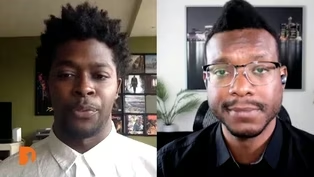
Detroit Police's Use of Social Media to Monitor Crime
Video has Closed Captions
Clip: S5 Ep16 | 5m 8s | From our partners at BridgeDetroit: how DPD uses our social media to monitor crime. (5m 8s)
DPSCD's Reopening Plan in the Midst of the Pandemic
Video has Closed Captions
Clip: S5 Ep16 | 9m 48s | Superintendent Dr. Nikolai Vitti talks with Stephen about the district’s reopening plan. (9m 48s)
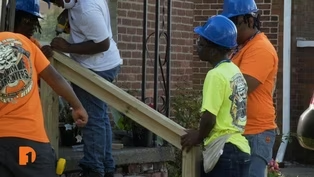
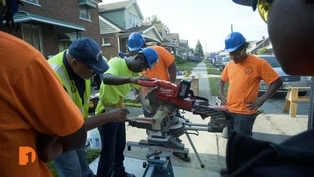
High Schoolers Learn Carpentry
Video has Closed Captions
Clip: S5 Ep16 | 5m 8s | The students have been helping repair porches & handrails around the Tuxedo neighborhood. (5m 8s)
Providing Support for PBS.org
Learn Moreabout PBS online sponsorship
- News and Public Affairs

Top journalists deliver compelling original analysis of the hour's headlines.

- News and Public Affairs

FRONTLINE is investigative journalism that questions, explains and changes our world.












Support for PBS provided by:
One Detroit is a local public television program presented by Detroit PBS