
Report Examines Equitable Transit-Oriented Development in Chicago
Clip: 5/19/2026 | 9m 4sVideo has Closed Captions
Some neighborhoods aren't seeing the same investment as others.
While the city has made significant progress to maintain affordability and accessibility for residents living near those developments, some neighborhoods aren't seeing the same investment as others.
Problems playing video? | Closed Captioning Feedback
Problems playing video? | Closed Captioning Feedback
Chicago Tonight is a local public television program presented by WTTW
WTTW video streaming support provided by members and sponsors.
Report Examines Equitable Transit-Oriented Development in Chicago
Clip: 5/19/2026 | 9m 4sVideo has Closed Captions
While the city has made significant progress to maintain affordability and accessibility for residents living near those developments, some neighborhoods aren't seeing the same investment as others.
Problems playing video? | Closed Captioning Feedback
How to Watch Chicago Tonight
Chicago Tonight is available to stream on pbs.org and the free PBS App, available on iPhone, Apple TV, Android TV, Android smartphones, Amazon Fire TV, Amazon Fire Tablet, Roku, Samsung Smart TV, LG TV, and Vizio.

WTTW News Explains
In this Emmy Award-winning series, WTTW News tackles your questions — big and small — about life in the Chicago area. Our video animations guide you through local government, city history, public utilities and everything in between.Providing Support for PBS.org
Learn Moreabout PBS online sponsorship>> Chicago has made significant progress to ensure that developments near transportation options around the city.
don't mean nearby residents get pushed out.
That's according to a new analysis from elevated Chicago that looked at 5 years of what's called equitable transit oriented development or E T OD policy in Chicago.
It found that while the city has made significant progress to maintain affordability and accessibility for residents living near those developments, some neighborhoods aren't seeing the same investment as others.
Joining us now, our Juan Sebastian Rds executive director of elevated Chicago.
Nina E to Moody, a CEO of the Center for Neighborhood Technology and Oji Eggleston executive director of the Renaissance Collaborative and a community developer.
Thanks to all of you for joining us.
Thanks for having Thank you.
the report says, as we mentioned, the city has made progress on all of the recommendations in the city's each DOD policy plan.
It reads, quote, unanimously adopted by the Chicago Plan Commission in 2021, the plans, 42 recommendations focus on directing investment to historically disinvestment.
tease preventing displacement in areas with rising housing costs, expanding affordable housing near transit and creating more walkable.
People centered neighborhoods citywide come to you first.
What are some examples of that progress?
>> Yeah.
Thank you for having us again here, too.
We've seen a lot of progress and 3 big successes that I would want to highlight today include a policy, innovative investment in programming and collaboration and to walk through those on the policy 4 years ago.
Now, the city past the connected communities Ordinance was the most comprehensive reform of our of our land use and zoning laws to promote more equitable, affordable and accessible in near transit.
And in addition to that, shortly after that, the city also put a historic investment in utility projects, including investing in an elevated works technical assistance program that per match those grants with coaching and support for largely first time emerging developers to be able being their community visions to life.
>> And has been the ongoing sustained cross sector collaboration.
>> Live Chicago convene this utility working group with the city.
And that really has been the driver of all this excess being together.
City officials, community leaders, advocates policy researchers, developers all around putting this plan into action.
What would you say is still lacking in Chicago?
See to the policy plan yet?
So as you noted, we made progress on all of the recommendations yet nearly half still have to be fully implemented.
So there are some of barriers that we still see challenges we see in our zoning and how our city is owned and what kind of development we allowed to have near transit to give you an example.
It's illegal to build a to flat Earth.
You fly in many parts within walking distance of many parts of the city while it is legal to build a gas station or an auto repair shop.
And those are not really aligned with the opportunity that we have in our public transit system.
In addition to that, we in our report did look at where we've seen recent dot development projects and well, we have we are seeing some more investment in growth happening in the south and West sides when there's still so there's still need for more.
We still see opportunity in the far South side along the red line along the future line extension.
And we also see a lot of opportunity are on the orange line in the southwest side of the >> do your project Abrams, intergenerational village in Washington Park is a housing development, quote, designed to allow older adults to effectively raise and nurture children collaboratively, which sounds important, right?
Thank for talking but intergenerational child-rearing.
So you received support through the elevated works.
Technical Assistance program that won just mentioned developers.
What were some of the challenges that you're facing as a developer?
>> As one mentioned, the elevated works west set up for emerging developers.
I was new to the right, the Renaissance Collaborative as executive director.
And so I need a technical assistance.
The organization need technical assistance, one funding.
There's always a need for funding and through elevated working relationships that they were lout to develop for us.
We received additional funding for our projects, too.
Partnerships as a developer there.
Very important partnerships.
That must be established and maintained in through the relationships and with the emerging groups.
That one mentioned, we're able to establish strong partnerships and 3rd was to the technical assistance, branding and marketing as developers as entities and nonprofit.
We tend to have our heads down getting the work done.
But we're not promoting and marketing the important work that we're doing.
And so through technical assistance, shout out to right resources to provide that technical assistance for us and allowed us to develop a marketing strategy.
A branding plan to allow us to promote the building and ultimately bring in additional funding for our organization.
>> So, Nina, the report also calls for stronger and tied gentrification protections.
Why does more investment often mean displacement?
>> More investment often means displacement because when we're thinking about neighborhoods that had been put out of place or or or just invested and we're thinking about black and brown neighborhoods places where depending on zip bank will make a loan to you or, you investor won't take a chance on you just because of where you want to put your business, which puts the communities the been about communities that CMT and elevated Chicago cares about at a disadvantage.
So as the FT, we think about what are the structural ways that we can make sure that the hopes and dreams of our community actually is translated into policy and funding actually accelerate the impact that community, that this of solutions that communities already have, but don't have the resources to actually see get off the ground.
It tell me more about that.
How do we combat this?
We combat it through few different ways.
So recently, Illinois just pass a bill called Northern Illinois Transit Authority Act, which means that for our 3 major carriers, CTA, Metra and pace, they will be reconfigured into a new governance body.
If you've ever taken CTA already public transit, you know, it's like a man.
Why are these things connected?
Why cannot walk here to get on the Why can I make it?
Why can't I north north to south very easily without going through the And so this new kind configuration, Ford and transit authority and also to have all those 3 agencies work together, get people exactly what they deserve.
They deserve a transit system that is fully funded, which now it is.
They deserve a transit system that allows their grandmother to go to their clinic appointment for their monthly checkups.
They deserve a transit system that gets those hourly workers at those restaurants to the places that they need to go in order to get the opportunity that they need to have and also get students to places throughout.
Chicago they have more opportunity G so beyond housing.
Whatever kind of investments do you think should surround, you know, any additional transit stations?
We're gonna talk about the red line in just a little bit.
But what other sort >> investments do you think should go around What's important for every community?
>> Are various resources and assets within the community plays based.
So, for instance, what's very important about time the businesses that are established around the public transportation as well as health clinics that are important to public transportation.
So I think as you at those additional assets to communities that allows the communities.
Residents to not have to travel far and has the ability Travel within their own community.
So I think those things that are needed also, I think it's very important for additional affordable housing to be developed because gentrification is outpacing affordability.
And so as you bring those assets into the community and allows those residents to gain employment through those assets, one we've got about a minute left.
But the red line extension just broke ground for new stations will be built.
How could the city take advantage of this opportunity to expand eat dog into the far South Side?
>> Yeah, it's a it's a huge opportunity.
It's a historic moment in our city's history for making transit access.
>> 2 communities that have been left out of the CTA is public transit system.
I would say just as we're investing so much money into the expansion of transit, we need to put that matching investment into the community assets and amenities that oh, gee, was just mentioning in affordable housing in small business supports.
And we also need to put in strong policies to make sure that as this development is coming, that there is not the displacement that is happening because it is truly what makes equitable development, equitable.
When you make sure that the protections and uses resources are in place for existing residents also benefit from all this growth in this activity, OK, that's where we'll have to leave it.
Best
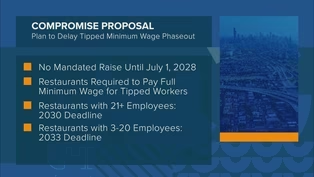
City Council Set to Vote on Delaying the Phaseout of Tipped Minimum Wage
Video has Closed Captions
The end of the tipped minimum wage in Chicago would be delayed for an additional two years. (10m 21s)
Providing Support for PBS.org
Learn Moreabout PBS online sponsorship New Episode
- News and Public Affairs

Top journalists deliver compelling original analysis of the hour's headlines.

- News and Public Affairs

FRONTLINE is investigative journalism that questions, explains and changes our world.
 New Episode
 New Episode
 New Episode
 New Episode

 New Episode
 New Episode
 New Episode
 New Episode
Support for PBS provided by:
Chicago Tonight is a local public television program presented by WTTW
WTTW video streaming support provided by members and sponsors.