
Reporter's Notebook
Clip: Season 4 Episode 357 | 7m 45sVideo has Closed Captions
Major legislation passed by Kentucky General Assembly and what the governor has vetoed.
Governor Beshear signs Logan's Law into law and vetoes two gun-related bills, Renee Shaw recaps the legislative session with Kentucky Lantern's McKenna Horsley.
Problems playing video? | Closed Captioning Feedback
Problems playing video? | Closed Captioning Feedback
Kentucky Edition is a local public television program presented by KET
Reporter's Notebook
Clip: Season 4 Episode 357 | 7m 45sVideo has Closed Captions
Governor Beshear signs Logan's Law into law and vetoes two gun-related bills, Renee Shaw recaps the legislative session with Kentucky Lantern's McKenna Horsley.
Problems playing video? | Closed Captioning Feedback
Where to Watch Kentucky Edition
Kentucky Edition is available to stream on pbs.org and the PBS app.
Providing Support for PBS.org
Learn Moreabout PBS online sponsorshipor against new projects or rate changes.
[MUSIC] Time now for our reporter's notebook, and we're going to go inside the Kentucky General Assembly lawmaking session that is in recess right now.
And we have with us McKenna Horsley, who is a politics reporter with the Kentucky Lantern, and we thank you so much for your time.
>> Oh, thanks for having me.
>> So we know that lawmakers really tried to beat the buzzer on getting the state budget, the two year spending plan for the upcoming biennium, Don and to the governor's desk, along with road projects and transportation judiciary budgets.
Tell us about what is already on the governor's desk that he's reviewing right now.
>> Yes.
So he is a slew of bills on his desk already.
He can sign them.
He can let them become signature or let them become law without his signature.
And he can obviously veto them.
And then lawmakers will have a chance to come back later this month and override any vetoes that he issues.
But obviously, the budget bills are a huge focus for him.
He can issue some line item veto to some of those measures and come up with different ask of the General Assembly that they may take into consideration.
Likely they will not is usually the case, but there's also a lot of policy decisions as well.
On his desk last night, he did issue two vetoes for two different bills that are related to guns and firearms at an event here in Louisville that honored his friend, who died in a 2023 shooting, along with other several other employees at the Old National Bank shooting.
One of those bills would have protected firearms manufacturers and sellers from liability in courts for actions related to gun violence, and another one lowered the concealed carry for firearms and other deadly weapons from 21 to 18.
Those are two big priorities for the Republican controlled legislature, so I'm sure we'll likely see those vetoes override when we come back later this morning.
>> Yeah.
And to your point about the budget, you know, it's not just the executive branch budget, but there are other budgets, the legislative and judicial branch budget.
There's not so much to talk about with the legislative branch budget.
But we know that that we know the Chief Justice, Denver Lambert, has called out an alarm about what possible cuts could come in the judicial branch because of what the legislature has sent to the governor's desk.
Tell us more about this.
>> Yes.
So when some of the final versions of these bills were released last week, we heard from the Chief Justice that the budget for the the judicial branch was underfunded and could jeopardize some services that are really important to a lot of communities, like specialty courts, which is often drug court, mental health court and things like that.
So that was the judiciary advocating for for more money throughout the week.
And then once the final judicial budget came out on Wednesday, the chief Justice said that it's still under funds for operations.
And she said that we know we will have significant layoffs, but will still focus on getting resources to people and providing those services that they do.
>> And there's nothing that lawmakers can do at this point right now to undo perhaps those negative consequences.
>> Right?
You know, I mean, you know, just kind of thinking of the process, maybe one thing that could happen is that we do see a veto override maybe, or a veto issued on this section, and they could let that stand up.
Typically, they don't let vetoes stand.
So we'll have to see how the next couple of weeks play out on that one.
>> Wright Medicaid has been a big issue that lawmakers have tackled.
We know that House Bill two, Representative Ken Fleming from Louisville took up that charge for this, and that got a lot of discussion all throughout this session.
But the final version of this measure, cost containment, essentially, of this Medicaid program.
What do you think will the governor's response will be to that bill?
>> You know, the governor, throughout the past few months, especially as we've seen different policies arise on Medicaid at the federal level, has big a big been a big proponent of keeping these resources that we have and things like that at the state level.
You know, this this budget is also and this topic is very intertwined with the budget itself.
After the budget was released, the governor was still critical of what money was in the budget, saying that it underfunds Medicaid.
And he predicts a 681 million shortfall from his administration on that, saying that the math doesn't math when it comes to that.
So, you know, I think this is a topic we'll definitely even see well into the next budget session that we have in 28.
And this will continue to evolve, I'm sure.
>> And the final version did lower those co-pays from 20 or $35 to as low as $1, right?
So there was some some negotiation there because there was concern that they would really make health care inaccessible for folks based on the co-pays that were originally proposed in that measure.
But that's been readjusted, right?
>> Yes.
That is some news that came out Wednesday.
>> A lot of stuff to keep track of when when you're in those final days.
And they actually went over past midnight.
So they actually used that 58th day, right?
>> Yes, yes.
And so how that works is once the clock struck midnight, the Senate had completed its orders of the day, which is when it would pass bills or lawmakers would take votes on things, but they kept the floor open into that next day to receive some action from the House and prepare themselves for when they come back later this year.
Right.
This month.
>> Yeah, yeah, yeah.
This month.
Which is going to seem like a year.
It's already seemed like a year, right?
Well, so much to have kept track of and, and waiting for information about impeachment.
We know real quickly that they did in the Senate, the Senate president announced who would serve for as I don't know what you call that, is that a jury of senators?
>> Yes.
So that will be the Senate impeachment Committee, basically.
And so what their role will be to will be to have a hearing in this veto period session that we're in right now.
When the Senate comes back, that's when we'll see all the senators kind of take part in that jury kind of thing.
So actually, an interesting note about that, too, is that the Senate could, even though they will have to meet on the 60th day, the Senate actually has the power to keep meeting past that 60th day to just focus on impeachment.
So, you know, depending on how quickly we see things move in this veto period session, we might even see lawmakers still in Frankfurt pass that 60th day later this month.
>> We sure could.
And just to give folks some context, this is the impeachment articles of impeachment that were sent down for Fayette Circuit Court Judge Julie Goodman, and we've covered that extensively so well.
Thank you, McKenna, for breaking it all down.
And we know we'll be seeing you soon on comment, but we do hope that you get some rest this weekend.
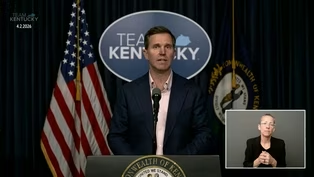
Governor Responds to Plans for McConnell Statue
Video has Closed Captions
Clip: S4 Ep357 | 1m 21s | Governor Beshear reacts to plans to put a statue of Senator Mitch McConnell in Rotunda. (1m 21s)
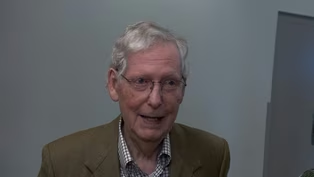
U.S. Senator McConnell's Advice to His Successor
Video has Closed Captions
Clip: S4 Ep357 | 2m 31s | Senator Mitch McConnell asked his advice for his successor when it comes to rural issues. (2m 31s)
Providing Support for PBS.org
Learn Moreabout PBS online sponsorship New Episode
- News and Public Affairs

Top journalists deliver compelling original analysis of the hour's headlines.
 New Episode
- News and Public Affairs

Today's top journalists discuss Washington's current political events and public affairs.
 New Episode
 New Episode
 New Episode
 New Episode
 New Episode
 New Episode
 New Episode
 New Episode
 New Episode
Support for PBS provided by:
Kentucky Edition is a local public television program presented by KET