
Reporter's Notebook
Clip: Season 4 Episode 332 | 7m 41sVideo has Closed Captions
Karolina Buczek of WLEX discusses education bills before the state legislature.
Karolina Buczek talks with Renee Shaw about education bills before the legislature, including the debate over a bill that creates a tax credit scholarship program.
Problems playing video? | Closed Captioning Feedback
Problems playing video? | Closed Captioning Feedback
Kentucky Edition is a local public television program presented by KET
Reporter's Notebook
Clip: Season 4 Episode 332 | 7m 41sVideo has Closed Captions
Karolina Buczek talks with Renee Shaw about education bills before the legislature, including the debate over a bill that creates a tax credit scholarship program.
Problems playing video? | Closed Captioning Feedback
How to Watch Kentucky Edition
Kentucky Edition is available to stream on pbs.org and the free PBS App, available on iPhone, Apple TV, Android TV, Android smartphones, Amazon Fire TV, Amazon Fire Tablet, Roku, Samsung Smart TV, and Vizio.
Providing Support for PBS.org
Learn Moreabout PBS online sponsorshipTime now for our reporter's notebook, where we're going to digest some of the major developments of week eight of the Kentucky General Assembly and regular session.
And we're so glad to have with us Karolina Burak, who was the politics and Frankfort reporter for Lex 18 here in Lexington, KY.
What a week, What a week.
Yeah.
I mean, when you last you were on, we were talking about how tempered the measures, the tempered the pace seem to be for this session, but things have really ramped up to high gear this week, has it not?
Yes, I think I told you I would be regretting my words, and I'm sure I will be eating my words and wishing for a slow week very soon.
And I definitely am.
I mean, things just picked up, it seems like out of nowhere and they are racing towards that finish line.
Yeah, the big item of this week the budget.
So that finally House Bill 500 and a couple of other bills related have moved through.
But the executive branch budget is what gets the most attention.
Tell us how you've been covering this, the maintenance of it and where where the conversation now goes.
Absolutely.
For the longest time, the conversation was like, where is the budget?
Right?
Where is it?
Well, now we have it.
The House passed its version yesterday.
So that's House Bill 500.
And the budget chairman describes it as a restrained budget.
He says this is about fulfilling needs, not wants.
But critics are looking at it and saying is it really fulfilling Kentucky's needs because they're skeptical that it is.
So I think that's kind of the battle right now.
House Republicans are saying this is enough.
This sets up Kentucky on a good path.
And, of course, Democrats and other critics are looking at this and saying this isn't really going to do much to help regular Kentuckians.
And wonder, you know, that's that's exactly what we heard a lot of.
And Democrats also bemoaning the fact that there's no universal pre-K funding, things that weren't probably going to go anywhere anyway.
But there's still some not completely satisfied with some of the K through 12 funding when it comes to transportation and other things.
So and Chairman Peachtree, who is the budget panel chairman, has said, you know, it's got miles to go before it sleeps like this is this is the first step and then it goes still goes to the Senate and then it goes to a conference situation.
So there's a lot of negotiating yet to be done.
He said what are you hearing particularly them from the education community or others who feel like they got gypped this time around?
Absolutely.
You're absolutely right.
This budget is going to change quite a few times before we get the final product.
But when it comes to education, I mean, education is always a hot button issue when it comes to the budget.
And this time around, what we saw come out of the house.
They definitely increase that basic formula so that per pupil funding that Kentucky schools receive, however, critics are looking at it and saying, listen, Kentucky funding has not even kept up with inflation over the years.
And one thing that they did not do is that they did not increase any funding for transportation, which was already not fully funded to begin with in Kentucky.
So education supporters and critics of this budget are looking at it saying, is this enough?
It doesn't seem like an increase at all.
That's the way they're looking at it.
But of course, people like the budget chairman are saying, you know, this, this is a good step.
We increased education funding, and House Republicans have said that this is a major priority for them, that they're focused on increasing education funding.
I mean, did they do it?
Yes.
Has it kept up with inflation?
Depends on who you speak, what you ask.
Right?
Well, an education, as you've just alluded to, has been the hallmark of this session so far.
A lot of education measures have gotten traction.
You know, we've had the House bill, one that was approved today.
You know, that's going now to the governor's desk.
TJ Roberts, Kim Mosier, and the speaker, all sponsors of that measure that takes the federal tax credit up to $1,700 a year for those who contribute to scholarship granting organizations.
And many people have tried to conflate this with Kentuckians overwhelming rejection of constitutional amendment number two a couple of years ago, because it also would have allowed for, public dollars to go to nonpublic schools.
So these are two different things, right?
They are two different things.
But the Republicans in the General Assembly, they know right now they have an image issue when it comes to tax credits, scholarship tax credits, however you want to word it.
People here in Kentucky, especially public education supporters, like they're there.
Their radar just starts firing whenever they hear stuff like this because they're worried.
They have seen the attempts that the General Assembly has made at state programs, and those programs have failed.
One way or another through the court system or they have been voted down by voters.
However, like you said, this is a federal program.
So this is different.
This program already exists.
It was created.
It was established by President Donald Trump's one big, beautiful bill.
So Kentucky Republicans are looking at it like we're leaving money on the table if we don't opt into this program.
So that's kind of where the fight is.
And there there were a lot of lawmakers, too, that expressed confusion because they said, well, of course I want to do more for Kentucky students, and I don't want to leave this funding on the table, but they're a little skeptical.
They're like, are you sure that this isn't going to hurt public schools?
So that's kind of where we are.
Well, and House Democrat Tina Bowser, who was a public educator in Jefferson County who supported the bill, unlike some of her other Democratic colleagues, said that she looks at it as an opportunity for public schools to start their own, scholarship granting organizations or those who are public education advocates.
That way, it would go to things like fees and other types of activities that that people have to pay for.
So there could be a different way to reframe it for Democrats to become more on board.
Absolutely.
And this is something that the representative behind the bill, Kim, she has really been highlighting this week.
She's been saying, listen, this is an opportunity not just for private schools, but also for public schools.
Everyone has an opportunity to create these scholarship granting organizations, and then you can use that money pretty creatively.
It does have to be used for educational reasons.
So tuition, transportation.
But she's like, we can get creative with how we use this money.
And if people are saying public schools are lacking in funds, this could be a great way to influx their schools with some money.
Yeah.
So what are you looking for in the next, 20 something odd days before they wrap up April 15th, other than the budget?
Oh, boy.
I mean, there's a lot.
There's a lot, but this is really an education legislation and that's what it has turned it into.
So that's what we're looking into.
There are a lot of bills floating out there also about student aggression right in classrooms and stuff.
So I'm looking to see where those go because there's some there's some debate on this.
Some people are looking at it like, do we do we refer our students to the court system or expel them from schools?
Is that really going to solve the problem?
But then others are looking at it like our teachers cannot be scared to go to work every single day.
And the Kentucky Department of Education has released some data that there have been 25,000 incidents of assaults on teachers since 2021.
So there is a problem in Kentucky.
The issue is how is the legislature going to deal with it?
That's a big issue that I'm looking at.
Yeah, I know you're looking a lot of things and a lot of miles to go before you sleep too.
So thank you, Carolina Tech, for being on the case and reporting from Frankfort.
We appreciate your time today.
Thank you.

Co-pays and Work Requirements Part of Proposed Medicaid Bill
Video has Closed Captions
Clip: S4 Ep332 | 3m 9s | Lawmaker says House Bill 2 aligns with federal Medicaid requirements. (3m 9s)
Video has Closed Captions
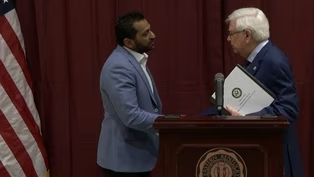
Clip: S4 Ep332 | 1m 40s | FBI Director Kash Patel attends law enforcement event in Manchester. (1m 40s)
Tax Credit Scholarship Bill Advances
Video has Closed Captions
Clip: S4 Ep332 | 3m 16s | Lawmakers advance a bill to create a tax credit scholarship program. (3m 16s)
Providing Support for PBS.org
Learn Moreabout PBS online sponsorship
- News and Public Affairs

Top journalists deliver compelling original analysis of the hour's headlines.

- News and Public Affairs

FRONTLINE is investigative journalism that questions, explains and changes our world.












Support for PBS provided by:
Kentucky Edition is a local public television program presented by KET