Utah Insight
Reproductive Rights
Season 4 Episode 6 | 26m 46sVideo has Closed Captions
With reproductive rights being questioned, how are Utah communities being affected?
Sexual and reproductive health is related to multiple human rights, including the right to life, the right to be free from torture, the right to health, the right to privacy, the prohibition of discrimination, and more. How will continued abortion banning legislation affect Utah communities and the rights we hold? Join us as we sit with both sides of the debate to discuss reproductive rights.
Problems playing video? | Closed Captioning Feedback
Problems playing video? | Closed Captioning Feedback
Utah Insight is a local public television program presented by PBS Utah
Utah Insight
Reproductive Rights
Season 4 Episode 6 | 26m 46sVideo has Closed Captions
Sexual and reproductive health is related to multiple human rights, including the right to life, the right to be free from torture, the right to health, the right to privacy, the prohibition of discrimination, and more. How will continued abortion banning legislation affect Utah communities and the rights we hold? Join us as we sit with both sides of the debate to discuss reproductive rights.
Problems playing video? | Closed Captioning Feedback
How to Watch Utah Insight
Utah Insight is available to stream on pbs.org and the free PBS App, available on iPhone, Apple TV, Android TV, Android smartphones, Amazon Fire TV, Amazon Fire Tablet, Roku, Samsung Smart TV, and Vizio.
All Episodes Now Streaming
Hosted by Jason Perry, each week’s guests feature Utah’s top journalists, lawmakers and policy experts.Providing Support for PBS.org
Learn Moreabout PBS online sponsorship(gentle music) - [Announcer] Funding for Utah Insight is made possible by viewers like you.
Thank you.
- Coming up on Utah Insight, reproductive healthcare.
- It angers me that we're still having to have this conversation in 2023.
- A fundamental right or a contentious issue?
The debate on abortion and access to healthcare continues to stir up controversy.
- We've gotten to a place where it seems like the choices are no abortions ever or no restrictions ever.
- We explore both sides of the issue and the challenges women face in accessing reproductive healthcare.
(gentle music) Welcome to Utah Insight, I'm Raeann Christensen.
Tonight we explore the ongoing conversations surrounding reproductive healthcare rights and unborn children's rights in Utah.
Where abortion stands in the state right now, abortion remains legal up to 18 weeks of pregnancy, and is still accessible at licensed clinics in the state.
But this could change based on outcomes of numerous pending lawsuits challenging abortion restrictions here in Utah.
Joining us in the studio tonight to discuss this issue we have Mary Taylor, president of Pro-Life Utah, Emily Anderson Stern state watch reporter for the Salt Lake Tribune.
She has been covering this topic very extensively.
And Dr. Misha Pangasa, a board certified OBGYN who provides abortion and family planning services to patients in Utah.
And I wanna thank you all for being here.
We do want a note of clarity for our viewers.
We did invite Planned Parenthood of Utah to join us for this panel, but they did decline our invitation.
So onto the conversation, we heard just a minute ago, the governor say we've gotten to a place where it's either no abortions or no restrictions, and I wanna get your thoughts on that.
Mary, do you wanna start us off?
- Oh sure, so if you believe that the baby, the fetus, the zygote is a human being, there is no middle ground, there is no option.
You're either destroying that life or protecting that life, and there's no middle ground.
So it's easy for me to see how we've got here.
Now, I will say that I have been on the pro-choice side of the aisle.
I can also see how a person can come to, to those beliefs as well.
But the science pretty much is with us that life begins very, very early after conception.
And for that reason, I don't think there's a lot of negotiating.
- Okay, Dr. Pangasa.
- You know, I would disagree with the idea that the science is clear on this.
You know, I've seen thousands of patients in my career at this point, and I've spoken with thousands of individuals about their reproductive lives.
And you know, I understand that there are some religious viewpoints in which life begins at a certain point.
But what I know is that for every patient that I see, everybody has a little bit of a different moral, philosophical, religious idea about these things.
And so, you know, as a physician my job is to trust and respect my patients.
And that's why I think that at the end of the day, you know, there are still ethical and moral guardrails that physicians work within.
We've been trained for many, many years to do so.
And I think that these decisions belong in the hands of providers and their patients.
- Emily, can I respond to that?
- Oh sure, go ahead.
- I would refer you to Dr. Maureen Condic's white paper on when life begins.
She is a, she has been doing research on this for a long time.
She's also on the National Medical Board.
And her position is that we do know when life begins.
What we debate is when we respect that life, when we protect that life.
- I don't know how much of a debate we wanna have, and I respect your, you know, referencing of one scientific investigation.
What I know is that, you know, having spent years in medical school and training and focusing on this issue, we have over 75 medical organizations including the American College of Obstetrics and Gynecology, and the American Medical Association, who say that abortion restrictions harm the health of our communities.
- Okay.
And Emily, do you want to add to any of this?
I know you've been reporting on this extensively, so you do have to cover both sides.
- Yeah, and what I will say to the governor's point is, you know, as you see debates about abortion restrictions at the Capitol, you'll see folks who are coming and saying, hey, these restrictions aren't going far enough.
But also what the governor, when he was speaking at that time, he was referencing, he was saying that, he was talking about an abortion clinic ban that recently passed the legislature and is currently blocked in court.
And was saying that as part of that bill, it's kind of a negotiation to allow for the few exceptions that are included in trigger ban for abortion.
That was a compromise to allow some of those abortions to go forward.
But a lot of folks will come and talk about these restrictions and say that any restriction does impact people who are in certain circumstances.
So, you know, there are a lot folks coming from both sides when we discuss these restrictions.
- Dr. Pangasa, I wanna talk about how many Utah women are getting abortions and why.
- You know, I think, to be honest with you, I think the number is a little bit irrelevant, because again, I come at this from the perspective of a physician who sees individual people.
And I just, I wanna touch on a little bit of what was just said, that the reality is, you know, the laws in Utah have tried to kind of carve out exceptions that there are certain reasons that are okay for people to have abortions.
And as a provider, I often have to navigate, is the person coming to me asking or seeking for an abortion meeting that criteria?
And I have to determine is your pregnancy dangerous enough?
Is your life complicated enough?
Is this abnormality in the fetus complicated enough?
And when the answer is no, to one individual person I have to say, you are not enough.
You do not deserve care here.
The state has decided that you are not enough.
You as a human being and a person are not enough.
And so, you know, I think people have abortions for a variety of reasons in Utah and across the country and the people of our community should be respected.
- Can we answer that question?
- Absolutely.
- Utah, typically by vital statistics records, has about 3000 abortions in the state.
Those go up and those go down.
The main reason given by women self-reported is for financial considerations.
And that's where Pro-Life Utah steps in with financial assistance, with helping her get connected with other resources around the, around the community.
And I would just say, as a woman who's, who abortion has impacted me in a very dramatic way, I would much rather offer that woman help to solve those particular problems than send her away with problems that she has no idea are coming and often will be with her for the rest of her life.
- May I respond really quickly?
I just wanna say that I absolutely, completely support the idea of providing financial assistance to would be mothers.
You know, the research in the past has actually shown that most people who seek abortions cite at least four reasons with financial concerns often being one of them.
I still believe that that person should have the ultimate decision as to whether or not to proceed with that pregnancy.
But I think, and as a physician I always, when people are trying to decide what to do, offer them resources, offer them whatever financial support or economic support or, you know, logistical support that they want or need to try to continue the pregnancy.
And people still make decisions about their own lives to have an abortion.
And again, I think that offering them resources is wonderful.
Making the decision for them is not.
- Sure, but that decision about their own life is also a decision about someone else's life.
- We did have a wide variety of opinions on this topic.
So we asked you on social media, how will legislation restricting abortion access affect the rights that we have, we hold?
And how will these laws impact Utah communities?
Brian Rogers says sadly this is about the removal of personal agency.
Kathy McGee says in part, and unless you live with the uterus and ovaries, you have no business telling those of us who do live with these parts what we can and cannot do.
We did have a lot of comments bringing up bodily autonomy for women.
Dr. Pangasa, what are your thoughts on that?
- Absolutely.
You know, I again, wholeheartedly understand and respect that there are religious views and philosophical views that view the fetus with a high amount of moral regard.
And I, you know, at the end of the day, the question to me is not whether a fetus is a person, it's whether the person sitting in front of me is, and I think if that person doesn't have the ability to, to make decisions about their own body, then how can they be considered a free human?
- And I would agree with you 100%, except for you're only taking half of the equation into account.
I believe in bodily autonomy.
I believe that women should make their own choices, with all my heart and soul I believe that.
But we're also making a decision for another human being.
- We did find in research telling us that many women seeking abortions already have children.
Mary, I would like to get your thoughts on that.
- That women who are having abortions already, yes.
You know, women with children often find themselves in the very same kind of circumstances that a woman without children will find herself.
Again, our approach is to sit down with her and talk about those problems, find a solution for those problems.
And like I said, as someone who knows the impact of abortion on a woman, we don't wanna send her out the door to set herself up for even more problems and more heartache.
- You know, I just wanna say that there's actually been really extensive well done research in the scientific literature that shows that, you know, 98% of people who have abortions even up to five years do not regret their decisions and do not have worse physical health or mental health.
And while again, I absolutely support the idea of providing resources and trying to talk people into, about what solutions they could have, the reality is that we live in a country that has one of the highest maternal mortality rates in the developed world.
Pregnancy, regardless of the solutions that you offer, is 15 times more likely to result in death, let alone, you know, significant morbidity than having an abortion early in pregnancy.
And like you said, a lot of the people, the majority of people who come seeking abortions have children already.
They're thinking about the children that they have at home.
They're thinking about how to provide the best life for them and how to be healthy and create a safe, sustainable community for their children.
- Can I just talk about the post-abortive women for a minute?
Because we have a post-abortive support healing group in our organization.
I work with women who are post-abortive.
I am post-abortive.
Oftentimes that regret and that heartache and the trauma that comes with that doesn't come out for as much as a decade or more.
I just don't believe that it's as harmless as you're saying.
- Emily, do you think the state has the resources, we're seeing states across the country that are getting very restrictive.
Do you think we have the resources to help these women if we do get to that restrictive state to support more children?
- That's a big question right?
You know, there's limits to what's available as far as healthcare coverage.
There's limits as to what's available as far as other social services.
Something I will say that, you know, even impacts reproductive care in general is that Utah has an ongoing healthcare provider shortage, and that impacts the entire state.
The majority of the state is classified as either having a population based healthcare provider shortage or a geographic based healthcare provider shortage.
And so that is one issue that does need to be addressed.
You know, no matter what happens with, with abortion policy in the state, it's, you know, you see that really impacting the access that people do have to reproductive care and making these decisions.
You know the Planned Parenthood in Logan, which is the only abortion clinic outside of Salt Lake County, closed in March because they couldn't find a healthcare provider to operate the clinic.
So there are a lot of questions as to whether, how people might be impacted if, if abortion isn't an option in Utah.
You know, as we've mentioned, about three to 4,000 people a year typically will have abortions in Utah.
And what does the state look like without, without that option is a big question.
- May I add too that you know, as a practicing OBGYN, abortion restrictions are not only implicated in the setting of abortion care facilities.
We deal with these issues on a regular basis when we see patients throughout pregnancies, when we see patients with complicated pregnancies, and what we know, we have already seen this in our neighboring state of Idaho, that when physicians and providers are in fear of making the best decisions for their patients, it absolutely leads to an overwhelming amount of burnout and people leave.
We already have preliminary research from a lot of the trainees in Utah saying that they don't want to stay in a state where not only they are not trusted to provide the best care for their patients, but they're worried about their own reproductive lives.
And so I absolutely think that these restrictions are gonna cause access issues for not only just potentially an increased amount of children from abortion restrictions, but they're gonna impact people who've never even thought about abortion.
Because if you don't have OBGYNs in your community, you don't get good care.
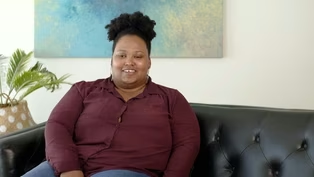
- The Utah Black Birth Workers Collective is an organization centered around creating a safe community for black parents who live in a state where they can often feel isolated.
Utah Insights' Liz Adeola spoke to one of the co-founders who opened up about her personal journey of feeling alone while making some of the toughest medical decisions of her life.
- [Liz Adeola] When you sit down for a conversation with Ashley Finley, wild uncontrollable laughter abound.
- It was like, I feel like it was like the Twilight Zone.
- [Liz Adeola] You'd never guess it from her demeanor, but the conversation we're having is about matters of life and death.
- I have a hard time like naming that as like oh, I had an abortion.
And not only was it an abortion, it was like a lifesaving abortion.
- [Liz Adeola] At a time when Ashley didn't even know she was pregnant.
- Like drove myself to the ER, like from Planned Parenthood.
- [Liz Adeola] Doctors discovered that she was suffering from an ectopic pregnancy.
- Essentially, the embryo or fetus doesn't fully make it to the ovaries, and it's stuck in your fallopian tube.
The danger is if that you don't catch it in time, what ends up happening is it bursts your fallopian tubes.
After the rupture, it can cause death.
- [Liz Adeola] But Ashley lived through this painful experience twice.
- Yeah, so I guess thinking about it is like, wow, I'm still dealing with it, and it'd be better for me not to think of the fact that I'm still dealing with it.
- [Liz Adeola] But for her, the new battle over abortion rights opens old wounds.
- They should be thinking about that situation.
And every other situation where a woman or a person who can have a baby says I don't want this.
This isn't the right choice for me.
It upsets me, it saddens me, and it angers me that we're still having to have this conversation in 2023.
- [Liz Adeola] Fueled by that lingering feeling of loneliness and despair when she sought medical help for her condition, and alarmed by black maternal mortality rates, Ashley created Sacred Sister Doula.
- So I take it really seriously to have clients who look at me and say, I need to have my baby in the hospital because of whatever diagnoses or maybe complications with the pregnancy.
And then like look at me and just say like, you know, just don't let me die.
You know, I hear that all of the time, specifically from black women, don't let me die.
Don't let them kill me.
- [Liz Adeola] In fact, hundreds die each year from pregnancy related complications.
With the CDC uncovering that over 80% of pregnancy related deaths are preventable, yet the risk of death is three times higher for black women than white women.
- And I think it's really important for like the specific demographics that I work with, which are largely black and indigenous people of color, to have someone there in that way, but also to have someone there to advocate for their choices and for their autonomy.
- [Liz Adeola] Which Ashley says goes beyond matters of life and death, to touch upon destiny.
- You know, there's a simple but powerful statement that I love.
It says black people are in the future.
And look, I'm like already gonna get like teary eyed thinking about it, but we are in the future and work like this is so important.
I want to see those babies not just surviving, but I want to see them thriving and blossoming and living in a world that sees them and loves them and says, yeah like, it may have been really terrible in the past, you know, but we're healing and we're sorry.
And it's different now.
- You heard Ashley say, some of her clients say, don't let them kill me.
And that's shocking to say the least.
Dr. Pangasa, what do you think is behind the numbers of, and what do you think we do to change the statistics for black women?
- You know, unfortunately it's not shocking to me.
You know, I have now practiced in four different states in the country, including Utah, and I've had black women come to their first prenatal appointment with me and saying, you know, I desperately wanna have a child, but I am terrified of what's gonna happen during this pregnancy.
And it's hard to reassure people because the realities are absolutely there.
That the rate of maternal mortality for black people is about three times as high as that for non-black.
And, you know, there is a huge multifactorial issue.
There are access issues when we have less providers in communities of color.
There are absolutely institutional and systemic racism issues in which the voices of black people have not been heard.
And you know, the Black Birth Workers Collective is an amazing organization that helps advocate for their voices.
You know, there is not gonna be a one size fits all answer to this, but I think maintaining access of skilled providers in all places possible, making sure that we have the voices of black people represented in these decisions, and continuing to work towards, you know, not just access, but making sure that, sorry, I'm gonna just reference the reproductive justice framework, which is saying really supporting the idea that people can decide if to become parents, when to become parents, and to have the opportunity to raise their children in safe and sustainable communities.
I think that's what we all need to be working towards.
- It was also mentioned 80% of pregnancy related deaths are preventable.
Another staggering statistic.
Mary, how do you think that we change this?
- Yes.
Well first of all, I'd like to say I am just thrilled with what Emily's doing, that's fantastic.
Second of all I would like to say that as by state statute, an ectopic pregnancy is not an abortion.
I don't think any, any pro-life person considers that an abortion.
But as far as the 80% go, I think now this latest study drills down on why that is the case.
And I think that's where we find the answers.
The alarm has been being sounded for a long time.
Back in 2020, ACOG released a initiative called, I think it was Redesigning Prenatal Care or something like that.
And they encouraged doctors to sit down with their patients at the beginning of a pregnancy and line out a plan, line out a plan based on family history, health history, social needs, and I love that approach.
That is what we do at Pro-Life Utah.
We sit down and design a plan because we know that no woman's needs are, no two women's needs are ever going to be the same.
And that gives the pregnant woman extra tools.
She knows what her risks are, she has management tools.
And I think you'll see that number come down if that program is implemented.
- Sorry, I absolutely agree that that is something that anybody who cares about this issue is implementing in their offices.
I don't think that that's gonna be a solution to the black maternal mortality crisis in the United States.
There are, the work that Ashley is doing and the work that, you know, so many other people are doing is really multifactorial at addressing the roots of racism in our medical system.
And those things are gonna be critically important at a much wider scale than individual patient visits to make sure that people have access to those visits, to make sure that they have the resources to actually follow up on physician recommendations, and that their voices are actually heard throughout their medical care.
- As newer abortion restriction laws are put into place, new lawsuits have been filed by Planned Parenthood of Utah and the ACLU.
Currently, there's a lawsuit over Utah's 2020 ban after Roe v. Wade was overturned, blocking a trigger ban on abortion.
And in May of this year, a new law requiring abortions to be done in a hospital setting was also delayed in its implementation because of another lawsuit.
Emily, can you talk about your reporting and these lawsuits and how that's going for you?
- Yeah, so the next step in these lawsuits is there's a hearing scheduled for August 8th where the two parties, the State and Planned Parenthood Association of Utah will come in front of the Supreme Court to talk about whether a block on the abortion trigger ban should stay in place.
That won't decide the lawsuit or what abortion policy will be in Utah, but it will decide what happens in the coming months as far as abortion access in Utah.
- I do wanna give you each about 30 seconds for final thoughts as we wrap up here.
Mary, would you like to go first?
- Yep, yeah.
So unplanned pregnancies have been a thing since the dawn of time, right?
And I think we're all on the same page that we want to see that problem solved.
I don't think you can solve the problem without taking the baby into account.
And I'm gonna say something that's a little bit controversial here, but humankind also has another tendency that has been with us since the dawn of time.
And that is to target a group of individuals based on race, religion, birth status, and dehumanize those individuals, and then deprive them of their rights.
And an unborn child has the fundamental right to life.
- Dr. Pangasa?
- You know, I think at the end of the day, every single person deserves access to the full spectrum of reproductive healthcare within their communities.
They deserve to access abortion care as well as prenatal care, postpartum care, like I said, the full spectrum of reproductive health care without fear of judgment, while feeling respected and not being shamed by the decisions that they're making.
- Emily?
- This is an issue that impacts everyone.
As we watch what happens to policy going forward, you know, Utah's statistics show that people who seek abortions come from all walks of life.
There are people who are married, who have never been married, who are divorced, separated, widowed, and there are people of all educational attainment levels who seek abortions in the state.
And so, as you know, this policy is debated, talked about, this is something that really does impact every Utahan in some way or another.
- Okay, thank you so much for being here.
This is definitely a topic that stirs up a lot of emotion on both sides, so we thank you for sharing your thoughts.
We have more re resources online for anyone who may want them.
You can go to the Utah Insight page on PBSUtah.org.
There's a list of links along with this episode.
And next time on Utah Insight, we're gonna talk about digital nomads, disrupting the economy, or is it the way forward?
Tune in as we uncover the truth behind the impact of the digital nomad lifestyle.
We wanna hear from you.
Share your thoughts using the methods you see on your screen.
Social media, email, or give us a call.
Thank you so much for watching Utah Insight, and we'll see you back here next week.
(gentle music)
Preview: S4 Ep6 | 30s | With reproductive rights being questioned, how are Utah communities being affected? (30s)
Utah Black Birth Workers Collective
Video has Closed Captions
Clip: S4 Ep6 | 3m 44s | Learn how a woman's near-death experience shaped her outlook on reproductive healthcare. (3m 44s)
Providing Support for PBS.org
Learn Moreabout PBS online sponsorship
- News and Public Affairs

Top journalists deliver compelling original analysis of the hour's headlines.

- News and Public Affairs

FRONTLINE is investigative journalism that questions, explains and changes our world.












Support for PBS provided by:
Utah Insight is a local public television program presented by PBS Utah