
Republican candidates for Governor, Covid-19, and More
12/17/2021 | 26m 46sVideo has Closed Captions
Discussion on Republican candidates for Governor, Covid-19, and More
Host Hannah Meisel (NPR Illinois) and guests Dave Dahl (WTAX) and John Jackson (Paul Simon Public Policy Institute) discuss Republican candidates for Governor, Covid-19, and more.
Problems playing video? | Closed Captioning Feedback
Problems playing video? | Closed Captioning Feedback
CapitolView is a local public television program presented by WSIU
CapitolView is a production of WSIU Public Broadcasting.
Republican candidates for Governor, Covid-19, and More
12/17/2021 | 26m 46sVideo has Closed Captions
Host Hannah Meisel (NPR Illinois) and guests Dave Dahl (WTAX) and John Jackson (Paul Simon Public Policy Institute) discuss Republican candidates for Governor, Covid-19, and more.
Problems playing video? | Closed Captioning Feedback
How to Watch CapitolView
CapitolView is available to stream on pbs.org and the free PBS App, available on iPhone, Apple TV, Android TV, Android smartphones, Amazon Fire TV, Amazon Fire Tablet, Roku, Samsung Smart TV, and Vizio.
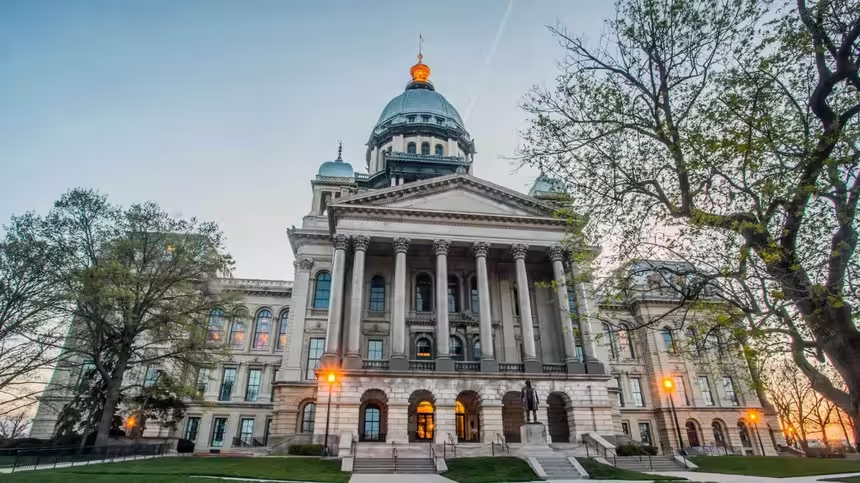
CapitolView
CapitolView is a weekly discussion of politics and government inside the Capitol, and around the state, with the Statehouse press corps. CapitolView is a production of WSIU Public Broadcasting.Providing Support for PBS.org
Learn Moreabout PBS online sponsorship(lively dramatic music) - Welcome to Capitol View, where we discuss the latest in state government and politics.
I'm Hannah Meisel with NPR Illinois.
Joining us this week is Dave Dahl of Springfield radio station, WTAX.
Thanks for being here, Dave.
(Dave laughs) - You're welcome, and thank you, Hannah.
- And also here is John Jackson, visiting Professor of Political Science at Southern Illinois University's Paul Simon Public Policy Institute.
Glad you're here, John.
- Thank you.
- This week we had- the first of the declared Republican candidates for Governor announced a running mate.
Dave, tell us a little bit about Stephanie Trussell.
Who is she?
- Well, she is a black woman.
She has been a radio talk show host in Chicago on WLS, for lack of a better term, a conservative talk station.
And there may be a bit of a backfire on this because in Ms. Trussell's past, oh, that social media, you can't get away from those footprints.
She came out as a never Trumper.
And so she's having to backpedal from that, and the political watchers are wondering how badly this will hurt Darren Bailey, if any.
He's the candidate who's a Republican that we've heard the most about probably, among the four.
And of course, he's a sitting lawmaker as well, which makes him unique among the four.
So it might be too early to tell if this is a damaging pick, who votes based on the Lieutenant Governor or Vice-President pick.
So I think you need to keep that in mind as well.
- Well, I mean, I would pause at 2008 when John McCain picked...
I'm forgetting her name.
- Palin, Governor Palin.
- Yes, Sarah Palin.
And there were a lot of statues in that campaign.
Obviously Barack Obama being this new force on the political scene, a lot of young liberals were really excited about him, and he also had the energy to unite a lot of rust belt country too.
But a lot of folks would also say that Sarah Palin kind of sunk John McCain.
I mean, let me, so- - You think that he lost the election because of that?
- Well, I mean, I was going to ask John Jackson, the political science professor.
- What do you think, Professor?
- Let me first, let me first read a few of the unearthed tweets from Stephanie Trussell during 2016.
For example, in March of 2016, after Trump had already won the Illinois Republican primary, she said, "Trump is a despicable human being."
Another tweet said, from May of that year, "My skin crawls when pundits call Trump the leader of the GOP.
He doesn't represent my values.
#neverTrump, #never Hilary, #nowaycrazyBernie."
And she had also gone on a podcast and said, "Those Trump people," I mean, this was a long time ago, this was I think also in 2016.
She said, "Those Trump people, if they lose, they're the biggest crybabies and the whiners that the system is rigged.
But if the system is rigged in their favor, then they shut up and their quiet."
She had to issue a statement saying, "I voted for Trump in 2016, and I campaigned for him in 2020."
John, a thing like this, is this a big deal?
Or is this- how far did the purity tests go these days?
Is this going to hurt Darren Bailey?
- Well, I think this case just illustrates a larger truth, and that is, it's very difficult, particularly in Illinois, to go from having run a state rep campaign and being a state rep, and then more recently run and won a state Senate campaign, and being a state Senator for less than a year.
But stepping up to the statewide is a whole different ballgame.
It's like going from AA farm club to the majors overnight, and the Governor's race in this state is the major league.
Darren Bailey's got a following, he's created a lot of name in Springfield and in media circles for his views, mostly rabid anti COVID restrictions of any kind.
But he doesn't really have statewide organization, statewide name recognition, statewide following.
And it's really tough to make that jump.
You don't have to name a Lieutenant Governor candidate at this stage of the game.
He's got other things he needs to be doing and talking about.
So I think this just illustrates a fair level of inexperience and creating a problem he didn't necessarily need at this point.
- Sure.
And it's also on the campaign to have vetted her social media, that's kind of campaigning 101 in the modern era.
- [John] Right.
But also John, since Dave did bring it up, what is your take, if we can go back in time really quickly on whether Sarah Palin did sink John McCain in 2008.
- Well, she was a mixed bag.
She energized what we now call the base.
There's no doubt, and brought some excitement to the campaign.
But John McCain made his own mistakes, and as you were indicating, he was running against the phenom, a really talented candidate, and we all know the outcome of that one.
- Dave, what- In the years that you've been watching state government and politics, I mean, first of all, having a Governor and Lieutenant Governor run together is actually a fairly new phenomenon in the last decade because of some events that happened back in 2009, if you want to fill us in on that.
But I mean, what have you, in those cycles that have gone on since then, what have, gubernatorial candidates looked for in a running mate?
- Well, you want someone who's qualified to walk in the front door if heaven forbid happens.
You want someone who has got some experience, but also someone who complements the ticket.
I mean, you've got the people in office now.
You've got black Christian woman against a white Jewish man, and they ran as a team.
And you had Pat Quinn and Paul Vallas as the ticket, and that wasn't a very diverse ticket, was it?
And they wound up losing to Bruce Rauner, and the Latino, Evelyn Sanguinetti.
And what do I win for remembering that name?
So it's just like the president, vice-president.
You want the vice-president to have some positives that maybe the president or in this case, governor, does not have.
So I don't think it's all that hard.
And as I said earlier, I'm a little doubtful of how much it really moves voters one way or the other.
I think if you like Darren Bailey, if you liked him before he named Stephanie Trussell to the ticket, you probably like him today.
If you didn't like him before, you probably don't like him much more now.
- But I mean, could she make inroads in communities that- Darren Bailey, I mean, in a general election, if he were the nominee, he would have no chance of winning anyway, John.
I mean, would Stephanie energize maybe some areas of Chicago that have populations of more conservative, older, church-going, black communities?
- Well, they're not the people that vote in Republican primaries by and large, so I don't see that as a very viable reason for making that appointment.
It seems to me he's got limitations and problems that naming this person, or even any Lieutenant Governor candidate is going to solve those problems.
- True.
Moving on, but also in the realm of the Republican primary and Republican politics in Illinois in general, this morning, as we film, Thursday morning, there are some reports out there, Ken Griffin has already decided on a GOP candidate to contribute $300 million to, to oppose Pritzker in the gubernatorial race next year.
Not any of the declared candidates, leaving aside the fact that we don't know who that person is, or who it might be.
But, $300 million, unconfirmed number, huge though.
Governor Pritzker spent $171.5 million in the 2018 cycle, and that was mind boggling and obnoxious to anyone who watches TV, or listens to radio, or pretty much does anything involving consuming media.
John, I mean, could $300 million actually, could it defeat Pritzker?
Could that make a big difference?
Or is it just everyone upping the ante in years to come, and we're just gonna, everyone's gonna get turned off from politics.
- Well, it could make a difference, but it certainly depends on the candidate.
You've got to have a candidate who really is up for that task, who has some charisma, for example, who has experience as another possibility.
Since we don't know who that candidate is apparently, it's hard to say in the abstract.
Money can get your name ID, money can get you commercials that drive everybody crazy because there's so many of them and they go so many times, but money can't really do it alone.
It's also important who the candidate is, who he or she has for an image already, and for a record already.
And so I'm skeptical that that alone would beat the governor.
- I mean, look at Donald Trump in 2016.
He's had decades of name recognition, and he built an image for himself.
He didn't actually spend all that much on his campaign.
You just can't buy... opponents couldn't necessarily make up for decades of that kind of image building.
And also his penchant for saying truly whatever.
But Dave, Pritzker also, obviously he has deep pockets, he's gonna have no problems spending money next year, but also this week, his name was floated as a possible candidate for president in 2024.
What do we know about that?
- I'm sorry, you're speaking to me?
- Yes.
Oh, okay.
I asked him about that when I interviewed him at the beginning of the current reelection campaign, and he said, no, no, no, and that it came out in the New York Times, and he was on a list of, if Biden doesn't go for a second term, and again, no, no, no.
That's what you expect him to say.
What do you expect him to say?
Yeah, I'm going to run for the White House, I'm announcing right now during my reelection campaign for governor.
And that's what frustrates me a little bit.
These folks in Chicago or anywhere else, are you gonna run, are you gonna run?
Again, what's he supposed to say?
He's not gonna say he's running.
He's not going to say he's interested.
I think probably in '24 or '28, he should be looking at it, and as I put it to him in that interview, you don't get to be JB Pritzker without thinking of the long game, without having a long range plan.
So he's gotta be thinking about something, unless he wants to be governor for life.
Who wants that?
Not me.
- It was all right for big Jim Thompson, but I mean, that was another era.
But John, I mean, I also, I agree with Dave, I... much as I love our reporter colleagues in Chicago, I was also pretty frustrated listening to that conference the other day when he got berated with questions that... there are more important things going on.
But I mean, if you were to be looked at for governor in races profile in that way, could that benefit Illinois in any way?
- Well, this is way premature to have him even talk about it.
He's gonna try to stay as far away from it as possible, as Dave was indicating.
He's got to run and be reelected and have a second term.
So we're now talking 2028, and it's just too far out.
It was just one of those fun stories, but it doesn't amount to very much at this point.
- Fair enough.
Speaking of big Jim Thompson, switching gears finally, after many, many years of trying to sell the Thompson Center in Chicago, Governor JB Pritzker this week said, that there is a buyer.
If we roll back the time machine, ex-Governor, Rod Blagojevich, back in 2003, tried to sell the Thompson Center, or at least floated it, to balance Illinois' budget.
Bruce Rauner actually factored in the supposed profits from selling the Thompson Center into multiple of his proposed budgets, obviously never went anywhere.
The most that Bruce ever thought that we would fetch for the building was 300 million.
Turns out it's only going to be worth 70 million at sale, although the state will retain a 30% ownership.
But there are genuine viewers who are unfamiliar with the Thompson Center.
It is kind of... it's one of those things that's become a perfect metaphor for state government, proposed on both sides of the aisle.
It's this big, very interesting spaceship looking building, 1980's era.
And it hasn't really been maintained or updated since the 1980's, and it's become rundown, totally dilapidated, every time you go into a bathroom, I always say, oh, am I gonna get tetanus this time?
I don't know.
It's just a very unpleasant building, especially for those who have to work in it.
And it's been one of those, like I said, metaphor punching bag.
Dave, finally selling the Thompson Center.
Is this... are you surprised that this is, the day has actually come?
Maybe?
- It might be a credit to the Pritzker administration that he did something that the others were not able to do, that he has found a buyer at apparently the right price.
No one wanted it for 300 million, apparently.
No future governors and lawmakers.
Don't try to sell it again.
I mean, they sell that thing every year.
Now they're not going to be able to lean on that.
Some interesting ideas coming out in that conference from Mr. Raushke, and so what I also kind of wonder about, and I asked and did not get an answer, how much is the state paying to buy back that space?
It must be fairly important to the state to move back into the Thompson Center after they move out.
I mean, the thing is just a great glass, white elephant.
It's architecturally significant, but it is not energy efficient.
I said, they run the AC year round, it's glass and you can't see out of it apparently.
I don't think I've ever been in there, I've seen the outside of it.
But, another thing I thought was interesting that it's not going to be redeveloped by tearing down the building.
It's apparently going to be maybe a hotel, retail and the office.
And also the CTA station is going to remain there.
So I think it's an interesting story.
- After a two year gut rehab, it's gonna be mixed use development, and like you indicated, the state will have still have some office space.
I mean, it's hard to give up that central location in the heart of The Loop, 'cause you got City Hall right next door, the state also owns the Blandick Building across the street.
It's an important space, but yeah, it's a deeply unpleasant building.
(Hannah laughing) John, I mean, do you have any thoughts on this?
You've watched the building be sold and sold and sold many, many years over.
- Well, my only comment that could be added is, this is gonna be one more thing the Governor's gonna add to his list, making his case for why he's gotten things done and should be reelected.
- Sure.
Yeah.
I mean, you definitely have that easy thing to say, easy contrast between him and his predecessors.
But yeah, so... (Hannah sighs) I know we did speak about this last week, but COVID is of course, again on the rise in Illinois.
But I think Pritzker is...
Many months ago, I think he made the decision to...
He's not going to reissue any mitigation, I mean, unless something goes drastically off the rails.
Illinois is one of only seven states, California re-upped theirs again this week, but with a statewide mask mandate for indoor spaces.
But that's really the only thing that we have.
Dave, I mean, the governor has taken the task of saying, okay, well if local municipalities, local governments want to issue more mitigation, they're welcome to, but I'm not doing it.
I mean, is this his best play, is this his only play?
- I think it would behoove the governor to stop making predictions of when this is going away, because he's been wrong every step of the way, as have all of us.
You can't predict politics or sports, or when COVID is going to end.
I think you have to assume that we're gonna keep going through the Greek alphabet on more variants for years to come, and the shots and the masks are going to be in the nose, in our arms, on our faces indefinitely.
So, I think the governor does kind of leave himself open to say, down the road we're gonna do such and such.
I think this is another thing that a lot of people think is a big story that I'm not sure is that big.
The governor says he's not gonna do it, but local people can do it.
Okay.
And then a couple of weeks later, they corner the governor and it becomes the same story.
I think the governor has learned that it's hard to predict.
You can't say, well, next week we're gonna all do such and such and stay inside.
So, the governor is probably doing the best he can given what his priorities are right now, knowing that a lot of people still disagree with what he's doing.
- And John, I mean, we have seen the mask issue, vaccines, other things that go along with that, as this notion of lockdown that, I mean, that was a long time ago.
Obviously, and I don't mean to belittle what a lot of people and businesses went through, obviously, it was detrimental to a lot of the economy, and I totally understand that.
But I mean, do you think, John, that we have reached kind of the apex of this issue?
Do you think that the outrage could possibly be dialed up even further?
I mean, do you feel like this, the issue could start to lose steam, or is it just going to keep on building momentum until God knows what happens?
- Well, I think COVID is going to be the number one item in the campaign on both sides.
I think the governor's record's already there.
He's gonna run on his record, he's going to vigorously defend it.
I don't think it's going to change that much in the future, either way.
He's, going to make the case that he managed it as well as any other state, and that he did a good job.
His detractors are built in, a lot of them epitomized by Darren Bailey that we talked about earlier, are convinced that that's what can beat him because a lot of people were arrested and a lot of people were critical, and it's gonna be a plus and a minus for him.
I think it's the top issue, I think his fiscal management will probably be the second issue in the campaign, and most of that's not gonna change a great deal between now and next November.
- But outside of the context of the governor's race, I kind of mean more largely where we're going as a country where we're going, I mean... We've already seen polarization amp up in the last, I don't know, decade, well, I mean truly in the last few decades, but in the last decade, especially.
And of course COVID was even more gasoline on that fire.
Do you think that we are at max capacity of outrage, or do you think there's more outrage to be had?
- I'm not sure what you're saying there.
What, I missed... right at the end, what did you say about max capacity?
- I mean, is there, is there more outrage in the- - Oh, more outrage.
- Action that could be drawn out of this?
- Oh yeah, it's possible if things got really, really bad again, but it seems to me that if we go along as we've been going roughly in the same direction, and if this current variant doesn't have the kind of huge negative impact that the Delta variant did, then I think in midterm elections and in all elections, it's already sort of baked in on both sides.
- And, Dave, your thoughts on, I mean, you are very plugged into local politics and, I think it's not your obviously main beat, but you know more about what's happening with the mandated vaccine hikes for the Springfield local school board.
I mean, do you think that we have reached max outrage on this issue?
- No.
The sky is the limit.
I mean, minds aren't going to change, I think the tone of the school board here in Springfield is we've got to follow the state mandate, there's really no choice about that.
Still people are mad, and it's almost like they want the superintendent and school board to say, Governor, we're doing what we want.
That's not gonna happen.
- Yeah.
I mean, obviously we all want COVID to end as quickly as possible, but the reality is it's not.
So we'll see where it happens, but for now we are out of time on Capitol View.
I'd like to thank our guests, John Jackson, Dave Dahl.
I'm Hannah Meisel, and we'll see you after the New Year on Capitol View.
(lively dramatic music) (bright tones)

- News and Public Affairs

Top journalists deliver compelling original analysis of the hour's headlines.

- News and Public Affairs

FRONTLINE is investigative journalism that questions, explains and changes our world.












Support for PBS provided by:
CapitolView is a local public television program presented by WSIU
CapitolView is a production of WSIU Public Broadcasting.