
Republicans Solidify their Hold on Power in Florida
11/8/2024 | 26m 46sVideo has Closed Captions
President-elect Trump’s victory in Florida propelled by gains with Hispanic voters.
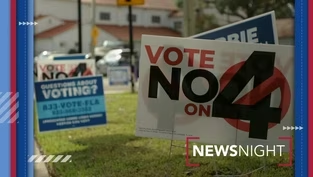
This week on NewsNight, a look at the outcome of the election in Florida as the GOP makes significant gains with Hispanic and Gen Z voters. Plus, proposed constitutional amendments on marijuana and abortion fail to gain enough support to pass.
Problems playing video? | Closed Captioning Feedback
Problems playing video? | Closed Captioning Feedback
NewsNight is a local public television program presented by WUCF
Republicans Solidify their Hold on Power in Florida
11/8/2024 | 26m 46sVideo has Closed Captions
This week on NewsNight, a look at the outcome of the election in Florida as the GOP makes significant gains with Hispanic and Gen Z voters. Plus, proposed constitutional amendments on marijuana and abortion fail to gain enough support to pass.
Problems playing video? | Closed Captioning Feedback
How to Watch NewsNight
NewsNight is available to stream on pbs.org and the free PBS App, available on iPhone, Apple TV, Android TV, Android smartphones, Amazon Fire TV, Amazon Fire Tablet, Roku, Samsung Smart TV, and Vizio.
Providing Support for PBS.org
Learn Moreabout PBS online sponsorship>>This week on NewsNight, Republicans solidif their hold on Florida politics.
>>Yeah, I voted for Trump.
I didn't vote for him last time.
>>I voted for Donald J. Trump.
>>A look at the outcom of key races and the failure of constitutional amendment on marijuana and abortion.
NewsNight starts now.
[MUSIC] Hello, I'm Steve Mort, welcome to NewsNight where we take an in-depth look at the top storie and issues in Central Florida and how they shap our community.
Tonigh we're delving into the results of the election here in Florida.
Tuesday night was another dominant performance for Republicans in what has become a reliably red state in recent cycles.
President elect Trump easily won here, as did U.S.
Senator Rick Scott.
The GOP keeps its grip on the legislature, and there were no surprises in the congressional delegation from central Florida heading to Washington.
But first, let's hear a few voices of voters at the polls on Tuesday in Seminole County gathered by UCF student journalists.
>>I don't think Donald Trump's fit to serve in office.
So it was a pretty easy decisio for me.
>>Yeah, I voted for Trump.
I, didn't vote for him last time in 2020, but, I think, I didn't like how the Democrat.
I didn't think it was a democratic process in how they chose Harris.
I didn't think it was fair.
I think they one day Biden stepped aside.
I think they should have let it go to the people.
>>I voted for Harris.
I did vote for Harris.
I mean, the discussions and the debates and having mature discussions about policies.
We've missed that these past ten years, and it's time to get back to that.
This isn't the reality show.
This is reality.
>>I voted for Donald J. Trump because of his stance on those two major issues, which is the immigratio and the cost of food and the and really because of the energy.
Energ affects everything in America.
And when you don't have the energy, it makes oil prices go up.
Well, after the dust had settled just a little bit.
I sat down on Wednesday morning with UCF political scientist Aubrey Jewett to analyze a big night for Republicans in Florida.
Clearly Florida is now a red state.
After the 2022 election and governor DeSantis' big victory by almost 20 points a lot of reporters are asking me, is Florida still a swing state?
And I said, maybe, maybe not.
We don't know.
It's just one election.
And so that just might be a one off.
But now when you see the size of the victory double digit victories for Trump and for Rick Scott, when you see the state legislature still ha a super majority of Republicans.
When you see that Republican voter registration now is 1 million voters greater than Democrats, when four years ago Democrats still had a lead?
You put all that together.
Florida is clearly a red state for the time being.
>>We'v asked the question on NewsNight several times about the role of Latino voters in Florida.
Presiden elect Trump won in Miami-Dade.
He won in Ocala.
Congressman Darren Soto held on to his seat.
But I wonder what the former and now president elect's performance in those heavil Hispanic parts of the state says about where that community i when it comes to its politics?
>>Absolutely.
And that's one of the big reasons why I think Florida is now a red state.
It's not the only reason but it's one of the big reasons that Hispanics have begun to really embrace the Republican Party here in Florida and nationally.
And you typically in Florida, you certainly have seen Cuban Americans have tended to be a little Republican, although the second and third and fourth generation Cuban seem like that.
For a while they were drifting towards Democrats, but no longer.
I mean, Miami-Dade is the perfect example.
It seems like a lifetime ago, but in 2016, they strongly went for Hillary Clinton.
Now the strongly went for Donald Trump.
And by double digits both times.
So it's been like a 30 point swing, 25 point swing.
>>That's not an accident, is it?
Because the Republicans and Donald Trump have gone after those communities, particularly Cuban and Venezuelans, very strongly during his first term and since.
>>Absolutely, it has been a very aggressive move on the part of Republicans charging the Democrats for Socialists, highlighting some of the social issues like LGBTQ or other things, where they know that Hispanics and particularly male Hispanics, tend to be a little more conservative.
And between the socialist on the economic side and then some of these social issues, they have been able to draw a number of those Hispanic voters, particularly young male Hispanics.
The exit polls have been showing mor so than young female Hispanics.
>>Let' talk about the state attorneys race in Orange and Osceola County.
Monique Worrell, who governor DeSantis had suspended, has won reelection, defeating Andrew Bain, who the governor had selected to replace her.
I wonder what you make of that and the fact that that only happens here, not in Hillsborough County, where Andrew Warren was defeated.
Kind of a mixed bag there.
>>It is.
But for Orange County it is still very democratic, despite the state movin Republican.
Orange County still has a ver large Democratic majority.
And in the in the at the end of the day, that is what carried Worrell across the finish line fairly comfortably.
In Hillsborough, they are actually now very evenly divided.
They used to be a little bit leaning Democratic, but now they're very evenly divided.
And they seem to have, you know, Trump seemed to hav a bit more coattails over there.
And that seemed to stop Andrew Warren.
He didn't lose by a big amount.
He was like 47%, but he didn't quite make it.
So I mean I think that's the main reason why Worrell was able to win and Warren wasn't it's just the counties are different, right.
One is a lot more Republican.
The other is a lot more Democratic.
>>What about the amendment?
Are you surprised about the failure of amendments three and four to get that 60% threshold on marijuana and abortion to pass, specifically because abortio rights did pass in other states?
>>I was not surprised.
I thought they still ha a chance to pass to get to 60%, but 60% is a much higher barrie than almost every other state.
It's like the vast majority of states only require 50%.
Maybe two other states require something like Colorado requires 55, but Florida requires 60.
And that's a lot.
That's a big hurdle.
And particularly when you again, you see that Republican registration is now a million more people.
And when you saw that the early voting there was 800,000 more Republicans turned out, that's when I really started t think, okay, I don't know that we're going to get to 60% on either of those amendments because there's so many Republicans turning out compared to Democrats.
And the other thing I think that really led to their defeat and not quite getting well, other than the obvious that you've got to get to 60%.
Was governor DeSantis' efforts to defeat those things.
I mean, he's spent full time for the past 3 or 4 weeks raising money and fighting against them, and even going so far as to sort of stretch the law, pushing up to the boundaries of the law and having the state agencies-- >>State resources-- >>Yes, using state resources to run ads that were basically campaign ads against these things.
Now, they weren' campaign ads in a legal sense, but anybody watching them would know that they're trying to defeat these amendments.
So without saying whether that's a good thing or a bad thing for democracy, I will say that governor DeSantis was very effective in leading the opposition and getting to the 41, 42, 43% "No."
>>Aubrey Jewett there from UCF.
You can find our full discussio at wucf.org/newsnight.
Well, let's bring in our pane now to break it all down.
Joining me in the studio this week Jeff Allen cover politics for Spectrum News 13.
Thanks for coming in Jeff.
>>Good to be here.
>>Good to see you.
Cheryn Stone, host of Engag on Central Florida Public Media.
Nice to see you Cheryn.
>>Thanks for having me.
>>And Skylar Swisher covers politics for the Orlando Sentinel Thanks for being here, Skylar.
>>Thanks.
>>Appreciate you guys coming in today.
Let's start with overall impressions of the night on Tuesday.
Jeff, what do you think in Florida?
>>Well, you know, I like, like, we heard from Aubrey Jewett out there, I think we see, Florida as a true red state now.
I mean, we're there.
You've had several electio cycles now to to prove that.
And I think you also saw here what you've seen across the countr where you had really a diverse electorate, you know, all different, you know, people came out for, you know, Trump, all different-- >>A very diverse coalition of people.
>>Diverse coalition.
And that's what I think you've seen in Florida with, the Hispanic vote, you know, in all other groups of Florida.
You know, I think that's that's why we got the result we did.
>>What do you guys think, Cheryn?
I mean, is this a solidification o Republican control in Florida?
>>I think it's pretty safe to say that the days are gone when Florida was looked at the big prize in the presidential race in the swing state back when-- >>Al the candidates coming through.
>>Yeah.
And Presiden Obama was able to take Florida.
I think that those day have passed.
>>Yeah What do you think, Skyler?
>>You know, I don't think there's any question that Florida is a red state and not only that, I mean, Democrats are losing ground in their traditiona strongholds.
I mean, you saw, Trump won Dade Count by more than ten points.
You know, Palm Beach County, which used to be a bastion of Democratic support, was about a tie.
Osceola County flipped, to Donald Trump, a very, Latino, county.
So I think, you know, you're seeing Democrats continuing to lose support and even their traditional strongholds in Florida.
>>Yeah.
>>One thing I would add to that as well is even if the Democrats were preparing to lose those offices, I thin they were still holding out hope on some of the amendments that they were backing.
And I'm sure talk about that later.
>>I mean, Democrats had hoped that those remarks at Madison Square Gardens Garden, disparaging remark about the island of Puerto Rico, might help them with Latino voters, and particularl that Puerto Rican constituency.
That didn't seem to happen on Election Day.
>>Yeah.
I mean, I think Latino voters in Florida reall helped Trump in these counties where Democrats had an edge in the prior election cycles.
And specifically that remark you were talking about, the comedian who was at a Trump rally and said something offensive about Puerto Rico.
There's a large Puert Rican community here in Osceola County and Trump actually took Osceola by 50%, 50.25% of the vote.
So he still wo I do want to point out, though, that Biden took that county i 56 with 56% of the vote in 2020.
So yes, there was a drop off.
Maybe it had an impact.
Trump still won.
>>Certainly shows that the swing to Trump over-- >>Yeah.
>>Over the last four years or so.
Let's talk about a couple of, different races.
We'll start with the U.S. Senate race, which you've been following very closely.
Jeff, what's been the reaction from state Democrats to Debbie Murcasel Powell's defeat you were at a party on Tuesday night?
What's the vibe?
>>Yes I was covering her campaign for about the last week and a half of her campaign, travelin throughout the state with her.
We had another colleague that was covering Rick Scott's, campaign.
And you know, I would say just there was definitely disappointment.
You know, she had kind of a positive attitude and a message that, hey, we're not going to give up, you know, in her in her concession speech and her remarks to her supporters there that night.
But, you know, I would say they have not really said a lot yet.
In fact, we reached out to, Democratic Chair Nikki Frie just the day after the election, and they weren't doing interviews yet at that point.
I'm sure they will hear shortly, but I think they're still in just, you know, kind of, evaluation mode, and taking a look at everything and taking a look at all the numbers, what happened and what they needed to do different because obviously they need to take steps differently, to move forward if they want to somehow reverse this trend.
>>And this has been a discussion that's been going on for the Democratic Party of Florida for some time.
I mean, how convincing a win do you think it was, Skyler, for, for Senator Scott, given how close his previous races have been in Florida?
>>Yeah.
I mean, for Senator Scott, this was a massive landslide.
I mean, let's look back to 2018.
That was like less than a percentage point.
I mean, i headed to an automatic, recount when he defeated the incumbent Democratic Senator Bill Nelson, his two governor governors, races were, lik less than one percentage point.
So to win by around 12, 13 percentage points, that's that's a huge victory and kind of a reflection once again of the general, move to the right in Florida.
>>Maybe some coattails, going on there with, with, now president elect Trump.
Jeff, the state attorney's race, this is interesting Monique Worrell of course, won in Orange and Osceola, as we just discussed with Aubrey Jewett, Andrew Warren lost in Hillsborough.
I mean, what do you make of Worrell's reelection and what might happen now given that the governor previously suspended her?
I'll ask you and then Cheryn.
>>Yeah, I think you you saw the the voice of the people.
Many people were saying that the governor was kind of taking that away from them when he suspended her because, you know, they elected her.
And, obviously Orange County is as Aubrey Jewett said, you know, obviously is still a very, Democratic, base of support.
So, she didn't win b as much as she did originally.
I think she won by about 67% in her original election, about 57% of this time, but still well above Andrew Bain, who was placed, in her place after she was suspended.
You know, and I think, it's we're gonna have to wait and see what happens.
The governor, I'm sure, will take any opportunity, I would imagine, to, look at her cases.
They'r going to be keeping a close eye.
He hasn't said anything yet at this point.
He would have to find some another specific reason to to for the for a suspension, but I don't think that would be unlikely.
What do you think?
>>Yeah, I'll be very interested to see that if he does do the same thing, because there's really nothing stopping him from stepping in and removing Monique Worrell again.
And replacing him with Bain.
>>No surprises really, in Central Florida's U.S. House races I think it's it's fair to say.
But a lot of interest in the state House, Republican incumbent district 45 Carolina Amnesty, who you guys at the Sentinel have covered, suffered an extremely narrow defeat.
Right.
That was made her legal woes.
And remind us of those if you can and then whether whether you think that might have cost her that election?
>>Yeah.
So, Carolina Amnesty was the only GOP, representative to, incumbent, to lose her seat.
And she's facing criminal charges there.
Forgery related charges.
And it has to do with, paperwork that was submitted, to the state, by her family's, private college.
Now, in terms of the effect, I mean, we talked to a political scientist who said, yeah it probably did have an effect.
I mean, any time you're running, you know, while indicted, it's kind of less than ideal.
The district was a little bit stacked against her.
It was kind of, You know, I think Biden did fairl well in that district in 2020, but, the person that we interviewed said that there were, you know, incumbents facing, you know, equally tough races and they held on to their seats.
So it does seem like the criminal charges probably, you know, played a factor in the decision of the voters there.
>>Running with legal troubles is difficult.
Unless, of course, you're called Donald Trump.
I mean, Republicans took back and this was really interesting one for me.
Talk about district 35 this time, Erika Booth, defeating Tom Keene.
That was a rematch.
The Democrats had pointed to that pickup right earlier in that seat as a sign of strength, maybe improving in Florida.
You guys have covered this race.
Is this a blow for Democrats?
>>So I'm I'm torn.
Yes and no.
Yes the Democrats flip the seat.
But that was just in January from a special election.
And he took the seat that Fred Hawkins had held.
He was a Republican.
And like you said, Democrat had invested so heavily in that battleground district, and they did it.
But that didn't carry over int the election that we just had.
So, yes, it's a significant blow for Dem in that the strategy didn't work in the long run.
But I guess you could make an argument that, no, it's not that significant because it's a very short lived seat they held.
He just took it in January.
>>What do you think, Jeff?
I mean, the symbolism there is pretty stark.
>>Yeah, I think because you had the general election, I think you might have also had more people coming out, obviously, for presidential elections.
I think that's when you see th most people coming out to vote.
And so I think, you know, whereas the special election you didn't have as many people and maybe you had more Democrats that were fired up, knew that that was happening and took part in that.
So I think, you know, you kind of got, just that general election crossover there down ballot.
And, you know, it's just it's a reversal of what they thought was progress.
They really saw that.
I mean, even nationally, Democrats were talking about that House seat in Florida, as a potential encouraging sign for Democrats.
And here we are.
You know, it's kind of a step back.
>>So many important races we can't possibly get to all of them tonight on the program.
We'll have more next week on commission races and charter amendments.
Meanwhile, be sure to joi the conversation on social media we're at WUCFTV, on Facebook and Instagram.
We're also on X, @NewsNightWUCF.
Okay, that was some keenly watched constitutional amendments on the ballot on Tuesday as well.
Amendments to make school boar races partizan, legalize recreational marijuana, enshrin abortion access and repeal public financing for statewide campaigns.
All fail to reach 60% needed for passage, but there will now be an annual inflation adjustment for property valuations and a constitutional right to fish and hunt.
So these were pretty highly anticipated, ballot initiatives.
Let's focus, first of all, Jeff, on amendments three and four, marijuana and abortion, respectively.
These were initiatives, as Aubrey Jewett mentioned, that the governor spent a lot of money and political capita on defeating during the course of the campaign.
Do you agree with him, Aubrey Jewett, that these were always going to be tough to get over the finish line?
>>I think they were, because that's 60%.
That is a huge threshold.
I mean, that's like what you see with the Senate, with the filibuster.
I mean, it's it's that's a huge threshold.
There's other states in th country, like Montana, where, an abortion protection amendment, passe because they did not have that, that high of a threshold So I think that's that's tough.
Anytime you need to reach that.
And I think, again, with the overwhelmingly larger number of registered Republicans in the state who we're also seeing DeSantis pushing against those both of those amendments I think that's where they just they were had too many headwinds there.
>>Very difficult for anybody to get elected with that, percentage of the vote.
I mean, Cheryn, Florida six week abortion ban now remains in place.
Your colleague, Joe Mario Pedersen has been following reactions this what are amendmen 4 backers saying they'll do now?
>>Well I'm thinking we had a reporter who was at a Democratic part for Anna Eskamani, Maxwell Frost get that little blue bubbl and they were celebrating.
But I remember Daniell Prieur reported.
She also said tha once it became clear what was going to happen with the abortion amendment, a group of people left and they were devastated.
That said, the ACLU, for example, they called the faile ballot measure a temporary loss.
I was seeing the National Women's Liberation chapter in Gainesville.
They are already planning meeting to like, regrou and reevaluate what's going on and getting to what Jeff was just talking about.
That 60 percentage, the yes on four campaign is pointing to the fact that 57% of people said yes on four, so they're calling on lawmakers to look at that and say, hey, the majority of people actually do want this, so you really should take that into consideration.
But it's a Republican stronghold.
So.
>>I mean, that's an interesting point, though, isn't it, Skyler, that that, you know, is it possible for us to say whether abortion rights is actually popular in Florida, despite the fact that it managed to fail?
>>I mean, amendment four got about as many voter Donald Trump did in Florida.
It got 57% of the vote.
If it Missouri passed their with 52% of the vote.
And I did put this question.
I talked to, a couple of GOP state senators this week in my reporting, and I asked them that very question.
Look, a majority of the people say they don't like the six week ban.
Are you all going to revisit it?
They said, probably not.
And their explanation was that they felt like, the voters, some of the voters weren't aware what they were voting on.
In their words, they were misled by the million and millions of dollars of ads that were spent, trying to get amendment four passed.
And they also made the point that look, we know we have our super majority if if the voters were upset with the job that we're doing in Tallahasse and the six week abortion ban, they didn't vote us out of office.
So... >>That's a good point-- >> would I would be very surprised if, the GOP super majority legislature would revisit the abortion issue, even with it getting 57% of the vote.
>>I mean, I think it's fair to say, isn't it, Jeff, that both sides on this abortion issue have kind of struggled to find their place and wa to where to take this argument going forward since the Supreme Court Dobbs decision.
>>Yeah, it's just it's simply not.
It's when you look a the kind of the biggest issue, and I think we saw from this election for most people was the economy or some level of that inflation, food prices, you know, housing prices.
And, you know, even though abortion is a big issue, it's just not number one for a lot of people who are who are at that ballot box.
>>We saw that reflected in the exit polls, for sure.
We'll be getting more reaction on the amendments for next week's program.
Meanwhile, for lots of data on the results of races around the state, a reminder to visit us online at wucf.org/newsnight.
America' first Gen Z congressman Maxwell Frost of Orlando won reelection on Tuesday night easily, but overall, Gen Z may have been a weak spot for Democrats and Vice President Kamala Harris.
The advantage for Harris among 18 to 29 year olds was just 13 points, as Donald Trump gained 6% among that group compared to 2020.
First, let's hear from some first tim Gen Z voters with their reaction to president elect Donald Trump's victory on Wednesday morning.
>>I think the results were, pretty exciting, especially with the amendments in Florida.
I found that most of them that I voted for, ended up either, not passing or passing based on the way I voted.
I found that his economi policies in the past have been a thing that I've looked to.
I remember, like most of my family has voted in the past pretty similarly.
And like, especially just like people I've known.
So I guess, like, I was raised in that sense, but then also my own opinions have played a part with that as well.
>>In terms of how he feels racially about like people of color, not just black people, but just people in color, people of color in general.
He's just a bad person, s I did not want to vote for him.
It wasn't necessarily like his policies.
His policies are not good either.
But he's a bad person, s I didn't want to vote for him.
>>Gen Z voters speaking to us on Wednesday morning.
Okay, Skyler, let's break this down.
That.
I mean, there's always been a hope, hasn't there, amongst the Democrats that that eventually demographics will will save the day.
You know, a younger diversifying country is going to be good for them along the lines of, you know, age and and sex and race and all of that.
What did we learn about the role of Gen Z in this election and how that might be wrong?
>>Yeah, actually, the support and all we can do right now is look at the exit polls.
So we're we're trying to kind of read the tea leaves a little bit, but it looks like the support for voters 18 to 29 actually dropped off for Democrats.
So, you know, President Bide had about a 24 point advantage that dropped down to an 11 point advantage for, Harris.
>>Yeah.
Interesting numbers.
I want to talk abou the enthusiasm of young voters, this time.
But first, let's hea a sampling of first time voters at a polling station at UCF on Tuesday.
Take a listen >>I voted for Trump.
I feel like his like I' a very religious person and I kind o have conservative viewpoints.
So he kind of aligned with that.
>>I think America is kind o in the dumpster anyways.
Regardless.
>>I don't really see the candidat for the Republican side as someone who know what he's doing, and that' why I'm voting for Kamala.
>>First time voters that not seemingly particularly enthusiastic.
I would say, about the the options that they, that they faced.
Cheryn, does there seem to be some cynicism, do you think, around the election from young voters, from people that you talk to?
>>Yes.
And I'm just I'm fascinated by this Gen Z population because they're so engaged in form about social and political issues.
And they grew up in this time where their norm is global pandemic inflation, climate change, all these issues.
But that passion, an informed view.
It's just not translating to the ballot box.
And I think there's a cynicism within that generation of the politicians are glad to court them as voters, bu they don't really care about us.
So I know a number I talked to said they'd just rather not vote.
>>And I think there's a level of misinformation.
I mean, that generation also like where they're getting their their news from, you know, a lot of it's through social media and we know how that can go awry quickly with with misinformation and even Debbie Murcasel Powell who lost he Senate bid against Rick Scott.
She said after that she said that she when she was out on the campaign trail, that some of the young people, she went to a lot of colleges throughout the state, in her canvasing in the final days of her election and the campaign.
And she said that a lot of the the younger people, these colleges, that were able to vote, didn't even know there were down ballot like some of the amendments and didn't even know those existed to vote on.
And so I think gettin the information out to people, is what these candidates are gonna have to do more on, especially when you talk about younger voters.
>>Now, president elect Trump appeared a lot on podcasts that many young people Gen Z, people are listening to, and that could have had an effect on the election.
But that is all the time we have for this week.
My thanks to our panelists, Jeff Allen from Spectrum News 13, Cheryn Stone from Central Florida Public Media.
Skyler Swisher from the Orlando Sentinel.
Thank you guys so much for coming in.
I really appreciate you joining me to break down the results of an intriguing election.
We'll see you next Friday night at 8:30 here on WUCF.
In the meantime, from all of us here at NewsNight.
Take care and have a great week.
Republicans Solidify their Hold on Power in Florida | Preview
Preview: 11/8/2024 | 20s | Watch a preview of the next episode of NewsNight. (20s)
Providing Support for PBS.org
Learn Moreabout PBS online sponsorship
- News and Public Affairs

Top journalists deliver compelling original analysis of the hour's headlines.

- News and Public Affairs

FRONTLINE is investigative journalism that questions, explains and changes our world.












Support for PBS provided by:
NewsNight is a local public television program presented by WUCF