
Researchers at U.K. Helping NASA with New Mission
Clip: Season 3 Episode 170 | 2m 57sVideo has Closed Captions
Researchers at U.K. are helping NASA improve the durability of a rocket's heat shields.
In December, NASA announced it's sending a second Artemis rocket into space. Aiding in its mission are researchers at the University of Kentucky. They have been working to improve the durability of the rocket's heat shields. But this isn't a new mission for students and professors in UK's Department of Mechanical and Aerospace Engineering.
Problems playing video? | Closed Captioning Feedback
Problems playing video? | Closed Captioning Feedback
Kentucky Edition is a local public television program presented by KET
Researchers at U.K. Helping NASA with New Mission
Clip: Season 3 Episode 170 | 2m 57sVideo has Closed Captions
In December, NASA announced it's sending a second Artemis rocket into space. Aiding in its mission are researchers at the University of Kentucky. They have been working to improve the durability of the rocket's heat shields. But this isn't a new mission for students and professors in UK's Department of Mechanical and Aerospace Engineering.
Problems playing video? | Closed Captioning Feedback
How to Watch Kentucky Edition
Kentucky Edition is available to stream on pbs.org and the free PBS App, available on iPhone, Apple TV, Android TV, Android smartphones, Amazon Fire TV, Amazon Fire Tablet, Roku, Samsung Smart TV, and Vizio.
Providing Support for PBS.org
Learn Moreabout PBS online sponsorshipIn December, Nassau announced it's sending a second Artemus rocket into space, aiding in its mission.
Researchers at the University of Kentucky, they've been working to improve the durability of the rockets heat shields.
But this isn't a new mission for students and professors at UC's Department of Mechanical and Aerospace Engineering.
We've been working with Nassau on Heat Shield for about 14 years now at the university, so we've always been very involved into analyzing, simulating modeling, heat shield, testing.
They're testing new concepts and trying to get better heat shield.
Heat shields, provide protection for capsules coming back from space.
And there's two different types of heat shields.
There are ones that don't damage when they come in.
So think about like a space shuttle tile that can be reused.
And then there are ablative heat shields, which are the ones that we're looking at.
Ablative heat shields have a material in them that form gases as they heat up and those gases push back out.
And that provides some additional protection so they can provide protection for higher temperatures and therefore higher velocity spacecraft.
For this one, there was an issue with cracking.
And so we were asked to look at those materials to try to provide data that could help them understand what was causing that issue.
So we look at these materials in their original form and then after they've been used and the gases have have been burned out of them in their final form, we look at them at various stages.
And so in my experimental rig, we take small pieces of the material and we seal it and push gases through it and look at what pressures are required to get gas to flow through through the material.
So when gases are formed in these during the ablation process, the gas has to get out and that can build up a lot of pressure and lead to cracking.
And so it's that pressure build up that we're primarily interested in measuring.
I've been doing this as a faculty for five years, but in my graduate work I was working on heat shields as well.
So being in this heat shield modeling slash experiments for over 15 years now, and so my work involved imaging.
So we use these really powerful microscopes to get a full picture of how the the material looks like locally.
And once we understand how it looks, we can kind of try to explain why it's behaving the way it's behaving.
Big part of it for our faculty is mentorship and workforce development.
So, you know, you're preparing your students to go out there in the workforce and compete with, you know, the best in the world, Right?
And what's been really nice with these partnerships is that they go for internships and then it translates into a job even before you know, they're graduating.
The crewed mission is set for April 20, 26.
NASA is planning a third art, a mass flight in 2027.

Are KY Schools Facing a $40 Million Shortfall?
Video has Closed Captions
Clip: S3 Ep170 | 2m 7s | The KDE estimates the SEEK funding will have a $40 million shortfall. (2m 7s)
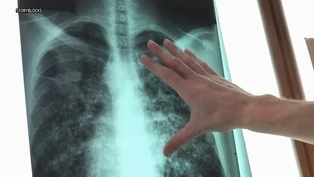
Doctors Offer Ways To Avoid Viral Infections
Video has Closed Captions
Clip: S3 Ep170 | 3m 22s | Kentucky is seeing some of the highest rates of viral infections in the country. (3m 22s)

Musician Swaps Guitar Strings for Woodworking
Video has Closed Captions
Clip: S3 Ep170 | 3m 50s | A musician turned woodworker has honed his craft and now makes elaborate wooden spoons. (3m 50s)
Providing Support for PBS.org
Learn Moreabout PBS online sponsorship
- News and Public Affairs

Top journalists deliver compelling original analysis of the hour's headlines.

- News and Public Affairs

FRONTLINE is investigative journalism that questions, explains and changes our world.












Support for PBS provided by:
Kentucky Edition is a local public television program presented by KET