
Rev. Charles G. Adams’ legacy, Michigan’s population growth
Season 51 Episode 50 | 23m 55sVideo has Closed Captions
Rev. Dr. Charles G. Adams’ legacy, and immigrants’ impact on Michigan’s population growth.
Detroit and the nation are mourning the loss of one of this country's most influential African American ministers. Rev. Dr. Charles G. Adams, of Detroit's Hartford Memorial Baptist Church, passed away at age 86. Host Stephen Henderson discusses Adams’ legacy with his son Rev. Charles Christian Adams. Plus, Global Detroit talks about how immigrants can help revitalize Detroit and the region.
Problems playing video? | Closed Captioning Feedback
Problems playing video? | Closed Captioning Feedback
American Black Journal is a local public television program presented by Detroit PBS
Rev. Charles G. Adams’ legacy, Michigan’s population growth
Season 51 Episode 50 | 23m 55sVideo has Closed Captions
Detroit and the nation are mourning the loss of one of this country's most influential African American ministers. Rev. Dr. Charles G. Adams, of Detroit's Hartford Memorial Baptist Church, passed away at age 86. Host Stephen Henderson discusses Adams’ legacy with his son Rev. Charles Christian Adams. Plus, Global Detroit talks about how immigrants can help revitalize Detroit and the region.
Problems playing video? | Closed Captioning Feedback
How to Watch American Black Journal
American Black Journal is available to stream on pbs.org and the free PBS App, available on iPhone, Apple TV, Android TV, Android smartphones, Amazon Fire TV, Amazon Fire Tablet, Roku, Samsung Smart TV, and Vizio.
Providing Support for PBS.org
Learn Moreabout PBS online sponsorshipwe're gonna reflect on the powerful legacy and contributions of the late Reverend Dr. Charles G. Adams, with his son, Reverend Charles Christian Adams.
Plus we'll hear about Global Detroit's efforts to include immigrants in the plans for Detroit's revitalization and for Michigan's growth.
Don't go away, "American Black Journal" starts right now.
- [Announcer] From Delta faucets to Behr paint.
Masco Corporation is proud to deliver products that enhance the way consumers all over the world experience and enjoy their living spaces.
Masco serving Michigan communities since 1929.
Support also provided by the Cynthia & Edsel Ford Fund for Journalism at Detroit Public TV.
- [Announcer] The DTE Foundation proudly supports 50 years of "American Black Journal" in covering African American history, culture, and politics.
The DTE Foundation and "American Black Journal" partners in presenting African American perspectives about our communities and in our world.
- [Announcer] Also brought to you by Nissan Foundation, and viewers like you, thank you.
(upbeat music) - Welcome to "American Black Journal."
I'm your host, Stephen Henderson.
Detroit has lost one of this country's most prominent African American ministers, the Reverend Dr. Charles G. Adams, Pastor Emeritus at Hartford Memorial Baptist Church passed away on November 29th at the age of 86.
Visitation and a celebration of his life will take place on December 14th and 15th at Hartford.
Over the years, Reverend Adams was a frequent guest on this show to talk about the Black religious experience, racial injustice, and, of course, economic development here in Detroit.
His son, Reverend Charles Christian Adams, who is senior pastor at Hartford and a member of our Black Church in Detroit Advisory Committee, sat down with me to reflect on his father's legacy.
Reverend Adams, our deepest condolences to you and your family and your congregation, and welcome to "American Black Journal."
- Thank you, Stephen, I'm honored to be here yet again.
- Obviously I always enjoy talking to you and these are terrible circumstances to have to do it, but I wanna start, I think on a bright note, you know, my family has been in the city a really long time, as has yours.
Our families have actually known each other a really long time, when I think about your dad, as I've done a lot since he passed, of course, all I can think of are good things.
All I can think of are tremendous things that he said or did, or the feelings that so many people in our city have for him.
And so, of course it's sad that he's no longer with us, but my goodness, what a celebration I feel like we can have of who he was and what he meant to us and our city.
- Yeah, I think that is a very powerful statement considering that the pathway to that kind of legacy was not one that caused him to surrender his integrity.
- Right.
- He was unafraid to trouble the waters, he was known for the enemies that he made.
When he was president of the NAACP, they accused him of being anti-suburbian.
And he said, "Look, I'm not anti-suburbs, I'm pro Detroit."
And as a pastor, he kept troubling the waters.
He moved us from the west side of Detroit to the northwest side of Detroit and to areas that were less integrated.
And, you know, many churches who moved over there moved into former synagogues, but there was still this feeling that somehow, the church we moved into was a white church that had moved to the suburbs, but there's still this feeling that Blacks were not gonna be successful on the northwest side of Detroit and its adjacent suburbs.
But yet he proved them wrong, yet again, when he ordained women into the diaconate ministry and into the ministry, many people were upset because of that.
And I can go onward, he interjected himself into the Middle East conversation and went to Jordan with Bill Clinton.
He, you know, whenever you fight for the least of these, you're going to trouble the waters.
However, with all of that said, you know, when we look back, you're right, I think the memories must be positive and uplifting.
And I believe that we see his heart, and the work of his hands.
- Yeah, and I guess that for me is everything, you know, the things that you were talking about that he did, the risks that he took, the fortitude he showed in standing by what he believed and standing up for what he believed, and standing up for other people, lending his voice and his strength to people who didn't have that.
I know that does get you in trouble and it does make people angry, but I think for us in this city, the people who do that, the people who do it unswervingly and dedicate so much of their lives to it, they're heroes.
I mean, that's a word that gets tossed around a lot, but in this case, it really matters.
- Yeah, oftentimes, we live in an age where the cause is us.
There's no real constituency, whether you're a pastor or a political leader or community activist, or whatever your role is, the cause has to be bigger than us.
You can't say or do anything just to get elected.
You can't say or do anything just to maintain your positions.
There is a guiding ethos.
There is the underpinnings of philosophy and belief that there has to be purpose in what you're doing that is bigger than your position.
We must not be so concerned about positions that we lose our purpose, and I think people felt that in him.
And even those who didn't agree with him, felt that his stance was sincere.
You know, it was interesting because, you know, Hartford had a lot of conservatives in its heyday we'll say, but it's still, the heyday continues.
But certainly when we had the phenomenal growth that, you know, is so well known, where we had 10,000 members on the roll and they were putting chairs down the aisle, and you had to park on Seven Mile Road just to get in the church.
There were a lot of conservatives.
I could start naming names, I won't do that.
But, you know, I remember there was one sermon that I preached as a young man, and I was railing against the Republicans and kind of deifying the Democrats.
And afterwards my father said, "You know, I was looking at so-and-so, and they were shaking their head.
I was looking at so-and-so, and they looked like they were angry."
I wanted to say, "Well, what are they doing here?"
Right, they know who we are.
But the fact of the matter is his love for humanity appealed to everybody.
Democrat, Republican, rich, poor, Black, white.
At one point we had, even though we were predominantly African American church, we had some white members in the church.
And still yet today we have those bridges.
We partner with Christ Church Cranbrook in Bloomfield Hills.
We do a lot of interfaith work.
We partner with churches in, now it escapes me, but an adjacent suburb of Michigan, Chilson Hills Church.
And there's many affiliations we have that go beyond the bounds of race, class, and political opinion because I think people respond to sincerity.
They respond to a pure heart.
- So I want to give you a chance to talk about your father as your father.
You know, for the rest of us, this is a public loss and the loss of a symbol and a leader and things like this.
This was your dad, the first man you knew in the world.
Talk about that relationship and how powerful that was for him and for you.
- Yeah, it's a profound loss.
And I guess I'm not the only one that's had to deal with this.
Many others have had to deal with the loss of their parents, but you cannot prepare yourself for grief.
It is one of those things that is, even though you know it is coming, you can brace yourself, but it's still going to be something that gets a visceral and emotional reaction, and I've had those moments.
But I'm gonna tell you something, Stephen, my gratitude outweighs my grief.
My thankfulness outdistances my sadness, because I have had a wonderful father.
Even though he was, you know, called upon all over the world, you know, he preached revivals where he had to be out of town.
I'm not talking about these new revivals, right?
The revival, the Sunday to Friday revivals, and he'd be all across the country preaching these long revivals, but somehow he always made his way back home, and he would take my sister and I out to the movies and, you know, if we had an event at school, he'd find his way to the schools.
And I remember some of my football games, you know, I played in high school, he would be at the game in the stands in a suit.
(both laugh) My sister sung for Mercy's Chorale one Christmas, and he was the loudest voice in the room.
They were singing the "Hallelujah" chorus, and the director and the other participants said, "Your dad carried the song," and he knew all the parts.
But yeah, he was, and just really generous with his time.
I don't have any student loans for undergraduate to forgive.
And when I became a minister, oh my God.
Even though it's not something he ever wanted for me, you know, you would not want this for your children.
You know, you want your children to do something else and have peace of mind and make money.
He did not want this for me.
But when indeed it happened, we would have conversations, three or four-hour conversations, you know, conversations about everything.
He was so generous in sharing his wisdom with me.
People say, "What are you gonna miss about your dad?"
I say, "The conversations."
The conversations, yean.
- Well, Reverend Adams, again, our condolences to you and your family, and of course, the entire Hartford community.
But thanks for being with us to share all of these memories on "American Black Journal."
- Thank you.
- For the past 13 years, the organization Global Detroit has worked to build an inclusive and prosperous Southeast Michigan.
At the heart of their strategy is making sure that immigrants are a vital part of the city and region's community and economic development plans.
The group also believes immigrants and global talent are key to growing the state's population.
Here's my conversation with Global Detroit's Managing Director, Dr. Alaina Jackson.
Let's start with getting our viewers caught up on what Global Detroit is.
This has been around now for more than a decade.
What does Global Detroit do?
- So, Global Detroit is a regional community and economic development organization with a focus on immigrants and global talent.
We develop and implement inclusive strategies to drive the growth, revitalization, and broadly share prosperity in Detroit and throughout Southeast Michigan.
- And a lot of that work is focused on immigration and immigrants.
The contributions that Global Detroit believes people who come to this country can make and should be able to make in this country and in this city.
And that's a key dynamic and factor right here in Southeast Michigan for lots of reasons.
- Oh, absolutely.
At Global Detroit, we believe that by intentionally including immigrants in our community and economic development strategies, we can spark growth, revitalization, and sustain prosperity throughout Michigan.
And the reality bears that to be true given the economic contributions immigrants make, given the fact that all of our net population growth over the last 30 years has been due to immigration.
And so we firmly believe that an immigrant-inclusive strategy as it relates to both community and economic development, can drive prosperity for all of us.
And that, you know, given the contributions both economically and in terms of population growth that immigrants are making, if we're going to have a growth strategy or a retention strategy, we should definitely invest in one of the strategies that is working for us already, and that is immigration.
And it's working for all of us, for all Michiganders.
- Immigrant-inclusive is the phrase that you used.
That's not always the case.
That's not the default, I think, position that a lot of folks have, and certainly a lot of institutions have.
But talk about what you mean when you say that.
What is immigrant-inclusive?
- So unfortunately, you're right, that isn't always the default, but our history bears this to be true.
You know, Henry Ford, long, long ago decided that he would pay anybody and everybody to work on the line and look what he created from that.
He hired, you know, Chaldean folk.
He hired African American folk.
He hired Asian folk, you know, Irish folk.
And somehow he brought them all together and he knew that if you paid them a living wage, that they could create something and they wouldn't go out of a job because he would pay them enough to buy the cars that they were making and he wouldn't go out of a job.
And so this is a long part of our history in Michigan, but somehow we have gotten away from it.
And I think people don't seem to understand that this is not a zero-sum game strategy.
Research has shown that by intentionally including immigrants in our community and economic development strategies, we can spark growth for everybody.
And so immigrant inclusion looks like language access, immigrant inclusion looks like driver's licenses for everybody so that everybody can get to work.
Immigrant inclusion looks like strategies to help our international students stay here.
They're attending our public universities, we're helping to educate them and grow their acumen in their respective fields.
And so why wouldn't we create a pipeline for them to stay here and continue to contribute to the statewide economy?
- So I do want to talk about the Governor's task force on growing Michigan's population and growing talent here.
You were a member of that task force.
Talk about the work that you were doing and the kind of perspective, I guess, you brought to that work.
- Sure, so I was on the Jobs, Talent and People Work Group, and we were charged with proposing economic development strategies that create safe, vibrant communities and lead to opportunities and upward economic mobility for all Michiganders.
And so we talked about issues that would ensure domestic migration to Michigan, such as retaining young talent, but also attracting new talent.
We talked about and discussed recommendations on how to leverage Michigan's natural resources and how to prepare for the expected climate change.
Climate change migration from other states, for example.
And we try to identify potential workforce strategies and strategic opportunities for Michigan's growth.
I think my perspective, everybody had a unique perspective, it was a really interesting group to participate in and was quite reflective of, you know, all the diverse perspectives one could expect across the state of Michigan.
My perspective was one that once again said, "Hey, we don't have to have a zero-sum game strategy to this.
There's a way for us to promote immigration as an economic development and population growth strategy, and do so in a way that leads to shared prosperity for everybody."
And so I tried to bring recommendations that looked at how we could use immigration to reinforce our talent pipeline.
I brought recommendations around further investing in some of the programs that we already have that we know to be working at Global Detroit, such as our Global Entrepreneur in Residence program that brings founders from other countries to start their businesses here, connects them with universities and they start businesses here that create jobs here, for example, which is what we want.
So those are the types of ideas that I brought to the table, and I found the group to be really receptive to exploring those types of solutions.
- When we think about the goals here, you know, Michigan is not losing population, but it is growing population much more slowly than other states.
And when I say much more slowly, I mean dramatically much more slowly.
There are parts of the country that are really growing and we are only growing a little bit.
It seems to me that one of the obvious differences between Michigan and some of those other places is immigration, the manner in which they attract immigrants in the first place, but also the way they promote the presence of those immigrants in their communities once they're there, and make sure that they're moving through the economy in a way that benefits them and other people.
It's almost like a no-brainer, right?
If you wanna win, find out what the winners are doing, and do the same.
- Yeah, you won't get any argument from me or from anybody from Global Detroit for that fact.
I mean, what we know is that none of the top 100 cities in the United States, that lost population has reversed that population loss without significant immigrant growth.
And for the most part, these large cities that have had actual population rebounds, immigration was the source of all of that net population growth.
And so, you know, once again, we can learn from others and their best practices that this doesn't have to be a zero-sum strategy.
And it's also not just a political or civil rights or justice issue, it's actually a community development issue.
It's actually an economic development issue.
And so when we don't do things like provide reciprocity, right, for people's licenses and certifications and degrees, we lose out.
We lose out on teachers, we lose out on nurses, we lose out on physical therapists, we lose out on engineers.
We lose out on skilled tradesmen.
I mean, we know that there's a skilled tradesman dearth.
We need more electricians, we need more, you know, welders, right?
And so when we don't provide reciprocity, or when we don't allow for driver's licenses to be extended to all residents, we create a gap in the pipeline that doesn't have to exist.
And so we need to rethink some of the policies that we're implementing, or some of the policies that we're refusing to implement.
And think through how they're actually doing more harm than good.
- That is gonna do it for us this week.
You can always find out more about our guests at americanblackjournal.org, and you can connect with us anytime on social media.
Take care, and we'll see you next time.
(light upbeat music)
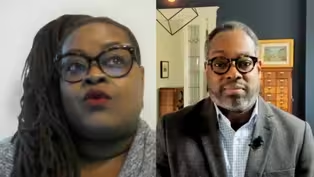
Global Detroit discusses Michigan’s population growth
Video has Closed Captions
Clip: S51 Ep50 | 9m 19s | Exploring the importance of immigrant inclusion in Michigan’s population revitalization. (9m 19s)
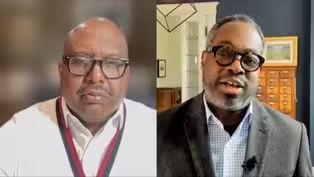
The legacy of Harford Baptist Church’s Rev. Charles G. Adams
Video has Closed Captions
Clip: S51 Ep50 | 12m 41s | Rev. Charles Christian Adams reflects on the legacy of his father Rev. Charles G. Adams. (12m 41s)
Providing Support for PBS.org
Learn Moreabout PBS online sponsorship
- News and Public Affairs

Top journalists deliver compelling original analysis of the hour's headlines.

- News and Public Affairs

FRONTLINE is investigative journalism that questions, explains and changes our world.












Support for PBS provided by:
American Black Journal is a local public television program presented by Detroit PBS