One-on-One
Rev. Dr. DeForest B. Soaries; Jared Maples; Kate Judge
Season 2021 Episode 2417 | 27m 25sVideo has Closed Captions
Rev. Dr. DeForest B. Soaries; Jared Maples; Kate Judge
Rev. Dr. DeForest B. Soaries Jr. talks about the role of the church in informing the community about COVID-19 and the importance of teaching about financial literacy & empowerment; Jared Maples discusses White supremacy in the nation and social media’s role in providing misinformation about the pandemic; Kate Judge shares the toll of the pandemic on nurses’ physical and mental health.
Problems playing video? | Closed Captioning Feedback
Problems playing video? | Closed Captioning Feedback
One-on-One is a local public television program presented by NJ PBS
One-on-One
Rev. Dr. DeForest B. Soaries; Jared Maples; Kate Judge
Season 2021 Episode 2417 | 27m 25sVideo has Closed Captions
Rev. Dr. DeForest B. Soaries Jr. talks about the role of the church in informing the community about COVID-19 and the importance of teaching about financial literacy & empowerment; Jared Maples discusses White supremacy in the nation and social media’s role in providing misinformation about the pandemic; Kate Judge shares the toll of the pandemic on nurses’ physical and mental health.
Problems playing video? | Closed Captioning Feedback
How to Watch One-on-One
One-on-One is available to stream on pbs.org and the free PBS App, available on iPhone, Apple TV, Android TV, Android smartphones, Amazon Fire TV, Amazon Fire Tablet, Roku, Samsung Smart TV, and Vizio.
Providing Support for PBS.org
Learn Moreabout PBS online sponsorship- [Narrator] Funding for this edition of One-On-One with Steve Adubato has been provided by Fedway Associates, Inc. Johnson & Johnson.
Englewood Health.
The New Jersey Economic Development Authority.
New Jersey Sharing Network.
The New Jersey Education Association.
PSE&G, committed to providing safe, reliable energy now and in the future.
Caldwell University.
And by IBEW Local 102.
Lighting the path, leading the way.
Promotional support provided by NJ.Com, keeping communities informed and connected.
And by NJBIZ, providing business news for New Jersey for more than 30 years, online, in print, and in person.
- This is One-On-One.
- I'm an equal American just like you are.
- The jobs of tomorrow are not the jobs of yesterday.
- Look at this.
You get this?
- Life without dance is boring.
- I don't care how good you are or how good you think you are, there is always something to learn.
- Do you enjoy talking politics?
- No.
- People call me 'cause they feel nobody's paying attention.
- Our culture, I don't think has ever been tested in the way it's being tested right now.
- That's a good question, high five.
(upbeat music) - Hi, I'm Steve Adubato.
Let's get right into this because I don't wanna take a second away from this conversation with my good friend, our good friend, Revered Dr. DeForest Buster Soaries, Junior, Senior Pastor at First Baptist Church of Lincoln Gardens and also founder of the Corporate Community Connections Incorporated.
Good to see you, Reverend.
- Good to see you, my friend.
Good to see you.
- Let's do this.
First of all, Mikaela Batts, who's one of our producers, Mikaela, you baptized her.
I just heard this before I got on the air.
You christened her, correct?
Mikaela, is that right?
I'm just hearing that, but also, I'm gonna beat that.
You ready?
See that picture of that young lady right there, the one younger than me?
That's my wife, Jennifer.
In June of this year, we're taping on the 16th of- Do you remember June 20 years ago?
Do you remember, Buster?
- I do, I do, at the Newark Club.
- We were married by the good Reverend Buster Soaries, and it was one of the most beautiful parts of that wedding, so thank you for doing that.
You've done (laughing) many others, and enough about us.
Let's talk about you.
- Well, it was a great day.
We go way back to Montclair in the 1980s.
Before you became famous, I knew you as a young political superstar.
I knew you as the son of one of my mentors and heroes, Steve Adubato, Senior, and I just knew you as a very active, creative genius, and so you know, there are very few of us left, Steve.
There are very few- (Steve laughing) (Steve clapping) Who were active then.
- Yeah.
- That are still active now.
You know, I don't know half the politicians in New Jersey.
They're all new to the scene.
Many of the people that we worked with have either left the state or left the planet, you know.
- That's right, that's right.
- So it's wonderful to stay connected with you because there are very few people who have the memories that we have.
- And it's always important to be connected with you because you ground us, and in that spirit, let me ask you this, Reverend Soaries.
We're doing a series on confronting racism.
The graphic will be up, but I wanna talk to you about vaccines first.
You are so involved, so engaged in so many ways.
What is the role of the church, and what role are you taking as it relates to vaccine distribution, COVID vaccine distribution in the state right now?
- Well, you know, New Jersey, like the rest of the country, has experienced disparate impact on ethnic minorities, on low-income communities from the beginning of coronavirus, COVID-19.
We have higher rates of infection of the virus.
We have higher mortality rates.
More people proportionately die if they're black or Hispanic, and it has a lot to do with a lack of access to healthcare and therefore pre-existing conditions, and so we began early by educating our congregation and community just around, you know, wash your hands, wear the mask, social distancing.
That was the first level, and we took it very seriously.
Then of course the issue of testing became an urgent issue, and we pressed some of the private healthcare organizations.
We pressed the state of New Jersey to help us bring testing not just to the community but to our church because we found that people who have trusting institutions where they have preexisting relationships were more likely to go there for testing than anyplace else, and so we tested over 2,000 people at First Baptist.
Even though we've been closed for worship and we've been closed for meetings, we opened for testing, and we tested, we did our own registration, we assembled the component parts, and then RWJBarnabas came along and helped us as we proceeded.
Then we began educating our congregation about the vaccine.
While we were testing, we knew the vaccine was coming, and we had webinars.
Our good mutual friend, Dr. Robert Johnson, did a marvelous webinar for us.
- From Rutgers School of Medicine.
- From Rutgers School of Medicine, and we invited the whole congregation, and while the leaders of the church were educating our members about the vaccine, trying to, frankly, offset some of these conspiracy theories about blacks and vaccine.
We had many high-profile blacks were promoting the idea that the vaccine was anti-black, you know.
(scoffs) - There's history, there's history, Reverend.
- Yeah, but there's history, but history is also history.
The fact is while the syphilis, for instance, experiment at Tuskegee was just for black people, this conspiracy argued that the same vial of vaccine that would not harm white people would harm black people, and you know, it was a special concoction, and I argued that if you don't believe in the conspiracy theory around the presidential election, then don't believe in the conspiracy theory around the vaccine.
(Steve laughing) I mean, conspiracy is conspiracy!
We began educating our congregation, and I kept, I was pressing the federal government, state government, everybody I could because what we found was just like we had a higher rate than the general population of the virus with a lower rate of access to testing, and when the vaccine was rolled out, didn't matter where you aim, the vaccine, we had a lower rate of access to vaccine among blacks and Hispanics and lower income people, and so in January, you'll love this, Steve, in January, I had my board of trustees at First Baptist Church vote unanimously that if I could find some vaccine, they would allow us to use the facility for vaccinations, and I had no idea where we would get vaccines.
(Steve laughing) But I just wanted- - You just said, "Trust me."
- I wanted pre-approval.
(both laughing) Just in case some of these conspiracy theorists were on my board, and then- - But then, hold on, Reverend.
We're actually gonna do a separate conversation with Reverend Soaries on leadership, and he's gonna talk about getting pre-approval, (laughing) which is a leadership trait.
Go ahead, pick it up, Reverend.
- And then I got a call from the governor's office, and as a result of the new administration's commitment to additional vaccines- - The Biden administration.
- The Biden administration, and they assigned it to FEMA.
FEMA outsourced to the Department of Defense, and the rest is history, and so we are now vaccinating 3,000 people in our facility.
- Wow.
- Based on that commitment and partnership.
- Reverend Soaries and First Baptist, they do things, let's just say creative, innovative, impacting the community outside the box, and one of them is our friends at Fedway talked to us about this, our mutual friends, the corporate community connections.
Financial empowerment, financial literacy, what is that, Reverend?
- Well, in 2005, Steve, I noticed that consumerism had become as large a barrier for black progress as racism.
I know you don't want me to talk like this, but the reality is (clears throat) if all the white people in America left, we would still have some economic gaps because consumerism, it really takes so much of our financial capacity that, you know, 60% of the NBA players who make $1 million a year file bankruptcy after three years of retirement.
So there's a strong need in America, generally, for financial literacy, for savings, discipline, and understanding of investment.
Almost 60% of Americans don't have $400 if there's an emergency, and so it's exacerbated by the legacy of racism, where generations don't leave financial legacies for future generations, and so black people are born broke and die broke, and we use GoFundMe as an insurance company, and so we started in 2005, right here at First Baptist.
CNN came along, you might recall, and so that- - I do remember them here.
- Did a 90-minute documentary on us, and as a result- - Was a role model around the country.
- And we've trained thousands of churches, literally thousands of churches.
We've reached 12 million people with our message, and it focuses on reducing and eliminating debt as the first step towards financial stability.
- Important.
Hey, Reverend, do me a favor.
I mentioned this leadership discussion.
Stay right there.
This is, there are two different things.
One is talking to Reverend Soaries about a whole range of issues that he just shared, but also our sister program that I want you to check out that I co-anchor with Mary Gamba, "Lessons in Leadership."
Reverend Soaries is gonna stay right there.
We'll do that interview.
Go on our website.
You can find out where that is.
Long-winded way of saying Reverend, thank you for joining us.
We'll continue the discussion in about two seconds, but for everyone watching, that's Reverend Buster Soaries.
I'm Steve Adubato.
We'll be right back.
- [Narrator] To watch more One on One with Steve Adubato find us online and follow us on Social media.
- We're now joined by Jared Maples, Director of the New Jersey Office of Homeland Security and Preparedness.
Good to see you again, Jared.
- Great to see you, as always, Steve.
Thanks for having me on.
- You got it.
Let's get right into this.
We're taping on the 16th of February.
This'll be seen after, but January 6th will live in infamy, if you will.
From a Homeland Security Domestic Preparedness, et cetera, et cetera perspective, what did it mean, and what will it mean?
- So I'll start out and say this is exactly what we were talking about in our threat assessments from last year, so we started in February by labeling white supremacy, anti-government, anarchist movements, and they all converged and collided, and that's why we released our second threat assessment, the supplemental threat assessment in September.
Because of this convergence of issues that you saw from that time: COVID, the civil unrest in the summer, the elections, the contesting of the elections, all the way through till January 6th, and it really did collide on top of the United States Capitol, so from our perspective, unfortunately, it bore out what we were saying in those threat assessments, one, and number two, it really did test the very limits of our system, I think, overall.
The good news is that the system has remained intact and went on as planned.
That's a big one.
The other side, I'll say, and I've been asked a couple times about this, but as you know, my background, I spent a lotta time overseas in hostile areas, denied areas, war zones, and I saw government facilities and buildings and governments themselves overrun.
I never imagined when I took the job as the Director of Homeland Security four years ago that I would be informing the governor, as I did that day, that the United States Capitol had been overrun, but thankfully, again, it was taken back, and I think we're moving forward in a security posture and as a country.
- What do you think, Jared, even with as many times- You can check out Jared on "NJ Spotlight News."
He talks about it all the time.
What do you believe is fueling, quote/unquote, white supremacy?
What's fueling it?
Not just nationally because I'm stunned at New Jersey!
- Yeah, it is nationally, and it is very much present here in New Jersey.
To your point, we have talked about this quite a bit, and we see that as an important point that we can do is talk about it, that it exists, that it's out there.
What's fueling it?
It's hard to say exactly.
There's certainly a lot of misinformation and disinformation online.
There's whisper campaigns offline.
You know, you look at some of the foreign government interference, no question about it.
I'll go on the record and say that Russia, China, Iran, some of those actors are fomenting and adding that discontent and chaos into the system, - What do they have to- I'm sorry, Jared, - through social media.
- for interrupting, I'm sorry, but here's my question: what does Russia or others have to do with fueling white supremacy in New Jersey or the nation?
- Yeah, it's really fascinating, and quite a bit, actually, because that's how they're targeting us from a covert action program on their part, and some of this, by the way, is all open.
I mean, they're going into open media and trying to foment and cause this chaos, but what it means for them is it causes that chaos.
It drives at our system itself.
It attacks our openness, our freedoms, our liberties that we take advantage, or that we take, you know, we have, and they go after us through those mechanisms, and by causing that discontent and chaos inside of our own system by driving people towards white supremacy, by saying, you know, "We hear your anger.
Here's more things to anger you and fuel your fire."
That's what's happening, but then also, domestic factors in general, right.
KKK, of course, has always been around or has been around for a long time, but there's a lot of other splinter groups.
- Who the heck are the Proud Boys?
Who are the Proud Boys, and are they, is that the KKK in another name?
- Not necessarily, but similar in many ideologies, for sure.
I mean, they're not wearing robes and hoods.
They have different garb, but a lot of the background, a lot of what they preach is generally about the same principles of white supremacy, but it goes further than that.
It goes into anti-government.
It goes into anti-police.
It goes into anti-system.
It's attacking the system itself.
Whether it be NJEHA, whether it be Proud Boys, whether it be Patriot Front or Sons of Liberty.
I could keep going down the list.
There's a lot of them.
They're right here in New Jersey, and they are trying to cause that chaos to bring about the downfall of our system.
- You know, Jared, as I was listening to the, you know, the people debating, people in Congress, with the trial and the Senate about the President, et cetera, I hear a fair number of folks, not just in Washington, but some of my friends, who are Trump fans and were somehow, "Oh, yeah, the 6th was really bad, but what about Antifa?"
There's always this what about-ism.
Where does Antifa fit into the equation of domestic terrorism?
- So it's a fantastic question.
You always hit the nail on the head, and I think it's an important point to make.
We are apolitical in our role in how we operate, how we call out domestic terrorism.
We call out ideologies as part of our threat matrix.
The anarchist movement is part of- Antifa largely adheres to that, and we do consider that a medium threat and probably a higher threat on the back end of this.
I think there's a lot of apples and oranges and watermelons and any other type of fruits you can compare in this other than to say that extremism is extremism in any form, and we will treat it as such.
So whether it be the far right or the far left, whether it be the Antifa movement, whether it be the Proud Boys, any movement against our government, any movement to use violence to get your message across and go beyond your constitutionally protected right of protest, that's a problem, and so we view it as such.
- You know, social media, a huge part of this, fuels a lot of it, and the president being taken off Twitter, others being taken off Twitter, only a part of it.
There's so much more than that, but as it relates to the pandemic, what is the role of your office as it relates to social media's role promoting disinformation about the pandemic, and what the heck does that have to do with domestic terrorism?
Loaded question, I know.
- So it is, but again, it's a great question, and it's one that's important to talk about.
Early on in March, I got inundated, I mean literally inundated- - March of 2020, we're taping on the 16th of February 2021, go ahead.
- Yeah, that's right, so it's, right, so last year, last March.
- A year ago or so now.
- Yeah, amazingly enough, a year ago, my phone, I was inundated on text messages, on calls, emails.
"Is this real?"
and all my analysts, et cetera, and that text message was- - You mean COVID?
- Yeah, in COVID, in March, and it said that this, there's a text message circulating that said, "My friend is a senior-ranking official in the military or FEMA, and America is gonna go into this nationwide lockdown, complete lockdown, and it's gonna," you know, and it caused a lot of concern, and I'm talking about some pretty senior-level folks in private industry, public sector, community leaders.
People were really concerned that this was happening.
In large parts, it led to the great toilet paper crisis, among other things, and so what you had there was, that was from a foreign entity.
I don't wanna get into some of the specifics.
I'll leave that to our federal colleagues, but that was from a federal, a foreign interference campaign, basically, and that was disinformation and misinformation, and once that settled, once that's set, you have these nefarious actors, not just foreign governments, also domestic extremists on both sides of the spectrum, on all sides of the spectrum, realize that you can cause that through disinformation and misinformation, and it caused a problem in our overall response.
So what was really an online social media, maybe a legal issue, maybe, you know, with the OEG, et cetera, became a Homeland Security problem because it was causing that concern inside, that panic inside the system, and that's the exact same narrative and problems that we're seeing throughout the last year, really.
- (sighs) You can see why Jared Maples, every day when he wakes up and heads to his office, there is a whole, huge, a plethora, if you will, of challenges to deal with.
That is Jared Maples, Director of the New Jersey Office of Homeland Security and Preparedness.
Jared, to you and your colleagues, thank you for the work you do every day.
We look forward to following up in the next few months with another conversation.
Thanks, Jared.
- Always great to be with you, Steve.
Thank you.
Stay safe.
- You got it, I'm Steve Adubato.
That's Jared Maples.
We'll be right back.
- [Narrator] To watch more One on One with Steve Adubato find us online and follow us on Social media.
- We are now joined by Kate Judge, Executive Director of the American Nurses Foundation.
Good to have you with us, Kate.
- Great to be here Steve.
- I wanna thank our friends at Johnson and Johnson, big supporters of nursing around this nation.
And they told us all about you.
So, and your organization.
Here's the first question.
Everyone talks about nurses, doctors are heroes, but as it relates to nurses a year in and this will be seen later into this pandemic, how are our nurses doing?
- Well, that's a great question, a new question and to all of us who rely upon nurses and all of us do really should be asking.
And when we started this pandemic a year ago there were lots of things we didn't know.
And one of them really was what kind of toll would this take on the nurses and doctors on the frontline?
And today we face some of the same challenges we did way back when in this endless pandemic we've been living through they're still shortages of PPE.
There are still things that people on the frontline need to keep them safe.
But really the issue is they've been doing this for a year and they are mentally and physically exhausted.
That's how they are.
And I had a nurse say to me, not too long ago, I still feel like I'm playing Russian roulette every day to not bring something home to my family.
And another who said, I feel like I live in prison and that you really hold with the fact that they show up every day with their knowledge and their expertise to try to make sure that all of us who get into the hospital get out of the hospital and are well.
So they're struggling, but they're still there for us.
- Kate we're taping on the 16th of February say this is seen in March, April, maybe even into May.
And again if you wanna check out what's happening every day, check out NJ Spotlight News, check out MetroFocus, our great colleagues in public broadcasting, but we're looking forward on this.
But there are so many question marks.
So here's my question.
Best case scenario, end of June 2021 with more and more nurses and others around them being vaccinated.
What should the situation look like for our nurses by then and halfway into the year?
- Well, I think all of us wish we had a a magic ball to look into and guarantee.
And what we know is that this virus changes.
And so the environment is dynamic.
We're all facing that as individuals.
I'm not a nurse, but I work with them and I listen to them every day.
My hope is with vaccinations not just of clinicians and frontline workers but all of those who are willing and able and want a vaccine that by June, it is a safer environment.
We still know though that we're gonna have to do things like social distance and make sure we wash our hands and still wear masks.
So some of these things that we're living through right now that we are all so anxious to get rid of are gonna be with us for longer, but let us hope that at least by mid-year people can catch their breath.
And for us Steve, one of the things we know from other pandemics and from what happened internationally early in this pandemic is that the fallout lasts for a long time.
And so part of what we're trying to do every day is make sure that when we get to June when we get to 2022, when nurses really are still processing the trauma that they went through that we're able to be there and support them.
- And by the way, the foundation, there's an economic component to this because the foundation has a Coronavirus Response Fund for Nurses.
What is it?
And is it involved in direct financial assistance to nurses?
- Yes, it is.
Early in the pandemic, we realized from listening to nurses on the ground talking about what they were experiencing, that we were gonna need to be able to provide them assistance.
And it really was not just helping nurses but in some ways helping Americans be able to thank nurses and to show their support because every one of us wanted to do something when we felt so helpless.
So we created this fund and it does several key things.
One of them is provide financial assistance to nurses nurses who were furloughed, nurses who were sick, nurses who lost their job through a partnership with Nurses House.
We also support nurses by getting them information that they need.
Evidence-based information, you remember that early in this pandemic as we were learning, it was a really chaotic environment.
What could you trust?
The information was changing?
The information is still changing, right?
So getting them information that they could trust and that they could use and then finally supporting their mental health and wellbeing.
And that's something that we see doing for a very long time.
- Could you stay on that, the mental health and wellbeing?
I don't want people to hear, oh, wow, nurses are having some mental health issues.
Be more specific.
What are we dealing with?
What are they dealing with?
- Well, we know from really surveying and listening to nurses in May, in December now that their sense of exhaustion, their sense of isolation, their sense of lack of sleep, all the signs that are somewhat a step towards real trauma and PTSD.
You can't expect that nurses and other clinicians who are really doing this in a daily way and have been doing this for months and months and months with the added challenge, even in combat, you don't have to worry about the safety of your family, that this is taking a toll.
And I would say that my nurse colleagues are the first to say, I'll be okay, just get in there and do it again.
And we're very concerned that this toll is great on them.
And we're hearing them say to us that it's breaking them.
It's really breaking them - Well, in this time I have left, you just opened up an area I've been wanting to ask you about.
In an effort to be as optimistic and positive as we can, we also want to be realistic.
A, you concerned about nurses leaving the profession and B, enough qualified committed folks going into the profession?
Kate, got a minute left.
- Sure, we do see that more people are beginning to say that they're thinking about leaving the profession.
So that's something we're tracking and we're worried about.
We are also seeing people that are looking at the heroes that nurses have been and wanting to go to school and become a nurse.
So it's still too early to see, to tell but it's something that we're gonna watch for.
And I'm so glad that you asked me that question.
- You're optimistic Kate?
- I am optimistic because I am surrounded by nurses but I'll tell you if we don't take care of them they will not be there to take care of us.
And if anything, this pandemic has shown us that we can have all the equipment but if we don't have the nurses, we can't make it through.
- So well said.
Kate Judge is the Executive Director of the American Nurses Foundation.
By the way their website, Lauren their website has been up throughout the entire segment.
If not, we'll do it in post-production so people can find out more.
Kate, I wanna thank you.
And needless to say, all of us in public broadcasting all broadcasters around this nation all Americans owe a debt of gratitude to our nurses every day not just today or when they're called heroes in the media.
Thank you, Kate.
- Thank you, Steve.
I'm Steve Adubato.
Thank you so much for watching.
We'll see you next time.
- [Narrator] One-On-One with Steve Adubato has been a production of the Caucus Educational Corporation.
Funding has been provided by Fedway Associates, Inc. Johnson & Johnson.
Englewood Health.
The New Jersey Economic Development Authority.
New Jersey Sharing Network.
The New Jersey Education Association.
PSE&G, Caldwell University.
And by IBEW Local 102.
Promotional support provided by NJ.com, And by NJBIZ.
- I could feel my lungs fill with oxygen, and I got my life back.
- The Sharing Network means to me hope, life, and everything.
- The Sharing Network was a lifeline to me when I really needed it.
- We are an organ procurement organization.
- The core purpose of the New Jersey Sharing Network is to save and enhance lives, - To honor those who gave, - Pay tribute to those who received, - Offer hope to those who continue to wait, - And remember the lives lost while waiting - For the gift of life.
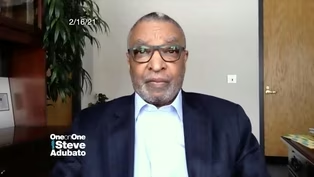
The Role of the Church in Informing Communities About COVID
Video has Closed Captions
Clip: S2021 Ep2417 | 10m 21s | The Role of the Church in Informing Communities About COVID (10m 21s)
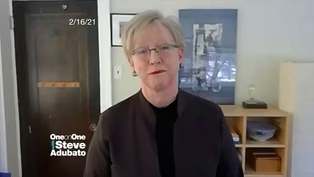
Supporting Nurses' Mental Health Throughout the Crisis
Video has Closed Captions
Clip: S2021 Ep2417 | 8m 42s | Supporting Nurses' Mental Health Throughout the Crisis (8m 42s)
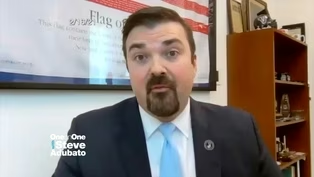
The Use of Social Media by Extremists in NJ and the Nation
Video has Closed Captions
Clip: S2021 Ep2417 | 9m 7s | The Use of Social Media by Extremists in NJ and the Nation (9m 7s)
Providing Support for PBS.org
Learn Moreabout PBS online sponsorship
- News and Public Affairs

Top journalists deliver compelling original analysis of the hour's headlines.

- News and Public Affairs

FRONTLINE is investigative journalism that questions, explains and changes our world.












Support for PBS provided by:
One-on-One is a local public television program presented by NJ PBS