
Rhode Island PBS Weekly 2/4/2024
Season 5 Episode 5 | 26m 40sVideo has Closed Captions
Ice-skating champion Vincent Zhou and Team USA finally get their gold medal.
Weekly revisits a profile of Olympic ice-skating champion and Brown University student Vincent Zhou, who is about to get Olympic gold as Team USA advances to the top spot. Then, contributor Dorothy Dickie profiles an artist who spent more than three decades behind bars. Finally, Michelle San Miguel and Ted Nesi unpack the federal government's investigation of the Washington Bridge closure.
Problems playing video? | Closed Captioning Feedback
Problems playing video? | Closed Captioning Feedback
Rhode Island PBS Weekly is a local public television program presented by Ocean State Media
Rhode Island PBS Weekly 2/4/2024
Season 5 Episode 5 | 26m 40sVideo has Closed Captions
Weekly revisits a profile of Olympic ice-skating champion and Brown University student Vincent Zhou, who is about to get Olympic gold as Team USA advances to the top spot. Then, contributor Dorothy Dickie profiles an artist who spent more than three decades behind bars. Finally, Michelle San Miguel and Ted Nesi unpack the federal government's investigation of the Washington Bridge closure.
Problems playing video? | Closed Captioning Feedback
How to Watch Rhode Island PBS Weekly
Rhode Island PBS Weekly is available to stream on pbs.org and the free PBS App, available on iPhone, Apple TV, Android TV, Android smartphones, Amazon Fire TV, Amazon Fire Tablet, Roku, Samsung Smart TV, and Vizio.
Providing Support for PBS.org
Learn Moreabout PBS online sponsorship- [Pamela] Tonight, delayed, but not denied.
A Brown University student's two-year wait for gold is over.
- The moment I realized I was going to be an Olympic medalist was emotional and fulfilling in a way that's difficult to put into words.
- [Pamela] And art behind bars.
- My imagination was never behind the walls.
- [Pamela] Finally, a look into the federal government's investigation of the 195 bridge closure with Ted Nesi.
(bright gentle music) (bright gentle music continues) (bright gentle music continues) - Good evening.
Welcome to "Rhode Island PBS Weekly", I'm Pamela Watts.
- And I'm Michelle San Miguel.
Tonight an international controversy in the world of figure skating brings vindication to a local athlete.
- This week, the top court in sports disqualified a Russian figure skater for doping during the 2022 Beijing Olympics.
That decision elevates Team USA to first place, and these empty boxes will soon be filled with the gold medals they deserved.
In light of that landmark ruling, we take a look back at our interview last year with a Brown University student.
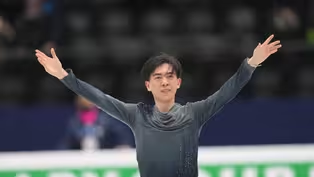
Vincent Zhou, a member of Team USA is now positioned to finally have his day at the top of the podium.
- [Vincent] There's always something new to be discovered every time you step out on the ice.
In skating, we are doing things that are on the edge of what's possible physically for humans.
- [Pamela] 22-year-old Olympic figure skater, Vincent Zhou, has been on the cutting edge of his sport since childhood.
He was the first to successfully land one of the most difficult jumps, a quadruple Lutz, at the 2018 Olympics.
We recently caught up with him at Brown's Meehan Auditorium where he makes it all look so easy.
- What you don't see is the hours and hours of pure physical training that we're doing.
It takes years and diligence and hard work to make just three or four minutes out there in front of the sparkling lights look perfect.
- [Rink Announcer] Ladies and gentlemen, please welcome our next skater.
- [Pamela] Zhou began seeking perfection as a 5-year-old boy growing up as a first-generation Chinese American in California.
He quickly began compiling top awards.
- [Vincent] I was this fearless kid who would stack tables on top of tables and chairs on top of those tables, and then boxes on top of those chairs to get to the Lego box at the top of the bookshelf.
It's kind of the same thing later on.
(bright upbeat music) I'm stacking tools I have on top of each other to try and build a great foundation so I can reach the ultimate dream one day.
- [Pamela] Zhou came in sixth at the 2018 Olympics.
In 2022 in Beijing, he was a silver medalist in the team event.
- The moment I realized I was going to be an Olympic medalist was emotional and fulfilling in a way that's difficult to put into words.
Something that I sacrificed 17 years of my life for is finally being fulfilled and all that time, all the hardships and the struggles and all the small victories along the way.
- [Pamela] But taking silver would turn into a hollow victory tarnished by another team's substance use.
- The Russian doping scandal remains the biggest topic of conversation.
- It's now been confirmed that Kamila Valieva tested positive for a banned substance before the games started.
- [Pamela] After the team event, it was discovered that 16-year-old Russian skater, Kamila Valieva, tested positive for a banned drug.
Russia won gold, but the court of arbitration for sport is still deciding the case.
A year later, there's been no ceremony and athletes have no medals, just empty boxes.
- It feels like a slap in the face.
It's not just a slap in the face to me, it's an insult to the meaning of sport and to the meaning of Olympics.
The Olympics are the pinnacle of sport, fair sport, clean sport, a great event that symbolizes unity and peace.
And to have cheaters, to compete with people who dope, it's an insult to all the hard work that we've put in.
It invalidates all of that.
- [Pamela] If Russia is disqualified in the illegal substance review, Team USA will move to the top of the podium and take the gold medal.
Something Zhou says would help bring the sport back to a level playing field.
- It would feel like a step in the right direction in terms of the fight for clean sport.
- [Pamela] The doping controversy is not the only heartache Zhou had to face at the Olympics.
- Hey everyone, I have no idea how to start off this video properly, so I'm just gonna get started.
- [Pamela] The night before he was to skate in the men's competition, he tested positive for COVID.
- I will have to withdraw from the individual event.
- [Pamela] That spiraled into a dark time for him.
Zhou says he didn't want to go to the World Championships after the Olympics and considered a complete halt to skating.
- It was devastating for me.
It was like losing a loved one.
As soon as I got home from Beijing, then it actually hit me, that's when the full weight of what had happened actually settled in.
And then I just felt like an empty shell, like there was this vast chasm with nothing inside me.
I had no motivation to skate.
At one point my mom told me that it was okay to withdraw from Worlds.
It was okay to give up.
And that's something that I've never heard come out of her mouth because she's always been that tough love, iron-willed mother who's drilled perseverance and grit and never giving up into me since I was a kid.
And that kind of made me rethink it a little.
Would you be able to live the rest of your life knowing that you allowed yourself to give up in the most critical moment?
- [Pamela] And he didn't.
Zhou, with very little time for training, competed at the Worlds in France, making a comeback from COVID and winning bronze.
- I don't really believe in magic or all that, but it was like magic.
It was highly emotional.
It was basically the victory that I didn't get the chance to achieve at the Olympics.
- [Pamela] Zhou is now attending Brown University, majoring in economics and business.
- It's like starting over all again and having to be a beginner.
The motto is, in practice, beat yourself, in competition, be yourself.
So I just have to put myself into this completely different mindset of accepting that I'm a beginner and accepting that I have so much to learn.
- [Announcer] And as far as his future in skating, Zhou says he's conflicted about competing in the 2026 Olympics.
- I have three more years here at Brown.
I'll be studying full-time and you can't study full-time and train full-time, there aren't 48 hours in a day.
But there is a short window after that where, if I was extremely motivated to make a comeback and if I saw an opportunity, then it's possible.
- For those of us who will never know what it's like to be out on the ice with the grace and the speed and the strength, is it possible for you to describe that sensation?
- To me, skating is freedom and joy and passion encapsulated into one activity that can be so simple, yet so complex and so difficult, yet, so rewarding.
It's everything under the sun.
It feels like flying.
And when you land with just as much speed as you had going in, it's the best feeling in the world.
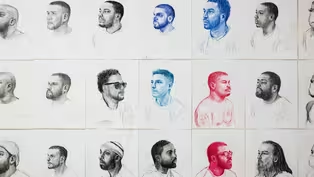
(bright gentle music) (bright gentle music continues) - Up next, contributor Dorothy Dickie introduces us to a Rhode Island artist who spent more than three decades in prison, where he produced a body of work that chronicles his life behind bars and to search for justice, which continues today.
And a warning, viewers may find some images in this story disturbing.
- So it's time to quit ignoring history and set our minds on the right track and to demand the rights of full citizenship in this age of the patriarchy.
My name is Leonard C Jefferson.
I am a artist, musician, a poet, a author and a dad, a granddad, a great-granddad.
(smooth jazz music) The evidence speaks for itself, but nobody looks at the evidence.
The jurors didn't look at the evidence.
Like I'm saying, when the prosecutor points at you, and especially if you are a person of color, right, the jury rolls right along with them.
(bright jazz music) (bright jazz music continues) (bright jazz music continues) The landlord in the house where I was living was, they say, robbed and killed during the robbery.
And the police came, of course, and they arrested Black people in the house basically, myself and another guy.
I was sentenced to life imprisonment, I served from 1973 till 1985.
(bright jazz music) I was confronted with a trespasser in my house late at night and I ejected the trespasser and she told the police that I had assaulted her, which was not true.
And they convicted me literally in a couple minutes.
In Pennsylvania, if you have a life sentence, you are never eligible for parole.
And from that point, I spent the next 26 years imprisoned.
The inspiration from my art came from me refusing to allow my mind to be trapped in prison.
They had my body, but not my mind.
If you allow them to trap your mind in prison, you're done.
And my imagination was never behind the walls.
I was drawing before I went to kindergarten.
I always, probably from before I can remember where I was drawing.
I'm from Pittsburgh, Pennsylvania and they have the Three Rivers Art Festival and my mother took me there.
Unfortunately she died when I was 13, so this was probably when I was about nine or 10 was the first time we went down there and I was exposed to art, painting.
Definitely I am self-taught.
I have not gone to any schools and I'm kind of like shocked and amazed when people ask me, "What school did you go to"?
And even some people ask me, "Do you teach?"
"Where did you teach?"
I'm like, "Wow, not me".
I'm like a trial and error guy.
If I see something or something in my imagination, I just pull it out and paint it or draw it.
I've never had a live model, but I've worked from photographs, "National Geographic", they have like excellent photographs.
That's what I worked from when I was in prison a lot.
Back in the day, the ACI, especially maximum security, everyone was really busy creating things.
They had woodworking shops and these were ran by prisoners themselves.
They had a program that's called Arts-In-Corrections, where they provided material for prisoners to work with.
They had a lot going on.
And so, I just kinda like fell right into that.
Being busy is very important, right?
When you run outta stuff to do in prison, you get in trouble.
And what do they say "Our hands are the devil's workshop"?
Yeah, so I tried to stay busy in my art, and the music gave me something to do, positive all the time.
This song is about seeking the truth and speaking the truth.
♪ Ain't no time for playing ♪ ♪ You know what I'm saying ♪ ♪ Get busy and get your heart right ♪ ♪ And seek the truth ♪ ♪ And speak the truth ♪ I actually had a situation where I was in maximum security for literally my entire time at the ACI between 1973 and 1985.
They shipped me to minimum security, but when I went to minimal security, they told me that I could not have my art equipment.
So I said, "Okay, put me back in max".
And that's what they did.
They put me back in maximum and I resumed painting.
Some of my pieces express and explain what happened in my cases.
Like this piece here, it's called "I am D. Law".
It's what I experienced in Pennsylvania.
The judge, he's urinating on the Constitution, he's urinating on the Bible, he's urinating on everything that's supposed to be held holy, everything that should be respected in law.
All they need against people of color in courts is an accusation, no matter how ridiculous it is.
I wound up doing 26 years on an accusation like that.
The system is wild.
I paint things that I see that are beautiful.
So, you know, it's not all protest art, it's not all protest art.
Some of it is, yes.
I mean I guess I'm like kind of like everyone else in the country, right?
With the advent of cell phones and cell phone videos and you see the police killing people on television.
I mean, Luquan McDonald being shot 16 times for walking away in the street and they have actual, that's not just shocking, I felt like the bullets were hitting me.
That's the way I feel that the people's pain, I see something, I couldn't walk past the person who was going through something painful and not feel for that person.
That's just being a human, I think.
Seeing this stuff going on, not commenting about it or not having it reappear in my artwork, I think that's kind of impossible.
It's still a major part of my message 'cause I'm involved with community organizations like this DARE, Direct Action for Rights and Equality, and I do artwork for them, a lot of posters and signs.
- There are, what is it, 75, 79 million people in the United States right now who have a loved one who has been directly impacted by the carceral system.
That means one in five.
I'm Lisa Biggs, I'm an assistant professor at Brown in the Africana Studies department.
(bright jazz music) (bright jazz music continues) We wanted to have an exhibition that would really set a new tone on campus.
Brown is not known for doing advocacy in terms of prison and incarceration work.
We saw Marking Time as an opportunity to take that work, that scholarship, that advocacy, that is bubbling on campus to a new level.
Students who didn't know anything about the carceral system, they got to learn about it through all these different perspectives from different artists.
There's that myth about people behind bars being bad and outsiders.
The myth silences people with deep and real knowledge about the limitations of our society.
But people who have lived on both sides of the prison door, they have tremendous knowledge that they can share with the rest of us.
And that I would argue we tremendously need.
(bright jazz music) (bright jazz music continues) - When I came in contact with Dr. Lisa Biggs and she mentioned that Marking Times was coming to Brown, it's from mid-September to mid-December of 2022, right?
And suggested that I have some work in there.
I guess I imagine any artist would feel good to have his stuff on display, to be able to see it and see people's response to it.
I was standing there one day and a woman came up and she looked at this particular painting here and she gasped.
I like, "Whoa".
It hit her that strong.
So to be present it's an experience within itself, but it's good to see how people respond to it.
The art produced by prisoners is relevant or maybe at the center of things because of the general idea that if you want to judge the level of humanity in a society, that is shown by the conditions inside prisons.
In prisons, you see how society treats people, basically.
If you wanna take another person's humanity away from you, you first have to give up your own.
And that's what it would be with the art of prisoners because in prison they count on you, many instances, defeating yourself.
I'm not going to allow these people to take away my humanity or to make me an animal.
You can put me in a cage, but you can't make me an animal.
You can't take away my humanity, I won't allow you to do that.
- There is pain and there is suffering.
But I think what I learned from the exhibit and from the artists is that the arts are a place in which one can do powerful and transformative work, first for self and then to offer it to others so that they can do their own work in the world of healing and change.
I think too often folks consider people behind bars to be stuck, fundamentally bad and irredeemable.
The visual artwork in the exhibit demonstrates that by giving people the chance to deepen their craft, to tell a story, to make work that is meaningful to them and then to be able to share it to the world can be deeply healing.
(bright gentle music) (bright gentle music continues) - Leonard Jefferson will have a solo show at the Nonviolence Institute's Chapel Gallery in Providence from March 4th to June 1st.
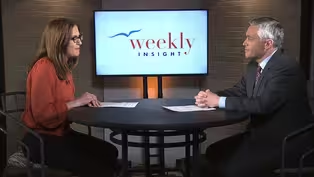
And finally tonight on this episode of "Weekly Insight", we unpack the federal government's investigation of the Washington Bridge closure with WPRI-12's politics editor, Ted Nesi.
Ted, it's good to be with you.
There is so much new information to unpack surrounding the closure of the Washington Bridge.
It's hard to believe, but we're approaching the two month mark since the westbound side of the bridge was really abruptly shut down.
- Yeah, I remember Michelle, I was in the newsroom at like four o'clock, about an hour before it happened.
I got a text from a source who said, "You're gonna want to be at your desk.
We have some big news coming."
And I said, "What?"
He said, "We're gonna have to close the Washington Bridge".
And I said, "Well, you can't be closing the whole Washington Bridge, that would be so disruptive."
And they were like, "That's why I'm texting you."
- [Michelle] Just wait and see.
- Yeah, exactly.
And so, and here we are now two months in, we don't even know how long it's gonna be closed anymore.
- And this is no longer just a Rhode Island issue, now the federal government's involved.
It's been about a week since Governor McKee received this letter from the Department of Justice saying we're looking into any potential violations of federal contracting laws, we wanna see basically, was there any fraud committed?
And it's interesting because the governor learned about this, but waited upon your reporting more than seven hours before divulging that to the public.
What do you make of that?
- Well, it's frustrating, right?
There is an old tradition in the news business of the Friday night news dump where a government or a business puts out bad news Friday night 'cause they know fewer reporters are working and the public's not paying as much attention.
Now, in fairness, the governor insists that's not what happened here.
He said it took all day to review it so that they could release it to the media, but that was a source of frustration.
And then when we finally did get the letter Friday night, like eight o'clock, they finally released the letter itself, it was interesting to see what they're looking for.
The Feds want documents up the bridge, not just from the last month or two, all the way back to 2015.
- [Michelle] Why 2015?
- I don't know.
But the first thought I had was that is Peter Alviti's entire tenure as director of the Department of Transportation, both for McKee and Gina Raimondo before him.
Now, Attorney General Neronha, who's really no fan of McKee, was the state's top prosecutor, he actually cautioned against reading too much into the letter.
He said, "With all the federal money in the bridge, it's not a shock that the Feds would at least be asking for documents, taking a look".
But I still think just the headline's been a black eye for everyone involved.
There was a quote from House Oversight Committee Chairwoman Patricia Serpa to one of my colleagues, she said, "The fact that Department of Justice has an investigation doesn't make me feel very good".
- We've also seen a change in tone from the governor.
He was in meetings all last weekend, we know that he was supposed to attend the ribbon cutting for the new Narragansett Library, he did not attend.
And then you go back to Monday, he announced that he's sending Joseph Almond, his Senior Deputy Chief of Staff over to RIDOT, basically to monitor the handling of this bridge closure.
Have you noticed a change in the governor since the letter from the DOJ?
- Yeah, I think I have for sure, Michelle.
I mean, not only did you have the Monday after that Friday night release of this DOJ letter, the announcement that Joe Almond's being sent over to RIDOT to monitor everything and coordinate it all.
You also had the governor announcing he'd had another call with FEMA, kind of beseeching them for flexibility to provide more federal emergency funding to Rhode Island, which they've said so far Rhode Island doesn't qualify for.
I think the other factor, of course, isn't just the DOJ letter, but the fact that that was the same week we found out finally publicly that the bridge might have to be entirely rebuilt.
We've gone from a three month closure for some quick repairs to this bridge might be unusable and who knows how long that could take.
I mean it took almost a decade to fix the eastbound side of the Washington Bridge.
So I think that also was sort of a wake up call to the governor's office, like what are we really talking about here?
- Yeah, another big development has been these emails that we've had from RIDOT employees that you and your colleagues at WPRI requested, along with other reporters from other media outlets, and it's interesting because engineers at RIDOT privately acknowledged in these emails that the section of the bridge that led to the closure had been hard to see until construction work made it noticeable.
Which begs the question, how did this bridge pass inspection last July?
- And that's a question everyone has, right?
Was it just that you couldn't see the broken parts of the bridge and now you could and that's why it had to be closed?
So was it already broken?
What does that tell us about the inspection process?
We are getting those questions a lot and we don't have answers to them.
- What also struck me is whose emails we weren't seeing?
- Yeah, so there were no emails in this document dump, Michelle, from RIDOT Director Peter Alviti, no emails from his Chief of Staff John Igliozi, who, of course, is a potential candidate for Attorney General in a couple years, so there's scrutiny on him as well.
It left me wondering, did they send no emails about the bridge in that period?
Are they being withheld?
- And the time period is when?
- We asked for emails from December 7th, the day the problem was identified, to a couple days after the bridge closed.
So a period you'd expect a lot of activity.
- So a short window of time, but still.
- Yes, exactly.
There were also no documentation of communication by anyone at RIDOT about the bridge over that crucial weekend between the Friday identification of the problem and the Monday closure of the bridge.
So as people can tell from this conversation, there are just so many questions that remain about the bridge situation, which is why I think you're gonna see a lot more reporting on it in the coming weeks and months.
- Thank you so much, Ted.
I appreciate it.
- [Ted] Thanks, Michelle.
- And that's our broadcast this evening.
I'm Michelle San Miguel.
- And I'm Pamela Watts.
We'll be back next week with another edition of "Rhode Island PBS Weekly", until then, please follow us on Facebook and X and visit us online.
To see all of our stories and past episodes, just go to ripbs.org/weekly or listen to our podcast on your favorite streaming platform.
Good night.
(bright upbeat music) (bright upbeat music continues) (bright upbeat music continues) (bright upbeat music continues) (bright upbeat music continues) (bright upbeat music continues)
Video has Closed Captions
Clip: S5 Ep5 | 12m 2s | Local artist and former inmate chronicles his years behind bars and search for justice. (12m 2s)
Video has Closed Captions
Clip: S5 Ep5 | 8m 48s | An Olympic figure skater shares his tumultuous journey to the top of the podium. (8m 48s)
Video has Closed Captions
Clip: S5 Ep5 | 6m 9s | Ted Nesi and Michelle San Miguel discuss the latest on the Washington Bridge closure. (6m 9s)
Providing Support for PBS.org
Learn Moreabout PBS online sponsorship
- News and Public Affairs

Top journalists deliver compelling original analysis of the hour's headlines.

- News and Public Affairs

FRONTLINE is investigative journalism that questions, explains and changes our world.












Support for PBS provided by:
Rhode Island PBS Weekly is a local public television program presented by Ocean State Media