
Rhode Island PBS Weekly 10/13/2024
Season 5 Episode 41 | 23m 15sVideo has Closed Captions
Growing up Hmong, and the diverse works of local sculptor Peter Diepenbrock.
Isabella Jibilian introduces us to a local Hmong family who talk about their history in the Ocean State. We meet again creator of Clock Man, contemporary sculptor Peter Diepenbrock. Michelle San Miguel and WPRI 12’s politics editor Ted Nesi discuss why the state should hold a constitutional convention and the upcoming layoffs at CVS.
Problems playing video? | Closed Captioning Feedback
Problems playing video? | Closed Captioning Feedback
Rhode Island PBS Weekly is a local public television program presented by Ocean State Media
Rhode Island PBS Weekly 10/13/2024
Season 5 Episode 41 | 23m 15sVideo has Closed Captions
Isabella Jibilian introduces us to a local Hmong family who talk about their history in the Ocean State. We meet again creator of Clock Man, contemporary sculptor Peter Diepenbrock. Michelle San Miguel and WPRI 12’s politics editor Ted Nesi discuss why the state should hold a constitutional convention and the upcoming layoffs at CVS.
Problems playing video? | Closed Captioning Feedback
How to Watch Rhode Island PBS Weekly
Rhode Island PBS Weekly is available to stream on pbs.org and the free PBS App, available on iPhone, Apple TV, Android TV, Android smartphones, Amazon Fire TV, Amazon Fire Tablet, Roku, Samsung Smart TV, and Vizio.
Providing Support for PBS.org
Learn Moreabout PBS online sponsorship(warm inquisitive music) - [Michelle] Tonight, one Rhode Island family's resilience.
- They had to fight for their lives.
- [Pamela] Then, his work is all around us.
Big public art and the evolution of the man who made it.
- There's a way to be a bit of a philosopher, a craftsperson, a designer, an engineer, and then a maker.
- And hundreds of local jobs will be lost at CVS, what it means with Ted Nesi.
(warm inquisitive music) (warm inquisitive music continues) Good evening and welcome to "Rhode Island PBS Weekly."
I'm Michelle San Miguel.
- And I'm Pamela Watts.
We begin tonight with a story about one of the many cultures that call Rhode Island home.
- Hmong people are an ethnic group that originated in China with a diaspora reaching across the globe.
Their journey to the United States began after one of the longest and most divisive wars in American history came to an end.
Producer, Isabella Jibilian, interviewed a Hmong family about their history.
This story is part of our continuing series, "My Take."
- It's pretty good to making soup.
(gentle music) - Very few times my mom and dad have told me they love me, but I know based on how they show me and based how they feed me.
When they feed you, it's a sign of love.
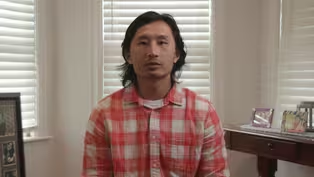
(claps) My name is Johnny Kue and this is "My Take" on growing up Hmong.
The term Hmong means "free man."
I would describe it as a ethnic group.
We don't have our own country, we have our own language.
Hmong, I guess the best way I can say it is, we're not a place, we are a people.
In the Hmong tradition, a lot of our history was passed down through oral history or through tapestry.
In our culture, we call this the pandau.
This one in particular explains my family's journey exactly.
My mother and father grew up in Laos, and it was around the time the Vietnam War happened that my father was recruited to join the Vietnam War.
- [Presenter] Laos, the strategic key to Southeast Asia's richest areas.
- The United States did not know how to navigate the jungles.
And because the Hmongs were familiar with the jungles and the terrain, they were sort of like navigators in the jungles.
(subdued music) When my dad was, was first recruited into the Secret Army, he was about 15 years old.
When the US left the war, they had to fight for their lives.
They were enemies of Laos and the orders were to kill the Hmong families on site or to put them in reeducation camps.
When my family were in the concentration camp and they were slated for either reeducation or they were slated to be executed.
My sister, my oldest sister at the time, she was so skinny that she was able to get a hand untied from the ropes.
And after she got her hand free, she was able to untie my family.
They were able to escape those camps.
They decided to flee Laos.
The only way was to cross the river that was adjacent to Laos and Thailand.
There were soldiers that were guarding the rivers.
My sister, at the time, she was probably one years old, she was on my mom's back and she slipped off and my father just said that if we go back for her, that there's a chance that we all might be dead.
But my mother was able to rescue her and thankfully they were able to get across the river safely.
Eventually they did settle into Thailand where they stayed for a while until the United States offered them political refuge.
(delicate music) We lived in South Providence near the West End, about one block away from the Knight Memorial Library.
I have a really, really big family, seven siblings.
Four were born in Laos and Thailand and three of us were born in the United States.
I am the last of the seven.
I am the baby of the family.
My father was an immigration caseworker and he would help get a lot of immigrants into Rhode Island.
A lot of the folks coming in did not have a voice and there was a lot of fear for the refugees coming in for the first time.
And my father did a lot of work with community leaders to help ease those fears and to help those early refugee settlers to become a part of the community.
So the Hmong community was always tight knit.
My father told me, "If you are traveling somewhere and you're tired and it's late and you have nowhere to stay, find a phone book and you look up the last name Kue.
And you say, 'Listen, I am so-and-so's son from Rhode Island.
Is it okay if we stay at your house tonight?'"
And he said that they would open up their home for you.
And that's just the community that I've been taught.
There was definitely a time in my life where I was trying to suppress like who I was because I was trying to fit in.
But as I got older, I realized how important my culture was and I realized how important I need to pass this on to my son.
It became evident that, you know, everything that my family has done to raise me the right way is because of our Hmong values.
(family chattering lightly) (mom laughs) (claps) My name is Johnny Kue and this was my take on growing up Hmong.
(gentle music) (gentle music continues) - Up next: you can find all sorts of public art, murals, mosaics, memorials throughout Rhode Island, but some stand out more than others.
Tonight, we take another look at a story we first brought you back in March, focusing on the diverse works of local sculptor Peter Diepenbrock.
He crafted something you can't help but see every time you drive along one of the busiest highways in the state.
(traffic droning) Time flies for tens of thousands of drivers who travel every day on Route 95 in Providence.
You can't miss the mischievous worker about to roll a clock right off the roof of the former Brown & Sharpe manufacturing company.
"Foundry Clock Man" is just one of the whimsical works of modern metal art created by contemporary sculptor Peter Diepenbrock.
- The sort of metaphor of it is, why is time so dominating in our lives?
Time is totally dominating.
You think about how we are obsessed with time of day, seasons, you know, retirement.
There's all these ways of chunk, you know, dividing life up into time chunks.
It's a rejection of that.
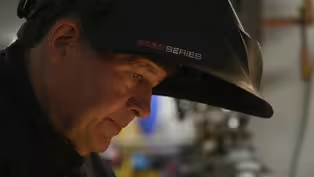
(grinder whirs) - [Pamela] Diepenbrock constructs most of his stainless steel pieces here in his home studio in Jamestown.
(welder buzzing) His is a curiosity shop of fanciful, quirky objects, handcrafted items, as well as many maquettes, artist preliminary models, early editions of his signature timepiece included.
Diepenbrock says a friend encouraged him to lean the clock visually.
- With the 12 being at the one o'clock position.
Just sort of to further emphasize that it's going off the building.
- [Pamela] Diepenbrock says his eye-catching icon is also a tip of the cap paying tribute to Rhode Island factory workers whose lives were spent clocking in and out.
Like those laborers, Diepenbrock says his designs are driven by manipulating materials and fabricating them.
- It's the breadth of all that stuff that maybe makes what I do a little bit more unique.
- [Pamela] Unique and playful.
Diepenbrock's recent piece of public art is an almost-10-foot-tall rabbit springing to life at the playground on Peace Dale's Village Green.
It was commissioned to commemorate South Kingstown's 300th anniversary.
- The gesture is sort of a skating kind of flying bunny, which is sort of inspiring hopefully to young people to kind of live lightly in your own life.
- [Pamela] The sculpture is comprised of some 4,000 pieces of metal fitted together in an organic form.
It's called "Ostara."
Translation: a celebration of new beginnings.
- Life is so serious right now, the world is in such crisis, it seems like everywhere you look that we could use a little more humor and a little less dark subject matter.
(grinder whirs) - [Pamela] When it comes to his artwork.
Diepenbrock says repeating metal patterns and shapes is one signature of his industrial design.
Constructing these structures has allowed him to be the architect of his own career.
- There's a way to be a bit of a philosopher, a craftsperson, a designer, an engineer, right?
And then a maker.
At the core of it is, I love making stuff.
And so it's kind of like, "Well, what could I make today?"
- [Pamela] A native Californian, Diepenbrock discovered that love of making stuff in his father's workshop at age five and continued here in the ocean state when he graduated from Rhode Island School of Design, RISD, in the mid '80s.
He has been successfully self-employed ever since.
Diepenbrock started in a studio in the old foundry building furniture and making sculpture out of recycled material.
Then, he scaled down, transitioning to a cottage industry of small metal art, pewter and cast bronze, and what's known as tabletop giftware.
All have humorous personalities like the "Dinobite Bottleopener."
- Letter opener, candlestick, picture frame, salad servers, centerpieces.
So they all had a function and they're for the most part one-piece products.
- [Pamela] And this product by Diepenbrock was used as a prop in the movie plot of "Men in Black."
(tall man speaking alien language) - [Pamela] But in 2002, Diepenbrock's art took a serious turn.
- A friend stopped by and said, "Peter, do you know about the 9/11 memorial competition?"
And I applied to that and won the competition.
And that is what started the public art practice.
- [Pamela] As you first enter the Rhode Island Statehouse, you pass by Diepenbrock's prestigious commission.
He had only five months to design, create, and install this solemn 9/11 memorial.
It's gold leaf on glass, stark, and steeped in symbolism.
- The reference was, so 9/11, so there's nine layers of glass.
And then the 11 is represented by what looks like the towers.
But if you just see them graphically, there's a, 9/11 is embedded three dimensionally.
It was gonna weigh 4,000 pounds.
And they had to reinforce the structure of the State House from below.
So they had to hire a state, you know, fabricator to come in and build a whole steel armature down below.
It was intense.
I mean, I can't even tell you how intense it was.
- [Pamela] The only project he says may have been more intense: getting "Clock Man" raised up and bolted down above the Providence skyline.
- This one was 14 holes through brick and granite that had to line up with templates that were gonna be cut out of 3/4" steel in another state.
And the parts had to come together and fit.
(bells chiming) - [Pamela] Another of Diepenbrock's heavy metal sculptures can be found on the University of Rhode Island campus.
"Torsion III" twists like the curl of an ocean wave.
This commission is part of the 1% for Public Art program, which mandates a portion of all state funding for construction be spent on artwork to create an atmosphere of beauty and citizen pride.
This 14-foot sculpture was installed outside Lippitt Hall after an extensive renovation.
Diepenbrock says the accessibility of public art is vital to a community.
- As an artist, it's great to have a work in a museum, but to have it out in the public environment's so much better for the general audience 'cause everybody can see it for free.
It's not intentional to have to go in to see the artwork.
And so it should enhance the site, make the site more interesting.
And it usually provides an opportunity to express some symbolism, some values.
- [Pamela] One of Diepenbrock's recent works is drawing the public's eyes in a new direction.
This aerial mobile is the centerpiece of the lobby at Hasbro Children's Hospital.
He calls it abstract construction.
- There's 160 discs of glass, dichroic glass.
There are four sizes and four colors, and they shift their color depending on your view, your angle view.
So the idea was to kind of create this arrangement of floating discs of glass and color that would turn and project those colors all around the room in slow motion.
- Like a rainbow?
- Yeah.
Or a disco ball, but with a little less jazzy.
And the idea being, recognizing that it's a high-stress environment, right?
So kids are coming in, they're scared, you know, their parents are coming in nervous, the staff, highly-stressed environment.
So I was thinking we need to create something that is calming, that is soothing.
If there's a metaphor there, it would be, what would healing look like?
- [Pamela] These days Diepenbrock' says his industrial art concepts aren't so much evolution as experimentation.
- [Peter] What am I doing?
Well, I'm in my tinker-thinker mode.
- He's been trying his hand at plexiglass kinetics.
How a piece revolves, has motion, movement, and balance.
A work in progress?
- Yeah, I don't think it's working.
(both laugh) - [Pamela] Outside Diepenbrock's studio are sculptures privately commissioned or just freeform pieces for his own enjoyment.
Each with a story that can bring a community together and Diepenbrock hopes will surround them for a very long time.
- What I do love about public art as a category is it demands the whole spectrum.
So you have to be able to write about it, you have to be able to speak about it, you have to be able to represent it in model, you have to transition it, you have to translate it, engineer it, actually build it, deliver it as a complete piece that's gonna last for a couple hundred years.
- And since our story first aired, one of the sculptures you saw on Peter Diepenbrock's lawn sold for $95,000, a record for one of his non-commissioned works.
The giant bunny titled "Big B and the Looking Glass" was then donated by the benefactors to the Waterfire Art Center.
You may also find "Big B," on occasion, displayed at some of the Waterfire events.
Now on tonight's episode of "Weekly Insight," Michelle and WPRI12's politics editor Ted Nesi, discuss why Rhode Island voters are being asked if the state should hold a constitutional convention.
But first, they unpack the upcoming layoffs at the local powerhouse: CVS.
- Ted, welcome back.
There is no company in Rhode Island bigger than CVS Health.
We're talking about more than 7,000 employees in the state when you factor in its Woonsocket headquarters, its drug stores, and its distribution facilities.
So clearly it's alarming to state leaders when they hear that CVS Health is having financial trouble.
- Absolutely, Michelle.
And I think it's important to step back as we think about the current moment for CVS.
You know, CVS has changed a lot over the years.
They were founded obviously as a drugstore chain.
We all think of the pharmacies when we think of CVS, that's why they're in Woonsocket.
But in the 2000s they acquired Caremark, which is a PBM, a pharmacy benefit manager, does the drug formulary thing for insurers.
And then since then they've also acquired Aetna, the big insurance company.
So all that has turned them into, first of all, one of the 10 biggest companies in the United States, headquartered in Rhode Island.
But then also their goal has been to transform from a retailer, from a drugstore chain, into a healthcare company.
And the problem is now it's not clear to Wall Street that that strategy has really worked.
- And as you're talking about, investors are clearly concerned about the company's strategy and their financial results.
And the company's CEO, Karen Lynch, is feeling the pressure along with her board of directors.
- They certainly are.
We've seen already a wave of layoffs previously.
Now they've recently announced CVS will be seeking another $2 billion in savings.
That's gonna include layoffs of almost 3,000 people.
We've just learned that they had to tell the state of Rhode Island that about 150 of those people are based at the Woonsocket headquarters and even more than that report to someone at the Woonsocket headquarters.
But I'd argue even bigger than the layoffs news, Michelle, is the news that's emerged in national business publications that the CVS board is considering breaking up the company, which obviously would be a dramatic step and sort of shows they aren't sure this strategy is working for them.
- So then the question becomes, what happens if CVS Health does break up?
What does that mean for Rhode Island?
- And that's the million dollar question, right?
Because we don't know enough.
First I wanna stress this is just, you know, reports.
The board might not take that step.
But if they did, there's been some talk, "The Wall Street Journal" had a piece recently suggesting CVS would put the drugstore chain in one company and then the health pieces in a different company, put the debt with the drug stores.
And that's the part that's really got the deepest ties to Rhode Island.
So that might be a little bit of a concerning move if the board went in that direction.
- And we'll keep monitoring that.
Let's turn to another issue that's getting more attention.
That is a ballot question that will be appearing before voters in November: if Rhode Island should hold a constitutional convention.
A recent poll found that about one in three voters don't know enough about this issue and it is a bit arcane.
Can you break down what would this convention look like?
- Yeah, so it basically, the Rhode Island Constitution demands that every 10 years voters get a chance to vote on whether to hold a constitutional convention.
The idea being to at least force the question of whether there should be deeper reforms to government than the stuff that the Legislature does every year.
So the last time one happened was in 1986, so the voters approved the constitutional convention, then there was a special election where voters elected delegates to that convention.
It met for, I believe, six months.
And then the proposals put forward by the constitutional convention went on the next November ballot for voters to vote up and down.
And that's what led to changes like the establishment of the Ethics Commission and the rules around felons running for office, which was a reaction to Buddy Cianci at the time.
- And you have several prominent organizations that are opposing this, including the ACLU, the Rhode Island AFL-CIO, a labor union, and Planned Parenthood.
They say this is a threat to civil liberties.
- Yes, and abortion rights, Michelle, comes up a lot in this conversation.
And that's because that 1986 convention did put on the ballot a pro-life amendment to the Constitution as a proposal.
So critics say that's their concern, that the convention would open up in their eyes a can of worms on issues they think are settled, they don't want touched.
Now critics of that argument push back because they say, "Well, wait a minute.
When that pro-life amendment went on the ballot, it went down in flames with the electorate.
So the electorate would still have a final say even if the constitutional convention went in directions that some of these groups don't like."
So that's been a lot of the back and forth so far in this debate.
- Meanwhile, you have supporters saying, "Look, here's an opportunity to push through reforms that the General Assembly has previously blocked."
- Yes, exactly.
This is not the General Assembly meeting, right?
This is a whole different group of people elected as delegates.
And some of the examples you've been seeing cited include creating an Office of the Inspector General, something that Republicans have pushed for years and some Democrats have also said might be needed to look for waste and fraud in Rhode Island government, especially when it's really become, effectively, a one-party state.
Another one is putting a constitutional right to education in the Constitution, which might let public school students file lawsuits for more funding, things like that.
- And we should point out, it's not the only way that Rhode Island can amend its constitution.
State lawmakers also have the authority to put this before voters at any time.
- Yes they can.
And they've done it before.
That's how separation of powers between the branches was put in place in Rhode Island, Ethics Commission authority over lawmakers was restored through a ballot measure.
That, lawmakers put on the ballot.
So that is another way, but they only put the things they want on the ballot.
- Good to see you, Ted.
Thank you.
- Good to be here, Michelle.
- Finally tonight, a sneak peek to next week's story about the iconic tall ship.
- Rhode Island's flagship stands proud at 131-feet tall.
She's 200-feet tip to tip, or sparred length we like to say, and about 135 feet on deck.
- [Pamela] Add to that: 3 masts, 20 sails, and six miles of rigging.
She is the official maritime ambassador for Rhode Island.
Docked in Newport, the vintage-inspired tall ship was christened in honor of South Kingstown native son, Commodore Oliver Hazard Perry, naval war hero of the Battle of Lake Erie in the War of 1812.
His monument, in Newport's Eisenhower Park, looks west to the harbor emblazoned with the famous quote from Perry to his fleet commander after the victory: "We have met the enemy and they are ours."
(bell tolls) The Oliver Hazard Perry serves as a floating classroom.
Captain Jonathan Kabak says the goal is to get students and adults to forge a bond with the ocean.
- We are on a mission to ensure that every Rhode Islander develops a meaningful and profound relationship and connection to the sea.
- That looks really interesting.
And that ship is also being used for educational purposes.
- And we'll hear more about that next week and from some of the students aboard.
And that's our broadcast this evening.
Thank you for joining us.
I'm Pamela Watts.
- And I'm Michelle San Miguel.
We'll be back next week with another edition of "Rhode Island PBS Weekly."
Until then, please follow us on Facebook and X and visit us online to see all of our stories and past episodes at ripbs.org/weekly.
Or listen to our podcast on your favorite streaming platform.
Goodnight.
(warm inquisitive music) (warm inquisitive music continues) (warm inquisitive music continues) (warm inquisitive music continues)
Video has Closed Captions
Clip: S5 Ep41 | 9m 40s | We meet again creator of Clock Man, contemporary sculptor Peter Diepenbrock. (9m 40s)
Video has Closed Captions
Clip: S5 Ep41 | 5m 42s | A Hmong family’s astonishing story of survival. (5m 42s)
Video has Closed Captions
Clip: S5 Ep41 | 5m 10s | CVS Health plans to lay off 632 workers employed at its Woonsocket-based headquarters. (5m 10s)
Providing Support for PBS.org
Learn Moreabout PBS online sponsorship
- News and Public Affairs

Top journalists deliver compelling original analysis of the hour's headlines.

- News and Public Affairs

FRONTLINE is investigative journalism that questions, explains and changes our world.












Support for PBS provided by:
Rhode Island PBS Weekly is a local public television program presented by Ocean State Media