
Rhode Island PBS Weekly 10/15/2023
Season 4 Episode 42 | 24m 37sVideo has Closed Captions
An in-depth look at Martha’s Vineyard Sign Language; the rise of centenarians
Island Signs: The hidden history of Martha’s Vineyard Sign Language. Living Longer: Rhode Island-based author William Kole explores how people make it to 100 years of age. My Take: Arlene Violet: Arlene Violet is worried about the fracturing of America.
Problems playing video? | Closed Captioning Feedback
Problems playing video? | Closed Captioning Feedback
Rhode Island PBS Weekly is a local public television program presented by Ocean State Media
Rhode Island PBS Weekly 10/15/2023
Season 4 Episode 42 | 24m 37sVideo has Closed Captions
Island Signs: The hidden history of Martha’s Vineyard Sign Language. Living Longer: Rhode Island-based author William Kole explores how people make it to 100 years of age. My Take: Arlene Violet: Arlene Violet is worried about the fracturing of America.
Problems playing video? | Closed Captioning Feedback
How to Watch Rhode Island PBS Weekly
Rhode Island PBS Weekly is available to stream on pbs.org and the free PBS App, available on iPhone, Apple TV, Android TV, Android smartphones, Amazon Fire TV, Amazon Fire Tablet, Roku, Samsung Smart TV, and Vizio.
Providing Support for PBS.org
Learn Moreabout PBS online sponsorship- [Pamela] Tonight, a forgotten language in Martha's Vineyard?
- My father, he said, "I was sitting right on top of history and I had no idea it was important."
- [Michelle] And how many of us can live to 100?
A Rhode Island author offers advice on increasing the odds.
- Toxic stress is the enemy of longevity.
- [Pamela] Then, Arlene Violet gives her take on the fracturing of America.
- I look at this country, and it's sad to me, that so many of us are really taking the gun to the other side of the equation.
(bright upbeat music) (bright upbeat music continues) - Welcome to "Rhode Island PBS Weekly."
I'm Pamela Watts.
- And I'm Michelle San Miguel.
We begin with a local story about language.
Humans are hardwired for it and the vocabulary we use is constantly evolving.
- Ask any Rhode Islander, and they'll tell you about cabinets, bubblers, and grinders.
The words we say are an important part of our culture.
Tonight we take a look back at a uniquely New England language, one that could have been lost to history.
Producer Isabella Jibilian takes us to the island of Martha's Vineyard to learn more.
- [Isabella] Martha's Vineyard is known as a salty escape.
A place where celebrities and New Englanders alike can leave their mainland worries behind.
It has a culture and a lingo of its own.
- The little frogs, called spring peepers, are on the vineyard called Pinkletinks, or Tupelo trees are called beetle bung trees.
- [Isabella] But unbeknown to the average vacationer, Martha's Vineyard is home to another language.
- Cranberry, swordfish, swordfish.
- [Isabella] One, not spoken, but signed.
- I can't hear, damn it.
- [Isabella] Joan Poole Nash grew up in the vineyard and learned sign language at age seven - I learned sign language from my great-grandmother and it became our private language between the two of us.
I had no idea where the sign language had come from or why she used it.
- [Isabella] Her best guess was that they were Native American signs from the back of the Boy Scout manual.
But when she went on to study American Sign Language, or ASL, in college, it dawned on her that these signs were special.
- There's a sign that no one had another sign for, which was twins, and this was the sign for twins.
Two of them rolling around inside.
- [Isabella] These were the days when many academics didn't believe sign language was a real language.
So evidence of signs growing and changing could be groundbreaking.
- Everybody got super excited and we went over to the vineyard and interviewed all my relatives that we thought had been exposed to the sign language.
- [Isabella] Relatives like Eric Coddle.
- That was diamonds, that was clubs, that was hearts, and that was spades.
- [Isabella] Who remembered deaf neighbors playing cards in town.
- They could concentrate, you know, no distraction.
- We ended up collecting about 300 signs.
- [Isabella] Signs like scallops, codfish, and New Bedford.
The historic whaling port sign translates to.
- Smells bad over there.
- [Isabella] But how did an early American Sign Language spring up in Martha's Vineyard?
We met Bow Van Riper, a historian at the Martha's Vineyard Museum, to learn more.
Today, he's taking us to the home of Martha's Vineyard Sign Language, Chilmark.
- Maybe one in 150 people in Chilmark as opposed to one in say 1,200 people in an average village on the mainland were deaf.
Martha's Vineyard Sign Language developed in Chilmark into essentially a second language alongside spoken English.
- [Isabella] Our first stop, the Chilmark Town Church.
- Jared Mayhew, who was one of the biggest landowners and sheep farmers in town, was deaf.
But his wife, Lottie, short for Jerusha, could hear and she'd sign the sermons to him.
- [Isabella] We also went to the home of Katie West.
- She always told the story that at the age of three or four she was struck by lightning and lost her hearing as a result.
- [Isabella] And visited the old town hall.
- Here in Chilmark, deafness was just another way of being human.
- What's our best guess as to where this gene for deafness came from?
- The first deaf person we know of who lived on the vineyard was a guy named Jonathan Lambert, who came to the island in the very early 1700s from an area of southeastern England called the Wield.
Martha's Vineyard in the 1700s, and really, as late as the middle of the 1800s, was quite isolated from the rest of New England.
Most people, when they got married, married somebody else from Chilmark.
This meant that the likelihood of them marrying somebody who also had the gene and thus both of them passing it on to their kids, was significantly higher.
- Chilmark became a deaf enclave, attracting the interest of one of the most famous inventors of the time.
What brought Alexander Graham Bell to the island?
- Alexander Graham Bell, having long been interested in deafness, his wife, for example, was deaf, was living at a time when the causes of deafness weren't yet well understood.
Because he suspected deafness was hereditary, an area like Martha's Vineyard might shed some light on what was going on.
And here's Bell's name and address.
- [Isabella] Alexander Graham Bell painstakingly mapped Chilmark's family trees.
Today, however, his motivations for research are controversial in the deaf community.
- Bell was deeply opposed to sign language and was a proponent of what was known in the day as eugenics, the control of human reproduction in order to produce a better human race.
He discouraged the deaf people he interacted with from marrying other deaf people.
- [Isabella] Bell was never able to figure out the pattern of how deafness is inherited, but today, academics use his old records to find new answers.
Justin Power is a researcher in linguistics at the University of Texas, Austin.
He has a new theory about how and when the sign language began.
- Humans are almost symbolicals, we're the symbol users.
If you have a group of deaf individuals who are regularly interacting with one another, they will try to communicate with one another.
In a short span of time, 1785 onwards, two families had a relatively lot of deaf children and that's where we hypothesized that the Martha's Vineyard signing community actually began.
- [Isabella] A community of hearing and deaf, both using signs.
Power estimates that Martha's Vineyard Sign Language developed in isolation for about 40 years.
But everything changed when the American School for the Deaf was established in nearby Hartford, Connecticut.
Here, ASL would develop.
- In 1825, the first three deaf individuals from Martha's Vineyard went away to Hartford to study at the American School for the Deaf.
- [Isabella] Today's historians have new ideas about the similarities between Martha's Vineyard Sign Language and ASL.
The traditional view says that signs from Martha's Vineyard were adopted by ASL, but Justin Power believes that it was mostly the other way around.
- So you can imagine that the deaf individuals would've shifted eventually to use more American Sign Language.
(boat horn blares) - [Isabella] It was the start of deaf education in America but it was the beginning of the end for Martha's Vineyard Sign Language.
- So the opening of the American School for the Deaf coincides with the beginnings of reliable, steam powered ferry service to the island.
- How did that affect the number of deaf people born?
- The marriage pool broadens, and although there's still deaf people born on the island, it drops significantly.
- Lots and lots of words.
- [Isabella] After her landmark research, Joan Poole Nash went on to have a decades long career teaching the deaf.
Before we parted, she had a lesson to share.
- The only thing that's gonna move is your thumb.
You need to go up higher.
Yeah, and now flick your thumb.
Yeah, cranberry.
As far as American Sign Language goes, they don't have a sign for cranberry.
So I make it my job to teach everyone, so that sign doesn't disappear up.
(bright music) - Up next, how long can we live and how long should we live?
These are some of the questions a Rhode Island based author is posing in his new book about centenarians, those who live to 100 or more years.
By 2050, demographers estimate there will be eight times more of these triple digit seniors worldwide than we have now.
Tonight we explore how we'll get there and the challenges a super aging society will bring.
- Get ready people because you very well may live to 100 and society is just not quite ready to accommodate us in large numbers.
- [Michelle] Journalist William Kole has long been fascinated by centenarians.
His grandmother, a former toe dancer and pianist for silent movies, was one of them.
- My grandmother was born in 1899 and died in 2003, just shy of her 104th birthday.
And when you have somebody like that in your family, it just leaves an indelible impression on you.
- [Michelle] Kole has been writing about extreme aging since the 1990s.
While based in Paris, he reported on Jeanne Calment, a French woman who lived to 122.
The world's oldest person on record garnered worldwide media attention.
- [Reporter] She lives at a retirement at Aries in southern France.
- She was a very amusing individual.
My favorite quote was, "I only have one wrinkle and I'm sitting on it."
- [Michelle] He also covered Dr. Jack Kevorkian, a controversial pathologist who helped end the lives of more than 100 terminally ill people.
- In a journalism career, there's a lot of death and dismemberment and tragedy.
I think that just helps you to treasure life and family.
And then when you see people living to these incredible ages, you have a real appreciation for everything they've had to overcome to get there.
- [Michelle] Kole's fascination with aging and life motivated him to write, "The Big 100: The New World of Super-Aging."
You talk in the book about how we are on the verge of this longevity revolution.
Why are we expected to see so many people reach 100 and beyond?
- The baby boom generation is a big deal, numerically.
There are more than 70 million of us.
I say us because I'm a boomer myself.
So in the next 25 years, they're going to be aging into triple digits and that will drive the numbers of people living to 100 significantly.
- [Michelle] On top of that, advancements in medicine have also contributed to an influx of centenarians, some of whom are still working, including 101 year old producer, Norman Lear.
He created sitcoms like "All in the Family."
- Now on three, okay?
One, two, three.
(audience laughs) (rocket whooshes) - [Michelle] And many inching their way toward 100 aren't slowing down.
Actor William Shatner was 90 when he became the oldest person to blast off into space in 2021.
- Oh, Jesus.
- [Michelle] The odds of a centenarian making it to space are growing.
Researchers at Stanford University say 50% of five year olds in the United States can expect to reach a triple digit lifespan.
- Some of us may live to 100 and not want to.
We have the genes and the healthy lifestyle that's gonna take us there.
The problem is, are we ready as a society for a 100 year life?
- [Michelle] The short answer, Kole says, is no.
For starters, Social Security's trust fund reserves are expected to run out of money in a decade.
He's conscious of what it costs to live a long life.
He recently retired as New England editor for the Associated Press, but decided to take on part-time work as a copy editor.
- I enjoy the work keeping my hand in journalism but I'd be lying if I said that a primary motivation wasn't to make bank.
We don't wanna outlive our money.
- [Michelle] If elderly people outlive their savings, Kole cautions that younger generations who've relied on inheritances to buy a home, may be left empty handed.
- I'm just gonna chop these so we have 'em.
I'll put 'em in a bag.
- [Michelle] Kole and his wife, Terry, think a great deal about what they need to do to increase their chances of living longer.
They want to be around for their two children and their two grandchildren.
Kole's also encouraged by his 92 year old mom who lives alone in the house where he grew up.
It turns out, humans have more control in increasing their lifespans than they might think.
- Our genes are a huge factor in what gets us to 100.
But it's very interesting that from birth to 90, our behaviors account for about 75% of success in living that long.
And the genetic piece is about 25%.
Once we reach 90 and go beyond, it all flips, and our genes are about 75% determining whether we get to 100 or beyond on.
- [Michelle] Kole's hopeful that his love of running helps him reach 100.
He's enjoyed running since he was a kid.
These days, he puts in about 25 miles a week around his neighborhood in Warwick's Pawtuxet Village.
It's a way for him to blow off stress and stay physically fit.
Several studies have shown that vigorous movement can also significantly reduce the risk of developing dementia.
- My wife and I recently have been moving more towards a pescatarian diet, so that's healthier for us.
And I stopped working full-time in the news industry because I wanted to control my stress.
- So what are you telling me that I should do?
- You're in the wrong business.
(Michelle laughs) - [Michelle] It's impossible to live a life without stress, but what sets super agers apart from everyone else, according to Kole, is their ability to find the best in a situation and make a plan to move forward.
- If you can maintain a positive attitude, there are studies that suggest that you can live seven and a half years longer, which is actually more than what you gain by watching your cholesterol and your weight.
- [Michelle] But while Kole's doing his part to live a long and healthy life, he says too many people have the odds stacked against them.
- White Americans, on average, live almost six years more than Black Americans.
Consequently, they die earlier of preventable causes.
They have higher incidences of diabetes and heart disease.
These are all things that are fixable and it feels to me like we need to make this a huge priority.
- [Michelle] Kole says the United States also needs to prioritize how it caress for the elderly.
The number of caregivers who work with seniors is projected to drop significantly in the coming decades.
- We live in a very youth obsessed, ageist society, frankly.
We value young people over elders in many respects.
And as our society shifts to be one of more older adults, what's that gonna look like?
- [Michelle] Kole says society should take a page from the Blue Zones, five communities around the world where people tend to live the longest.
- People tend to not stuff themselves and then push themselves away from the table full.
They eat until they're 80% full and then they stop.
Another thing is good sleep hygiene.
They get at least eight hours a minimum of good sleep.
In many places, especially in Western culture, we are going all the time.
That's not a recipe for 100 year life.
Hello.
You're so pretty.
Did you just get a shampoo?
- [Michelle] Social isolation isn't part of the recipe either.
- Okay, here you go.
Want it?
That's your ball.
- [Michelle] Kole's in good company but he acknowledges many people are growing old alone.
- The US Surgeon General recently declared loneliness to be a public health crisis.
Really being lonely is like smoking 15 cigarettes a day.
That's how harmful it is to our bodies.
- What scares you most about the prospect of getting to 100 and older?
- I think loneliness, outliving a child, is just not something anybody wants to do.
And I think, honestly, climate change, it throws a big question mark over all of this.
- [Michelle] If conditions are favorable and if Kole's in good health, it's no surprise, he says, he would like to reach the big 100.
- I do like the idea of living to 100.
I think there's a lot of bleakness, but also brightness about a long life.
Time spent creating and contributing more to society, extra years spent in the company of those we love the most.
It's beautiful, potentially.
- And here's another interesting thing I learned from William Kole.
Nationwide, Rhode Island has among the most centenarians per capita, and William thinks it has to do with our proximity to the ocean.
There was a study done in Canada that showed people who live near the water have a longevity advantage versus people who don't live near the ocean.
- Good excuse for a beach day.
- Absolutely.
- Well, finally tonight, we hear from someone who knows a thing or two about Rhode Island's political ups and downs.
She's a former nun and the first female elected attorney general in the United States.
As we first heard in the spring, Arlene Violet tells us about an issue that's been front and center in her mind, the increased polarization of the United States and the fracturing of America.
- Regrettably, I don't think we are the United States of America anymore.
We are fractured America.
We don't even speak to one another.
Citizens vilify other citizens.
We don't even talk at dinner tables anymore because we're afraid that that dinner is going to end up in a toxic environment and spoil the entire occasion that brought us together.
Hello, I'm Arlene Violet, and this is my take on the fracturing of America.
I'm a Black person.
I'm white.
I'm Native American.
I am Italian, French, Irish, Jewish, German.
I'm heterosexual, I'm gay, I'm transgender, I'm binary.
I am not sure, but I'm all those things for certain, because I'm a citizen of the United States of America and that is the country that has promised me that I have inalienable rights.
Margaret Thatcher once said, "This country of America is different from us.
Europe was founded on history.
They are the people that are founded on a philosophy."
I look at this country and it's sad to me that so many of us are really taking the gun to the other side of the equation because we disagree.
Citizens hate other citizens for no other reason than they don't think like they do.
They fight about politics.
But it's not just a great argument where sides present sides and then they walk away as friends.
It actually has turned into alienation.
We are tearing down, also, the bedrock of principles in here, this fabulous country of ours, or what should be a fabulous country.
The Bill of Rights is under attack.
Take the First Amendment.
Journalists are vilified.
They're trying to ban books now in libraries.
Schools are subjected to a curriculum which really is whitewashed.
The truthfulness or the complete truthfulness of our history is not, in fact, taught anymore from the perspectives of the people who are sometimes victimized by American history.
So as I look at the United States today, regrettably, it's a really poor picture and we're also bad toward immigrants.
Back in 1886, when we got the Statue of Liberty from France, they gave it to us because they really believed that we would welcome those huddled masses, those poor, those tired people, who are looking for a break in life.
But yet today, we vilify immigrants.
That's not the America that we're supposed to live in.
I hope that America can be turned around.
We need to go back to our basic founding principles.
We've got to stop fighting angrily with each other and get talking again.
We need to do less arguing and more listening.
Let's go back to the basics, can't we?
If we really want to make America great again in that full sense of the term, it's time for us to start speaking with each other and stop hating each other.
I'm Arlene Violet and that's my take on the fracturing of America - And that's our broadcast this evening.
Thank you for joining us.
I'm Pamela Watts.
- And I'm Michelle San Miguel.
We'll be back next week with another edition of "Rhode Island PBS Weekly."
Until then, please follow us on Facebook and X and visit us online to see all of our stories and past episodes at ripbs.org/weekly or listen to our podcast on your favorite streaming platform.
Goodnight.
(bright music) (bright music continues) (bright music continues) (bright music continues)
Video has Closed Captions
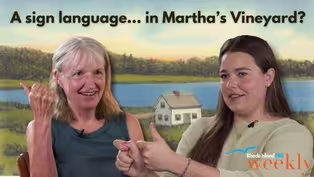
Clip: S4 Ep42 | 9m 22s | The hidden history of Martha’s Vineyard Sign Language. (9m 22s)
Video has Closed Captions
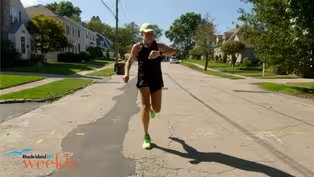
Clip: S4 Ep42 | 10m 26s | Rhode Island-based author William Kole explores how people make it to 100 years of age. (10m 26s)
Video has Closed Captions
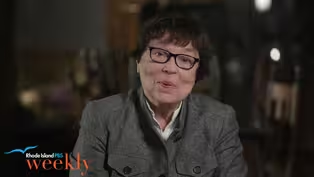
Clip: S4 Ep42 | 4m 40s | Arlene Violet is worried about the fracturing of America. (4m 40s)
Providing Support for PBS.org
Learn Moreabout PBS online sponsorship
- News and Public Affairs

Top journalists deliver compelling original analysis of the hour's headlines.

- News and Public Affairs

FRONTLINE is investigative journalism that questions, explains and changes our world.












Support for PBS provided by:
Rhode Island PBS Weekly is a local public television program presented by Ocean State Media