
Rhode Island PBS Weekly 10/20/2024
Season 5 Episode 42 | 26m 55sVideo has Closed Captions
Horses rescued and saved from slaughter and aboard the Ocean State’s iconic tall ship.
Local equine sanctuary rescues horses from abuse, neglect, and slaughtering. Then, students learning how to navigate and much more aboard the iconic tall ship. Plus, Michelle San Miguel and WPRI 12’s politics editor Ted Nesi discuss bond issues and the Washington Bridge. And finally, another look at a local ceramist who gives us his take on how clay becomes art.
Problems playing video? | Closed Captioning Feedback
Problems playing video? | Closed Captioning Feedback
Rhode Island PBS Weekly is a local public television program presented by Ocean State Media
Rhode Island PBS Weekly 10/20/2024
Season 5 Episode 42 | 26m 55sVideo has Closed Captions
Local equine sanctuary rescues horses from abuse, neglect, and slaughtering. Then, students learning how to navigate and much more aboard the iconic tall ship. Plus, Michelle San Miguel and WPRI 12’s politics editor Ted Nesi discuss bond issues and the Washington Bridge. And finally, another look at a local ceramist who gives us his take on how clay becomes art.
Problems playing video? | Closed Captioning Feedback
How to Watch Rhode Island PBS Weekly
Rhode Island PBS Weekly is available to stream on pbs.org and the free PBS App, available on iPhone, Apple TV, Android TV, Android smartphones, Amazon Fire TV, Amazon Fire Tablet, Roku, Samsung Smart TV, and Vizio.
Providing Support for PBS.org
Learn Moreabout PBS online sponsorship- [Michelle] Tonight, rescuing horses in North Kingstown.
- I've seen horses where they've been beaten, they've been starved.
♪ And all I ask is a tall ship ♪ ♪ And a star to steer her by ♪ (bell rings) - [Pamela] And singing the praises of educational programs aboard Rhode Island's tall ship.
- Then, more developments in the Washington Bridge saga with Ted Nesi.
(bright music) (bright music continues) Good evening and welcome to "Rhode Island PBS Weekly."
I'm Michelle San Miguel.
- And I'm Pamela Watts.
We begin tonight with a story about horses.
- These iconic creatures hold a special place in the history of the country.
From workhorse to horsepower, they remained, for many, an integral part of the American story.
But there is a dark side.
What happens to horses today that have been discarded and deemed no longer useful?
One Rhode Island sanctuary has been answering that question and saving horses for decades.
- I've always been drawn to them.
I've always enjoyed the company of horses.
Every day I say thank you.
I do.
And I love this place.
This is paradise for me, for the ponies.
It is.
It's just, it's a wonderful, wonderful place.
(Deidre whistles) - [Michelle] For Deidre Sharp, caring for horses is not a job, it's a passion.
- Let's go.
Quick, quick, quick, quick, get.
- [Michelle] A passion that gets her out of bed at 3:00 AM.
- I never wake up in the morning and go, "Oh my God."
No, I look forward to getting up.
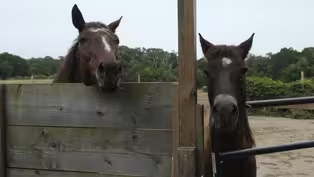
- [Michelle] Sharp is the founder and president of Horse Play an equine rescue and sanctuary in North Kingstown.
- Harry.
- [Michelle] On this quiet farmstead, Sharp and a small but devoted group of volunteers care for abused, neglected, and unwanted horses.
- Harley!
Junior, let's go!
- [Michelle] The majority of the horses that are coming here, what circumstances are they coming from when they arrive here?
- Right now, I would say predominantly lack of knowledge on the owner's part and it turning into a much bigger issue to take care of the horse than they thought.
Whether it be behavioral, financial, a lot of financial issues where people can no longer afford their horse.
- [Michelle] Too often, she says, people part ways with their horses once they're no longer of value to them.
- It's not what can they do for the horse, it's what can the horse do for them?
And when the horse can no longer do for them, then it gets unloaded.
- Mandy Crow has been volunteering at Horse Play for 14 years.
She says many of the horses that have roamed these fields were once viewed as disposable.
- People get tired of them, kids grow up, they lose interest, and horses live for 30 odd years and it's a big commitment for some people and they're just not able to follow through.
At least there's some horse rescues out there that help take care of them.
(gentle music) - Jump up.
Come on, Tom.
- [Michelle] Sharp started Horse Play 25 years ago as a therapeutic riding program for people with mental and emotional challenges.
Over time, it evolved into a sanctuary that's helped more than 400 horses.
Many were headed to an auction when Sharp intervened.
- They're bought by a kill buyer or a meat buyer.
They send them up to Canada where they're slaughtered and the meat is sent overseas.
Places like France, Japan, Italy, I believe, and even Canada itself.
They do eat horse meat there and that's unfortunate, but that's where a lot of horses go.
- And a good number of the horses that you've rescued, you would say, were headed down that road?
- Very much so.
Very much so.
- [Michelle] There are no horse slaughter plants in the United States, but according to the ASPCA, the American Society for the Prevention of Cruelty to Animals, many horses in the country are taken to facilities in Mexico and Canada to be killed for their meat.
- I've had people call me, "Oh, we're interested in," you know, and it's my two biggest horses, and I'm thinking, "And who are you?"
And I find out they actually drive for a meat packing person.
So no, you're not adopting my two horses.
But again, it's by the pound and it's unfortunate, but it is happening every day.
- [Michelle] It's a reality that's troubling for Steven Viens.
10 years ago, he felt called to volunteer with horses.
He picked up the phone and has been at Horse Play ever since.
- They're incredible animals and I tell anybody that if you don't love horses, it's because you don't know any.
There's nothing like 'em.
Once you get used to 'em, they're family.
- [Michelle] These days, it's a blended family of nine horses from all walks of life, including Buddy, a 21-year-old Tennessee walking horse.
Some have behavioral issues.
Others, like Reno, have medical ones.
The roughly 22-year-old American Mustang, named after a city in his home state of Nevada, is going blind, and that's not all.
- His right hind foot was injured when he was rounded up and he was lame and it became a chronic problem and he has never been able to heal totally from it.
He's crippled, essentially.
- Running the sanctuary is a full-time commitment, but it's not Sharp's only job.
During the day, she works as a police clerk at the Newport Police Department.
You work at the police department in large part to fund the work here at the sanctuary?
- I sure do.
Yep.
Unfortunately, there is no funding or very little minimal funding for what we do.
The costs are exorbitant.
- [Michelle] Sharp says about 75% of the organization's expenses come out of her own pocket and costs have gone up, including the price of hay and trips to the vet.
Volunteers, like Mary Cadieux, are grateful Sharp contributes so much.
- It takes a lot to take care of a horse.
Big animals require big space, lots of times, big dollars.
I do wonder and worry where they would be if not for what Deidre has done for a long time.
And of course, the volunteers.
We love doing this, too.
- [Michelle] Steven Viens admits it can be a lot of work.
Some days, he says, he can barely move when he gets home.
He puts in five hours a day, three days a week.
But he says it's well worth it.
- I don't have to pay for counseling because I get all the counseling from the horses.
It's something just totally different.
And you don't even know this place exists.
And when you turn up that driveway and you drive up here, this is another world up here.
(horse whinnies) - [Michelle] It's a world that's still amazes Sharp 25 years later.
And she's quick to point out, she doesn't view these horses as her children.
She says they're her brothers and sisters and teachers.
What have you learned from them?
- Family, friends.
Don't need to do it all by yourself.
You know, seriously, you gotta, you know, the community, pay attention.
Listen, feel, don't be afraid to feel, 'cause they do.
They can feel, sense your heartbeat, four or five feet away.
I think that's what I've learned a lot from them.
Sensitivity to others.
- No horses are currently up for adoption, but Sharp has offered them in the past and people who would like to adopt are required to come to the sanctuary between six to 10 times.
And after a horse is adopted, Sharp says, she reserves the right to take back the horse if it's not being cared for properly.
- She is really giving those horses a second chance at life.
Well we now head out to the mighty waters that surround the ocean state.
Not for recreation, but for education.
And we are traveling with Rhode Island's dashing ambassador, who is also a teacher for many of the state students.
It's a tall order, but this ship is ready to handle it.
- [Jonathan] I'm hard pressed to find anybody that is not captivated by her power, her beauty.
When we show up somewhere, people take note.
She is breathtaking.
We get to sail on the waters of Narraganset Bay, Rhode Island Sound, Block Island Sound, where the sailing is often spectacular.
The views are magnificent.
- [Pamela] Captain Jonathan Kabak commands Rhode Island's tall ship, the Oliver Hazard Perry, and that's not all.
Kabak back is a man of many talents.
♪ I must go down to the seas again ♪ ♪ To the lonely sea and the sky ♪ - [Pamela] While the lyrics of this song are taken from the 1901 poem, "Sea Fever."
♪ And all I ask is a tall ship ♪ ♪ And a star to steer her by ♪ - [Pamela] Captain Kabak could well be singing the praises of taking the helm of this 1800 style tall ship.
It is the largest regularly operating civilian sail training vessel in the United States.
- Rhode Island's flagship stands proud at 131 feet tall.
She's 200 feet tip to tip or sparred length we like to say.
And about 135 feet on deck.
- [Pamela] Add to that three masts, 20 sails, and seven miles of rigging, this is the official maritime ambassador for Rhode Island, home port, Fort Adams, Newport.
- So one of the things that makes this ship so interesting is what looks old on the outside is usually thoroughly modern on the inside.
- [Pamela] Rhode Island's tall ship was christened in honor of South Kingstown native son, Commodore Oliver Hazard Perry, naval hero of the Battle of Lake Erie in The War of 1812.
His monument in Newport's Eisenhower Park looks west to the harbor, emblazoned with the famous quote from Perry to his fleet commander after the victory, "We have met the enemy and they are ours."
Oliver Hazard Perry's namesake was launched in 2015.
It was inspired by tall ships from around the world sailing to Newport 76 for the bicentennial.
- Out of that came an opportunity to create an organization called Tall Ships Rhode Island, which worked to put young people on tall ships for character building experiences at sea.
(bell rings) - [Pamela] The ring of the ship's bell could also double as a school bell.
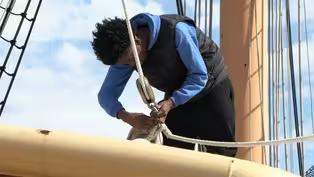
The Oliver Hazard Perry has now embarked on an educational voyage serving as a floating classroom for Rhode Island High School students.
- So welcome aboard the Oliver Hazard Perry.
- [Pamela] Captain Kabak says it's about forging a bond with the sea.
He calls the program Ocean Access, a chance to learn about the boundless opportunities beyond recreational sailing.
- In order to build resilient communities, you need great careers.
So part of our portfolio of programs are workforce development programs for the maritime industry, the marine trade, and the defense sector, all of which are key industries here in Rhode Island that support our economic growth.
- [Pamela] Growing as a person is also part of the curriculum.
- One of the things that we like to say aboard this ship is that you should feel empowered to be the best version of yourself here.
- [Pamela] Some Rhode Island ninth graders spend a day on the bay.
Others, such as these students from the Met School, engage in two day sessions for 11 weeks, learning the ropes.
- And set the main stays'l.
- [Students] Set the main stays'l.
- From bow to stern, from the keel all the way to the masthead, 131 feet in the air, our students participate in every aspect of the operation of the ship.
So they learn how to handle the lines, they learn how to work the engine controls, they learn how to help out in the galley.
They set the sails.
They learn a little bit about marine navigation.
They learn the history of the bay.
(metal clangs) - [Pamela] This is the second tour of duty for 15-year-old Serenity Cooper.
She enjoyed the program so much last year, she signed on for another hitch.
- This experience has been like, it's been life changing, actually.
We learned quite a bit about physics as well.
I learned a lot more about the water, like its currents.
Star platoon, 436, that's 35 gallons.
- [Pamela] Cooper says she discovered a knack for working in the engine room and wants a seafaring career.
- I really just wanna sail around and just figure out ways to help others.
- [Pamela] Roselyn Lopez-Morales describes her experience as an eyeopener.
- It's definitely brought me out of my shell a lot.
- [Pamela] Lopez-Morales, who is a senior, is already charting her future course.
- I'm interested in attending Maine Maritime Academy where I want to do their program with vessel operations and technology, which is basically learning about navigation.
- [Pamela] But the biggest lesson for students.
- Understanding that there is no ocean state without their connectivity to the ocean and the opportunities that we offer and the programs, the experiences are really a conduit for Rhode Islanders to build a profound, meaningful connection to the sea, and in turn, become better stewards.
- [Pamela] Captain Kabak says it takes all hands on deck.
A crew pulling together to keep the Oliver Hazard Perry ship shape.
- When you are shoulder to shoulder, 100 feet in the air with somebody you may not know, you may not share the same background with, but you come away with a pretty profound understanding that you are intrinsically linked to each other.
- The captain says that deep connection to the sea and each other is something he stresses to tourists, volunteers, and those who attend the adult workforce development programs.
Captain, what is it you want people to come away with, most of all?
- I like to say people come for the pirate ship and stay for the opportunities.
The focus is to really share with people that it's not just a pretty picture, that it's not just a historical relic, but rather the ship and the opportunities that we offer aboard are really consistent with the 21st century and where we as a community in Rhode Island are going.
- Now on tonight's episode of "Weekly Insight," Michelle and WPRI 12's Politics Editor, Ted Nesi, discuss bond measures on the November ballot.
But first, the latest on the Washington Bridge.
- Ted, welcome back.
Always good to see you.
Let's start with the latest developments with the Washington Bridge.
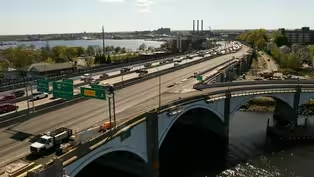
We recently received some news about the next steps that Rhode Island state leaders plan to take regarding finding someone to build the westbound Washington Bridge.
At the same time, there are still so many unknowns about that timeline.
- Yeah, as people probably remember, the original goal set up by Governor McKee was to have the new bridge open by the end of August, 2026.
While no one's saying officially that that is out the window, it's getting much harder to imagine that happening because ever since they failed to get any bidders for the project back in July, the state has been unwilling to give a new timeline.
So this week we learned that they're going out to bid for a second time.
They no longer expect to pick a contractor to build the bridge until next June, June of 2025.
They're so worried about not having enough participation, they're actually gonna pay the runner up bidder $1.75 million just to participate.
That's the bidder that doesn't get the contract.
And then separately, McKee says demolition of the old bridge, which was supposed to be done by like January of 2025, will actually now take all of 2025 because they're gonna take down the piers that used to hold up, that currently hold up the old bridge, too.
So a lot of changes to the timeline already, even though we don't even have a full timeline yet.
- And it's telling that Governor Dan McKee is not even estimating when commuters can expect to drive over that new bridge.
And as you said, we don't even know if that bridge will be built in time when he's seeking reelection in 2026.
- Yeah, certainly the political risks here are very real.
McKee says, you know, he argues that part of, there's a responsible reason he's not giving a new timeline, which is they have to see these bids come in, they have to see what these companies say they can do.
But it's certainly, the indications are, we aren't gonna really have a firm timeline till next spring or even summer.
- Yeah, very frustrating for people who drive over that bridge daily.
I do wanna stress, though, there is some encouraging news.
Recently there was a major infusion of federal money for that bridge.
- Yes, Rhode Island's congressional delegation very pleased about this announcement.
They've now secured $221 million from two different US DOT grants to help pay for repairing the bridge.
That was the maximum the state could get under the old cost estimate for the project, which again, is now off the table.
So we don't actually know how much money is going to be needed because that new cost estimate is needed to find out, but still, certainly the state leaders are very happy to have this amount of money set aside for the bridge project, at least as a large down payment and then they'll maybe go for more later.
- Sure.
Let's turn now to the election.
Early voting is underway in Rhode Island and voters are being asked five ballot questions.
Last week we talked about the constitutional convention question.
There are four other questions all centered around bond issues.
Question two is a $160.5 million higher education bond for URI and Rhode Island College.
Question three, a $120 million bond for affordable housing programs.
Question four a $53 million so-called green bond for environmental projects and port infrastructure.
And then question five is a $10 million bond for arts and cultural facilities.
And Ted, historically, these bond questions almost always pass.
- Right, it wasn't always that way.
As recently as the early 2000s, a couple of bond questions did fail.
But ever since the 2008 election, Rhode Island voters have approved every single bond issue that state lawmakers have put on the ballot.
Right now, I'd say that's the expectation again this year, that these will also pass.
There are active political campaigns being run on behalf of all of them.
And so far there are no signs of any real organized opposition to these bond questions.
- We should point out, it's not a small amount of money that we're talking about.
- No, it's not.
I mean, once you take the bond, once you add the interest payments and it's like a mortgage over the next 20 years, these will cost Rhode Island taxpayers over half a billion dollars for these projects.
So I think, while politically it doesn't seem like there's a lot of concern that voters will reject them, though a surprise could happen, the question maybe is more around, is the state gonna get value for money once this money, this bond money, hits the streets.
Housing, the big housing bond, I think is a place that's really in focus.
The Rhode Island Public Expenditure Council just recently put out a report looking at all the money the state's been putting into housing and where that money is going.
And they did raise some concerns about the high cost of each affordable housing unit.
And they stress that, you know, with more money potentially coming in, if this bond question passes, the state leaders really should also take a look at how they're spending it, not just throw the money out there and see what happens.
- And Ted, I know how much you love political history, so there is some interesting trivia that ties these two topics together, bond questions and the Washington Bridge.
What is it?
- Yeah, Michelle.
Well, as we said, most bond questions pass in Rhode Island, but a few have failed over the last century.
One of them, 1932, Rhode Island voters rejected a $5 million bond request for the Washington Bridge.
- Wow.
Full circle.
- Full circle.
- Thank you very much, Ted.
- Great to be here.
- Finally tonight, it's one of the oldest art forms in human history.
But these days, the craft has garnered new audiences from scores of likes on TikTok to television shows like "The Great Pottery Throw Down."
Back in April, Producer Isabella Jibilian first in introduced us to a Rhode Island Potter who gave us his thoughts on how clay becomes art.
This story is part of our continuing My Take series.
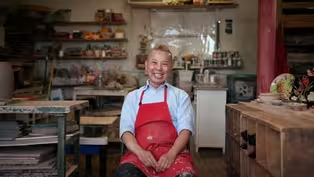
(clay thumps) - From a lump of nothing, you can create this functional or a sculptural work and I think it's magic.
My name is Dwo Wen Chen and this is My Take on pottery.
I am a studio potter and I've been doing this for over 20 years now.
I grew up in Taiwan in a really small farming village.
We did not have any video games or toys to speak of.
We had to create our own toys.
And I remember one of the things we do is we pinch clay pots.
At that time, I did not know they're clay pots, you know, just like mud from the rice field.
We pinch it and then we would slam it on the ground to see whose pot created the biggest hole.
So that's our game.
(laughs) I have always been a painter and I never had thought that I would become a potter.
- [Isabella] And why did you become a potter?
- Out of necessity.
I couldn't sell any of my paintings, but I managed to sell all of my, at that time, very rudimentary pinch pots.
This is one of my first pots.
There's just no technique to it.
(laughs) I just love the passion of it, I think.
I thought there was probably a little future in the pottery making for me.
(soft bright music) Being self-taught, you don't have all the restraints of all the disciplines, of all the rules.
(machine whirs) I really go into the pottery making blindfolded in a way.
And therefore, I make a lot of mistakes.
(clay thumps) I think I have to redo it.
I'm even tempted to say I make all the mistakes (laughs) there is to make in pottery making.
But out of that, I came up with some pretty creative way of having a final piece.
Gonna collapse the center to form a double wall.
I was cooperating with this chef to come up with a piece for his restaurant to serve a little appetizer.
His inspiration is he wants me to mimic the shape of a cornerstone that's been indented by the dripping of the rainwater.
- [Isabella] How many times did you fail making this before?
- Oh, maybe more than 100, 200 times.
And the more I fail, the more I wanna make it happen.
And there we have a base of a pillow bowl.
The history of pottery making, it's of course born out of necessity.
People need vessels to use for their meals.
As you can see, this is a hand pinched pinch pot.
But with the handle, they usually, they would rope it and hang it on an open fire.
It's close to 5,000 year old in the (speaks in foreign language) Chinese cultural period.
I remember at a younger age, being in the western art education, I was trying to disguise my Eastern heritage, you know, trying to fit in.
In any of my creations, my heritage just naturally comes through and that's when I'm most comfortable with my work.
And then I learn not to fight it and instead trying to find a way to combine it, you know, to find a good balance between the two.
(soft music) My understanding of pottery is we're creating something that people can use in their everyday life.
It's a small pleasure to enhance somebody's daily life.
And for me, that's art enough.
My name is Dwo Wen Chen, and this is My Take on pottery.
- Since we first aired this story, Dwo Wen Chen's work was shown at the Smithsonian Craft Show in Washington DC, and in November, his pottery will be exhibited at the Philadelphia Museum of Art Craft Show.
- Quite an honor.
- Congratulations to him.
And that's our broadcast this evening.
Thank you for joining us.
I'm Michelle San Miguel.
- And I'm Pamela Watts.
We'll be back next week with another edition of "Rhode Island PBS Weekly."
Until then, please follow us on Facebook and X and visit us online to see all of our stories and past episodes at ripbs.org/weekly.
Or listen to our podcast on your favorite streaming platform.
Goodnight.
(bright upbeat music) (bright upbeat music continues) (bright upbeat music continues) (bright upbeat music continues)
Video has Closed Captions
Clip: S5 Ep42 | 6m 5s | Inside Dwo Wen Chen’s pottery studio. (6m 5s)
Video has Closed Captions
Clip: S5 Ep42 | 8m 20s | An equine rescue and sanctuary cares for abused, neglected and unwanted horses. (8m 20s)
Video has Closed Captions
Clip: S5 Ep42 | 4m 49s | A date has not been set for opening a new westbound Washington Bridge. (4m 49s)
Video has Closed Captions
Clip: S5 Ep42 | 7m 26s | Rhode Island’s Tall Ship, the Oliver Hazard Perry is about education as well as recreation. (7m 26s)
Providing Support for PBS.org
Learn Moreabout PBS online sponsorship
- News and Public Affairs

Top journalists deliver compelling original analysis of the hour's headlines.

- News and Public Affairs

FRONTLINE is investigative journalism that questions, explains and changes our world.












Support for PBS provided by:
Rhode Island PBS Weekly is a local public television program presented by Ocean State Media