
Rhode Island PBS Weekly 10/22/2023
Season 4 Episode 43 | 25m 13sVideo has Closed Captions
Unequal tree canopy distribution in Rhode Island and mummy curses haunt the Ocean State
In this episode, Michelle San Miguel explores the importance of “trees” in our environment and the tree inequities that poorer neighborhoods in Rhode Island experience. Then, another look at the Rhode Island School of Design’s nature lab where unusual creatures are the norm. Finally, Pamela Watts interviews a Rhode Island author who has been collecting stories about the Ocean State’s haunted pas
Problems playing video? | Closed Captioning Feedback
Problems playing video? | Closed Captioning Feedback
Rhode Island PBS Weekly is a local public television program presented by Ocean State Media
Rhode Island PBS Weekly 10/22/2023
Season 4 Episode 43 | 25m 13sVideo has Closed Captions
In this episode, Michelle San Miguel explores the importance of “trees” in our environment and the tree inequities that poorer neighborhoods in Rhode Island experience. Then, another look at the Rhode Island School of Design’s nature lab where unusual creatures are the norm. Finally, Pamela Watts interviews a Rhode Island author who has been collecting stories about the Ocean State’s haunted pas
Problems playing video? | Closed Captioning Feedback
How to Watch Rhode Island PBS Weekly
Rhode Island PBS Weekly is available to stream on pbs.org and the free PBS App, available on iPhone, Apple TV, Android TV, Android smartphones, Amazon Fire TV, Amazon Fire Tablet, Roku, Samsung Smart TV, and Vizio.
Providing Support for PBS.org
Learn Moreabout PBS online sponsorship- [Pamela] Tonight, trees offer countless benefits but not everyone in Rhode Island is reaping the rewards.
- On a really hot day in the summer, there can be up to a 10 degree difference in temperature from a a high-canopy neighborhood and a low-canopy neighborhood, and that has all sorts of impacts on public health.
- [Pamela] And we take you to the wilds of College Hill.
- These snakes, I swear, they're like, they're so lovable when you give 'em the chance.
- [Pamela] Then, did the curse of the Mummy haunt the Newport man who discovered Egypt's Valley of the Kings?
- The Curse of the Pharaoh was put in place to ward off anyone from disturbing the final resting place of the Pharaohs.
The penalty for doing so was death.
(upbeat music) (upbeat music) - Welcome to Rhode Island, PBS Weekly.
I'm Michelle San Miguel.
- And I'm Pamela Watts.
Fall foliage in Rhode Island is about to reach its peak, a great time to walk outside and look at the vibrant colors.
- Those trees also provide much needed shade.
After all, Rhode Island is one of the fastest warming states in the country.
But the tree canopy is not distributed equally across our state.
Tonight we explore how tree equity is taking root in the ocean state.
This story is part of our continuing Green Seeker series.
- I don't pretend that, well, if we just added trees here all the problems we have with inequity would be addressed, but they are one piece of it.
- [Michelle] Cassie Tharinger has spent a lot of time thinking about trees in Providence.
Specifically, what neighborhoods lack trees and what can she do about it?
- [Cassie] We see that we have higher tree canopy in areas that are higher income or have higher rates of home ownership.
And we have lower tree canopy in areas with lower income, in areas that have more communities of color living.
- [Michelle] Tharinger is the executive director of the Providence Neighborhood Planting Program.
The nonprofit works with the city of Providence and other groups to offer free street trees to people in the community.
- This is a map of tree canopy cover in the city of Providence.
- [Michelle] Blackstone, one of the wealthiest areas in the capital city has the highest tree canopy at 51%.
Trees are abundant on the east side of Providence.
Wayland and College Hill also have some of the highest tree canopies in the city.
But poor neighborhoods like Upper and Lower South Providence and Washington Park are among the lowest.
- Decades and decades have contributed to this, to tree inequity.
Things like redlining, historic redlining, how policies around zoning and land use have played out over time, highway relocation.
- [Michelle] Tharinger wants people who've been affected by tree inequity, like Leo Mota, to have a role in fixing it.
Mota's seen how greenery can improve a community.
A few years ago, about a dozen trees were planted in his neighborhood on the west end of Providence.
- Before we planted the trees there was broken glass everywhere.
I mean, you still catch a few broken bottles here but it's not as much.
Every time we are taking care of the trees, people say, oh, nice job.
If they see something on the ground, they'll pick it up.
Before, nobody really cared.
(clipper clicking) - [Michelle] Mota works for Garden Time, a group that prepares incarcerated and formerly incarcerated individuals for the workforce by training them for fields like landscaping.
- I believe my neighborhood has benefited from those trees 'cause it's made the neighborhood look a lot better.
It's helping with the shade for the children.
It doesn't look neglected anymore.
- [Michelle] And the environmental benefits are well documented.
Trees help lower energy consumption, capture pollutants in the air, and filter runoff.
Rhode Island State Forester, Tee Jay Boudreau says trees also reduce what's known as the urban heat island effect, when dense areas of pavements and buildings absorb and retain heat.
- We've noticed here in Rhode Island through studies that we've done that on any given day the temperature can be dramatically lower in a shaded area, as much as like 12 degrees versus one spot to the next.
The data showed us that one part of town it's 94 degrees in the same city, a different part of town that is more canopied, it's 82 degrees.
- At the same time.
- Same time, yeah.
- [Michelle] More than half of the state is forested and Boudreau wants to see more cities and towns increase their tree canopy.
He views urban forestry as a way to curb carbon emissions.
- The work we're doing shows concrete data that allows decision makers to put trees in the ground based on the best locations for them.
So we're giving them the information that they might need in order to make the right decisions about where to plant trees, and that makes it a lot easier for them to spend their dollars in an area where they know it's gonna make a difference.
- [Michelle] American Forest, a nonprofit conservation organization, released this interactive map for Rhode Island a few years ago.
It shows a neighborhood's tree cover in relation to its demographic information and gives a score for each community.
- It might sound obvious, but the goal is to get to a tree equity score of 100.
- Yeah, that's everyone's goal is to get 100, which doesn't mean that there is a completely planted base of trees where every tree could possibly go.
It means that the neighborhoods within a community are equitable to each other.
- [Michelle] Those scores showed what people who live in urban core areas already knew.
Places like Central Falls and Pawtucket, among others, need more trees.
- The work that we did to develop that tree equity score is literally house lot by house lot.
So we can determine the best location in front of an individual's home or in any location in the community.
- [Michelle] Boudreau says those tree equity scores mobilized communities to act faster to increase their tree canopy.
John Campanini agrees.
He's the technical advisor for the Rhode Island Tree Council, a non-profit organization aimed at improving urban forestry statewide.
- We've seen more citizen-led tree advocacy where we're working with groups to plant trees in athletic fields or in their neighborhood.
- [Michelle] Campanini previously served as the Providence City Forester for 28 years.
He says, when cities and towns were developed, too often trees were an afterthought.
- No one ever told me not to plant or prohibit me from planting, or the parks department, from planting in certain area because of race, color, creed, economic status, or what have you that.
But there were just so many inferior environments in that part of town because of the way it was developed.
- [Michelle] And planting trees can be costly.
For instance professionally planting this red maple can range from 400 to $500, and putting one in a sidewalk can be even more expensive.
- There's places where we can remove asphalt and create pervious soils, which will accept water and drain water, but actually sustain trees long time.
And those are the type of things that cost a lot of money.
- This one was growing down.
- [Michelle] It's money that Leo Mota believes is worth the investment, and he's doing his part to keep these trees alive.
- We go out there every week, water them, we do the tree pick care, make sure that they have mulch, make sure that they look nice.
- [Michelle] He wants to make sure his 10 year old son reaps the rewards of more greenery.
- I feel, especially someone like myself with a criminal history, we've done things to deteriorate our community, so it almost feels good to help and try to rebuild it.
Our children live here, you know, and they're the future.
We want different lives for them than the ones that we had if we had rough lives.
- For Boudreau, expanding tree coverage is more than a landscape issue.
It's a way for Rhode Island to help mitigate climate change.
What do you say to people who will hear things that you say and say, we need to do a lot more than plant trees to reduce the effects of climate change?
- I think they're right.
I think there is a definitely a lot to do.
I think there's personal responsibility and I think that there is responsibility towards organizations and corporations throughout the world and the United States.
But what we're doing and what we have the capability of doing in the forestry program is helping communities plant trees, plan for planting trees, and to recognize the importance of green spaces in their community.
- [Michelle] Communities are taking note.
The Providence Neighborhood planting program has increased the number of trees it's getting in the ground, averaging 550 a year.
- I think there has, fortunately, been a real increase in awareness of just even that term, tree equity, five years ago, knowing that wasn't even a saying, no one talked about that.
The problem was there, the disparity was there, but it wasn't a conversation being had.
It was wasn't something people were really plugging into.
- [Michelle] But now Tharinger and many others are focused on the future.
- We're not gonna see the real benefits and impacts of this of this tree's canopy for 10, 20, 25, 30 years down the road.
So we're really, we're planting trees for our children and our grandchildren.
We're in it for the long haul.
(bright music) - Up next, we take another look inside the Rhode Island School of Design, or RISD, as it's affectionately known.
The college was founded by a small group of women 145 years ago driven by a desire back then to support Rhode Island's thriving textile and jewelry industries.
Classes included freehand drawing, painting, and design.
Today, RISD also offers filmmaking, industrial design, and glassworking.
As part of our continuing series, Window on Rhode Island, we visit an unusual part of the college where for the past 85 years, students can find owls, skeletons, and mysteries only seen by microscope.
- Welcome to the Edna W. Lawrence Nature Lab at the Rhode Island School of Design.
My name is Jen Bissonnette, and I'm the interim director of the lab.
(whimsical music) So the building that we're in right now was RISD back in 1877.
So this beautiful brick building on Waterman Avenue was the entirety of the Rhode Island School of Design.
And in 1937, this became the studio space for one of the professors here, Edna Lawrence, hence the name of the lab.
(whimsical music) She taught nature drawing in this classroom.
And her thinking was that if ever you were at a loss for what to do with one of your projects, that nature could serve as endless inspiration in terms of color and form and pattern and structure.
(whimsical music) Edna Lawrence, she definitely marched to the beat of her own drummer, thankfully.
And there's stories that she actually at one point stowed away on a barge.
She was so eager to get to these other countries that she found any way that she could as a woman to book her passage to get to these incredible destinations.
When Edna left, there were about 20,000 specimens in the collection, and now we say there's somewhere between 90 and 100,000 specimens.
(whimsical music) The Nature Lab is in this funny kind of a space, right?
It reads a little bit like a natural history museum, except it is a little bit more like a lending library.
Most of the things in this collection don't have, what we call, a red dot on them.
If it's a red dot, you can't check it out, like my friend the bear here, he can't be checked out.
But other things you can check out just like you would a library book.
Students take the specimens, they take them back to their dorm rooms or their studio and they're able to really explore them and apply them into their projects in whatever way they want to.
- Hello, I'm Benedict Gagliardi.
I'm the staff biologist and collections manager at the RISD Nature Lab.
(whimsical music) In addition to all the preserved and dried specimens that we have, which is the majority of what we have here, there's been a long history of having live animals as well.
To my left here is our resident corn snake.
Hey!
We do occasionally get found escaped pets and things like that from various dorms on campus.
Recently we got a small snake, the same type of snake, a corn snake.
A plumber on campus walked into the lab with it in a cardboard box and said, "I found this escaped in one of the dorms and thought you were the people to deal with it."
(laughs) - So one of the interesting creatures we have here at the Nature Lab is our Axolotl Gulliver.
They're actually critically endangered in their natural habitat, which is in Mexico City.
It's just one lake in Mexico City where they're found naturally.
Hi.
But they're very, very widespread globally because they're used in labs for a number of different purposes, one of which is to study limb regeneration.
So these guys can actually lose an arm or a leg and grow it back again.
And I thought, well, this will be interesting.
I'll see if I can grow an axolotl.
And basically we wound up with 24 full grown axolotls at the end.
So we had a little bit of an axolotl overabundance, which we, we found them all really good homes.
Okay, so let's head over to the bone room.
So here we are in the bone room, and this is obviously a collection of bones, internal skeletons and exoskeletons.
(whimsical music) You know, one of the things that I find exciting about this collection is it probably is the space that highlights most what we're trying to do in terms of biomimicry.
Biomimicry is looking to the natural world for design solutions.
So thinking about the 3.8 billion years of evolution that life has been on this planet, there are a lot of pressures that have been solved by organisms over time that we as designers can look to for inspiration of how to solve some of the design problems that we're facing.
(whimsical music) So welcome to the imaging lab.
When Edna Lawrence left in 1977, the one thing that she said when she was going out the door was, there'd be a whole new array of things to explore if we could see them at different scales.
(whimsical music) So for example, using the high speed video camera, there's some images on the screen back there that show how a dragonfly's wing, when it's raining, the water falls on the wing, beads up, and rolls right off of the wing.
So then students came over and used the scanning electron microscope to see what those microstructures of the wing are that allow it to have that hydrophobic surface.
So the collection is always changing.
Students will send things from their travels as well, and we even sometimes get mystery boxes.
So that's always a fun opportunity too, to know that the students are thinking of us, but also potentially to add to the collection.
So the collection is always growing.
(bright music) - It's the season when Halloween means reveling in fear for fun.
And according to one author who's been collecting local legends and folklore for years, the ocean state is steeped in haunted tales.
Tonight we explore how an infamous curse came home to roost in Rhode Island, or did it?
- I just, from a very young age, was fascinated by these types of stories that had something that no one could explain.
- [Pamela] Stories like the Tale of Mercy Brown.
Rhode Island author, Mary Elizabeth Reilly-McGreen, says she grew up near the place where Brown is buried in Exeter and later exhumed in the 1800s on suspicion of being a local vampire.
Instead of frightening Reilly-McGreen, it was the fuel to start collecting macabre and mysterious local lore.
Do you ever get a strange feeling when you're working on these stories?
- I wish I could say I do.
I've never, I will characterize myself as ghost repellent.
- Reilly-McGreen has written extensively on Rhode Island legends, publishing several books on the topic of monsters and haunted hallows.
Does Rhode Island, though, have an inordinate amount of these stories for a little state?
I was impressed by the amount of material that was available.
You find that Rhode Island's breadth of folklore, in terms of the different types of stories, are remarkable.
- [Pamela] She says many stories came from people worldwide sailing through Newport.
Reilly-McGreen says, the late John Updyke, author of "The Witches of Eastwick," had an expression for it.
- Updyke called it "A state of mercurial uncaring," and I loved that.
I was like, yeah, I think Rhode Island really doesn't care what anybody else thinks of it.
- [Pamela] One of those non-conformist Rhode Islanders might be Theodore Montgomery Davis, copper tycoon, lawyer, and millionaire financier.
Davis built an estate on Majestic Brenton Point in Newport.
His mansion was called The Reef.
- He was an explorer and an archeologist, and he was responsible for some of the most important and sensational discoveries of his day in terms of Egyptian artifacts.
- [Pamela] Davis funded explorations that uncovered the Valley of the Kings in Egypt.
Here are where lie the rock tombs built for ancient royal families and their possessions.
Davis carved the way for British archeologist, Howard Carter, to eventually discover King Tut's burial site.
Carter was financed by British Earl, Lord Carnarvon.
Davis collected many artifacts from his own excavations.
- Not everything went to museums.
Some things the the archeologists claimed for their own personal collections.
He had many, many priceless artifacts.
- Right in Rhode Island?
In Rhode Island.
- In his gilded mansion.
- Exactly.
- Davis's home, where he kept the rare Egyptian antiquities, was later destroyed by fire.
All that remains today is the dangerous, decaying, vine-covered stable, now known as The Bells.
Was it a haunted house?
- It depends on your belief system.
So if you're inclined to believe that houses can be haunted, objects can be haunted, then yes, I would say it is a haunted house.
- [Pamela] Haunted perhaps because of what's known as the Curse of the Mummy.
- Death, eternal punishment for anyone who opens this casket.
- [Pamela] Woe to those who disturbed the repose of the pharaohs, an often told tale scaring up several Hollywood movies.
- The Curse of the Pharaoh was put in place to ward off anyone from disturbing the final resting place of the Pharaohs.
The penalty for doing so was death.
We called them archeologists, the Egyptians would've called them grave robbers.
It was a desecration.
- Reilly-McGreen read us an excerpt from her book on Rhode Island legends where she describes the curse as a dark winged thing.
- "From the dust she'd risen, hot, angry, and thirsty for the blood of the infidels, commoners who'd hollowed out the Valley of the Kings."
- [Pamela] And she writes, horrible deaths would shadow these treasure hunters of the early 20th century.
Howard Carter died of cancer.
Lord Carnarvon died in Egypt of an infected mosquito bite only months after finding King Tut's tomb.
It was Sherlock Holmes creator, Sir Arthur Conan Doyle, who publicly speculated on the mummy's curse, bolstering the myth.
Davis died in Florida at age 78.
Did he escape the curse?
- That is the curse of the Pharaoh, and Theodore M. Davis, who died unremarked upon in Miami, far away from those objects that he prized most in life.
- [Pamela] So while Davis did not die an untimely death, he did perish in relative obscurity.
The Pharaohs buried in the Valley of the Kings have eternal fame.
Davis's ashes are interred in Island Cemetery Newport, largely forgotten.
(bright music) And author Reilly-McGreen says she's now searching for tales of mermaids in Rhode Island, which she refers to as Sea Witches.
- Interesting.
You know, when people think of Halloween, they think of Salem and the witchcraft trials.
But the truth is, we have a lot of haunted history right here in Rhode Island.
- We do.
And speaking of that, we have a sneak peek to a story that will air next week.
The Spirit of Rhode Island Horror fantasy author, H.P.
Lovecraft, still lingers, but for some the memory of this literary icon's writings is both painful and filled with disdain.
- He has this famous quote, "The oldest and strongest emotion of mankind is fear, and the oldest and strongest fear is fear of the unknown."
- [Pamela] Fear creeps throughout the pages of some 66 short stories written by H.P.
Lovecraft.
His supernatural tales published in Pulp Magazines of the 1920s and '30s earned the author the title, Father of Cosmic Horror.
A potion of weird literature, science fiction, and fantasy.
(chilling music) But those possessed with reading Lovecraft also have to come to grips with something more sinister than his imaginings.
The author had a chilling monster inside: bigotry.
It is no secret in his writings.
And that's our broadcast this evening.
Thank you for joining us.
I'm Pamela Watts.
- And I'm Michelle San Miguel.
We'll be back next week with another edition of Rhode Island PBS Weekly.
Until then, please follow us on Facebook and X, and visit us online to see all of our stories and past episodes at ripbs.org/weekly.
Or listen to our podcast on your favorite streaming platform.
Goodnight.
(upbeat music) (upbeat music) (upbeat music) (upbeat music) (upbeat music)
Video has Closed Captions
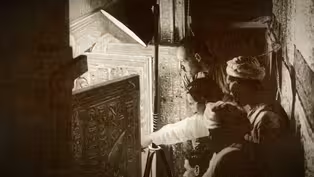
Clip: S4 Ep43 | 6m 35s | Legend has it the “Curse of the Mummy” still haunts Rhode Island. Explore the spooky tale. (6m 35s)
Video has Closed Captions
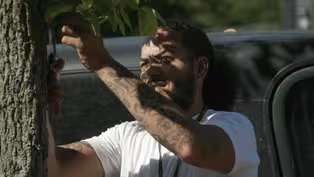
Clip: S4 Ep43 | 9m 47s | Tree canopy isn’t distributed equally in Rhode Island but there’s work to change that. (9m 47s)
Window on Rhode Island: The Nature Lab
Video has Closed Captions
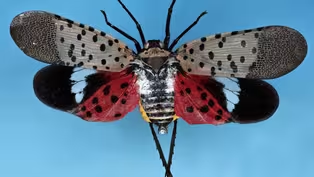
Clip: S4 Ep43 | 7m 19s | Explore RISD’s Nature Lab, where unusual creatures are the norm. (7m 19s)
Providing Support for PBS.org
Learn Moreabout PBS online sponsorship
- News and Public Affairs

Top journalists deliver compelling original analysis of the hour's headlines.

- News and Public Affairs

FRONTLINE is investigative journalism that questions, explains and changes our world.












Support for PBS provided by:
Rhode Island PBS Weekly is a local public television program presented by Ocean State Media