
Rhode Island PBS Weekly 10/27/2024
Season 5 Episode 43 | 23m 5sVideo has Closed Captions
Breast cancer awareness and restoring historic grave sites
An in-depth report on why many women with dense breasts are at greater risk of developing cancer. Then, Michelle San Miguel and WPRI 12’s politics editor Ted Nesi, unpack some of Rhode Island’s biggest election races. Finally, it’s Halloween week, and Pamela Watts reports how and why a local couple has made it their mission to restore the grave of the so-called Conjuring House ghost.
Problems playing video? | Closed Captioning Feedback
Problems playing video? | Closed Captioning Feedback
Rhode Island PBS Weekly is a local public television program presented by Ocean State Media
Rhode Island PBS Weekly 10/27/2024
Season 5 Episode 43 | 23m 5sVideo has Closed Captions
An in-depth report on why many women with dense breasts are at greater risk of developing cancer. Then, Michelle San Miguel and WPRI 12’s politics editor Ted Nesi, unpack some of Rhode Island’s biggest election races. Finally, it’s Halloween week, and Pamela Watts reports how and why a local couple has made it their mission to restore the grave of the so-called Conjuring House ghost.
Problems playing video? | Closed Captioning Feedback
How to Watch Rhode Island PBS Weekly
Rhode Island PBS Weekly is available to stream on pbs.org and the free PBS App, available on iPhone, Apple TV, Android TV, Android smartphones, Amazon Fire TV, Amazon Fire Tablet, Roku, Samsung Smart TV, and Vizio.
Providing Support for PBS.org
Learn Moreabout PBS online sponsorship(soft bright music) - [Michelle] Tonight, an often unknown condition that increases the risk of breast cancer.
- Why haven't I been getting an ultrasound all this time if my doctor recommends it now?
(tool scrapes) - Caretakers of the alleged "Conjuring" witch and many others long departed.
People have to come up to you and say, "Oh, this is creepy."
- Yeah, we get that a lot.
- And previewing the 2024 election with Ted Nesi.
(bright music) (bright music continues) Good evening and welcome to "Rhode Island PBS Weekly."
I'm Michelle San Miguel.
- And I'm Pamela Watts.
We begin tonight with a story about breast cancer.
According to the CDC, it's the second leading cause of cancer death among women in the United States.
- Many women who are at greater risk of developing the disease are often the same women for whom detection through a mammogram is more difficult.
And if additional screening is not conducted, the consequences for some can be life-threatening.
In honor of Breast Cancer Awareness Month, we're taking a look at how a new Rhode Island law is helping uncover this hidden risk.
- I could tell by the look on her face there was something, but she couldn't say.
And then they brought somebody in and said they had to do a biopsy.
- [Michelle] Michele Winn was recently diagnosed with breast cancer for the second time.
Her first diagnosis was eight years ago.
- They found something back when I was 50, and they immediately took me in for an ultrasound.
They just saw a shadow, but they couldn't...
They had to make sure with the ultrasound, and that's when that all this got set into motion, and it was definitely there.
- [Michelle] Winn went through treatment and was grateful her cancer was found in stage one.
She's been diligent about getting her mammogram every year.
She was surprised to learn this year that she once again had breast cancer, this time on her other breast.
Winn did not realize having dense breasts increased her risk of breast cancer.
- They did tell me they were dense, but again, I heard everybody (laughs) had dense, so I didn't really take too much stock in it, but it's real.
- [Michelle] The breasts are made up of fatty tissue and dense tissue, which includes the milk glands, milk ducts, and supportive tissue.
A person with dense breasts has more dense tissue than fatty tissue.
- We can't change our breast density.
- [Michelle] Dr. Jennifer Gass is the director of the Breast Health Center for Care New England.
She's also a professor of surgery at Brown University.
- How do you go about detecting if you have dense breasts?
Can you do a self-exam, or you really need a professional to do that mammogram to find out?
- It's a mammographic finding, and so a breast self-exam won't tell you.
- [Michelle] About half of women 40 and older have dense breasts, which can make mammograms harder to read.
- The fatty tissue is helpful in the breast because on X-ray, mammogram, the fatty tissue is very translucent.
And so when the mammogram is translucent, then the density pops out like a light bulb.
But when the mammogram is dense, the brilliance of that light bulb is masked by all of that density.
- [Michelle] Dr. Gass pointed to an image from the CDC website.
On the left, it shows a mostly fatty breast compared to the one on the right, which is a dense breast.
- The white tissue is the dense tissue, and the challenge here is that any one of these little white nodules could be the beginning of a cancer, but when it's masked in the background of all of this patchy density, you can't pick it up as a cancer.
- [Michelle] According to the Susan G. Komen Breast Cancer Foundation, women with very dense breasts are four to five times more likely to get breast cancer than those with fatty breasts.
It's a sobering statistic for Charles Kelley.
His wife Ann died of breast cancer in 2019.
- It was quite a shock to her and all of us.
When she found a lump in her breast, she said, "Well, it can't be anything serious because I've just got a clean bill of health for my mammogram."
- [Michelle] Ann Kelley's doctor recommended she get an ultrasound, which found a tumor in her breast.
When the mother of two asked why the tumor did not show up on a mammogram, the doctor said it was because she had dense breasts.
- She, being a very logical CPA and businessperson said, "Well, why hasn't someone told me this years ago that I should have had some alternative procedures?"
We talked about it, and that set her off on not only fighting her own fight with cancer, but also fighting to make the public and particularly, women, aware that they needed to be an advocate for themselves.
- [Michelle] Ann Kelley helped write and pass a law in Rhode Island that requires healthcare facilities that perform mammograms to notify patients if they have dense breasts.
It took effect in 2014.
- Patients receive a letter about their mammogram results, and on that mammogram result letter was an additional paragraph about your breast density and that if you were dense that you should be asking your provider for additional imaging such as ultrasound or MRI.
- [Michelle] We asked Care New England for a sample of what a mammography report in Rhode Island looks like for patients with dense breasts.
It includes a notice that, quote, "In some people with dense tissue, other imaging tests in addition to a mammogram may help find cancers."
A state law took effect this year that requires insurance companies to cover additional screening needed for patients with dense breasts.
- Before this legislation, my office spent some time working to ensure there would be coverage, so there was unnecessary work effort to ensure that the patient could get the test that she needed.
So now hopefully with this legislation, it will be more streamlined and really, you know, the woman should be able to advocate for herself.
- [Michelle] Michelle Winn says she's learned how important it is to advocate for your health.
Her cancer was found early, and she says her prognosis looks good, but she says she did not know she could have benefited from additional screening over the years because she has dense breasts.
- That's why this time when I went in, and they said there was something there, I was angry.
(laughs) I was like, "Why haven't I been getting an ultrasound all this time if my doctor recommends it now?"
There were two schools of thought with whether or not an ultrasound was necessary with every mammogram.
Again, they might find something with every ultrasound and go in unnecessarily, but in this case, I'm glad they did.
- [Michelle] Doctors say ultrasounds and MRIs can lead to false alarms and involve unnecessary biopsies.
It's a concern Kelley heard when his late wife was working to pass the legislation, but he believes it's worth it.
- I grew up around strong women.
My wife was a strong woman.
They wanna know what's going on with their body and their health, and it's a lot more anxiety-prone to be dealing with surgery and radiation and chemotherapy than just finding out that you maybe should get a little biopsy.
- [Michelle] Kelley has no doubt that Ann has saved lives and continues to make an impact.
- Many people have said to me, "I never knew that I needed these additional procedures."
A couple of people have actually said, "We found a tumor early, stage one," and if they hadn't found it, it could have developed and metastasized and been a real problem for that person.
So there's nothing more rewarding or heartening or a greater tribute to Ann's efforts than those women.
- The FDA has followed the lead of Rhode Island and several other states.
Its regulations now require that all mammogram facilities notify women of their breast density.
And now on tonight's episode of "Weekly Insight," Michelle and WPRI 12's politics editor Ted Nesi unpack some of Rhode Island's biggest election races.
- Ted, welcome back.
So election day is approaching, and polls show that once again Rhode Island is poised to vote for the Democratic presidential ticket.
With that in mind, let's look at the local races for Congress, which really have not been very contested.
- No, and that's not a huge surprise, right, Michelle, because Republicans have only won two US Senate races in Rhode Island in the last 90 years, John Chafee and then of course his son Link Chafee.
The Republicans did have some success in US House races, but that was all the way back in the '80s and '90s, and it's now been, it's actually been 32 years since the last time Republicans won a US House seat in Rhode Island.
- Let's take a look at the major federal races in Rhode Island, of course, the big one being the race for US Senate.
We have Democratic incumbent Sheldon Whitehouse, who is seeking his fourth six-year term, and he's facing off against Republican state Representative Patricia Morgan.
You and your colleague Tim White recently moderated what has been the only debate between the two candidates.
Here's what both had to say about the bipartisan border bill that failed in Congress earlier this year.
- I was closely watching the recent bipartisan measure in the Senate for a very good immigration bill I believe that Republicans were lining up behind until Donald Trump said, "I would rather have this as an issue than I would have a solution to this problem."
And he told them all to back away from the bill they had negotiated, and obediently they did.
- It was a bad bill.
A much better bill was the one passed by Congress, which is H.R.
2, that has been sitting in the Senate waiting to be taken up for over a year.
That would have actually put in place the real policies that would've stopped that flow of humanity across our border.
- And as you very well know, immigration is just one of the many issues that Morgan and Whitehouse have differing views about how to address.
- Yeah, voters have a real choice for sure in this US Senate race.
We know we talk a lot about Sheldon White House's political advantages here.
Obviously incumbency is a big advantage.
He has a financial gap, millions of dollars more than Morgan, which he's putting to use.
But of course, even if he had less money, as you said, Michelle, at the top of this segment, Democrats are poised to win Rhode Island again at the presidential level.
The majority of voters from Rhode Island generally are siding in this era with the national Democratic Party, so that helps Whitehouse too.
- I'm curious how the race for US Senate in Rhode Island compares to that in neighboring Massachusetts, where we have Democratic incumbent Elizabeth Warren, who's facing off against Republican John Deaton.
What are you seeing there?
- Well, it's really interesting, Michelle, because you see two very different strategies being applied here.
It's almost like a political science test case.
In Massachusetts, John Deaton is painting himself very much as a moderate Republican.
He says he supports abortion rights.
He's not for Donald Trump.
He's clearly trying to paint himself as closer to the center of the electorate there than Warren, saying she's too far left.
Patricia Morgan in Rhode Island, on the other hand, is not putting a lot of distance between herself and Donald Trump.
She's not made big moves to the center ground.
She's really making this a traditional Democrat versus Republican race, and neither strategy is working, Michelle.
If you look at the polls, both of them are down by double digits, which to me just reinforces that it's just very, very hard for Republicans to compete in Rhode Island and Massachusetts at this moment.
- And back in Rhode Island, we have of course, those two races for US House, where you have freshman congressmen who are facing opponents who really are not very well known, and we're just a little bit more than a week away from the election.
- Yes, and they always say your first reelection race is the hardest, Michelle, so this is a crucial year for the two incumbents.
First one is Democrat Gabe Amo in the 1st Congressional District.
He won that special election last year to replace David Cicilline.
He's facing Republican nominee Allen Waters, who people might remember the name because he's run multiple times previous cycles, sometimes as a Republican, even as a Democrat.
Then in the 2nd District, Democrat Seth Magaziner's running for reelection for the first time.
He's facing a Republican newcomer named Steven Corvi, who's an adjunct history professor.
But in both the case of Waters and Corvi, they have very, very little money to mount significant campaigns against these well-funded Democratic incumbents.
And Amo clearly feels safe enough in his seat, he's actually been traveling frequently on the weekends to swing states to campaign for Kamala Harris instead, which just gives a sense of how comfortable his team is about their prospects.
- Yeah, he does not appear worried.
- He doesn't seem concerned at all, no.
- Thanks so much, Ted.
- Great to be here.
- Finally, tonight we turn to Halloween week.
While you might be delighted to find some spooky trick-or-treaters at your door, skeletons, hobgoblins and zombies, spending hours year round communing with the dead might not be your idea of a good time.
Yet, one local couple is dedicating their retirement years to undoing the desecration and damage at many of the most historic grave sites in Rhode Island.
- A cemetery is like a library with very heavy books.
(laughs) - [Betty] Okay, who is it?
- And it should be respected like a library because it's a library holding the history of people that no longer exist.
- [Pamela] The history of Carlo and Betty Mencucci of Burrillville also reads like a book.
Their retirement hobby is resurrecting the past lives and final resting places of 130 historic cemeteries in their hometown.
- About 14 years now, we did 45.
I don't think we're gonna live long enough to do 'em all.
(laughs) - The Mencuccis were college sweethearts.
Married almost 50 years, they built their log cabin by hand.
Betty currently is president of the Burrillville Historical Society, Carlo vice president.
Preservation is a shared passion since they first met.
Did you ever think in those days that you would end up working side by side in a hobby in cemeteries?
- Never, never, never, never, never, never (laughs) would I ever thought that.
- [Pamela] That's because Betty's career was teaching high school computer science, and her husband was an electronics technician.
This grave business began while visiting the town's historic cemeteries.
- So what did this cemetery look like when you first got here?
- We came down here, and every stone was laying on the ground.
A lot of 'em were buried.
It looked like a bomb hit 'em.
You know, everything's down.
Everything's broken.
Everything's smashed.
And it just seemed like this is terrible.
From years of neglect and sometimes vandalism, the cemeteries were a mess.
- It's kind of disrespectful what we saw.
That's the last vestiges of somebody that once lived on this planet that is no more, except scratches on a worn out piece of marble or slate.
That's it.
That's all that's left of that guy's existence that ever was.
- And we went, "Ah, does it have to be like this?
Can something be done?"
We knew nothing.
- [Pamela] So they took classes at the Association of Gravestone Studies.
Now they teach local volunteers in caring for burial grounds.
The state's Advisory Commission on Historic Cemeteries says there are about 3,200 family plots in the Ocean State, often abandoned and inaccessible.
And Rhode Island has a higher density of these grave sites than any other Atlantic coast state.
- It goes back to Roger Williams.
- Because why?
- Separation of church and state.
- [Pamela] That meant physically as well as philosophically Rhode Island's founding principles of parting religion and politics meant there were no village commons with a town office sharing the same space with a church graveyard.
- People were buried in their backyards.
So every time there's a farm, there's gonna be a cemetery associated with it, and it's probably figured that there's probably a cemetery almost every square mile in the entire state.
- [Pamela] But many disappeared when families left the farm.
The Mencuccis say it's more than moving rocks.
It's restoration and conservation.
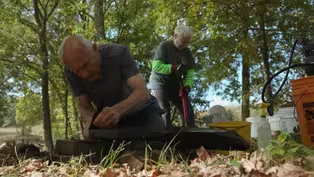
In addition to finding, researching, and recording the graveyards, they first have to clear the brush.
This historic marker on this overgrown lot in a neighbor's backyard was barely visible.
Today it's being readied for restoration.
First step, the stones have to be washed with a non-toxic product.
(tool scraping) - So everything has to be cleaned, and then you have to assess the damage and what needs to be done.
You kind of have to let the stone talk to you, and it tells you what it needs.
- [Pamela] Betty uses her handmade probe to find missing gravestones based on genealogy records.
She says families were usually buried in a row, so if there's a gap, it's a clue.
- It's kind of like finding treasures, like I found somebody, you know, when you get all excited and try to figure out where things go.
So we spend a bunch of time figuring out, you know, what needs to be done.
This needs an epoxy repair.
This just needs a simple reset.
(Carlo grunts) - It takes muscles to keep these memorials in shape.
They find broken pieces and mend them with special compounds that won't mar the lettering or weaken the stone.
Then they cement the headstones on sturdy bases.
It may seem macabre, but it takes a little grave digging.
- I dig out the bases.
I dig out stones that are on the ground.
We lift them up.
We put it on pieces of dunnage, just old pieces of wood, so it's up off the ground.
- You'd be surprised the things that are written on some of the stones that we've come across.
- [Pamela] Such as this one, a girl named Cinderrila, whose life did not have a fairytale ending.
- Cinderrila, and found out was a 16-year-old girl that died in 1860.
- She died from injuries from fire.
- [Pamela] There is more than Cinderrila's story engraved here.
The cemeteries contain a community's history.
This woman's husband was a Revolutionary War pensioner.
Here lies a Civil War veteran.
This man perished in the collision of the steamer Narragansett.
There is artistry, a sculpted hand pointing towards heaven, lambs atop the double tombstone of baby brothers, etchings and epitaphs that read like poetry: "Until the day break, and the shadows flee away," and, "Weep not for me."
The Mencuccis say their work is heartwarming, not spine-chilling.
But people have to come up to you and say, "Oh, this is creepy."
- Yeah, we get that a lot.
- You never get goosebumps?
- Never.
- No.
- [Pamela] Not even when they cared for the tombstone of the Burrillville woman who could easily make the most haunted list, Bathsheba Sherman.
She died in 1885, accused of being a demonic baby-murdering witch, causing scary episodes at the old Arnold Farm in town, made famous in the horror movie series "The Conjuring."
- Bathsheba!
(chilling music) (Bathsheba exhales) - [Pamela] While she may have put the town of Burrillville on the paranormal map, the Mencuccis say she got a bad rap.
- We want her to rest in peace.
We want people to leave her alone.
She's an ordinary woman, lived an ordinary life in an ordinary farmhouse in this ordinary town.
- [Pamela] They say Bathsheba Sherman lived a distance away from the old Arnold Estate and died of paralysis, probably a stroke in her '70s.
They also believe she's been made an undeserving villain in death.
- If your grandmother's name happened to be Bathsheba, and somebody walked into the cemetery and oh, there's a satanic-sounding name, and started this myth about your grandmother, how would you feel?
- [Pamela] Bathsheba's marble tombstone was tipped over so many times it severed.
They've since restored it and hidden it in an undisclosed location to protect the marker from thrill-seeking souvenir hunters.
Interest in Bathsheba is so intense, a GoFundMe page raised $2,100 for this recently erected granite marker bearing the same inscription as the original, trinkets and a lantern proof it still lures the curious about the mysterious from all over the country.
The Mencuccis find their own enchantment with their hobby, sometimes spending eight hours a day with what they say are their newfound friends.
- Make sure it's level.
(tool thuds) - It's very, very peaceful.
We have a very peaceful picnic in every cemetery that we've ever worked in.
- I enjoy it because I'm working with my wife.
(Betty laughs) (gate creaks) - [Pamela] And as fate would have it, the couple has an historic cemetery right on their own property, which they are also currently restoring.
As for their own final plans, they say they wish to be buried as they have lived, side by side.
And Carlo has already chosen what he wants his tombstone to say.
- "Leave me the heck alone.
(laughs) I'm resting."
(Betty laughs) - Wow, what an awesome couple, and they're really doing great work.
- Yeah, they're restoring cemeteries and reputations like Bathsheba.
And that's our broadcast this evening.
Thank you for joining us.
I'm Pamela Watts.
- And I'm Michelle San Miguel.
We'll be back next week with another edition of "Rhode Island PBS Weekly."
Until then, please follow us on Facebook and X and visit us online to see all of our stories and past episodes at ripbs.org/weekly.
Or listen to our podcast on your favorite streaming platform.
Goodnight.
(bright music) (bright music continues) (bright music continues) (bright music continues)
Video has Closed Captions
Clip: S5 Ep43 | 9m 34s | A local couple restores historic graves like Bathsheba Sherman’s of the Conjuring House. (9m 34s)
Video has Closed Captions
Clip: S5 Ep43 | 8m 24s | Women with dense breasts are at greater risk of developing breast cancer. (8m 24s)
Video has Closed Captions
Clip: S5 Ep43 | 4m 9s | A look into the Rhode Island candidates running for U.S. House and Senate. (4m 9s)
Providing Support for PBS.org
Learn Moreabout PBS online sponsorship
- News and Public Affairs

Top journalists deliver compelling original analysis of the hour's headlines.

- News and Public Affairs

FRONTLINE is investigative journalism that questions, explains and changes our world.












Support for PBS provided by:
Rhode Island PBS Weekly is a local public television program presented by Ocean State Media