
Rhode Island PBS Weekly 11/10/2024
Season 5 Episode 45 | 25m 35sVideo has Closed Captions
History of Federal Indian boarding schools impact on the Narragansetts, and Chat GPT.
In honor of Native American Heritage Month, Pamela Watts reports on Federal Indian boarding schools' impact on the Narragansetts. Then, a report on the fast-growing world of Chat GPT. On Weekly Insight, Michelle San Miguel and WPRI 12’s politics editor, Ted Nesi, discuss the election results. Finally, a look back at stories featured on Rhode Island PBS Weekly marking 4 years on the air.
Problems playing video? | Closed Captioning Feedback
Problems playing video? | Closed Captioning Feedback
Rhode Island PBS Weekly is a local public television program presented by Ocean State Media
Rhode Island PBS Weekly 11/10/2024
Season 5 Episode 45 | 25m 35sVideo has Closed Captions
In honor of Native American Heritage Month, Pamela Watts reports on Federal Indian boarding schools' impact on the Narragansetts. Then, a report on the fast-growing world of Chat GPT. On Weekly Insight, Michelle San Miguel and WPRI 12’s politics editor, Ted Nesi, discuss the election results. Finally, a look back at stories featured on Rhode Island PBS Weekly marking 4 years on the air.
Problems playing video? | Closed Captioning Feedback
How to Watch Rhode Island PBS Weekly
Rhode Island PBS Weekly is available to stream on pbs.org and the free PBS App, available on iPhone, Apple TV, Android TV, Android smartphones, Amazon Fire TV, Amazon Fire Tablet, Roku, Samsung Smart TV, and Vizio.
Providing Support for PBS.org
Learn Moreabout PBS online sponsorship(bright music) - [Pamela] Tonight, the shocking historic mistreatment of our area's Indigenous population.
- The ultimate goal was to take the land, but also to strip us of our identity, our culture, our communities, our nations.
- [Michelle] Then, inside the mind of Chat GPT.
- It's really hard to turn off part of your brain that feels like it's a human, right?
Like, you just don't have experience with that.
- [Pamela] Also, election analysis with Ted Nesi.
- [Michelle] And finally, a look back at four years of "Rhode Island PBS Weekly".
(bright uplifting music) (bright uplifting music continues) - Good evening.
Welcome to "Rhode Island PBS Weekly".
I'm Pamela Watts.
- And I'm Michelle San Miguel.
We begin tonight with an historic apology.
It came recently from the President of the United States to Native Americans.
- Including Rhode Island's Narragansett tribe.
Joe Biden says he's sorry for the country's forced placement of Indigenous children in federal boarding schools, where they were mistreated and abused in an attempt to erase their culture.
- After 150 years, the United States government eventually stopped the program.
But the federal government has never, never formally apologized for what happened, until today.
I formally apologize.
(audience cheering) (audience applauding) As President of the United States of America for what we did.
I formally apologize.
- The president went on to brand it a sin on our souls, and a black mark on our nation.
In light of his apology, and in honor of Native American Heritage Month, we revisit our story on that hidden history, and the efforts locally to set the record straight.
(soft music) (soft music continues) - The real goal was to take the land.
If they couldn't exterminate us through genocide and warfare, they were gonna exterminate us through forced assimilation.
- [Pamela] Forced assimilation was part of a land grab tactic for early settlers, and it was an attempt by the US government to eradicate the identity of Native Americans.
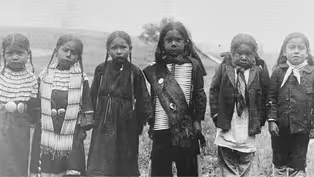
In the late 1800s, little children were taken far away from home to Indian boarding schools and were routinely abused.
Many died of neglect and disease.
The practice ran for decades.
Loren Spears, known in Narragansett language as Macasuni Pashou, meaning moccasin flower, or lady slipper, is director of the Tomaquag Indian Memorial Museum, as well as a writer and educator.
- That education, on the surface, seems like a good thing, but in the case of the boarding schools, the industrial schools, the religious boarding schools that came before the federal system, these were detrimental to Indigenous children, families, and communities, and that literally they were acts of violence against the Indigenous peoples and their nations.
And the ultimate goal was to take the land, but also to strip us of our identity, our culture, our communities, our nations.
- It has been branded the Hidden History, one that is being acknowledged in exhibits such as this, held recently at the University of Rhode Island.
A poignant part of the display, these child-sized handcuffs.
When you saw these handcuffs for the first time, what went through you?
- You know, it was visceral.
Tiny children with these tiny handcuffs, and I always think of it like this.
I have a three-year-old grandson, and the idea of him being ripped from his family and community and being handcuffed in that way just is so extraordinarily painful.
- [Pamela] Spears said she first heard about Indian boarding schools from her family.
- I learned it first through our stories, through our oral histories, through the understanding that these structures were structures of slavery.
You can pretty it up with words like indentured servitude, but when people are taken as young children and never returned to your community until they're 30 or more, that's slavery.
They kept them, even during the long summer months, by putting them with white families to act as domestic help, or to do laboring jobs, and that was the way that the boarding schools actually raised money to keep these kids here.
So they've literally stolen you, and now they're forcing you to work in order to keep stealing you, and keeping you there.
- [Pamela] Spears says many Indian parents were threatened if they didn't relinquish their children or tried to hide them.
Some parents who resisted were imprisoned.
- Think about what it's like when you're a parent, and your child's been stolen from you, and you were not able to protect them.
What does that do to your heart, and to your psyche?
- [Pamela] And Spears says once their children were taken off the reservation, the cultural cleansing began.
These before and after pictures of Indigenous children reveal the process.
Native American clothing was replaced by starched Victorian dress.
The students were severely punished if they spoke their language, practiced their customs, or religion.
They were given English names.
But the first part of the transition was to cut their hair.
- Our cultural ways, your hair is like your life's blood.
It represents the past, the present, the future.
This is why this is so triggering.
It's like this overt symbol of the complete erasure of your indigeneity.
- [Pamela] This erase and replace model was first started in 1879 by Richard Pratt, a former military officer.
Among the thousands of children who were held at the Carlisle Indian Industrial School in Pennsylvania, old records indicate they were Narragansetts, as well as members of other southern New England tribes, Wampanoags, Pokanokets, and Pequots.
- One of my uncles, he's not Narragansett, he's from another tribal nation, but he was literally taken, he and his siblings, from their family and community, and he has not only the emotional scars, but the physical scars to show for it.
- [Pamela] Spears says those scars have marred the lives of Native Americans for generations.
- The violence of that theft of your childhood, the theft of your cultural knowledge, the theft of your language, and your relationships with your family and community, and how when you think of these lateral traumas today of alcoholism and drug abuse and poverty, that these are all connected.
- [Pamela] The interconnections of the story in this exhibition are too large to display in the tiny Tomaquag museum.
It has been in existence for 60 years, and is currently housed in what was once a country church deep in Exeter.
- [Loren] The idea is to re-indigenize the landscape in different kinds of ways.
- [Pamela] Now in Kingston, a new extensive museum complex will be built on 18 acres of land owned by URI.
Spears points out it is a place that has always been homeland to Narragansetts.
- All of this land that we now know as Rhode Island is Narragansett land.
We wanted it to still feel rural.
We wanted to be near water, like the Chipuxet River, and the White Horn Brook.
The campus will have four buildings, the main museum building, the education center, the Indigenous Empowerment Center, and the Archive Collections Research Center, which we'll call the Belongings Research Center.
- [Pamela] Spears also envisions gardens, hiking trails, and a replica village, where everyone is welcome to come learn.
She says education is the first step towards reconciliation.
- You know, if we wanna create equity, and undo some of the injustice that has taken place, we have to also create equity through education, we have to create equity through job training and development, we have to create equity in acknowledging and healing from the pains of the past.
- Yet the lessons of the past have not always helped heal the wounds inflicted upon Native Americans.
Spears says the Narragansett nation was detribalized in the 1800s, and not recognized until 1979.
It was a slight she felt even as a little girl.
Can you tell me what it was like for you to be a Narragansett in Rhode Island?
- There was two things happening.
When I was with my family and my community, there's such a pride and honor and respect to our culture and our community, and then it was the outside community that didn't seem to understand, so when I was in my fifth grade classroom, I had a history textbook that said I didn't exist, right there in the textbook.
So how do you, as a fifth grader, understand that?
How do you process that information?
How do you stand up for yourself?
In the classroom, it's very difficult.
My daughter is a college student now, and her first Native Studies course, the professor had them making up fictional tribes.
So there's still such a lack of understanding and a lack of knowledge, and perpetuation of stereotypes and generalizations, and just misinformation.
- Even today?
- Even today, in the 21st century.
And teachers were taught it wrong when they were in school, and they're regurgitating that misinformation and passing it forward to new generations.
And most of the time, only talking about it in the mythological sense of the quote unquote, "First Thanksgiving," as their way of bringing up indigeneity in their classrooms.
- [Pamela] Spears hope the new Tomaquag museum programs will help educate the educators.
- It gives us the opportunity to work with professors, and really build their knowledge around local Indigenous history and culture, and the intersectionality of that.
It also gives us an opportunity to work with students so that we can hopefully go forward, and this next generation isn't as misinformed as the last several generations have been.
- [Pamela] Spears believes despite the loss of family and freedom during the time of Indian boarding schools, some Native Americans still flourished by using their education and the skills they learned there.
For example, former female Sachem of the Narragansetts, Princess Red Wing, who was sent to a Quaker school.
- She was an educator and an advocate her whole life, and a culture bearer, and passing forth traditional knowledge, so she was able to, as many people that were, if you will, subjugated under the umbrella of boarding schools, in one way, was able to then take that knowledge and utilize that to support Indigenous initiatives, including speaking on behalf of Indigenous rights at the United Nations.
- [Pamela] Spears says the new Tomaquag museum will better preserve the rich history and culture of Narragansetts, including a fully fluent language.
(speaking Narragansett) It has been revived today in greetings, storytelling, and prayer.
(Loren speaking Narragansett) It translates, in part.
- Today, Creator, we come to you with a quiet heart and we give thanks for all our beloved relations.
We give thanks for those that persevered, and survived so that we could be here today.
- With voter approval of the Arts and Culture Bond issue on this year's ballot, the Tomaquag Museum stands to receive $2 million for its new headquarters and research center.
They hope to break ground on the project sometime next year.
We now turn to Chat GPT.
Since being released, the technology has become part of our everyday lives.
Governor McKee formed an AI Taskforce to expand the industry here in the Ocean State, and Rhode Island College now offers AI as a major.
But as the technology expands, questions abound, including how exactly does AI think, and what's happening under the hood?
Producer Isabella Jibilian interviewed a Brown University professor who's investigating those questions, and much more.
This story as part of our continuing series, My Take.
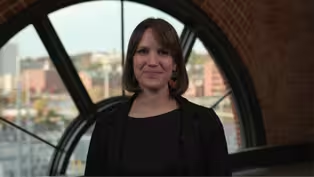
(claps hands) - My name is Ellie Pavlick, and this is my take on artificial intelligence.
So AI is a system that's not human, but otherwise has human-like intelligence.
(soft music) I'm a professor at Brown University, and I study artificial intelligence, particularly language.
Starting around the 1950s, there was work on AI that is what we would call rule-based.
- [Announcer 1] Rules for decision making stored in the machine's memory.
- This would be things like playing chess.
We write down kind of rules that a computer could follow to be very good at chess.
- [Announcer 2] The sensory aid matches your skill.
- Then there was this shift to what we would call statistical or machine learning based approaches.
A really useful example to have in your head is something like a spam filter.
- [Automated Voice] You've got mail.
- The designer of the system would come up with the features of an email that might be useful signals of spam.
One feature that says is the subject line in all capitals?
Is there an image attached?
And then the model would learn statistically, given that there's capitalized subject and an image in the email, there's an 80% chance of it being spam.
The era we're in now is a continuation of this statistical approach, but what we would call the neural network based approach.
And that way of doing things, they just throw the whole text of the email to the system, and I say these ones are spam, these ones are not, and then the system kind of decides what features are useful on its own.
And Chat GPT is one of these neural network based systems.
Chat GPT is what we would call a large language model.
They're big statistical systems that are just learning to generation language one word at a time.
The president said on Monday that, you know, da-da-da.
And after going through a very, very, very large amount of text on the internet, they get very good at this, and then they can generate really good sounding texts.
Until recently, the only time you could have a chat conversation was when there was a human on the other side, and now all of a sudden, you're talking to a thing that's not a human with language.
It's really hard to turn off part of your brain that feels like it's a human.
- Men are all alike.
- In what way?
- This isn't the first time this has happened.
There was a very famous system called ELIZA, in these early days of rule-based AI.
- [Announcer 3] Does it understand what it's doing in the sense that we do?
It's easy to leap to false conclusions, as Professor Weizenbaum discovered when he created ELIZA.
- It was an AI therapist, or like a computer therapist, and it would talk over text.
- [Patient] He says I'm depressed much the time.
- [ELIZA] I'm sorry to hear that you're depressed.
- People got very attached to this system, even knowing that it was this rule-based system, they felt like it understand them, and it cared about them.
- [Announcer 3] Weizenbaum's secretary fell under the spell of the machine.
(keys clacking) - After two or three interchanges with the machine, she turned to me, and she said, "Would you mind leaving the room, please?"
- We have trouble sometimes interacting with a system that's doing human-like things and not feeling like it must be human-like underneath.
Something people always wanna ask, is Chat GPT intelligent?
Does Chat GPT understand language?
I don't think anyone can honestly give you a scientifically valid answer.
So if you think about a rule-based system, there is no uncertainty, no ambiguity about how the system is working.
So if I write down a set of rules for how to play chess, I know that the system is gonna follow the rules in the order I told it, exactly when I told it.
But the way that the current AI systems work is not like that.
There's this output of this large statistical learning process, and so when they do something weird or bad, you might know that the problem exists and not know how to fix it.
(soft music) I always like to emphasize how little we understand these systems.
We don't actually know what is happening inside, so it is very highly debated how much we should be able to attribute intelligence to these systems.
(bright music) (keys clacking) (claps hands) My name is Ellie Pavlick, and this was my take on artificial intelligence.
- On tonight's episode of "Weekly Insight", Michelle and WPRI12's politics editor, Ted Nesi, discuss the recent election results.
- Ted, as we break down the election results here in Rhode Island, generally speaking, the winners of these races weren't a big surprise.
What may have surprised people were the margins, specifically in the presidential race.
- Yes.
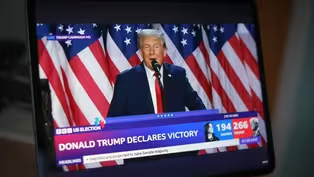
I think, Michelle, it's fascinating to see Donald Trump actually is on track to get the highest share of the vote for a Republican presidential nominee in Rhode Island since 1988 when George H.W.
Bush ran for the first time.
Trump's at about 42% of the vote in Rhode Island currently.
There's still some straggler ballots being counted, but I expect him to land around there.
Also fascinating to me, Michelle, if you map the results granularlly by community, every single city and town in Rhode Island shifted to some degree towards the Republicans.
Not a single community shifted toward the Democrats compared with the 2020 presidential election.
So it was really a uniform swing to the right.
- And president elect Trump made the biggest gains in Central Falls, which is interesting because we know it's about two thirds Latino.
- Yes, and I really connect that, Michelle, with the exit polls, which show Trump making further inroads into the Latino community, particularly with Latino men.
I just think it's such an interesting story in Central Falls.
If you go back to 2016, Trump's first election against Hilary Clinton, he only got about 15, 16%.
Terrible showing.
Then in 2020, he's up for reelection, he gets about 25 or 26% in Central Falls, and now his third attempt, he's up to about 25% in Central Falls.
So clear growth for Trump with that community.
- And some might think that Trump doing well in Rhode Island would mean trouble for the Democratic incumbents in the state, which we know was not the case on election night.
- No, every Democratic incumbent for major office won again.
The whole Congressional delegation.
Senator Sheldon Whitehouse hit about 60% of the vote.
Congressman Amo and Magaziner both were safe.
And then as you go further down the ballot, it's a similar story in the General Assembly.
Basically no change.
Maybe one to two seat shifts in the two chambers, but Democratic super majorities once again for 2025.
And then incumbent mayors.
And frankly, no matter their party.
Republican Ken Hopkins won reelection as mayor in Cranston.
Independent Frank Picozzi won reelection as mayor in Warwick.
Democratic mayor Don Grebien won reelection in Pawtucket.
So it's kind of a funny paradox, considering the polls that would show Rhode Islanders are frustrated with the status quo, they say, but they put nearly all the same incumbents back in.
- Right.
People say they want change, yet they're voting for the incumbents.
As far as the ballot questions go, you and I have been talking about this over the last several weeks.
It was a great night for the bond issues.
Those all passed.
The only one that was rejected was about the constitutional convention, which was a surprise to you, or not really?
- No, not by the end, Michelle, because there was organized well-funded opposition to the constitutional convention question.
Unions, women's groups, the ACLU, all spent money to tell voters not to vote for that.
There really wasn't a counterbalancing well-funded support for the con-con, as people called it.
And then the bond question's frankly even less of a surprise, because those have been passing every election reliably now for almost 20 years, so no big surprises on those questions.
- Thanks so much, Ted.
Good to see you.
- Great to be here.
- Finally tonight, a look a back.
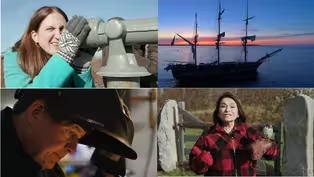
This week, we commemorate "Rhode Island PBS Weekly"'s fourth anniversary.
To mark this milestone, our senior producer, Justin Kenny, has been mining our archive over the last few weeks to bring us some of our show's most memorable moments.
Here's what he found.
(bright inspiring music) How beautiful.
- Happiness is all I'm looking for.
- I'm living the dream.
- That's how close I feel to this farmland - Let's go, boys!
Let's go!
(water splashes) (clay thuds) - Why?
- Try to suppress the feelings that I had.
- She watched her son drown.
- What's at stake if more money is not put into helping these students succeed?
- Many of them are gonna fall through the cracks.
- Did you get death threats?
- Yeah, there were death threats.
Things of like people saying, "He needs to be brought to justice."
- And it gives me the strength to go on.
(bright inspiring music continues) - Not all who wander are lost.
- A lot of people questioned my sanity when I decided to run for Congress.
- Do you believe that what is happening in Gaza is a genocide?
- No, I don't.
- Do you think that those are scare tactics or standard practice?
- Please go talk to our legal team.
(speaks foreign language) - What were you thinking at that time?
(speaking foreign language) - [Translator] I was thinking about my children.
- I want everybody to know that redemption is possible for everybody.
- And it was one of the most important times of my life.
- We need to do less arguing and more listening.
- Hi, Derg.
It's good to see you.
- Can I touch you?
Nope, don't wanna be touched.
- A work in progress?
- Yeah, I don't think it's working.
(both laughing) - Governor Rivera.
(both laughing) Treasurer Rivera, Secretary Rivera?
- I think they all sound good.
(both laughing) (crowd cheering) (bright inspiring music continues) - Oh, here's a bit of fun information for you.
We were able to squeeze 73 of our stories into that short retrospective.
- We wanna thank everyone on the team, past and present, for making this show what it is.
- And more stories to come.
- Absolutely.
And that's our broadcast this evening.
Thank you for joining us.
I'm Michelle San Miguel.
- And I'm Pamela Watts.
We'll be back next week with another edition of "Rhode Island PBS Weekly".
Until then, please follow us on Facebook and X, and visit us online to see all of our stories and past episodes at ripbs.org/weekly, or you can listen to our podcast on your favorite streaming platform.
Goodnight.
(bright music) (bright music continues) (bright music continues) (bright music continues)
Video has Closed Captions
Clip: S5 Ep45 | 11m 24s | Indigenous children forced to assimilate to white ways of life. (11m 24s)
My Take: Artificial Intelligence
Video has Closed Captions
Clip: S5 Ep45 | 5m 41s | How does ChatGPT “think”? (5m 41s)
Video has Closed Captions
Clip: S5 Ep45 | 4m 30s | A look back at stories featured on Rhode Island PBS Weekly marking 4 years on the air. (4m 30s)
Video has Closed Captions
Clip: S5 Ep45 | 2m 58s | President-elect Donald Trump gained votes in all Rhode Island communities. (2m 58s)
Providing Support for PBS.org
Learn Moreabout PBS online sponsorship
- News and Public Affairs

Top journalists deliver compelling original analysis of the hour's headlines.

- News and Public Affairs

FRONTLINE is investigative journalism that questions, explains and changes our world.












Support for PBS provided by:
Rhode Island PBS Weekly is a local public television program presented by Ocean State Media