
Rhode Island PBS Weekly 11/19/2023
Season 4 Episode 47 | 26m 56sVideo has Closed Captions
How the neurodiversity movement is changing perceptions of autism and more
Producer Isabella Jibilian explores neurodiversity and the efforts here in Rhode Island to embrace neurological differences through theatre. Pamela Watts reports on Native American children taken from their families and placed in boarding schools by the Federal Government where they were forced to assimilate to quote, “white ways of life. ” Plus, visit the “Sistine Chapel of Rhode Island."
Problems playing video? | Closed Captioning Feedback
Problems playing video? | Closed Captioning Feedback
Rhode Island PBS Weekly is a local public television program presented by Ocean State Media
Rhode Island PBS Weekly 11/19/2023
Season 4 Episode 47 | 26m 56sVideo has Closed Captions
Producer Isabella Jibilian explores neurodiversity and the efforts here in Rhode Island to embrace neurological differences through theatre. Pamela Watts reports on Native American children taken from their families and placed in boarding schools by the Federal Government where they were forced to assimilate to quote, “white ways of life. ” Plus, visit the “Sistine Chapel of Rhode Island."
Problems playing video? | Closed Captioning Feedback
How to Watch Rhode Island PBS Weekly
Rhode Island PBS Weekly is available to stream on pbs.org and the free PBS App, available on iPhone, Apple TV, Android TV, Android smartphones, Amazon Fire TV, Amazon Fire Tablet, Roku, Samsung Smart TV, and Vizio.
Providing Support for PBS.org
Learn Moreabout PBS online sponsorship- [Michelle San Miguel] Tonight, changing perspectives through theater.
- I didn't know what was wrong with me or why people didn't wanna be near me.
- [Pamela Watts] Then the hidden history of Native Americans in our area and beyond.
- When people are taken as young children and never returned to your community until they're 30 or more, that's slavery.
- [Michelle San Miguel] And did you know Woonsocket is home to the largest collection of fresco paintings in North America?
- Welcome to the St. Ann Arts and Cultural Center.
(perky music) (perky music continues) - Good evening and welcome to "Rhode Island PBS Weekly."
I'm Michelle San Miguel.
- And I'm Pamela Watts.
Thinking differently, it's the trademark of world changing inventors, entrepreneurs, and artists.
- And today, neuroscientists are finding that more people than ever have brains that are wired differently.
Take autism, for example, the Centers for Disease Control and Prevention estimate that one in 36 children nationwide is diagnosed with autism spectrum disorder.
Producer Isabella Jibilian explores efforts here in Rhode Island to embrace neurological differences through theater.
- [Isabella Jibilian] On audition day, a collection of Providence dramatists capture a full spectrum of emotions.
Humor- - Can you give me like, a good growl?
- [Isabella Jibilian] Anger.
- How can you dare speak to me in this manner?
- [Isabella Jibilian] Joy.
(pair laughs) - Did you feel it?
- Definitely.
- Yeah.
- [Isabella Jibilian] But for these actors and directors, there's another spectrum they're especially interested in.
- I was diagnosed as autistic when I was like 13-ish.
- [Isabella Jibilian] Korbin Johnson is an actor and administrator with Spectrum Theater Ensemble.
- Most of the plays that we put on now have themes of neuro diversity.
Our actors and creative team are neuro diverse.
- [Isabella Jibilian] They're looking to change perceptions about conditions like autism, ADHD, dyslexia, and other neurological differences.
- From as long as I can remember, I was like, "There's something different."
I would be like, "Why did everyone laugh at me there?
Why did, you know, everyone kind of steer away from me there?"
And then it's like, oh, 'cause I was very obviously missing a major social cue.
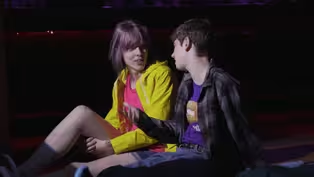
- [Isabella Jibilian] After auditions, Johnson was cast as the lead in the play "Space."
- Now it's, it's me up in, up in the mulberry tree.
My character is named Margaret.
It starts out they're kind of in like a clinic with a couple other people in like the middle of nowhere in like the Midwest.
- [Isabella Jibilian] Margaret is autistic and has synesthesia, a neurological condition in which people's senses can combine, colors might have smells or sounds might have shapes associated with them.
- Bedroom is barely there yellow, a butter yellow.
- [Isabella Jibilian] The character is a bit of an outcast and faces difficult questions about identity.
It's a plight Johnson understands.
- When I was in middle school, I was getting physically beaten up, almost on a daily basis.
I would get friends for a couple years and then I would lose them and I wouldn't know why I'd lost them 'cause I had missed a social cue and no one would explain it to me.
- Every human being has a different brain and because a neurology is different, we process the world differently.
- [Isabella Jibilian] Barry Prizant is author of the bestselling book, "Uniquely Human, A Different Way of Seeing Autism."
A language pathologist by training, he has spent the last 50 years working and collaborating with autistic people.
At the beginning of his career, the options for therapy were limited primarily to what is now known as Applied Behavioral Analysis or ABA.
- The founder of ABA actually said that autism is basically a bunch of quirky behaviors and the way you treat autism is you decrease the quirky behaviors and the undesirable behaviors and you enhance or build up the desirable behaviors.
- [Isabella Jibilian] Korbin Johnson experienced elements of this approach firsthand.
Like many others on the spectrum, Johnson experienced his sensory sensitivity.
Loud sounds can be upsetting and even painful.
- I remember I had a really big fear of the fire alarm.
Whenever a fire alarm went off, it literally felt like someone was digging knives into my ears.
My school decided they were going to make me watch them pull the alarm and then stand there for 10 seconds before I was allowed to go outside, and if I tried to plug my ears or showed any distress, they would yell at me, and if I was in distress after the fire alarm, they would either tell me that I was faking it or it would be like it's not a big deal.
- [Isabella Jibilian] Prizant has spent much of his career questioning practices like these, the try to change behaviors without looking at what he calls, "The deeper why."
- Behaviors such as flapping and rocking and spinning and staring at your fingers, a lot of behavioral therapies are focused on getting rid of those behaviors.
And now at the very least we have to understand why a child does that or why a person does that.
- And why are they doing it?
- In many cases, it's to regulate emotionally.
- So it's to calm yourself.
- Exactly, exactly.
- And if you don't let a kid calm themselves, what happens?
- It can overflow into outbursts, it could result in severe anxiety in the child.
And this is the area that a lot of autistic adults say that there was so much time and effort putting into trying to make me look normal, as a child, I was traumatized.
- What was the low point?
- Multiple suicide attempts.
I didn't know what was wrong with me or why people didn't wanna be near me.
I was, you know, dealing with depression and other senses too and then some trauma, and I just, you know, I just didn't see a future.
- [Isabella Jibilian] Today, EBA is the default treatment for autism in the U.S. and many families say it's helpful, but in recent years- - More and more different autistic people, getting up and talking about what medical systems have done that was not only wrong but even harmful in the past.
- [Isabella Jibilian] These advocates are part of what's known as the Neuro Diversity Movement.
They are calling for a different approach.
- The best way to support them is to understand them as opposed to just trying to fix them and have them look and behave like every neuro typical person.
- [Isabella Jibilian] And the rise of popular figures, from Temple Grandin to Greta Thunberg- - And change is coming, whether you like it or not, - [Isabella Jibilian] Have shown that autism comes with strengths.
(audience applauds) For Johnson, college was a turning point.
- I came out of the closet, started making more friends, and I was taking classes that I really enjoyed and I kind of had the freedom to just be me and find myself.
- It's almost like instead of fighting autism- - Yeah, I can adapt my surroundings to it.
- Johnson also changed majors from forensic science to theater.
What is it about theater that you feel like clicks for you?
- I've always been really interested in storytelling.
They enunciate a lot of the nuance.
So it's like all of a sudden I can read the social cues because they're being performed and explicitly stated right in front of me.
(people chattering) (door rattles) (shuffling footsteps) - [Isabella Jibilian] It's opening night for "Space" and Spectrum Theater Ensemble is getting ready for show time.
(people chattering) "Space" is the first show on the program.
Johnson's character, Margaret, begins the show as a teen victim of the healthcare system.
- No, I'm not Michelle, I'm Margaret!
- [Isabella Jibilian] But partway through, a plot twist.
- We find out that Margaret's actually a poet and a playwright.
- [Isabella Jibilian] It's a play within a play and it's about how Margaret moves past stereotypes as a neuro divergent young person.
- What about that poem you wrote about your synesthesia?
Come on, spoken word, let's go.
- I can't, there's difficult subjects in it.
- So what, that's your truth.
- On a fundamental level, I go through many of the same challenges that Margaret shares.
Both Margaret and myself are being told that these fundamental parts of our identities are wrong and shouldn't, you know, shouldn't exist and should be suppressed.
- What do you wish people knew about autism?
- I think just the fact that it can be a great thing.
Neuro diversity is a way to kind of bring all of these different groups together that are all different, but share a lot of the same conflicts and struggles.
And so it just creates like this big community of people of all different shapes and sizes and brains and everything.
(audience applauding) (audience cheers) - Up next, we take another look at a practice that began in the late 1800s and lasted almost a century.
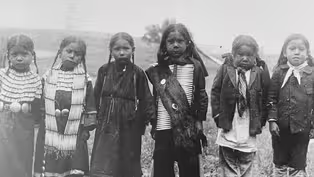
Native American children taken from their families and forced into Indian boarding schools by the federal government.
Many were only toddlers.
The suffering caused by the often brutal assimilation has resulted in multi-generational trauma for indigenous people such as the Narragansetts of Rhode Island.
The stories of the federal Indian boarding schools are just some that will now have the place and the space to be told at a new Tomaquag museum being built in Kingston.
(gentle music) (gentle music continues) - The real goal was to take the land.
If they couldn't exterminate us through genocide and warfare, they were going to exterminate us through forced assimilation.
- [Pamela Watts] Forced assimilation was part of a land grab tactic for early settlers and it was an attempt by the U.S. government to eradicate the identity of Native Americans.
In the late 1800s, little children were taken far away from home to Indian boarding schools and were routinely abused.
Many died of neglect and disease.
The practice ran for decades.
Loren Spears, known in Narragansett language as Macasuni Pashou, meaning moccasin flower or lady slipper, is director of the Tomaquag Indian Memorial Museum, as well as a writer and educator.
- That education, on the surface, seems like a good thing.
But in the case of the boarding schools, the industrial schools, the religious boarding schools that came before the federal system, these were detrimental to indigenous children, families, and communities.
And that literally they were acts of violence against the indigenous peoples and their nations.
And the ultimate goal was to take the land, but also to strip us of our identity, our culture, our communities, our nations.
- [Pamela Watts] It has been branded "The Hidden History," one that is being acknowledged in exhibits such as this, held recently at the University of Rhode Island.
A poignant part of the display, these child-sized handcuffs.
When you saw these handcuffs for the first time, what went through you?
- You know, it was visceral.
Tiny children with these tiny handcuffs, and I always think of it like this, I have a three year old grandson and the idea of him being ripped from his family and community and being handcuffed in that way, just like is so extraordinarily painful.
- [Pamela Watts] Spears says she first heard about Indian boarding schools from her family.
- I learned it first through our stories, through our oral histories, through the understanding that these structures were structures of slavery.
You can pretty it up with words like indentured servitude, but when people are taken as young children and never return to your community until they're 30 or more, that's slavery.
They kept them, even during the long summer months, by putting them with White families to act as domestic help or to do laboring jobs, and that was a way that the boarding schools actually raised the money to keep these kids here.
So they've literally stolen you and now they're forcing you to work in order to keep stealing you, and keeping you there.
- [Pamela Watts] Spears says many Indian parents were threatened if they didn't relinquish their children or tried to hide them.
Some parents who resisted were imprisoned.
- Think about what it's like when you're a parent and your child's been stolen from you and you were not able to protect them.
What does that do to your heart and to your psyche?
- [Pamela Watts] And Spears says once their children were taken off the reservation, the cultural cleansing began.
These before and after pictures of indigenous children reveal the process.
Native American clothing was replaced by starched Victorian dress.
The students were severely punished if they spoke their language, practiced their customs or religion.
They were given English names.
But the first part of the transition was to cut their hair.
- Our cultural ways, your hair is like your life's blood.
It represents the past, the present, the future.
This is why this is so triggering.
It's like this overt symbol of the complete erasure of your Indigeneity.
- [Pamela Watts] This erase and replace model was first started in 1879 by Richard Pratt, a former military officer.
Among the thousands of children who were held at the Carlisle Indian Industrial School in Pennsylvania, old records indicate there were Narragansetts as well as members of other Southern New England tribes, Wampanoags, Pokanokets, and Pequots.
- One of my uncles, he's not Narragansett, he's from another tribal nation, but he was literally taken, he and his siblings from their family and community.
And he has not only the emotional scars, but the physical scars to show for it.
- [Pamela Watts] Spears says those scars have marred the lives of Native Americans for generations.
- The violence of that theft of your childhood, the theft of your cultural knowledge, the theft of your language, and your relationships with your family and community, and how, when you think of these lateral traumas today of alcoholism and drug abuse and poverty, that these are all connected.
- [Pamela Watts] The interconnections of the story in this exhibition are too large to display in the tiny Tomaquag Museum.
It has been in existence for 60 years and is currently housed in what was once a country church, deep in Exeter.
(animals chattering) - [Loren Spears] The idea is to re-indigenize the landscape in different kinds of ways.
- [Pamela Watts] Now in Kingston, a new extensive museum complex will be built on 18 acres of land owned by URI.
Spears points out, it is a place that has always been homeland to Narragansetts.
- All of this land that we now know as Rhode Island is Narragansett land.
We wanted it to still feel rural.
We want it to be near water like the Chipuxet River and the Whitehorn Brook.
The campus will have four buildings, the main museum building, the education center, the Indigenous Empowerment Center, and the Archive Collections Research Center, which we'll call the Belongings Research Center.
- [Pamela Watts] Spears also envisions gardens, hiking trails, and a replica village where everyone is welcome to come learn.
She says education is the first step towards reconciliation.
- You know, if we wanna create equity and undo some of the injustice that has taken place, we have to also create equity through education, we have to create equity through job training and development.
We have to create equity in acknowledging and healing from the pains of the past.
- Yet the lessons of the past have not always helped heal the wounds inflicted upon Native Americans.
Spears says the Narragansett Nation was detribalized in the 1800s and not recognized until 1979.
It was a slight she felt even as a little girl.
Can you tell me what it was like for you to be a Narragansett in Rhode Island?
- There was two things happening.
When I was with my family and my community, there's such a pride and honor and respect to our culture and our community, and then there was the outside community that didn't seem to understand.
So when I was in my fifth grade classroom, I had a history textbook that said I didn't exist, right there in the textbook.
So how do you, as a fifth grader, understand that?
How do you process that information?
How do you stand up for yourself in the classroom?
It's very difficult.
My daughter is a college student now and her first native studies course, the professor had them making up fictional tribes.
So there's still such a lack of understanding and a lack of knowledge and, you know, perpetuation of stereotypes and generalizations and just misinformation- - Even today?
- Even today, in the 21st century.
And teachers were taught it wrong when they were in school and they're regurgitating that misinformation and passing it forward to new generations, and most of the time, only talking about it in the mythological sense of the quote, unquote "First Thanksgiving," as their way of bringing up indigeneity in their classrooms.
- [Pamela Watts] Spears hopes the new Tomaquag Museum programs will help educate the educators.
- It gives us the opportunity to work with professors and really build their knowledge around local indigenous history and culture and the intersectionality of that.
It also gives us an opportunity to work with students so that we can hopefully go forward, and this next generation isn't as misinformed as the last several generations have been.
- [Pamela Watts] Spears believes, despite the loss of family and freedom during the time of Indian boarding schools, some Native Americans still flourished by using their education and the skills they learned there.
For example, former female sachem of the Narragansetts, Princess Red Wing, who was sent to a Quaker school.
- She was an educator and an advocate her whole life, you know, and a culture bearer, and passing forth traditional knowledge.
So she was able to, as many people that were, if you will, subjugated under the umbrella of boarding schools, in one way, was able to then take that knowledge and utilize that to support indigenous initiatives, including, you know, speaking on behalf of indigenous rights at the United Nations.
- [Pamela Watts] Spears says the new Tomaquag Museum will better preserve the rich history and culture of Narragansetts, including a fully fluent language.
(speaking Narragansett) - [Pamela Watts] It is being revived today in greetings, storytelling and prayer.
(speaking Narragansett) - [Pamela Watts] It translates, in part- - Today Creator, we come to you with a quiet heart and we give thanks for all our beloved relations.
We give thanks for those that persevered and survived so that we could be here today.
- Finally tonight, Michelangelo once said, "Genius is eternal patience."
In our continuing series "Window on Rhode Island," we revisit a cultural center in Woonsocket where visitors can see the genius of an artist who paid homage to the great Italian masters of the Renaissance one glorious brush stroke at a time.
- I'm Dominique Doiron and welcome to the St. Ann Arts and Cultural Center.
Many people will drive by the outside of the church, and when they look at the structure, the outside gives no hint whatsoever as to what is contained inside.
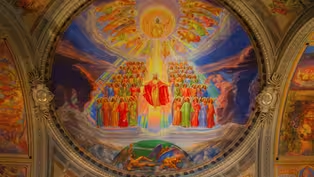
And it contains the largest collection of fresco artwork in North America.
This is the same style as the famed Sistine Chapel in Rome.
Some people call it the Sistine Chapel of Rhode Island.
What we see today was not what the parishioners saw back in the day.
There were no fresco paintings.
It was the walls and ceilings were finished in our gray stucco cement.
There were no stained glass windows and there was no marble.
It was a byproduct of the American Industrial Revolution.
At the time in the 19th century, many mills had opened up here in Woonsocket and they needed workers, so they turned north to Canada.
And so St. Ann's itself was the second of the several French Canadian parishes that were opened.
And it was founded in 1890.
And so 1925, they added the stained glass windows, which were imported from Chartreuse, France, and then in the 1940s, pastor at the time decided, "Let's add a a little bit more color to the building."
And so he visited different churches around New England and found the Italian artist Guido Nincheri.
(gentle music) Guido Nincheri was born in Prato, Italy.
His father wanted him to take over the family textile business.
Nincheri had a huge passion for the arts and that's what he wanted to study.
And they had a big argument, and his father beat him with a stick, and it displaced a couple of his vertebrae.
And over several years, he developed a very pronounced hunch.
But he wasn't deterred.
He walked the train tracks from Prato, Italy to Florence with this incredible back pain, and he was homeless for just about a year.
(gentle music) One day, an artist who taught at the famed Academy of Florence, that was founded by the popular Medici family, literally took him into his house and got him into the Academy of Fine Arts.
And he married, and part of the honeymoon, they decided to visit some friends that had come over to the United States.
While he was here in Boston, his father wrote to him and said, "Don't come home."
The political climate of Italy, at the time, with the rise of fascism, things weren't going so well in Europe.
(speaking Italian) - I think part of what Nincheri was so excited about when he came into this building was he saw an opportunity to do his own Sistine Chapel, 'cause the fresco style doesn't present itself often.
(peaceful music) For eight years, there was always wooden scaffolding in the building somewhere.
Some of the interesting faces we have, one of 'em is the parish sexton Alphonse Lavoie, the parish janitor.
He's portrayed as Jonah in "Jonah and the Whale," and when you look at "Jonah and the Whale," he's this very incredible physique, this great body, and that was his body as well.
Those were the days when there was a coal-fired furnace, and so he was in the boiler room, shoveling coal.
The story with the painting of this building has so many similarities to when Michelangelo painted the Sistine Chapel.
There was controversy, Nincheri paints Adam and Eve.
The Mother Superior at the time kind of led a little revolt about it because she wasn't happy that these figures were nude.
And he goes to do another painting called "The Rebellion of the Angels," where Archangel Michael and the heavenly angels are casting the rebellious angels into Hell, and in that painting, Michael is piercing one of the rebellious angels, and you can see part of her face, and he based that face on that Mother Superior.
(gentle music) All the faces and the walls and the ceilings, every single face was a parishioner who sat in these pews, or a member of the city of Woonsocket, and what we are saving isn't just a church structure, but it's a scrapbook, it's a snapshot, a moment of time.
These people who were immortalized were textile workers.
These are the people who worked in the mills.
Here we have portraits of the common person, and you don't see that in a lot of places.
- It's remarkable to think that there were once conversations about demolishing that building.
- The community came together, raised the funds, and saved the building, and for that, we are eternally grateful.
That's our broadcast this evening, thank you for joining us.
I'm Pamela Watts.
- And I'm Michelle San Miguel.
We'll be back next week with another edition of "Rhode Island PBS Weekly."
Until then, please follow us on Facebook and X and visit us online to see all of our stories and past episodes at ripbs.org/weekly, or listen to our podcast on your favorite streaming platform.
Goodnight.
(buoyant cheerful music) (buoyant cheerful music continues) (buoyant cheerful music continues) (buoyant cheerful music continues) (buoyant cheerful music continues)
Video has Closed Captions
Clip: S4 Ep47 | 11m 24s | The hidden history of federal Indian boarding schools and its impact on the Narragansetts. (11m 24s)
Window on Rhode Island: St. Ann
Video has Closed Captions
Clip: S4 Ep47 | 6m 8s | A visit to the “Sistine Chapel of Rhode Island.” (6m 8s)
Video has Closed Captions
Clip: S4 Ep47 | 9m 21s | How the neurodiversity movement is changing perceptions of autism and more (9m 21s)
Providing Support for PBS.org
Learn Moreabout PBS online sponsorship
- News and Public Affairs

Top journalists deliver compelling original analysis of the hour's headlines.

- News and Public Affairs

FRONTLINE is investigative journalism that questions, explains and changes our world.












Support for PBS provided by:
Rhode Island PBS Weekly is a local public television program presented by Ocean State Media