
Rhode Island PBS Weekly 11/24/2024
Season 5 Episode 47 | 23m 55sVideo has Closed Captions
Rhode Islanders talk about the devastating physical and mental effects of loneliness.
In-depth report on loneliness and its devastating effects – both physical and mental on both young and old. Then, Elisha Project founder George Ortiz talks about his mission to feed the hungry through community sharing. Finally, Michelle San Miguel and Ted Nesi discuss how local lawmakers are preparing for a new Presidential Administration, and State budget concerns.
Problems playing video? | Closed Captioning Feedback
Problems playing video? | Closed Captioning Feedback
Rhode Island PBS Weekly is a local public television program presented by Ocean State Media
Rhode Island PBS Weekly 11/24/2024
Season 5 Episode 47 | 23m 55sVideo has Closed Captions
In-depth report on loneliness and its devastating effects – both physical and mental on both young and old. Then, Elisha Project founder George Ortiz talks about his mission to feed the hungry through community sharing. Finally, Michelle San Miguel and Ted Nesi discuss how local lawmakers are preparing for a new Presidential Administration, and State budget concerns.
Problems playing video? | Closed Captioning Feedback
How to Watch Rhode Island PBS Weekly
Rhode Island PBS Weekly is available to stream on pbs.org and the free PBS App, available on iPhone, Apple TV, Android TV, Android smartphones, Amazon Fire TV, Amazon Fire Tablet, Roku, Samsung Smart TV, and Vizio.
Providing Support for PBS.org
Learn Moreabout PBS online sponsorship- [Michelle] Tonight, the troubling number of Americans who feel alone.
- Loneliness is just as deadly as smoking an entire pack of cigarettes a day.
- Gracias.
- Then we introduce you to one local nonprofit serving the community in new ways.
- If I want to do something, I'm either gonna die or get it done.
There's no other way for me because I've never had a plan B for anything in life.
- And competing priorities in an increasingly strange Rhode Island budget with Ted Nesi.
(bright music) (bright music continues) Good evening and welcome to "Rhode Island PBS Weekly."
I'm Michelle San Miguel.
- And I'm Pamela Watts.
We begin tonight with a story about the ever-growing sense of loneliness that many here in Rhode Island and around the country are experiencing.
- It's a feeling we all have from time to time, but new research has found it's more widespread than many previously realized.
An October Gallup poll found one in five Americans said they experience loneliness for much of their day.
Producer Isabella Jibilian explores how this problem and potential solutions are taking shape here in Rhode Island.
- I was like so nervous to go.
- [Isabella] At 17, Tabitha Grandolfo moved from Hong Kong to Providence to study at Brown University.
- It was 2021 and there were COVID restrictions.
Meant that if I wanted to go home, I would have to spend three weeks in a hotel in quarantine before I was able to like, go back and see my family.
- [Isabella] She says being so far from home made finding community even more important.
But by the second semester, she worried that other students weren't looking for new friends anymore.
- I was in a play and I was really excited.
It was my first play that I did on campus.
A roommate and a friend came to see it and I came back after the show and they didn't talk about it at all.
And then the two of them went to some, like, party or after party and left me in the dorm alone.
I was just sitting there in my room alone, folding laundry.
(laughs) - [Isabella] When she returned home to Hong Kong at the end of the school year, her depression was overwhelming.
- I remember not being able to get out of bed and my mom was like, "Do you think you can go back?"
- [Isabella] Stories like Grandolfo's are familiar to Richard Weissbourd, a senior lecturer at Harvard University.
- When people think of loneliness, they often think of senior citizens.
But in our data, the people who have the highest rates of loneliness are young adults.
They're people in their 20s and they're people in their 30s.
- [Isabella] Weissbourd did a national survey on loneliness during the pandemic and found that 36% of Americans felt miserable levels of loneliness.
For young adults, it was 61%.
He says, since then, those statistics have improved, but remain a worry.
- The loneliness rates are still high.
They were high before the pandemic.
- What particular challenges do young adults face that you feel contributes to this high rate of loneliness?
- I don't think social media is the main cause of this, but I think social media can really diminish our sense of connection to other people.
- [Isabella] And our social infrastructure has changed.
He says people used to find greater community in work and in religion.
♪ Glory can be found ♪ - There are rituals of gratitude and coming of age ceremonies where you're asked to think about your responsibility for people in your community.
I'm not saying we should become more religious, but I think we need to think about how to reproduce some of these aspects of religion and secular life.
I think that's a very important thing to do.
- [Isabella] That's because loneliness comes at a cost.
Last year, the US Surgeon General warned that there was an epidemic of loneliness.
- And social disconnection is associated with an increased risk of not only depression, anxiety, and suicide, but also heart disease, dementia, stroke, and premature death.
- Loneliness is just as deadly as smoking an entire pack of cigarettes a day.
- [Isabella] Ashley Kirsner has spent much of her career studying the psychology of loneliness.
- It's really impacting our bodies in ways that we're just only beginning to learn about.
- Why is loneliness a tricky problem to solve?
- One of the trickiest things about loneliness is that, the lonelier you are, the more negatively you see social situations and therefore the less likely you are to put yourself in social situations.
Let's say you're at a bar and you see someone look at you and look away.
Very neutral social interaction.
You can make any narrative you want of it.
But if you're already feeling lonely, you're likelier to see someone look at you and look away and you might make a narrative that's something like, "Oh, they don't wanna talk to me," or "Oh, they looked at me, they decided I'm not worth their time."
- [Isabella] Kirsner saw firsthand how damaging this mindset can be.
For two years, she volunteered at a suicide hotline.
It was there that she began to notice a pattern among the people who called in.
- No matter who I was talking to, they generally had someone who cared about them in their life, but when I asked them, "Oh, have you talked about how you're feeling to that person?"
Almost across the board people would say, "Oh no, we just don't talk about that sort of thing."
Or, "No, I don't wanna be a burden."
It was really striking to me that you can still feel lonely even with having someone who cared about you.
It just seemed like the determining factor of whether you were lonely or not was whether you felt comfortable opening up to those people.
I started asking, "Well, if the roles were reversed, would you want them to tell you about it?"
And the answer was, without exception, "Oh, of course I would want them to tell me about it."
So I realized there was this weird gap between how vulnerable people were comfortable being and how vulnerable people wanted others to be with them.
- [Isabella] It gave her an idea.
Creating an event where people could practice being vulnerable.
- I posted it on Facebook and before I knew it, we sold out at 50 tickets weeks in advance.
It was supposed to be a three hour long event and I had to kick people out after seven hours 'cause they wouldn't stop talking to each other.
I told myself, "Okay, I'll just keep hosting these until people stop showing up."
And it's been about eight years.
People keep showing up, so we keep posting 'em.
(indistinct chatter) - [Isabella] Skip the Small Talk has since spread to Providence and more than 20 other cities across the world.
(indistinct chatter) - We use question prompts, designed based on psychology research, to help people have one-on-one conversations that are a little more meaningful and a little more vulnerable than you might get to.
- All right, you got about 30 seconds left, 30 seconds.
- I remember one thing people expressed at the event were, "Oh, I thought I was the only one who wanted to talk about this more vulnerable, deep stuff."
And people were surprised to see that other people wanted to talk about it too.
- [Isabella] Talking about it also proved important for Brown student, Tabitha Grandolfo.
She worked with a therapist on her insecurities, took medication for her depression, and was vulnerable with a friend.
- I told her, I was like, "I don't know how I'm feeling, I'm feeling really nervous."
And I was telling her all the reasons why and she was like, "We can create a routine together."
- [Isabella] Each morning, she and her friend would eat breakfast and then walk to class together.
And each evening, they met up to do homework.
- Thanks for coming.
- [Isabella] She also got involved with a mental health advocacy group on campus, called Active Minds.
- The first day I joined, they're like, "We're looking for someone to do our graphic design."
And I was like, "I'll do it."
- [Isabella] They have a tradition of making friendship bracelets.
- Everyone have their eyes closed.
- [Isabella] Club members give each other beads and then string them together.
♪ Run away with you ♪ - [Isabella] Now a senior with plans to graduate this spring with degrees in psychology and theater, Grandolfo also keeps her bracelets from years past.
- I have some others too, but this one I feel like is special 'cause it's the first one that I did.
- [Isabella] They're a reminder of the community she has found.
- It was my birthday and- - [Group Member] Oh no!
Happy late birthday to Tabitha.
- No matter what happens, I can go on a Wednesday evening and be able to see these people who are willing to listen to me and the Active Minds is really where I found that comfort and community.
- And now on tonight's episode of Weekly Insight, Michelle and WPRI 12's politics editor, Ted Nesi, discuss how local lawmakers are preparing for a new presidential administration.
But first, why next year's state budget is causing concern.
- Ted, as we approach the end of the year, state legislators and leaders of different organizations are anxiously awaiting Governor Dan McKee's budget, which is due in January.
What we know is that this budget will look very different from recent years.
- Yes, there has been so much federal money, Michelle, flowing into Rhode Island since the pandemic, flowing into all states, really.
Most of that tied directly to the pandemic.
Relief money, the American Rescue Plan Act, but then also you've had laws, like President Biden's bipartisan infrastructure law, which also steered a lot of additional money into Rhode Island.
So all of that has meant the state has been running very large surpluses in most years.
There's been a lot of spending flexibility.
That money's pretty much gone now.
And so I think it's really gonna be a back to reality budget year - And state leaders have been warning the state will have to tighten its belt.
House Speaker, Joe Shekarchi, Governor Dan McKee, had been echoing this message across the state.
Let's take a listen to what they've been saying.
- This will be a very challenging year in the general, perhaps the most challenging, because I assure you there is no more federal money.
I got a call from my home city of Warwick.
"Oops, Speaker, we made a mistake with our school bond funding.
We're $38 million short.
Can we have it?"
I wish it was that easy.
Town of Coventry is $5 million short in their budget.
My good friends in Central Falls are in the process of restructuring some of the schools, looking for more money.
- Now we have to figure out a way to make sure that we address the structural deficit now so that it becomes a number that we can manage, right?
- Ted, you've been reading through reports to get a handle on the state's finances.
Walk us through the numbers as they stand today.
- So first thing to remember, of course, is that the fiscal year for the state runs from July 1st to June 30th.
So the next budget will start next July.
But that's the one we'll start talking about in January, when the governor's budget bill goes in.
A recent budget office report had suggested, Michelle, that there could be a deficit of $400 million in that budget that has to come in in January that the governor would need to close.
Now, since then, some numbers, some positive news has come in.
Tax revenues up a little more than expected, spending's down a little, they're running a surplus it looks like in the current year.
So that should help a bit.
But it looks like the governor will still be facing a deficit in the neighborhood of, very ballpark, I'd say like $250 million, maybe.
- That's still a lot of money.
And like you mentioned, ultimately, it's up to Governor McKee to decide what stays and what goes.
- Yes.
And there's concern certainly, I think, in the healthcare world, particularly right now, because medical spending is such a big part of the budget with the Medicaid program, about the potential for cuts or pare backs there.
But again, we really won't know until the governor puts that budget bill in and shows us the numbers.
- Sure, let's turn now to Washington DC, as Rhode Island's Congressional delegation prepares for President-elect Donald Trump to take control of the White House.
One of the people closely watching the situation is US Senator Jack Reed, who we know is the chair of the Armed Services Committee.
Now, you and your colleague, Tim White, over at Channel 12 recently spoke with Reed over on "Newsmakers" and he expressed concern about the initial cabinet picks that the President-elect has selected.
Let's take a listen to what Senator Reed had to say.
- President Trump is not trying to build a cabinet.
He's trying to build a court that is subservient to him and it will ignore the Constitution.
And that is a very dangerous trend.
And if you look at these choices for, frankly all of them, no real experience or they are essentially yes men and yes women.
The problem here is that, you're gonna have a group of people whose obligation is to Donald Trump and not the Constitution of the United States and the people of the United States.
- It's no surprise that a democratic senator feels this way, but it's noteworthy because you and I both know that Senator Reed chooses his words carefully.
- Yes, he's being pretty aggressive in his criticism here.
And what I'm curious about is what kind of influence Reed will have in a Republican controlled Washington come January.
I mean, while he won't be a chairman anymore, he'll still be the top Democrat on the Armed Services Committee, which has a history of bipartisanship.
He also ranks, Michelle, sixth in seniority in the entire Senate.
Only five senators more senior than Reed at this point.
And seniority is very important in the Senate in terms of your influence.
So I tend to think he'll still have some sway, but not nearly as much as he has recent years, controlling that gavel.
- What about the rest of the delegation?
Where do they stand?
- Well, none of them I think will have as much influence as Reed might because of again, his seniority.
But you know, Senator Whitehouse certainly is on some committees like judiciary that are more partisan.
I assume he'll be mixing it up with Republicans a lot during the Trump era.
And for the two congressmen, Seth Magaziner and Gabe Amo, I mean, they're still very junior.
They're gonna be in the minority party.
So junior members of the party without power, that's not, you know, a great place to be in terms of having sway.
But that said, the House is gonna be so evenly split, Michelle, that I think it could magnify the democratic lawmaker's rule.
- Great to see you.
Thanks so much, Ted.
- Good to be here.
- Finally, combating hunger in the ocean state.
According to the Rhode Island Life Index, nearly one in three local households cannot afford adequate food.
Communities of color and families with children are at greatest risk.
The struggles for many in our state are especially difficult at this time of Thanksgiving.
Tonight, we revisit a story we first brought you last September.
One local organization is taking community sharing to a whole new level.
- I really wanted to build a nonprofit that worked and acted differently.
How do you create one of these and help people, but also at the same time, can we not offer something that helps us be self-sustainable?
Can we offer some kind of service, some kind of help?
And that was how I thought the Elisha Project would be.
Gracias.
- [Pamela] George Ortiz is the driving force behind the Elisha Project, a community assistance program.
On this day in South Providence, cars came in droves to receive fresh produce, meat, and healthcare products.
- [George] That's 25 pounds of vegetables.
We have five pounds of fresh chicken.
(George speaks in Spanish) - [Pamela] This drive-through distribution is what Ortiz has branded a share market.
Instead of those in need going to a food bank or church pantry, the Elisha Project goes out into the community.
Families can receive all sorts of essential items, no questions asked.
Ortiz says his own difficult childhood was the genesis of the Elisha Project.
- Yes, we did have a rough childhood in the sense that it wasn't your traditional mom and dad.
And a lot of things happened during those years, including one of my youngest of siblings passed away, which really had an effect on us.
- What happened?
- My seven-year-old brother passed away due to malnutrition that was going on in the house.
It was neglect and lack of community and all those things that contribute to that kind of outcome.
(George speaks in Spanish) - Reversing that outcome for others is what Ortiz believes he was born to do.
But the road to this was a long one.
His mother was charged with manslaughter in his brother's death and sent to prison.
His father had died years before.
Do you think that that informed what direction your life would take later?
- At the time, my only quest was, "How do I make sure that this never happens again via money?"
If I could just be successful in life and start a family of my own and never find myself in that situation where I was in want or need, then that would never happen to me again.
Ironically, it did happen to me.
- [Pamela] At first, Ortiz came to live with his grandmother in Rhode Island.
He later joined the Marines, serving in Operation Desert Storm.
Afterwards, Ortiz began his own marketing business, but that success didn't last.
And he says failure was swift and painful.
- It went under in such a dramatic way that we lost everything little by little.
So if you can imagine, you take a kid that grew up on food stamps and welfare, with a mother in jail.
You take that kid, you put him in the Marine Corps, the kid does well and now he's living on a golf course in Newport Beach, California.
Comes to Rhode Island and in three years he's back at square one.
Loses the house, loses the cars, loses the business.
- [Pamela] Depleted and desperate, Ortiz, his wife, and children moved into his brother-in-law's basement.
He became active in their church's soup kitchen.
(George speaking in Spanish) Eventually, Ortiz was inspired to enroll in Divinity School, becoming a minister.
Some 15 years ago, he created the Elisha Project, named for the Biblical Prophet who performed many miracles.
- Let's do what we can with what we have and let God do the miracles.
So we went to Price Rite with $48.50.
We made 24 lunches.
We went to the corner of Classical and where Crossroads meet and we started giving out meals.
- That humble beginning with bag lunches is now the logo of the Elisha Project.
In 2023, the nonprofit distributed more than six and a half million pounds of food and 2,000 pallets of furniture and household items.
How are you different?
- We're always hustling to bring in fresh protein.
And yes, of course, we need shelf stable, but they can get those at the food banks and the pantries.
What they can't get, because they lack refrigeration, is what I give.
The food banks have to work under something called Feeding America.
And because of that, they are limited to what they can take.
The food bank's like the Army, we're like the Marine Corps.
We're specialized.
We can receive a call from fishermen down in Wakefield that say, "Hey, we're a group of spear fishermen and we collect X amount and we usually have like 40 extra.
Do you know families that can take that?"
Yes.
- [Pamela] Using the same military precision, the Elijah Project acts as a distributor, creating partnerships with community and charitable groups.
Ortiz serves as a quartermaster of surplus.
He calls the roundup food rescue.
- Food rescue is whatever you think that you're gonna throw out, we show up and we get days end.
I just took it a step further and started knocking on LongHorn Steakhouse, Olive Garden, pizzerias, anything you could think of.
We had Seven Stars Bakery, we had Providence Bagel, we had Stop & Shop.
We were collecting from 26 restaurants.
- Perishables from bread to bananas, fresh produce and toiletries are all given away at monthly share markets or more frequent neighborhood popups.
This is amazing.
I mean furniture.
- That's all Christmas stuff, right?
So this is all holiday stuff, stuff that's going out.
- [Pamela] Today, the outreach program is headquartered in what looks like a warehouse, but is actually the old Apex department store in Pawtucket.
Excess new furniture donated by Costco is stored here and provided to low income families.
Volunteers are busy each day, bundling up bags and boxes of toiletries and personal care items, surplus from CVS and other stores.
Even new towels are donated by local hotels.
Volunteers work with a determined passion.
- Sometimes, you know, you have to work with your heart.
- [Pamela] Marvin Mayorga is a Spanish language radio DJ by profession, but he says his purpose is his daily donation of time to helping others.
People like the woman who asked about a box being loaded on the truck that was about to be thrown out - And somebody say, "Can I take that box?"
And I say, "Nah, that box is no good.
It's garbage."
And the lady said, "Whatever's garbage for you is food for me."
When you hear that, your heart is moving, it's broken into pieces, because sometimes, you don't know what you have when you don't have nothing.
- [Pamela] Ortiz says he's also motivated by what he witnessed growing up.
And he tries to instill in his son, who works with him, the example set by his grandmother.
- Even when we were in the housing projects, she would always say, "All we need is a little bit more water to make some more rice.
Invite your friends over to eat."
So we always had an open apartment where anybody could come through and eat.
And that kind of was instilled in me that you always have enough to share.
- [Pamela] And Ortiz says, just because you have fallen on hard times, doesn't mean you are any less human.
The share market and his work hunting down fresh food and resources is a mission he undertakes full force.
- If I want to do something, I'm either gonna die or get it done.
There's no other way for me because I've never had a plan B for anything in life.
If I said I'm going forward, forward, I'm going.
- And they're seeking more people to help package food.
So if you'd like to volunteer, go to elishaproject.org.
- You know, this time of year always drives home how great the needs are in our community.
- So true.
And that is our broadcast this evening.
Thank you for joining us.
I'm Pamela Watts.
- And I'm Michelle San Miguel.
We'll be back next week with another edition of "Rhode Island PBS Weekly."
Until then, please follow us on Facebook and X and visit us online to see all of our stories and past episodes at ripbs.org/weekly or listen to our podcast on your favorite streaming platform.
Goodnight.
(bright music) (bright music continues) (bright music continues) (bright music continues)
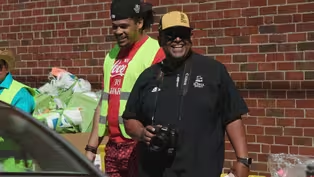
Video has Closed Captions
Clip: S5 Ep47 | 8m 55s | George Ortiz talks about his mission to feed the hungry through community sharing. (8m 55s)

Video has Closed Captions
Clip: S5 Ep47 | 8m 58s | The U.S. surgeon general has declared loneliness to be an “epidemic.” (8m 58s)
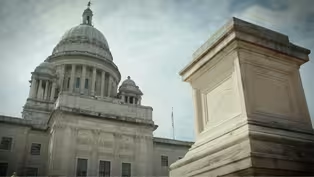
Video has Closed Captions
Clip: S5 Ep47 | 4m 54s | Governor Dan McKee will submit his budget in January; legislators are preparing for cuts. (4m 54s)
Providing Support for PBS.org
Learn Moreabout PBS online sponsorship
- News and Public Affairs

Top journalists deliver compelling original analysis of the hour's headlines.

- News and Public Affairs

FRONTLINE is investigative journalism that questions, explains and changes our world.












Support for PBS provided by:
Rhode Island PBS Weekly is a local public television program presented by Ocean State Media