
Rhode Island PBS Weekly 11/3/2024
Season 5 Episode 44 | 26m 35sVideo has Closed Captions
The President of the largest teachers union talks about challenges facing state schools.
Longtime Providence teacher, now leads RI’s largest teachers union. Then, Michelle San Miguel and WPRI 12’s politics editor Ted Nesi discuss local Mayoral races and the investigation into the Governor. Finally, a second look at Mashapaug Pond, the largest freshwater body in Providence, and why it has long been off limits for recreational use.
Problems playing video? | Closed Captioning Feedback
Problems playing video? | Closed Captioning Feedback
Rhode Island PBS Weekly is a local public television program presented by Ocean State Media
Rhode Island PBS Weekly 11/3/2024
Season 5 Episode 44 | 26m 35sVideo has Closed Captions
Longtime Providence teacher, now leads RI’s largest teachers union. Then, Michelle San Miguel and WPRI 12’s politics editor Ted Nesi discuss local Mayoral races and the investigation into the Governor. Finally, a second look at Mashapaug Pond, the largest freshwater body in Providence, and why it has long been off limits for recreational use.
Problems playing video? | Closed Captioning Feedback
How to Watch Rhode Island PBS Weekly
Rhode Island PBS Weekly is available to stream on pbs.org and the free PBS App, available on iPhone, Apple TV, Android TV, Android smartphones, Amazon Fire TV, Amazon Fire Tablet, Roku, Samsung Smart TV, and Vizio.
Providing Support for PBS.org
Learn Moreabout PBS online sponsorship(warm bright music) - [Michelle] Tonight, the new head of Rhode Island's largest teacher's union on the challenges facing state schools.
- What is your take on how Dan McKee is doing as governor when it comes to education?
- I don't think he's doing well.
- [Pamela] Then, a look at Cranston and Woonsocket's mayoral races with Ted Nesi.
- [Michelle] And, a toxic pond in Providence contaminated for decades.
- If this pond was in East Greenwich or Barrington, you might see a different response to the pollution that's in it.
(warm bright music) (warm bright music continues) - Good evening and welcome to "Rhode Island PBS Weekly."
I'm Michelle San Miguel.
- And I'm Pamela Watts.
We begin tonight with education.
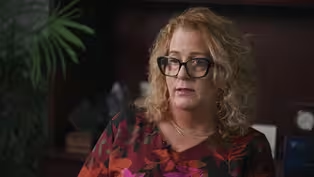
- Maribeth Calabro is the newly-elected president of the Rhode Island chapter of the American Federation of Teachers, which represents 12,000 members mostly in the urban core.
Contributor Steph Machado recently sat down with the new union boss and former Providence teacher for a wide-ranging conversation about what's ahead.
- [Steph] Among Maribeth Calabro's top priority as the new leader of the Rhode Island Federation of Teachers are improvements to the teacher retirement system and pushing to limit the number of seats at charter schools, which unions have long criticized for pulling resources from traditional public schools.
- It does not cost the same amount of money to teach all children, so we get a per-pupil expenditure that follows the child.
But those students who do not hit the lottery and get to go to the charter schools who have differing abilities, who are multi-language learners, require a lot more services, a lot more supports that are expensive.
- You just had a charter school though, the Paul Cuffee School- - Correct.
- the teachers have voted to join the AFT?
- Correct.
- Will that change anything about your criticism of charters if they're now union members?
- So if you look back, my criticisms have been of charters, but I specifically call out big-box charters or education factories as I like to refer to them.
I have always been supportive of niche charter schools.
- Teachers union often have a really influential voice in elections.
The AFT in the last governor's race split with the other teachers union, the NEA, and endorsed Nellie Gorbea over Dan McKee.
What is your take on how Dan McKee is doing as governor when it comes to education?
- I don't think he's doing well.
I don't think he's doing right by the students and families of our city or our state.
I think that he doesn't understand what the needs of individual schools are, but particularly urban schools.
And I think that he's put all of his eggs in the basket of the 365 that he talks about and he's promoting, and the afterschool programs and stuff, which are all fantastic, but we need support day in and day out from morning till early evening for our students.
- Right now, his main challenger appears to be Helena Foulkes.
Do you have any thoughts on her?
- I think that she is not nuanced enough in talking about assessments, but I do think that she has some really good ideas, really solid ideas about education in Providence, urbans, and particularly the state at large.
- [Steph] The new scores on the statewide assessment called the RICAS released in October showed only 3 in 10 elementary and middle school students statewide are reading or doing math at grade level.
Massachusetts' scores on the MCATs dropped this year too.
Though Massachusetts students are still roughly 10 percentage points above Rhode Island in both English language arts and math.
- I have very strong feelings about RICAS and assessments, but it's one moment in time, it's a snapshot, and I don't think it tells us everything that we need to know about our individual students.
I'm not one to blame COVID for everything, but we are teaching different children right now.
The children that were impacted by COVID are not the same children that we used to teach.
The level and degree of social-emotional issues that they're having, loneliness, depression, anxiety, acting out, behavioral needs, is nothing like we've ever seen before and not just in Providence, it's across the state.
- So you don't seem to hold a lot of stock in the RICAS scores.
- That test doesn't measure other things.
It doesn't measure creativity, it doesn't measure artistic ability, it doesn't measure musical ability.
It literally measures what it's intended to measure, which is the curriculum products that we're using.
And so we have to think about if our students aren't making gains the way that people expect them to, then maybe we should take a deeper, harder look at what the curriculum is that we're using.
- You are leaving your job as a special educator at Nathanael Greene Middle School where you've been for 30 years.
Could you reflect for me on how the district has changed from when you started to now?
- Oh yeah.
Well, a lot.
It's changed a lot and it's changed a lot of different times, right?
So when I started in 1993, we had just embarked on looking at standards, and over the years we've gone through different edifications of curriculum products.
We've been through, I can't tell you how many superintendents I've been through, but it's been a few.
I say this all the time and I will say it probably till the day I die: Providence teachers are some of the best teachers in the country.
And regardless of whether or not the test scores show that, when you see kids coming in every day running up to their teacher, hugging them, and having relationships with families, and being invited to quinces and going to baseball games and developing these interpersonal relationships to support our students, to me, that speaks volumes to the character and the dedication of our teachers.
And I've seen some really amazing teachers get burnt out recently, partially due to the takeover and partially due to the effects of COVID, if you will.
I tell the new teachers in my building, "I'm older than the furniture (Steph chuckles) and I've been here a lot longer than the furniture."
I've seen a lot.
I've seen a lot.
- Demographic shifts too, right?
I mean in the- - Yeah.
Absolutely.
Absolutely.
- needs of the kids more.
- The needs have changed a great deal.
The demographics have changed.
We are seeing a lot more multi-language learners than we've ever seen before.
And not just Spanish speakers, right?
We're seeing people who are from Cambodia, from Vietnam, from Afghanistan.
So, you know, we have to again, pivot.
- So for the past five years, and you've been Providence Teachers Union president for all that time, the district has been under state takeover, which you've been highly critical of.
Are the Providence schools better or worse today than they were five years ago?
- They're different.
Are they better?
I would say in some instances, maybe.
I think that we are better at identifying the social-emotional needs of our students.
I believe that teachers are trying to be more engaged with the parents and the families to which they serve.
I think that there have been some good changes.
I think that Dr. Montañez being made superintendent was a good change.
I think that some of the things that are not great are the amount of folks that we've lost.
- You mean teachers leaving the district?
- Teachers leaving, principals leaving, you know, upper admin staff.
I think that that's a problem.
- [Steph] The Providence Public School District is in the midst of a financial crisis with officials warning the school system could run out of cash this winter without an infusion of nearly $11 million.
The list of cuts on the table includes eliminating all sports and cutting transportation for high schoolers who live less than two miles away from school.
What do you make of this position that the district is in right now?
- We're in trouble.
We're in big trouble.
And whenever the powers that be get to this point where we're in court and we're arguing and we're pointing fingers and we're doing all those things.
In our situation, the people who are suffering are gonna be our students.
Sports is on the table.
Sports is what brings them to school on a regular basis.
Sports is what keeps them focused in class so that they can get the grades that they need to get in order to stay on the team.
Plus, it's an outlet for them, so they're not, you know, doing nothing and on the phones and with they're on social media.
That's a big deal.
Cutting staff, we're at bare bones as it is.
And so this is literally a fiscal DEFCON 1.
- You think the city should put more money in, do you think the state should put more money in?
- They need to be grownups.
Come to the table and say, "I'll give you 10 million if the state kicks in 10 million."
"I'll give you 7 million if the state kicks in 7 million."
And then going forward after that, if they want to check receipts, they want checks and balances, fine, but we can't go backwards.
The money's gone.
It's already been spent.
So can we stop pointing fingers and name calling And "he said, she said," "they did, I didn't," "I paid, she didn't pay."
I don't care and I don't think our kids care either.
Pay up and we'll figure it out later.
- You can hear an extended version of this conversation on the "Rhode Island Report Podcast" at globe.com/rhodeisland, including Calabro's thoughts on the school board election in Providence.
And now, on tonight's episode of Weekly Insight, Michelle and WPR12's politics editor Ted Nesi break down the mayoral races in Woonsocket and Cranston.
But first, a closer look at the investigation surrounding Governor Dan McKee and a multimillion dollar state contract.
- Welcome back, Ted.
Rhode Island Attorney General Peter Neronha recently released his report on the criminal investigation into the ILO deal.
Just to remind folks, this was a more than $5 million state contract that Governor Dan McKee's administration awarded soon after he took office.
Bottom line, Neronha is saying there was no criminal wrongdoing found, but he says, quote, "The governor personally and directly intervened to steer that contract to ILO, an organization that had ties to McKee and to allies."
- Yes, so although there's no criminal wrongdoing found, it's certainly not a good look for the governor and his administration, particularly, Michelle, because the governor repeatedly insisted to reporters there was no wrongdoing at all, no misconduct, he did not get involved in steering this contract.
We now know that's not true.
We also had other revelations in the report.
There's this complex web of financing where people involved in ILO were getting a political consulting firm to help McKee with an unclear chain of funds around that.
And an email where one leader from ILO told a colleague that the bid was, quote, "fixed."
- People are posing the question, how fair was this report?
Again, given that there was no criminal wrongdoing, it was a question that Neronha was asked at a press conference, here's what he had to say.
- I think, you know, we're caught between, how do I put this, people who may not want us to share what we think or share the facts and then people who want public transparency and you can't have it both ways.
Number two, as I said earlier, all of this material on which these reports rely, hold on a minute, Brian, is public and so and so and so, someone needs to put it in context.
- And Governor Dan McKee is saying this investigation was a waste of taxpayer money.
- Yes, and I presume that's what he will continue to say as well as his allies.
And it's now gonna really come down to the court of public opinion about how voters feel about the revelations in this report within the lens on McKee's plan to run for reelection in 2026.
- Before we get to 2026, let's look at 2024.
We have two mayoral races in Rhode Island that are being viewed as competitive.
Let's look first at the one in Cranston.
We have Republican and incumbent Ken Hopkins, who is facing his democratic rival, Robert Ferri.
You recently moderated a debate between both men.
Let's hear first from Ferri followed by Hopkins in that debate.
- If I had a surplus as the mayor, I would spend that money on the things that the people are constantly complaining about in the city, like rodent control and getting trees trimmed and roads fixed and sidewalks fixed, if we had a surplus.
So I think any accountant can tell you you have a surplus when you really don't have one.
- When you're doing a budget, you have to balance between taxes and services.
The amount of money that we used from the ARPA funds was to give tax relief to the people of Cranston.
We did that for the first couple of years coming out of COVID.
- And Hopkins really is a rare bright spot for Republicans in Rhode Island at this moment.
- Absolutely, Michelle.
Cranston is still a place where the GOP is organized and competitive.
They feel that Hopkins has cross-party appeal.
They think he can hang on, but Democrats think Ferri has a shot because presidential year turnout is higher and usually benefits Democrats.
- Okay, let's turn now to Woonsocket where we have Mayor Christopher Beauchamp who's seeking a full term as mayor.
He'll be facing off against City Council President John Ward.
Again, you recently moderated a debate between the both men.
Let's hear what they had to say specifically about homelessness in the city.
- The homeless situation is a multifaceted problem, and it's not just the city that's gonna solve it.
We need the public safety people's involvement, we need partners in the community.
- People have a right to to have the best benefit of our public parks and our public facilities.
And that cannot be a permanent home for people who are otherwise unhoused.
- And this race is really hard to predict.
- Yes, it's non-partisan so you don't have party labels.
And so much of it is about former Mayor Lisa Baldelli-Hunt and how she left office.
So I'm very interested to see where Woonsocket voters land.
- Thanks so much, Ted.
- Great to be here.
- Finally, Mashapaug Pond in Providence has long been off limits for recreational use due to contamination.
While the pollution may appear to be isolated within the body of water's banks, it eventually contaminates Narraganset Bay.
Tonight, we take another look at a plan by the state to clean up the Mashapaug and hold polluters responsible.
This story is part of our Green Seeker series.
Tucked behind businesses, homes, and industrial sites sits the largest body of fresh water in Providence: Mashapaug Pond.
Suzannah Rutherford bought a home overlooking the water six years ago.
- It's just so open when you stand here and look out.
I mean, it's beautiful.
It's just like you see more sky, you feel like you have a larger expanse of yard.
- [Michelle] Rutherford fell in love with the scenic views from her gazebo, but she also had her share of questions.
Signs around the water warn "Mashapaug Pond is sick."
- I was very concerned.
So I did a lot of research before we moved here.
(subdued music) - [Michelle] For nearly 100 years, the Gorham Manufacturing Company, one of the largest producers of sterling silver, operated a factory by the pond and dumped toxic byproducts into the water.
- Gorham Silver was in the cove at the other end of the pond and dumped a lot of solvents in the water.
So I read about the remediation efforts.
I spoke to a few environmental scientists at Brown University.
- [Michelle] Those remediation efforts included dredging the pond's cove in 2015.
These days, pollution left behind from Gorham is not the primary source of contamination in Mashapaug pond.
It's stormwater runoff, which can produce a blue-green algae known as cyanobacteria.
- It's an environmental problem of our time that I feel like people are going to be very motivated to figure out how to deal with it eventually.
- [Michelle] Topher Hamblett is one of them.
He's the executive director of the conservation organization, Save the Bay.
- No matter who you are or where you live, you have a right to clean water, period.
And I think it's a travesty that people who live around this pond can't enjoy it as people can enjoy other waters around Rhode Island.
- [Michelle] Storm water runoff, Hamblett says, is causing excess nutrients like phosphorus to enter Mashapaug Pond.
And it's susceptible to polluted runoff because it's surrounded by impervious surfaces like asphalt and concrete.
- This whole watershed's a mix of some park areas like we're sitting in now, but also some very wide open, heavily-paved areas.
When water hits pavement, it can't go into the ground.
It has to go somewhere.
And that's one of the reasons why we see ponds like this so polluted.
- [Michelle] Since at least 1998, Mashapaug Pond has been listed on Rhode Island's list of impaired waters because of the contamination.
- No one likes to see a pond that's covered in green scum or other types of invasive flora that just cover the whole surface of the pond.
A lot of it is, I believe, is getting driven by climate change as well.
- [Michelle] Terry Gray is the director of the Rhode Island Department of Environmental Management, or DEM.
He says, warmer waters and more frequent, intense storms are adding to the problem.
- When we see these unbelievable short bursts of rainfall, that creates a huge slug of stormwater that's being introduced into our water bodies and those slugs can really trigger bacterial growth and algae growth.
- [Michelle] Awareness about algae growth has increased in the community.
It's an important message for Lorén Spears, a Narraganset tribal citizen.
- Water, as the slogan goes, is life.
You know, we need it.
It's a giving force.
- [Michelle] The banks of the pond were once home to a thriving Narraganset settlement.
- Our ancestors have lived here, but also our contemporary ancestors, if you will, just a generation ago, were living on and around this pond.
(lively drum music) - [Michelle] Spears credits a decade of annual processions held around the pond with helping to raise awareness about the contamination.
- The average person knew a lot about what was happening here, and it kind of rises to the political entities that can do something about it and puts more pressure on them to do something about it.
- [Michelle] Environmental groups and state agencies have taken note.
In 2018, the Conservation Law Foundation, or CLF, petitioned DEM to require businesses to control stormwater runoff.
But that petition went unanswered.
Then, earlier this year, the Rhode Island Attorney General's Office got involved.
- We filed our own petition.
We got involved because we've seen the algae blooms in some of our most critical urban ponds.
And you can see in the summertime, it's this really bright lime green stuff, algae, on top of these ponds, - [Michelle] DEM recently announced about 70 businesses near Mashapaug Pond watershed in Providence and Cranston will be required to control runoff.
The agency's director, Terry Gray, says in the short term, commercial and industrial properties will have to take basic housekeeping steps like picking up leaf litter and clearing storm drains.
- A lot of times what happens is the rain flushes nitrogen and phosphorus out of that material by flowing through it, and then the water, which could look perfectly clear, carries those materials downstream and boom, what that is, is that's food for the organisms that are living in the pond naturally.
And if you over feed 'em, boom, you get this bloom that people see towards the end of the summer every year.
- I have heard from a few people who say, "Look, telling people to clean up their leaf litter or sweep their parking lots doesn't go far enough."
We're asking people for the bare minimum.
- That's where we have to start.
One of the things we may ask some of the property owners to do is to put measures in place to keep that stormwater on your site.
That could include pervious pavement, rain gardens, tree wells.
These are all sort of technologies that are more current, that get the water back in the ground and then it's not flowing over the surface of the land as stormwater.
- Oh my gosh.
It's so deep.
- [Michelle] Suzannah Rutherford will be among the first to know if the water quality is improving on Mashapaug Pond.
She's also a volunteer with the University of Rhode Island's Watershed Watch program, which measures water quality.
On this day, Rutherford and a neighbor were out collecting samples.
- We monitor visibility, which is an indicator of how many bacteria or algae are blooming.
We test for chlorophyll content.
We test for dissolved oxygen.
So one of the problems when you have overgrowth from runoff, from fertilizer and stuff, that the oxygen lower down goes down to the point where fish can't survive.
- Some animals still make their home here, like the swan we saw gliding across the water.
We also spotted a turtle perched on a log.
Topher Hamblett from Save the Bay says cleaning this pond is an environmental justice issue.
Ultimately, what does justice look like in terms of restoring the pond?
- I think justice looks like a clean, vibrant, healthy pond that people in this community are enjoying.
- [Michelle] Hamblett says there's an acceptance of this kind of pollution in urban areas that would not exist in more affluent communities.
- If this pond was in East Greenwich or Barrington, you might see a different response to the pollution that's in it.
- [Michelle] Terry Gray says the work being done in the Mashapaug Pond watershed, which flows into Narragansett Bay, is a case study with lasting ripple effects.
- As we learn and we see the benefits and we see how to do this effectively, my hope is that we'll apply the those lessons to other parts of the state.
- The long term goal, he says, is to restore the water so it can be fishable and swimmable.
When can people expect to go swimming in that pond?
To go fishing there?
- Too early to say.
Remember, it's taken over a hundred years to really get to this point, and that's a hundred years of history that we have to overcome in order to restore the water quality in this pond.
So it's gonna take a while.
- [Michelle] Suzannah Rutherford says being out on the water feels like a ghost town.
She's seen rotting docks submerged, a sign, she says, this was once a vibrant place.
- I'd love to be able to dive off a dock and swim across the pond.
You know, someday.
We enjoy just looking at it.
We enjoy the birds.
We enjoy watching the eagles catching fish, but it would be a beautiful thing to have people be able to swim here again.
- [Michelle] But it's unclear how long it will take to make that a reality.
- A hundred years from now, I'd like the people to be telling the story about how this generation did this work and repaired this waterway so that others could enjoy it.
You know, there was a time where most people couldn't enjoy the bay, and we did a lot of work, and now most of the bay is enjoyable.
And so if we can do that, then we can do this.
- Mashapaug Pond sits right behind our television studio.
The Rhode Island PBS Foundation and The Public's Radio will be one of the properties required to control stormwater runoff under the state's new plan.
And that's our broadcast this evening.
Thank you for joining us.
I'm Michelle San Miguel.
- And I'm Pamela Watts.
We'll be back next week with another edition of "Rhode Island PBS Weekly."
Until then, please follow us on Facebook and X and visit us online to see all of our stories and past episodes at ripbs.org/weekly.
Or listen to our podcast on your favorite streaming platform.
Goodnight.
(warm bright music) (warm bright music continues) (warm bright music continues) (warm bright music continues)
Video has Closed Captions
Clip: S5 Ep44 | 10m 5s | Maribeth Calabro, a longtime Providence teacher, now leads RI’s largest teachers union. (10m 5s)

Video has Closed Captions
Clip: S5 Ep44 | 11m 21s | Reducing stormwater runoff in Mashapaug Pond. (11m 21s)
Video has Closed Captions
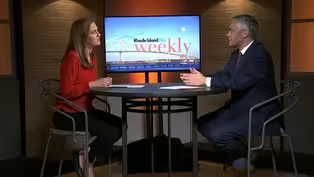
Clip: S5 Ep44 | 4m | A report finds Governor Dan McKee intervened to steer a large contract to ILO. (4m)
Providing Support for PBS.org
Learn Moreabout PBS online sponsorship
- News and Public Affairs

Top journalists deliver compelling original analysis of the hour's headlines.

- News and Public Affairs

FRONTLINE is investigative journalism that questions, explains and changes our world.












Support for PBS provided by:
Rhode Island PBS Weekly is a local public television program presented by Ocean State Media