
Rhode Island PBS Weekly 1/21/2024
Season 5 Episode 3 | 24m 50sVideo has Closed Captions
A Rhode Island man’s journey to redemption and how microplastics invade our lives.
Meet Keith Nunes and hear about his journey to redemption after taking another man’s life. Then, we revisit Michelle San Miguel’s plastic pollution story and new evidence of the dangers of microplastics in all aspects of our lives. Finally, we share a portion of Rhode Island PBS’s three-part docuseries, The Risk of Giving Birth.
Problems playing video? | Closed Captioning Feedback
Problems playing video? | Closed Captioning Feedback
Rhode Island PBS Weekly is a local public television program presented by Ocean State Media
Rhode Island PBS Weekly 1/21/2024
Season 5 Episode 3 | 24m 50sVideo has Closed Captions
Meet Keith Nunes and hear about his journey to redemption after taking another man’s life. Then, we revisit Michelle San Miguel’s plastic pollution story and new evidence of the dangers of microplastics in all aspects of our lives. Finally, we share a portion of Rhode Island PBS’s three-part docuseries, The Risk of Giving Birth.
Problems playing video? | Closed Captioning Feedback
How to Watch Rhode Island PBS Weekly
Rhode Island PBS Weekly is available to stream on pbs.org and the free PBS App, available on iPhone, Apple TV, Android TV, Android smartphones, Amazon Fire TV, Amazon Fire Tablet, Roku, Samsung Smart TV, and Vizio.
Providing Support for PBS.org
Learn Moreabout PBS online sponsorship- [Pamela] Tonight, one Rhode Island man's story of redemption.
- If someone such as myself can be redeemed, if someone such as myself could go from serving a life sentence that began at 18 years old to applying for a master's degree and helping others, it could be done for anybody, anybody could do it.
- [Michelle] Microplastics invade Narraganset Bay.
What are they and what are they doing to our environment and beyond?
- We are being exposed to these plastics that are having negative impacts on everything they encounter.
(upbeat music) (upbeat music continues) - Good evening, welcome to Rhode Island PBS Weekly.
I'm Pamela Watts.
- And I'm Michelle San Miguel.
Philosopher Martin Buber wrote, "We can be redeemed only to the extent to which we see ourselves."
- In our first story tonight, senior producer Justin Kenny, introduces us to a man whose search for redemption began when he took a life.
This is part of our continuing Turning Point series.
- My name is Keith Nunes, and I'm here to tell you about a second chance that I received that changed my life.
When I was a young man, I came up in the eighties and nineties, the height of the crack epidemic and violence epidemic, inner city poverty, which is a story that's pretty common.
There's plenty of other individuals that came up in them circumstances, but when I was in them circumstances, you know, I didn't necessarily make the right decisions.
And I started down the road of, you know, selling drugs to try to get money and to try to get out of the poverty I was in.
And when you're in that world, one thing leads to another.
You know, it's a lot of physical toughness that's portrayed in that world, and you feel like you have to defend yourself in that type of environment.
So, it was those circumstances that led me to being out at a nightclub and getting into a altercation with some older, bigger gentleman.
One thing led to another and it ended with me wrongly and unnecessarily taking the life of another man.
So, at 18 years old, I was arrested and charged with a first degree murder and another attempted murder where I received a mandatory life sentence for a first degree murder and an additional 10 years to run consecutive with a life sentence.
I knew that I deserved to be held accountable for my actions, and prison should definitely be a part of that, with that serious of a crime.
Now, the length of time one should receive for that ultimate act, it's debatable.
I know some people believe that, if you take a life wrongly, you should forfeit your life, whether that's with life imprisonment or with death penalty.
And I would be hard pressed to argue against that logic, you know, on the one hand.
But on the other hand, having lived it, I know that people come from tough circumstances and at young ages are forced to make tough decisions on what they think will keep them alive or keep them maintaining in a rough environment.
And I think people should be given a second chance in many of those circumstances.
(somber music) Education for me, both informal and formal, was one of the major components of my story of redemption.
I believe my story is a redemption story above all else.
It's a cliche, but when you know better, you do better.
And a lot of decisions are made out of ignorance.
So, when you learn certain things about yourself, about society, about, you know, moral or ethical matters, you start making different decisions.
(somber music) (somber music continues) (somber music continues) If receiving a life sentence at 18 years old is difficult to describe, being released from that situation when you didn't necessarily expect to is equally, if not more difficult to describe it.
There's just a flux of different emotions hitting you at once.
You're happy, you're overjoyed, of course, you're excited.
There's a little bit of survivor's guilt there.
There's other individuals that you grew up with in that situation that, you know, they come from the same circumstances as you made the same decisions for the same reasons, in the same type of situation.
And they're not coming home, they're not getting the opportunity.
You also feel, you know, you're trying to make up for some lost time.
You know, I was 41 when I was released.
As a 40-year-old man, I knew I had to come out here and try to rebuild my life and that was gonna be challenging.
You're a little bit fearful, because of that.
You wonder if you're gonna make good or if you're gonna fail, and you just feel the seriousness.
You feel the gravity of it knowing that, you know, you've been given this second chance at life, literally.
And it's on you to make the best of it, and to show everybody involved.
You know, people that might've been hurt by your bad decisions, and people that were faithful enough to support you through 23 years of incarceration.
You wanna prove to everybody that it wasn't for naught.
Something occurred and you're here to make good.
And it could be a little bit of pressure, you know?
(somber music) (somber music continues) if someone such as myself can be redeemed, if someone such as myself could go from serving a life sentence that began at 18 years old to applying for a master's degree and helping others, it could be done for anybody, anybody could do it.
First and foremost, it takes a look at self.
It takes some serious introspection.
It takes a willingness and a desire to change.
It's definitely gonna take good people to help you along the way, 'cause no one could do it themselves.
But the change is possible, and it's a very powerful thing when it occurs.
I personally believe that the tougher circumstances that a person comes from, the stronger they are when they make the change.
The better position they're in to help others when the change occurs.
And it's a very powerful thing.
I want everybody to know that redemption is possible for everybody.
- There's a chance that Keith Nunes could return to prison as the state of Rhode Island has appealed the Superior Court judge's ruling.
Up next, a new study is shining a light on how pervasive microplastics have become in our world.
Scientists at Columbia and Rutgers Universities recently discovered about a quarter million plastic fragments in a liter of bottled water.
There's one major question that researchers, including those here in Rhode Island, are trying to answer.
How are these microplastics affecting our health?
As we first told you in December, scientists at the University of Rhode Island are exploring how these tiny pieces of plastic are infiltrating all aspects of our lives.
This is part of our Green Seeker series.
- Microplastics are in our water, they're in our air, and it's a very difficult problem to control, because they are so prevalent.
- [Michelle] The proof of how reliant we've all become on plastic can be found at the bottom of Narraganset Bay.
Researchers at the University of Rhode Island estimate the top two inches of the floor of the bay contain more than 1,000 tons of microplastics.
Plastic pieces less than five millimeters in diameter.
- That has been accumulating over the past 10 to 20 years.
And so, plastics are coming into the bay, they float through the water, and eventually, they land on the seabed.
And so over time, they're accumulating at these really high concentrations, because we just keep using plastics and the sources are not being mitigated.
- [Michelle] Doctoral student Victoria Fulfer said the levels were shocking.
She and JP Walsh, director of URI's Coastal Resources Center, published their study earlier this year.
Using a toad sled, they documented just how much debris lies in the water.
They found the upper parts of the bay near Providence contain higher concentrations of plastic waste than the lower bay.
- Plastics come from people.
And in Rhode Island, we have a really dense population, particularly surrounding the Northern Bay.
So, inherently there's going to be more plastic that can make its way into the bay - And before they end up at the bottom of the bay, many are littered throughout Rhode Island's beaches, including Rocky Point State Park in Warwick.
What did you find here?
- So, here we have a bottle cap and one of the rings that goes around a milk carton container.
I see some fragments of plastic and food wrapping, things like that.
Very common items to find.
- [Michelle] As debris makes its way into the water, Fulfer says it's slowly breaks down over time into microplastics then microscopic organisms like zooplankton confuse it for food.
- I've published a study looking at the impact on zooplankton, which form the base of the food web, and we're seeing that they are growing at much lower rates, they're reproducing less, and they're not living as long.
If there are less zooplankton, that's less food for fish.
And you know, that obviously, has far reaching implications.
- [Michelle] Fulfer says more research is needed to determine whether microplastics are causing the decline in the zooplankton population.
Still, she's concerned about how those small plastics are affecting marine life and humans.
- We eat seafood and unfortunately, marine organisms are eating microplastics and then we eat them.
And so, there's potential that we are ingesting microplastics when we eat our food.
- It's troubling to Jaime Ross as well, an assistant professor of neuroscience at URI.
She's been studying the health effects of microplastics in mammals.
- There's not really anything known about plastics on brain health and neurological disease, and also, the lifecycle of plastics in the body.
- [Michelle] Ross and her team exposed mice, young and old to microplastics in drinking water over the span of three weeks.
After observing them in an open field, researchers found ingesting microplastics cause the mice to have changes in their behavior akin to dementia in humans.
- The young adult animals and the older adult animals, they both did things that they shouldn't.
They spent a lot of time in the center of the arena.
Mice are not supposed to really do that.
- Did any of that surprise you?
- For three weeks of exposure it did.
I thought perhaps if you're chronically exposed for months and months, maybe you would see something like this, but only three weeks was really shocking to us.
- [Michelle] Ross's team also learned the plastic particles had begun to bioaccumulate in every organ in the mouse, including the brain.
- The fact that they are crossing the blood-brain barrier, which really is supposed to keep out bad things from the brain, including viruses and bacteria.
The fact that they were able to sneak in there was almost alarming to us.
- [Pamela] The mice that ingested microplastics had a decrease in glial fibrillary acidic protein, known as GFAP a protein that supports many cell processes in the brain.
- It suggests that the microplastics could be changing the environment in the brain, and the brain is reacting to them in a way that could point to changes in cognition down the road.
- Both Ross and Fulfer say there's an urgency to the work they're doing.
- I think we're going to see a wide range of ecosystem impacts, if we continue to create plastic and allow it to get into the environment.
I think eventually, you would see widespread collapse of shellfish and fisheries.
- [Michelle] Inside her lab, Fulfer has slides full of microplastics She's collected from Narraganset Bay ranging in size, shape, and color.
Many of the fragments are items we all use.
- So, three of the main types we found were polystyrene, which you might be familiar with as the white foam that we use in packaging, polypropylene and polyethylene.
And polypropylene and polyethylene are really common types of plastic used specifically in single-use plastics.
So, those are our takeout containers, our coffee cups, things like that.
- [Michelle] Littering is one way these plastics are getting into the water, but Fulfer says it's bigger than that.
- Microplastics take all kinds of forms, so we can have particles which are formed from the breakdown of larger items like bags or bottles, but we also have microfibers, which mostly come from your clothing.
And so, a lot of our clothing is unfortunately synthetic now that makes it last longer and have different qualities.
So, we like to use it, but unfortunately, when you wash your clothes, those microfibers are being released and going into the wastewater.
- [Michelle] That's why Ross says she tries to buy cotton fabrics when possible.
Among other changes she's made.
- I really try to always purchase a product that's not in plastic.
I try not to store our food in plastic.
I try not to drink out of plastic.
Sometimes these things are not avoidable.
- [Michelle] As Ross continues her research, there are several key questions she's eager to answer, including where do microplastics go once they enter the body, and how long do they stay there?
- Another question is, are they really contributing to this large uptick that we see in society of a lot of different inflammatory diseases and neurological disease?
Are they contributing to our health in a negative way?
- To be clear, it's not known, if microplastics can leave the body or how to get rid of them, right?
- Right, right.
- Ross hopes further analysis will shed light on the far reaching effects of these materials.
- And I think we need to really understand that black box of what are plastics doing to us and what plastics do we really need as a society for healthcare, for example, and what plastics can we part ways with and say, "We don't need this.
This is just to the benefit of packaging.
This is not really helping us."
And we need to find an alternative, either source or get rid of it.
(suspenseful music) - Finally, as we mentioned last week, Rhode Island PBS recently premiered a three-part docuseries on the risk of giving birth, which examines the maternal health crisis through a local lens.
Tonight, we share a portion of the series that looks at the often serious consequences of postpartum depression.
And a warning, this story contains subject matter that some viewers may find disturbing.
- Well, you're awake.
I never thought that this would happen to us.
Not in a million years.
- [Narrator] Tyler Sutton is the father of newborn twins, Rowan and Everly, and a vibrant 4-year-old Melody, and he's now parenting on his own.
- It's Everly, it's your sister, - [Narrator] His wife, Ariana, took her own life just nine days after giving birth to the twins.
- It happened at such an alarming rate that no one was ready for it, not her therapists, psychologists, or OB.
No one was prepared for what was happening in front of them.
- [Narrator] Joyful and outgoing, Ariana owned a local dance studio with her sister.
- [Tyler] She was an accomplished dancer and a great choreographer, cared a lot about her students, (Ariana and students screaming) but it took up a good portion of her life that she enjoyed very much.
- Go, come in.
(balloon popping) (people cheering) - Then we decided to have Melody.
The birth went very well, and when we came home, everything seemed fine initially.
There was no cause for concern or any immediate changes in her behavior.
Some weeks later, it started off small where she became obsessive over certain things.
She became concerned with the cleanliness of the house.
Her first few changes didn't really seem like it was a problem.
It seemed like a simple change from her being a new mother.
Eventually, she started to obsess over things such as the tap water.
- [Narrator] Ariana developed an irrational fear that there was something harmful in the water.
The obsessive compulsive behaviors were early warning signs.
- But again, I didn't know that this was postpartum depression yet, because I didn't know anything about it, didn't even know it existed.
It became a real problem when it started to affect her ability to care for Melody.
That's when it started to become nerve wracking.
There was a morning where I came home from a midnight shift 08:00 in the morning, and Melody was crying upstairs in her crib, and Ariana could clearly hear her.
She's still in bed.
She looked at me with tears in her eyes saying like just, she's like, she knew something was wrong and was having horrible thoughts.
And she said, "I need to go to the hospital."
- [Narrator] Ariana would end up being hospitalized twice for her mental health issues before they found the right balance of medication and therapy that would lift her out of it.
- Hey, see the video.
- [Tyler] And then when that happened, she was the ideal mother, loved being a mother.
She was Melody's favorite person in the world.
- [Narrator] But the episode with postpartum depression hung over Ariana.
- It was sort of a lingering shadow behind her, something that always followed her throughout the last four years.
It always upset her that we let it get that bad, because of sheer ignorance.
If we had been more well-informed, then there was a good chance she never would've been hospitalized in the first place.
- [Narrator] Four years later, when Ariana decided she wanted to have more children, she and Tyler approached it with caution.
- She met with her OB, her psychiatrist, her therapist, and they came up with a plan, and it was a good plan.
- [Narrator] When she became pregnant with twins, they were happy.
They always wanted a larger family.
- She seemed very confident, excited, and towards the end of the pregnancy, she was ready for them to be born.
- [Narrator] But the twins were born sooner than expected, coming prematurely at just 34 weeks.
- Once the children were born, you could see that she was upset that they were born early, that there might be something wrong with them.
But even while we were in the hospital in the special care ward where the twins were being kept, all these nurses that deal with twins on a daily basis were saying they're fine.
- [Narrator] Five days after giving birth, Ariana was released, but Everly and Rowan stayed in the hospital.
- That was definitely a big trigger, her coming home without her babies.
So, that was definitely something that hit her hard.
So, she blamed herself on some level for the early childbirth.
- [Narrator] Ariana was once again having irrational fears.
- Her anxiety was back, and she kept telling me that she was taking her medication and everyone, therapist, psychologist, and myself thought we had time.
- [Narrator] The day she died, Tyler left the house planning to pick her up later for their daily visit to see the twins.
- As I was leaving the house, she was going through her normal routine.
She was getting her breast pump machine ready, putting all the bottles together.
Everything about the morning seemed normal.
- [Narrator] But by the time Tyler returned home, Ariana had ended her life and left a note.
- She described herself as a burden, which she was not.
She was a great mom, but she truly believed that, so much that she took her own life.
- If you know someone who is in crisis, call or text 988 to connect with the Suicide and Crisis hotline, and you can watch the entire series online at ripbs.org/riskofgivingbirth.
And how courageous of Tyler Sutton to share his family's story with us.
- Absolutely, you never know the impact that you can have on someone.
And that's our broadcast this evening.
Thank you for joining us.
I'm Michelle San Miguel.
- And I'm Pamela Watts.
We'll be back next week with another edition of Rhode Island PBS Weekly.
Until then, follow us on Facebook and X and visit us online to see all of our stories and past episodes at ripbs.org/weekly, or listen to our podcast on your favorite streaming platform, good night.
(upbeat music) (upbeat music continues) (upbeat music continues) (upbeat music continues) (upbeat music continues)
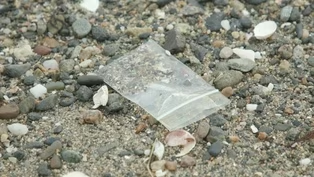
Green Seeker: Plastic Pollution
Video has Closed Captions
Clip: S5 Ep3 | 9m 34s | Researchers explore the effects of microplastics on the environment and mammals. (9m 34s)
Video has Closed Captions
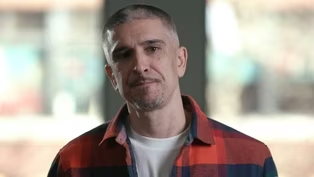
Clip: S5 Ep3 | 7m 59s | A Rhode Island man’s journey for redemption after decades in prison. (7m 59s)
Providing Support for PBS.org
Learn Moreabout PBS online sponsorship
- News and Public Affairs

Top journalists deliver compelling original analysis of the hour's headlines.

- News and Public Affairs

FRONTLINE is investigative journalism that questions, explains and changes our world.












Support for PBS provided by:
Rhode Island PBS Weekly is a local public television program presented by Ocean State Media