
Rhode Island PBS Weekly 12/8/2024
Season 5 Episode 49 | 24mVideo has Closed Captions
Central Falls Mayor fighting to take back the schools from the State.
An in-depth report on the city of Central Falls efforts to take back their schools, which the state has been running for 33 years. Then, laptops for typewriters? Pawtucket man says these are vintage clicks for a new generation. Finally, Michelle San Miguel and Ted Nesi discuss the latest on the Washington Bridge and why Providence has to pay a lot more for education.
Problems playing video? | Closed Captioning Feedback
Problems playing video? | Closed Captioning Feedback
Rhode Island PBS Weekly is a local public television program presented by Ocean State Media
Rhode Island PBS Weekly 12/8/2024
Season 5 Episode 49 | 24mVideo has Closed Captions
An in-depth report on the city of Central Falls efforts to take back their schools, which the state has been running for 33 years. Then, laptops for typewriters? Pawtucket man says these are vintage clicks for a new generation. Finally, Michelle San Miguel and Ted Nesi discuss the latest on the Washington Bridge and why Providence has to pay a lot more for education.
Problems playing video? | Closed Captioning Feedback
How to Watch Rhode Island PBS Weekly
Rhode Island PBS Weekly is available to stream on pbs.org and the free PBS App, available on iPhone, Apple TV, Android TV, Android smartphones, Amazon Fire TV, Amazon Fire Tablet, Roku, Samsung Smart TV, and Vizio.
Providing Support for PBS.org
Learn Moreabout PBS online sponsorship(gentle upbeat music) - [Michelle] Tonight, the mayor of Central Falls says the state takeover of the city's schools needs to end.
- This is a systemic problem that has happened for far too long, and I feel like everybody who's coming into this district is inheriting this.
- [Pamela] Also, how a Pawtucket businessman is fixing vintage typewriters that click with a new generation.
- They're like totally like, "Wow, I gotta have one of these.
I gotta try it."
- And why Providence has to cough up millions more, with Ted Nesi.
(joyful music) (joyful music continues) Good evening.
Welcome to "Rhode Island PBS Weekly."
I'm Michelle San Miguel.
- And I'm Pamela Watts.
We begin tonight with a look into the Central Falls School District.
- The city's mayor says the public schools have been under state control for far too long.
More than three decades ago when the state's oversight began, the Soviet Union had collapsed.
The first webpage went live.
And Bruce Sundlun was the governor of Rhode Island.
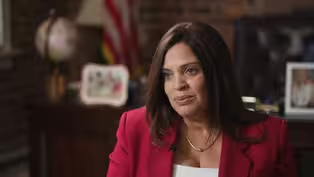
Since then, Mayor Maria Rivera says outcomes for children in Central Falls schools have not improved, something she believes can only be fixed when the community takes them back.
- When I placed them in the school, I led with blind faith.
I led believing that the educational system would work and only to find out that it did not.
- [Michelle] Isabel Amado says the Central Falls School District failed her seven-year-old twin sons Aiden and Tristan.
They're nonverbal and have autism.
- I just felt like with the diagnosis of autism and nonverbal, everyone knows that there's a window.
The first few years are very important.
And not providing them services, we don't know if they could have been verbal today.
- You wonder if the district plays a role in- - Plays a huge role in that failure.
- [Michelle] Amado says when she approached the district about giving her sons more speech services, she was told they already had plenty.
She went on to hire an attorney.
- As a parent, I should not have to hire an attorney to get services.
They were in a place to tell me, "Hey, Mom, these are the services that your kids need."
But when I requested more, they pushed back to give me less.
- [Michelle] Amado's experience is one of hundreds reflected in a report recently released by Central Falls Mayor Maria Rivera.
It outlines what Rivera calls the systemic failures in the city's public schools since the state took control of the district in 1991.
- I don't blame the failure of our students or the outcomes, the low outcomes on anyone.
This is a systemic problem that has happened for far too long, and I feel like everybody who's coming into this district is inheriting this.
- [Michelle] 33 years ago, the city gave the state control of its schools because Central Falls could not afford them.
Governor Dan McKee alluded to this in his state of the state address in 2023.
- The state has intervened in two local school districts, one for far too long and one not quite long enough to get the job done.
- Did you feel like that statement was a call to action for you?
- Absolutely.
Absolutely.
You know, you just can't give me the schools back.
You just can't give me the schools.
I need to have a plan in place.
And I would not be a responsible mayor for the city if I wasn't taking action.
- Rivera wants the city to take back control of the schools, but she says the city does not have the property tax revenue to afford them.
The city has a $21 million budget, and this past school year, the state gave the district more than $51 million.
What do you say to people who say, "Mayor, you want the best of both worlds.
You want the state to pay for the schools, but you want the city to have control of the schools"?
- Well, we continue to fail our kids because I know what this is gonna come down to, right, the finances of the city.
I would love to have more economic development in this community.
I would love it to increase the tax revenue.
But Central Falls is a small community.
It's very limited.
There's not a lot of space.
- [Michelle] Last year, the Central Falls School District ranked last on state standardized tests among all the districts in this state.
It's a reality Sarah Friedman is determined to change.
She is the chief of education strategy for the city.
- No teacher is writing off their kids, but I think the system as a whole, we've gotten complacent in feeling like, well, these outcomes are the only thing you can expect with the composition of this community.
And I refuse to believe that.
I have been immersed with this community.
I know these families.
I know these kids.
And I know these teachers.
- [Michelle] Friedman wrote the report which details numerous failures in the school district.
She says she spoke with some teachers who described feeling pressured not to refer students for special education services.
- I think it's resources.
It doesn't make it right though.
And so there may be practices that are in place to try to live within too small of a pie at the expense of family voice and rights.
And I think special ed is a really prime example of that, where there are a lot of families in this community who don't speak the language, who have limited educational background, who maybe come from another country and are not as familiar with the laws in the United States, and maybe they're not as likely to advocate as in a suburban community.
- [Michelle] The Central Falls School District Board of Trustees is appointed by the State Board of Education.
In 2019, the board of trustees named Stephanie Downey Toledo interim superintendent, a position that later became permanent.
The superintendent declined my request for an interview.
In a statement she said in part, "My focus will continue to be on the systemic leadership required to keep strengthening our schools and the opportunities they provide our students."
Isabel Amado says she wants other parents in Central Falls to know how important it is to advocate for your children.
She wonders what would've happened had she pulled her sons out of the district sooner.
- Just the fact that they may be verbal if they had the right resources is huge.
And part of me blames myself for not knowing that they should have been provided more.
- [Michelle] Friedman and Rivera say the city's public schools are also failing multilingual learners, which make up 52% of students in the district, and less than 5% of them pass state tests.
- You just can't put 30 kids in a classroom with a teacher who doesn't speak the language and expect her to help our students succeed, right?
Like, it's not working, and I get it.
You know, people are gonna say to me, "There's a teacher shortage."
"There's a teacher shortage."
We have to figure something out.
- [Michelle] Central Falls High School sophomore Sofia Roca Ruiz remembers what it was like moving from Colombia to Central Falls several years ago as a multilingual learner.
She says it was hard being in classrooms with teachers who did not speak Spanish.
- I feel like right now my English has improved a lot, but even though I sometimes am, like, sitting at classroom, and I'm like, "Oh my God, what does that even mean?"
Or when I'm with my friends, and they say a word, and I just have to ask them like, "What does that mean?"
and they have to explain it to me, it's like, kind of like overwhelming.
- [Michelle] Another common theme echoed in the findings is the need for more resources and staffing.
A number of teachers reported spending $4,000 to $5,000 of their own money each year on basic supplies for their classrooms.
The report goes on to say that when Friedman was visiting a preschool in Central Falls, she saw two children vomiting into garbage cans while the teacher continued teaching the 16 students on the rug in front of her.
When asked why the children were in the room, Friedman was told they had no staff to send them to, and they were waiting for a nurse to come from another building, since they share a nurse with another school.
- Especially with really little kids, like, they're sick every five minutes.
Any mom knows this, right?
Germs spread really quickly.
And so I had questions about how that decision was made, you know, staffing-wise.
- [Michelle] Rivera says there's an urgency to improve the city's seven public schools.
Central Falls is building a new high school, but enrollment is projected to fall 38 to 49% by 2035 if all planned state-approved charter seats are filled.
- If we do things right, we're getting a new high school, we start addressing these issues, I don't think parents are gonna feel the need to try to figure out where the kids are gonna go for high school, and they'll keep them here in Central Falls.
And that's what we have to do.
- [Michelle] Meanwhile, Friedman says she's exploring viable funding solutions.
She says it's unclear for many in the district who's making decisions.
- When resources are particularly scarce in the state, you see more involvement from the state in saying like, "This is the budget we need you to approve," to the board of trustees.
When resources are more abundant, they tend to step back and say like, "You can decide."
And it's really hard to know who holds the accountability and the responsibility for any given decision in a transparent way.
- Rivera says a community advisory board made up of 26 people recently began meeting to discuss the next steps and come up with a plan to go before the General Assembly early next year.
She's hopeful the city can take back control of the schools sometime next year.
Why are you confident that student outcome will be better if the schools are under local control versus state control?
- Because we understand the needs of this community.
Nobody's really paying attention.
I need people from this community who understand the needs of this community to be involved in the schools.
- Up next, maybe it's a yearning for nostalgia or to be unplugged, but typewriters seem to be enjoying a renaissance of sorts, especially among the under-30 crowd.
And it's become a popular Christmas gift according to the owner of a small shop in Pawtucket who's keeping the keys cranking.
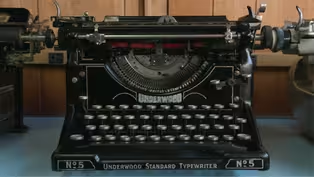
(knob clicking) Perhaps it's the taps (keys clacking) or the caps, or the satisfying clickety-clack.
(bell dings) It appears this throwback is making a comeback.
Yet at Marr Office Equipment in Pawtucket, vintage typewriters were never a thing of the past.
(bells dinging) - When the vacuum came along, they said you'd never need a broom in your house, right?
And if you go in most households, you'll find a broom, right?
Same with typewriters.
- [Pamela] Michael Marr is the third generation of his family able to coax these classic communication pieces into working order.
He says the company makes almost as much revenue on these as it does on his service calls repairing copiers, printers, and shredders.
But it's tinkering with typewriters that strikes a chord.
- [Michael] Now, we should have a typewriter that'll type, (keys clacking) and it does.
- [Pamela] In addition to refurbishing customers' antiques at the shop, there's a variety for sale, all reconditioned.
The manuals on average range in price from $200 to $450.
Electrics can go as high as $1,000.
The supply comes from donations or flea market finds.
The Marrs sales showroom looks like a mini museum, a type of time capsule.
- We've got these black Royals, Underwoods.
These are in the '40s.
You've got an Olympia here.
That's in the '70s.
This is like a Ferrari of typewriters.
I love it.
- How come?
- Just well built.
Never see a problem with them.
All right.
- But it's the problems that have become his passion.
- [Michael] Come on.
There we go.
- Is it something you love?
- I do.
I like figuring things out, you know?
I love troubleshooting.
One night I was here till, I mean, I was stuck on a machine.
It was 2:30 in the morning.
I just, I kept at it, you know, just obsessed with fixing it.
- [Pamela] The fix began nearly three quarters of a century ago.
- My grandfather, who started the business, he was the pioneer.
He was involved in it at a young age, and he passed it along to my father.
- [Pamela] And it continues today for his dad Ray, who, while retired, still types invoices on a snappy old electric.
(typewriter clicking) - I was ready to put the key in the door when the computer come out 'cause things slowed down.
- [Pamela] Then in came his son, Mike.
- [Michael] This Olympia came out nice.
- [Pamela] They sometimes still work side by side in the back shop.
Ray says he's glad to be well versed in service as well as sales.
- It came in handy when the portable typewriter took off with today's generation.
- So there was a ribbon drive issue with this?
- [Pamela] Mike Marr says people under 30 are their most frequent customers.
- They're like, totally like, "Wow, I gotta have one of these.
I gotta try it."
So I think that the mystique of it all, of how it was put together, fascinates people.
- [Pamela] Growing up in an era dominated by digital high-speed technology, many go retro because of what typewriters don't have, no charger, no interruption from the internet, no temptation to scroll.
Marr says it forces the writer to go slow with concentration on spelling, punctuation, and an alphabet soup of imagination.
- The feel, the touch, it puts you in a mind frame of total, you know, focus.
That's the biggest thing we get from writers.
They get in a zone with typing.
You know, everything's blocked out.
There's no electronic devices to disturb them, and it puts them in just an area where they can focus better.
It transcends anything out there, you know.
It's a writer's best friend.
- [Pamela] The first writer to adopt a typewriter in the 1870s was Mark Twain.
He dubbed it "a newfangled writing machine."
Twain's trend continued with authors from Ernest Hemingway to Dr. Seuss, Theodor Geisel.
Actor Tom Hanks collects them.
- The sound of a typewriter is the sound of productivity.
- [Pamela] And superstar Taylor Swift has been known to use them.
Marr says the celebrity cachet may be part of the reason more people are bringing in family heirlooms for him to resurrect.
- We actually bring the typewriter back to life for them.
It comes in here, and it's in shambles, or it's dusty, dirty, and they think there's no hope.
And with us, we look at it and like, "Okay, it's gotta take a bath."
- [Pamela] The first stop is here.
- [Michael] I'm just gonna submerge it like so, and I'll take this brush and just kind of gently go along.
(brush swooshing) (air hissing) Good to go.
- [Pamela] The Marrs have all sorts of typewriter parts on hand, and if they don't, they fabricate them.
Many of the old manual typewriters took a beating in the early days.
Office workers used the hunt-and-peck method because it took some muscle to pound the keys.
At the workbench, mending those keys means making adjustments and giving lots of shots of oil and grease.
Finally, this oldie is... - [Michael] Like a brand-new typewriter.
- [Pamela] With a new ribbon in place, it's the perfect package.
- I mean, it's just absolutely gorgeous.
(keys clacking) The biggest thing is the joy you get, you know, seeing people's expressions.
That alone makes it all worth the while.
- [Pamela] Marr says getting a typewriter as timeless as the classics that have been written on them into mint condition for a customer is when carrying on the family tradition really clicks.
- We got a big surge around Christmastime, you know, and it's funny, I'll be like working right up till Christmas Eve.
- Like one of Santa's elves.
- Yeah, yeah.
And they'll come in like eight, nine o'clock customers to pick up the machine, you know, for their children or whatnot.
And I won't feel complete until I get that last one done.
(keys clacking) (bell dings) (return carriage clicking) - Finally, on tonight's episode of "Weekly Insight," Michelle and WPRI 12's politics editor Ted Nesi discussed the latest on the Washington Bridge nearly one year after the westbound side was shut down.
But first, why Providence has to pay a lot more for education.
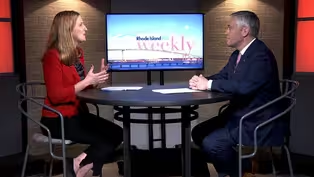
- Ted, there was recently a dispute playing out in court between the Rhode Island Department of Education and the Mayor of Providence over funding for the city schools.
In the end, they reached a settlement, but there really was no clear winner.
- No, and I spoke to Providence Mayor Brett Smiley on the day the numbers came out, and he said that neither side got everything they wanted.
And that's usually the sign of a decent resolution to this kind of dispute.
But I do think there will be some hard feelings around how all this played out, Michelle.
The mayor called it a bruising fight, a bruising argument.
That was his word that he used, so I think there's some scars left, yeah.
- As part of the settlement, Providence has to pay this year $15 million for school funding.
In addition to that, in subsequent years, the city will also have to pay more money for education.
Now, we heard from the State Education Commissioner Angelica Infante-Green and Mayor Smiley the day that the details of this settlement were released.
Let's take a listen.
- We have reached an agreement that will provide additional dollars for funding for students.
The mutual agreement will allow PPSD to avoid making further cuts to important student services and programs this year.
- I want the best for these students.
It's water under the bridge at this point.
The agreement is signed, and we're moving forward.
I still don't think a mid-year settlement like this is the right way to go about it, but it's done, and the most important thing is now that we have certainty and predictability going forward.
- And as we've talked about before, it's not as if Providence has a lot of financial flexibility to just say, "Here is $15 million to pay for our schools."
- No, I mean, Providence, people have to remember, has the lowest rainy day fund among any city and town in Rhode Island.
It's a pretty financially strapped city.
And you see that in how the mayor's trying to fund this, Michelle.
He's put a hiring freeze in place.
He's seeking pilot money from the non-profits or using money he has from them.
They're repurposing American Rescue Plan Act COVID relief dollars.
They're even taking $5 million that had been set aside for potential legal settlements and giving that to the schools.
And they'll figure out how to fund the settlements later if those come to fruition.
So, you know, it's kind of a looking-under-the-couch-cushions way of funding this school money.
And then of course, for residents, they're gonna be asked to pay more in taxes.
The mayor's already signaling he is going to ask the General Assembly for permission in the new session to go over the 4% annual cap on tax hikes because he says he needs more than that to cover the school funding and the rest of the city budget.
- For me, the big question is, what does this additional funding mean for students in Providence, a city that has been under state takeover now for more than five years?
- Yeah, and the numbers are still pretty grim in Providence, Michelle, even after the state takeover and of course in the wake of the pandemic.
Only about 15% of Providence students are currently reading at grade level or proficient in math.
And the city's already spending about $27,000 a year per student.
So that's one thing you haven't heard from a lot of people here, that this money is going to be a game-changer for the city schools.
- Meanwhile, the debate continues over when the state should hand back control of the schools to the city, so we'll wait and see when that happens.
Okay, let's turn to a story that we've been talking about a lot this year, which is the Washington Bridge.
It's hard to believe, but we are approaching the one-year mark of when the westbound side of the bridge was abruptly shut down.
And I think most people are surprised that we are at this moment, and not much has changed in a year.
- Yes, I mean, people have to remember, I'm sure they do, that when this bridge closed on December 11th last year, we were told it would be reopened in about three months.
Certainly no one was signaling this bridge was a goner.
And now we've reached the point where the state's saying it's going to take over 18 months just to give an estimate of when the new bridge will be built and how much it's going to cost.
So the goalposts have moved enormously over that period of time.
- So it's a wait and see just for information, not for results.
- Yes, and you know, we have the anniversary now, and I think people are going to see some momentum now.
You're seeing that we're going to have announcements about a short list of companies that want to build the new bridge.
And that process, I think, is going to give people a little more hope, hopefully.
- Yeah, well, let's talk about that.
There's some encouraging news as you mentioned.
The state plans to release soon the names of the two finalists, the two finalist companies, who want to build the westbound side of the bridge, which is encouraging.
- Yes, they've asked for qualifications.
People remember the first bidding process failed over the summer.
They're going with a whole different way of doing this now.
They've asked for qualifications from various companies.
Now they're being interviewed.
We expect on December 11th, the anniversary, an announcement of the two companies that'll move forward.
And then those two finalist companies are going to help put the request for proposals together and give their estimates of cost and timing.
But again, Michelle, the state has said they don't expect to announce which company will build the new bridge, how much it'll cost, when it'll be done, until next July.
- Meanwhile, drivers like you who go over that bridge regularly have to be frustrated.
- To come to you.
- Right, I mean, you don't have that timeline yet, and also we don't know how much this will cost.
- Yes, and so I think that's why people, you know, the state officials still won't say that the 2026 completion of the bridge is off the table, but there's a lot of skepticism that can happen now.
- [Michelle] It may be unlikely, but we'll wait and see.
- Exactly.
- Thank you, Ted.
- Great to be here.
- That's our broadcast this evening.
Thank you for joining us.
I'm Michelle San Miguel.
- And I'm Pamela Watts.
We'll be back next week with another edition of "Rhode Island PBS Weekly."
Until then, please follow us on Facebook and YouTube and visit us online to see all of our stories and past episodes at ripbs.org/weekly.
Or listen to our podcast on your favorite streaming platform.
Goodnight.
(joyful music) (joyful music continues) (joyful music continues) (joyful music continues)
Video has Closed Captions
Clip: S5 Ep49 | 7m 57s | Swapping laptops for typewriters. A Pawtucket man says vintage clicks for a new generation. (7m 57s)
Video has Closed Captions
Clip: S5 Ep49 | 10m 22s | The mayor of Central Falls wants the state’s takeover of the city’s public schools to end. (10m 22s)
Video has Closed Captions
Clip: S5 Ep49 | 4m 56s | Providence and the Rhode Island Department of Education reach school funding settlement. (4m 56s)
Providing Support for PBS.org
Learn Moreabout PBS online sponsorship
- News and Public Affairs

Top journalists deliver compelling original analysis of the hour's headlines.

- News and Public Affairs

FRONTLINE is investigative journalism that questions, explains and changes our world.












Support for PBS provided by:
Rhode Island PBS Weekly is a local public television program presented by Ocean State Media