
Rhode Island PBS Weekly 3/10/2024
Season 5 Episode 10 | 24m 36sVideo has Closed Captions
Teen parenting and efforts to reduce teen pregnancy and Urban exploration of iconic sites.
An in-depth report by Michelle San Miguel on teen parenting and efforts to reduce teen pregnancy. Filmmaker Jason Allard explores abandoned buildings across New England and gives us his take on why these iconic sites should not be forgotten. Michelle San Miguel and Ted Nesi discuss how soaring home prices in the state continue to fuel a housing shortage.
Problems playing video? | Closed Captioning Feedback
Problems playing video? | Closed Captioning Feedback
Rhode Island PBS Weekly is a local public television program presented by Ocean State Media
Rhode Island PBS Weekly 3/10/2024
Season 5 Episode 10 | 24m 36sVideo has Closed Captions
An in-depth report by Michelle San Miguel on teen parenting and efforts to reduce teen pregnancy. Filmmaker Jason Allard explores abandoned buildings across New England and gives us his take on why these iconic sites should not be forgotten. Michelle San Miguel and Ted Nesi discuss how soaring home prices in the state continue to fuel a housing shortage.
Problems playing video? | Closed Captioning Feedback
How to Watch Rhode Island PBS Weekly
Rhode Island PBS Weekly is available to stream on pbs.org and the free PBS App, available on iPhone, Apple TV, Android TV, Android smartphones, Amazon Fire TV, Amazon Fire Tablet, Roku, Samsung Smart TV, and Vizio.
Providing Support for PBS.org
Learn Moreabout PBS online sponsorship- [Michelle] Tonight, a look inside the lives of teenage parents in Rhode Island.
- My mom also helps me a lot at night.
She's like, "I'm gonna help you these first months because I know it's hard and I want you to go to school."
- [Pamela] Then, exploring our area's abandoned places.
- This bustling social center that's now just left to rot above the tracks.
- [Michelle] And what's behind the state's housing crisis with Ted Nesi.
(bright music) (bright music continues) Good evening and welcome to "Rhode Island PBS Weekly."
I'm Michelle San Miguel.
- And I'm Pamela Watts.
Many parents dread having "the talk" with their children, but there's encouraging news.
The rate of teenagers having babies in Rhode Island is among the lowest in the country.
- Still, there are several cities in the state where teen parenting is significantly more common.
Research shows it can lead to lifelong consequences for teen parents and their babies.
According to the Centers for Disease Control and Prevention, teen mothers are more likely to drop out of high school and so are their children.
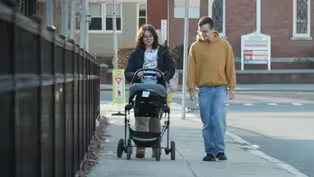
Tonight we meet Rhode Islanders who became teen parents and look at what's being done now to reduce the teen pregnancy rate.
- It kind of felt like my whole life just flashed in my face because I was like, "Wow, everything's about to change."
- [Michelle] 16-year-old Sara Fernandes looks like your typical teenager.
She attends school in downtown Providence.
- [Teacher] And the hypotenuse, it's always opposite of right angle or the longer side in the right triangle.
- [Michelle] So does her boyfriend, 17-year-old Caleb Faria.
They've been together two years.
- [Caleb] It's like (imitates wheel squeaking) - [Sara] This one's squeaks too.
You don't hear it?
- [Michelle] But when they head home to Pawtucket, there's a lot more than school work on their minds.
They have a five month old daughter named Skyler.
Fernandes remembers taking a pregnancy test in the high school bathroom which confirmed she was pregnant.
Soon there was a swarm of classmates in the bathroom.
- They were like, "Oh my god, Sara's pregnant!
Sara's pregnant!"
- Did you start noticing a difference in how people were treating you?
- Most of it was people being rude to me.
- Yeah.
- They were saying that I was a slut and a whore and you know, all that stuff that wasn't true.
- [Michelle] After finding out they were expecting, the couple transferred to Nowell Academy, a charter school that serves pregnant, parenting, and underserved youth.
- At my other school, nobody was pregnant and nobody had kids and it was just weird.
But here it kind of felt like I belonged.
- [Michelle] Nationwide, fewer teenagers are having sex and those who do are more likely to use contraception.
- Especially in the last 10 years, we've seen significant declines in the rates of teen pregnancy.
- Sounivone Phanthavong manages the Department of Health's Adolescent School and Reproductive Health Program.
In 2012, about 30 of every 1000 pregnancies in Rhode Island was to a teen between 15 and 19 years old.
That number dropped to 12 of every 1000 pregnancies in 2021.
- I think it's improved access to care, improved education, and more information about sexual reproductive health.
- [Michelle] While the number of teens giving birth has declined, the cities facing among the highest poverty rates in the state are also grappling with the highest rates of teen pregnancy.
The number of teens having babies in Central falls, Pawtucket, Providence, and Woonsocket combined is more than three times higher than the rest of the state.
- Teen pregnancy is no different than other health outcomes that are impacted by social and environmental conditions that influence those experiences.
That might be impacted by access to healthcare, it may be impacted by their access to employment and socioeconomic status.
- Okay.
- [Michelle] 30-year-old, Adaysa Rodriguez says she's proof of that.
The mother of five had her first child at 16.
- Perfect!
You look pretty.
- [Michelle] Before she became a mom, Rodriguez says she already felt like one.
She helped her single mom take care of her two younger siblings.
- Let's go.
It was overwhelming.
I felt like it was a lot for me, but I just wanted to help my mom and make sure she was okay.
I would even cook for her.
- What was it like to find out you were pregnant at 15 years old?
- I was scared.
I felt like the world dropped on me.
I didn't tell my mom until I was five months pregnant.
I hide it very well 'cause I had a small belly.
- [Michelle] Rodriguez was living in Central Falls when she gave birth to her daughter Anyelie who was premature.
She ended up being homeschooled for a few months, but still graduated from high school.
- When they called my name, I wanted to scream "I did it!
I did it."
- [Michelle] She says it was a special moment to have her daughter and mother in the audience, especially because her mom was a high school dropout.
Rodriguez's mom gave birth to her when she was a teenager.
Caleb Faria's parents were also teenagers when they had his brother.
- I was never given the talk or anything, but when I told my parents that we were pregnant, my dad was like, "And I was about to talk to you guys about that too."
- So he just missed his window of time to have that conversation?
- Yep.
- Were you guys using any protection?
- No.
- Thoughts and prayers.
- But you make light of it, but you knew what the risks were.
- Yeah.
- Yeah.
- [Michelle] According to data from the State's Department of Health, among sexually active high school students, 10% used no method to prevent pregnancy during their last sexual intercourse with an opposite sex partner.
Susanna Magee is a clinical professor of family medicine at Brown University.
She says finances prevent more teens from using contraception.
- Kids have to have money in order to have contraception unless they have access to a Title 10 healthcare site where they can get that for free.
Or some offices, private offices will offer condoms for free.
- What organs do you need to give birth?
Yeah.
- A uterus.
- A uterus.
What else?
- Ovaries.
- Ovaries.
Uh-huh.
- [Michelle] Medical students at Brown University are trying to reduce the teen pregnancy rate in Central Falls.
- Where are sperm produced?
- [Michelle] They teach sex education to students at Calcutt Middle School.
The program Sex Ed by Brown Med began in 2014.
Magee is the program's faculty advisor.
Before you guys started this program 10 years ago, what sex education were these students receiving?
- At the time, it was really just the physical education teacher teaching sex ed.
It was very much about anatomy, very little about actual sex or STI prevention or those sorts of things.
- We're gonna be talking about birth control and different ways to prevent pregnancies from happening.
- [Michelle] Talking about sex can be awkward, but Miranda Lassar, a second year medical student says many students warm up to the conversations.
- They really reflect the energy in the room.
And so when the energy in the room is that we're just talking about this, you can ask me whatever you want and I will answer your question with zero judgment, then I think the awkwardness is removed.
- [Michelle] Parents of seventh grade students choose whether they want their children to take the class and most do.
The eight lessons cover a range of topics.
- We talk about anatomy, reproductive anatomy, we talk about puberty, we talk about the menstrual cycle.
- [Michelle] Students are also taught about pregnancy, sexually transmitted diseases and contraception.
Seventh grader Quentin Dunbar says everything he's learned in this class is new information.
- Like how to be safe and stuff.
- Like condoms?
- Yeah.
- There's probably people out there who worry that giving information means the behavior will increase and there's a lot of information about the fact that that's not true.
Harm reduction information does not increase a harmful behavior.
- What's this?
- [Michelle] The teen pregnancy rate in Central Falls has dropped significantly in recent years, but Magee says it's hard to attribute that to the program.
- At the same time that Sex Ed by Brown Med was happening in Central Falls, there was also a clinic that had started at the high school that was a Title 10 site, so there was contraception available, there was some education happening from the physician who worked there.
So that obviously had to have been impactful as well.
- [Michelle] There's still a Title 10 funded health clinic at the high school.
Sounivone Phanthavong from the Department of Health says it's one of the ways the state is working to reduce pregnancy among teenagers.
- We fund Title 10 family planning service sites that offer high quality, affordable, confidential if needed, reproductive healthcare services.
We also make sure we are implementing evidence-based programming in different settings that serve young people that may be in schools, in communities, and after school programs.
- [Michelle] Back at Calcutt Middle School, students also learn about healthy relationships and consent.
- So the first question that I have is, would it still be abuse if they didn't mean to hit you?
- [Michelle] They're asked to write anonymous questions on post-it notes for the medical students to answer.
- [Miranda] So this is a number that you can call.
It's a 24 hour hotline if you have any concerns of sexual assault.
- Adaysa Rodriguez says it's important students learn about abuse and consent.
For her, it's personal.
- When I was 14, I was raped by a close friend of mine.
- [Michelle] She says it changed how she viewed herself.
- Hey, come on guys.
- [Michelle] Several years later, she was in an abusive relationship with someone else.
She hopes other teens in a similar situation will get help.
- Yo, I need you to look both ways.
Okay, come on.
Don't think just because you are in love with a person, it's okay for them to physically, emotionally, or mentally abuse you.
I feel like everybody has a voice and everybody can speak.
In front of me.
- [Michelle] Rodriguez's life revolves around her family.
She also works as a medical assistant.
The days are long, but she says her education has been key.
- Good morning.
- What's your advice to other teen moms who are watching this?
- Don't drop off out of high school.
Get a career.
'Cause without a career nowadays, you are not going to move forward.
If you have a support system, use that support system.
Go look for help.
- Well, I think all babies look alike when they're first born, they're all wrinkly.
- [Michelle] Fernandes and Faria rely on their support system.
They say they've been able to stay in school because of the help they receive from their parents.
- I couldn't imagine being able to come to school and go to work without both of our families.
Like, "Oh, if you need help, let me know.
We'll watch her."
- Yeah.
- And even our parents are like, "You can't afford formula, so I'll buy it this week and you just get it next week."
- [Michelle] The couple says having Skyler has changed their lives for the better.
They both say they're more motivated to do well in school because they want to give their daughter a good life.
Still, they would not advise other teens to follow their path.
- Don't get pregnant.
Mostly because I don't know if their family's supportive.
I feel like if they did get pregnant and they weren't ready, it would be more harm to the baby.
Not everybody matures that quickly after getting pregnant as a teenager.
- We now turn to urban explorers, men and women who often go where many do not dare, buildings forgotten and often deemed too dangerous to enter.
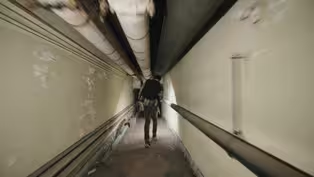
Tonight we meet Rhode Island filmmaker and urban explorer Jason Allard, who gives us his take on why we should never forget these iconic sites.
- Rhode Island is a great place to be an urban explorer because we have a little bit of everything.
You have the haunted Ram Tail Mill remains in Foster, Rhode Island that goes back to 1822.
It's the only place actually designated as haunted in a state census.
We have an abandoned gilded age mansion in Newport that's just rotting away on the coast.
It's actually currently being demolished right now so that history is being erased.
We have a milk can from the 1930s that was a crazy example of roadside vernacular architecture, which is when people would build these huge gaudy structures to try to attract people to come in and spend their money.
My name is Jason Allard and this is my take on urban exploration.
I've been an urban explorer for about 13 years now.
Urban exploration is the exploration of or documentation of hidden components or off limit areas of the manmade environment.
So picture almost anywhere that has a no trespassing sign out front, chances are you can do some urban exploration there.
There was a huge boom of this after the recession in 2008 where a lot of businesses shut down, there were a lot of places that were abandoned.
And then once social media came around, it just absolutely exploded.
There was a group of urban explorers who got into the Superman building.
It's the tallest building in Rhode Island.
It's like a famous picture in the UrbEx community of these guys at the very top of the Superman building overlooking the city of Providence, and they've still never had their identities revealed.
Police don't know who they are.
So there are actually rules to urban exploration that every urban explorer should follow.
And probably the biggest one, especially with social media right now, is don't share locations online because that attracts oftentimes the wrong type of crowd.
Vandals, arsonists, and it's happened time and time again.
There was a drive-in theater on Route 146 in Sutton, Mass.
It was actually the biggest drive-in movie screen in New England.
I'd gone there several times to shoot video and just take in the sights because it's just, you know, it was left the way it was in 1994.
But in 2022, someone went there and lit the screen on fire and it just burned to the ground and now it's just gone.
So that's why we keep locations close to us because we're afraid that something like that will happen again.
A lot of what I do, I document in my web series Abandoned from Above, which is on my YouTube channel, where I show the history of abandoned places throughout Rhode Island and show people why they deserve our respect and attention.
Before I even step foot into a place, I'm looking at blueprints to figure out exactly where we want to go, what we wanna shoot, how we wanna shoot it, and researching what the risks are associated with it.
For example, the abandoned train station in Central Falls in Pawtucket, it was built in 1916, abandoned in the 1950s, and it's just a beautiful example of architecture that's been left to decay.
My concern was, are the floors safe to walk on?
Because if you fall through a floor in there, you're falling 40 feet onto the tracks below, which are live.
Here comes a train.
There's still hints of the beauty that it once had.
This bustling social center that's now just left to rot above the tracks.
I try to give people a new appreciation for the history around us.
I at least want to let people know why they were important and why they mattered and give them a new appreciation for it.
My name is Jason Allard and this was my take on urban exploration.
- It's interesting to note that the Superman building is planned for some mixed use renovation.
- The hope right now is to add about 300 apartments there and of course, we know that we need more housing all across Rhode Island, which brings us to our next segment.
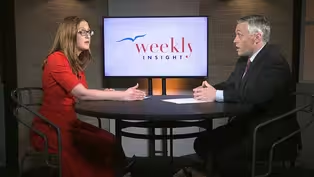
In this episode of Weekly Insight, WPRI 12's Politics Editor Ted Nesi and I discuss how soaring home prices in the state continue to fuel a housing shortage.
Ted, it's always good to have you back.
You and your colleagues at WPRI 12 recently aired this week long series taking a look at the housing crisis in Rhode Island.
And I saw on social media a lot of people were commenting.
What were viewers telling you?
- Well Michelle, obviously we knew there was a lot of interest in this.
We wouldn't have done a big series if we didn't.
But I was still, I guess, surprised by the level of feedback we got, which reinforced to me that this has become an almost universal concern in Rhode Island, in New England, frankly, the cost of housing.
We heard from renters who said they were getting letters, you know, "My rent's gonna go up $300, I can't afford it, but I can't do anything out of it, there are no other apartments."
And of course we heard from people who either wanna buy a home or need to buy a bigger home if their family's expanding, who just feel like there's nothing on the market and no sign it's gonna get better.
So people are frustrated and worried about it.
- For me, one of the big takeaways was that we have known about this problem, the housing crisis, long before the pandemic.
We have had warnings.
This is looming.
You had talked about in one of your stories, this 2016 Rhode Island housing report, which showed that Rhode Island needed to build between 34,000 and 40,000 housing units over the next decade to avoid a crisis.
Here we are, eight years later and we've only built half of that.
Why has construction been so slow?
- Well, and you know, of course Michelle, nobody affirmatively said, "Why don't we create a housing crisis by not building enough?"
It was really all these little decisions and the piling up of them.
So obviously in the Northeast, cities and towns have enormous control over what gets built with zoning restrictions and things like that.
And so each time one city or town makes things more restrictive, rejects a new development, it might seem small on the local level, but when you replicate that over all 39 Rhode Island cities and towns, and then you had the state until recently taking a very hands-off approach, that's how you wind up with a crisis to the degree Rhode Island finds itself in now.
- And it's not just a Rhode Island problem, in neighboring Massachusetts, the Attorney General's office is suing the town of Milton because voters there rejected a plan that would've allowed for more multifamily housing to be built.
Here in Rhode Island, are you seeing cities and towns taking similar measures, making housing more difficult for certain people?
- Well, nothing yet as dramatic as what's going on in Milton and we now see other Massachusetts cities threatening, Wrentham is one of them, to potentially also sue, get into a legal battle.
But you are seeing pushback to the steps state leaders have taken recently, kind of force cities and towns to be more welcoming to housing growth.
Speaker Shekarchi has called out Narraganset as one that's taken some steps to kind of push back against his efforts to make it easier to build housing.
I believe Tiverton has a short term development moratorium in place.
And you've seen planners in multiple cities sort of complain frankly, that this is a lot of work to revamp our zoning code and we don't necessarily want control to be at the state level so I think you're gonna see those tensions keep rising if the state leaders keep pushing for more growth.
- And in recent years we have seen elected officials in Rhode Island take more action to address the housing crisis.
Of course, Speaker Shekarchi is one of the people who's really taken this as his main issue that he's focused on.
Hundreds of millions of dollars had been poured into this.
We now have a housing secretary.
That position only began a few years ago.
Your colleague over at Channel 12, Tim White, recently sat down with Housing Secretary Stefan Pryor to get an answer as to when can we really expect to see significant increases in housing?
Let's take a listen to that conversation.
- When does that money start translating into units?
- Yes.
- Give me a date.
- Well, there's no single date because every development is different, but it's gonna take years.
It is going to take years.
So we've charted this out.
We're looking at the projects individually.
- Two years, three years, five years?
- Some of these developments that are being financed now, it'll be three years.
- We'll start seeing things- - On the edge even four when they're done but in a couple years, we'll see a lot of them.
- Ted, Secretary Pryor's answer obviously is going to disappoint a lot of people.
- Yeah, I mean, they've put a lot of money into housing as you said in the setup there, Michelle, and it's gonna take time to even see results.
Construction costs are part of the reason for that, the complexity of finding enough financing for housing.
But one other thing that the secretary said that really hit home to me was the fact he said even if Rhode Island reached the level of two to 3000 housing units a year, which is what they say is needed to sort of keep up with demand, he said that wouldn't even start to bring down prices to make things more affordable.
That's a treading water level of housing construction for Rhode Island.
And he said we're not even close yet to doing that, let alone something that would really bring down prices.
So Rhode Island's dug itself a pretty deep hole and it's gonna take quite a while, I think, to get out of it if people want to get out of it.
- Yeah, so we're talking about there are no short term solutions to this.
- No quick fixes.
Nope.
- Thank you so much Ted.
Always good to have you.
- Good to be here.
- Finally tonight, a preview of what's ahead on next week's show.
As we approach the pinnacle of college basketball season, March Madness, we decided to take a look back at the career of one Providence college and later pro basketball player that many consider to be the best ever to come out of Rhode Island, Ernie DiGregorio.
You're a little guy from a little school, from the littlest state in the union, and you went all the way to become Rookie of the Year in the NBA.
- Yeah.
- How'd you do it?
- Confidence and practice.
You know, practice and confidence can take you a long way because when I first started playing, I couldn't play any better than you could play.
- But I played- - That's not saying much.
- But I played 10 hours a day times seven days a week is 70 hours in a week.
You should be good after playing 70 hours.
You put that in for 15 years, you should be a good player.
Being Rookie the Year was a great, great, great honor because that proved to everyone that I wasn't lucky.
You can't be lucky to win that award, you have to produce.
- And Ernie D. has written a book all about his experiences called "Star with a Broken Heart."
- I'm looking forward to that story.
- And that's our broadcast this evening.
I'm Pamela Watts.
- And I'm Michelle San Miguel.
We'll be back next week with another edition of "Rhode Island PBS Weekly."
Until then, please follow us on Facebook and X and visit us online to see all of our stories and past episodes at ripbs.org/weekly or listen to our podcast on your favorite streaming platform.
Goodnight.
(bright music) (bright music continues) (bright music continues) (bright music continues) (bright music continues)
Video has Closed Captions
Clip: S5 Ep10 | 12m 4s | Rhode Island PBS Weekly explores teen parenting and efforts to reduce teen pregnancy. (12m 4s)
Video has Closed Captions
Clip: S5 Ep10 | 5m 37s | Filmmaker Jason Allard explores abandoned buildings across New England. (5m 37s)
Video has Closed Captions
Clip: S5 Ep10 | 6m 7s | WPRI 12’s Ted Nesi explains what’s being done to address Rhode Island’s housing crisis. (6m 7s)
Providing Support for PBS.org
Learn Moreabout PBS online sponsorship
- News and Public Affairs

Top journalists deliver compelling original analysis of the hour's headlines.

- News and Public Affairs

FRONTLINE is investigative journalism that questions, explains and changes our world.












Support for PBS provided by:
Rhode Island PBS Weekly is a local public television program presented by Ocean State Media