
Rhode Island PBS Weekly 3/17/2024
Season 5 Episode 11 | 25m 57sVideo has Closed Captions
Local basketball phenom Ernie Digregorio, fondly known as Ernie D. & the Queen of Diamonds
Meet basketball star Ernie DiGregorio, who went from North Providence High School champion to NBA Rookie of the Year. Then, look back at our piece on Lizzie Murphy, the first female to play in the major leagues at Fenway Park. Finally, in our continuing Turning Point series, revisit the story of a woman who had a life-changing moment as a fourth grader in 1968. Warning: Contains racial slurs.
Problems playing video? | Closed Captioning Feedback
Problems playing video? | Closed Captioning Feedback
Rhode Island PBS Weekly is a local public television program presented by Ocean State Media
Rhode Island PBS Weekly 3/17/2024
Season 5 Episode 11 | 25m 57sVideo has Closed Captions
Meet basketball star Ernie DiGregorio, who went from North Providence High School champion to NBA Rookie of the Year. Then, look back at our piece on Lizzie Murphy, the first female to play in the major leagues at Fenway Park. Finally, in our continuing Turning Point series, revisit the story of a woman who had a life-changing moment as a fourth grader in 1968. Warning: Contains racial slurs.
Problems playing video? | Closed Captioning Feedback
How to Watch Rhode Island PBS Weekly
Rhode Island PBS Weekly is available to stream on pbs.org and the free PBS App, available on iPhone, Apple TV, Android TV, Android smartphones, Amazon Fire TV, Amazon Fire Tablet, Roku, Samsung Smart TV, and Vizio.
Providing Support for PBS.org
Learn Moreabout PBS online sponsorship- [Pamela] Tonight, Rhode Island basketball legend, Ernie D. Then and now.
- I think the reason I became a professional basketball player is I never listened to someone tell me I couldn't be one.
- [Pamela] Next, we revisit the life of a Warren woman who made history when she played in a Major League Baseball game.
- They believed women cannot play baseball and she debunked that myth.
- [Pamela] And a critical turning point in one local woman's childhood.
- He reached out his hand and walked me out of that room and it was one of the most important times in my life.
(bright upbeat music) (bright upbeat music continues) - Good evening.
Welcome to "Rhode Island PBS Weekly."
I'm Pamela Watts.
- And I'm Michelle San Miguel.
This month, basketball fans are focused on the NCAA Championship, which is generating excitement and a lot of office pools.
- It's called March Madness.
And more than 50 years ago, Providence College was on its way to the Final Four tournament.
The point guard on that dream team went on to play in the NBA.
Ernie DiGregorio has written a book about his glory days and a lot more.
Tonight we go one-on-one with Ernie D. - [Commentator] Ernie at point guard, spinning, going into the right corner.
There's that shot from there, and in.
- [Pamela] Ernie DiGregorio, a Providence College Friars phenom.
- [Commentator] The bucket, beats off to Barnes.
Layup is good.
- I was very creative and imaginative when I played.
I would anticipate what someone would do and I would throw the ball ahead of them.
And that came from hours and hours of just bouncing a basketball.
- [Pamela] And a half century later, he's still bouncing a basketball and putting up some of his trick shots.
It was 1973 when DiGregorio led the Friars to the Final Four, with skills such as this, a long court behind the back pass that stunned the crowd.
- And like my coach, Gavitt, used to say, it was an extension of my arm.
And so when I dribble the ball, I didn't have to look at the ball.
I could look down there and see who was open and I would make split second decisions just spontaneously, instinctively, mostly.
And that's what made it, me a little different than everybody else.
- [Pamela] Different and legendary.
Affectionately known by fans as Ernie D, DiGregorio is enshrined in the Collegiate Basketball Hall of Fame and here at his Alma Mater.
- Yeah, there's some great coaches and great players in this hall.
- Mm-hmm.
And then there's Ernie D. - [Ernie] Yeah, the little kid from North Providence who made good.
(Ernie and Pamela laugh) - [Crowd] Let's go Friars!
- That local kid not only fired up Friar Fever, he also defied the odds.
At just six feet tall, he was selected first team all American, the number three NBA draft pick his senior year, and 1974 Rookie of the Year.
You're a little guy from a little school from the littlest state in the union, and you went all the way to become Rookie of the year in the NBA.
- Yeah.
- How'd to do it?
- Confidence and practice.
I knew if God gave me anything, it gave me that mindset where I knew where to go and how to get there.
You know, when I was a little kid, I had a dream and the dream was to be a professional basketball player.
And I think the reason I became a professional basketball player is I never listened to someone tell me I couldn't be one.
- Do you remember the point as a child that you said, "I got game."
- When I was 12 years old, I knew I was good.
I had confidence the first day I stepped on the court.
But what I did was, I didn't practice shooting long three point shots.
I just stood under the basket and shot little close shots, little close shots, and I made them.
I would play eight hours a day.
And if you played one hour a day, I knew I was a better player.
So when I stepped on the court, I had confidence and I developed a left hand and a right hand.
You put that in for 15 years, you should be a good player.
Being Rookie of the Year was a great, great, great honor because that proved to everyone that I wasn't lucky.
You can't be lucky to win that award.
You have to, you know, produce.
(crowd cheers) - [Pamela] Radio color commentator for Providence College basketball games is Joe Hassett, another former Friar who went on to play in the NBA.
He was a high school freshman at LaSalle Academy when DiGregorio was a PC senior.
- I watched him score 30 points in a game a number of times, but he could also pass the ball and make everybody else better.
He just had a great never say die attitude.
He was only six feet, but he dominated the game.
He dominated the game of giants, basically.
So everybody, every young kid who came up, wanted to be like Ernie.
You know, I said, "Okay, so do you wanna play division one?
You gotta be as good as him."
And you started to play more because you saw him play on TV a lot.
- [Commentator] Ernie D fires and hits his first points and it was a pretty shot.
- [Pamela] Ernie D's first pro team was the old Buffalo Braves, where he became Rookie of the Year by leading the league with assists, free throw percentages, and average 15 points a game.
Eventually traded to the LA Lakers, DiGregorio played his fifth and final year with the Boston Celtics.
What was it like to wear the Celtics jersey?
- It was a thrill because I got to play with my childhood hero, John Havlicek, who was a great teammate and a great mentor.
- [Pamela] Yet after the Celtics and dealing with a knee injury from his days with the Braves, DiGregorio threw in his last basket.
- It wasn't fun anymore.
And so that's why I decided to retire and spend time with my four daughters and my wife.
- [Pamela] And spending time staying close to the Providence College Friars basketball program.
DiGregorio also worked as a host at Foxwoods Casino and did some motivational speaking.
Now he's written a book that gives a play-by-play of his success story, "Star with a Broken Heart."
But as the title suggests, it's not just about basketball, it's about the synergy and tragedy he experienced with his standout PC teammate, Marvin Barnes, and the legacy of his PC coach, Dave Gavitt, founding force of the Big East Conference.
- He knew he had two great players and he let us do what we could do.
- A player's coach.
- Yeah, oh, everybody would love to play for a coach like that.
- Every loose ball in St. Louis is ours.
- [Player] Let's go baby!
- We used to laugh and have fun, and I think that's what's missing a lot of times in sports today.
You know, people don't have fun.
They're just so serious and nervous and tight.
We were loose goosey and we just had a ball.
- [Pamela] DiGregorio says he and Barnes formed a bond on and off the court.
A deep friendship he believes bridged the racial divide of the early 1970s.
- [Commentator] And wouldn't you know, it was Marvin Barnes who finally got the best.
- [Pamela] While Barnes also went on to become a Rookie of the Year and play for the pros, he was dogged by drug addiction that ultimately led to his death.
DiGregorio says they were like brothers.
- He was such a beautiful guy and he, you know, was so special on the court.
He was so unselfish.
He was a team player.
He could rebound, he could pass.
I mean, block shots.
He was a perfect complement to what I did.
- [Commentator] Ernie with the ball, beating high and low.
Barnes, turnaround shot is good.
Hit him right on target.
- Then the product was so exciting that we used to sell out the Civic Center, there'd be standing room only crowds and we would put on a show.
We never lost a game there.
- [Pamela] DiGregorio says losing both Barnes and Coach Gavitt within a few years of each other left him with a broken heart.
And he hopes his book will help it heal.
- I want their memories to be alive again.
I want people to know how special that team was.
I want people to know how great a person Marvin was and how special Coach was in my life.
- [Announcer] Let's hear it for your Providence College Friars!
- [Pamela] You can still find DiGregorio at the Providence College home games where he remains a hero.
- Thank you, Mom.
Thank you very much.
- Oh, thank you.
- I've waited to meet you for 51 years.
- 51 years, geez!
- [Pamela] This fan showing him a scrapbook she made of his triumphs all those years ago.
And when he looks up and sees his retired jersey in the rafters next to Marvin Barnes?
- Oh, it gives you the goosebumps.
Puts tears in your eyes.
It's, you know, I lost a piece of me.
A big part of my basketball family is no longer there again, so it'll never be the same.
- [Pamela] But what remains are the memories of the era when Ernie D, Marvin Barnes, and Coach Dave Gavitt took hoops and dreams to the Final Four.
- Reality surpassed everything.
Surpassed even my wildest dreams, what we've accomplished and the relationship and the love and friendship we've had.
- Wow, Ernie D is proof that when you put in the hard work, you will see the results.
- Yeah, he's always on the ball.
And we should mention that the proceeds from the book will be benefiting a scholarship fund at Providence College.
Up next, we go from basketball to baseball, where opening day is just around the corner and there's one Ocean State athlete whose historic milestone has all but been forgotten.
In honor of Women's History Month, we have a replay of our story from 2022 about the first woman ever to step up to the plate in the major leagues.
Here's the answer to baseball's proverbial question, who's on first?
It's the queen of diamonds.
- Here's someone who was told, "You're a girl, you can't play baseball."
But she loved the game.
She was a fine, again, a fine athlete.
She could run, swim, ice skate with the best in town in Warren, and she wanted to be around the ball players and carry the equipment.
- [Pamela] But the woman from Warren did more than just carry equipment.
She grabbed a glove and went pro.
Former Harvard librarian, Jay Hurd, has spent a decade researching the achievements of the female first base player who broke into the men's game.
She was born Mary Elizabeth Murphy in 1894.
- But she became known as Lizzie, and she had another nickname, Spike.
And that came around one time when she was playing on a men's team versus another men's team and they were poking some fun at her, and they said, "All right, Spike, let's see what you can do.
Let's see what you can do."
And she showed them what she could do.
- What Lizzie "Spike" Murphy could do was play ball in the big leagues.
She came to be called the Queen of Baseball.
As early as 1910, the Warren town directory lists Murphy as a baseball player.
She was playing with men and impressing them.
Newspapers across the country took note.
How did she actually start playing baseball?
- Well, through her brother.
They would gather at whatever the local sandlot was here in Warren, Rhode Island.
And she started playing with them.
And finally she was old enough when they said, and they needed a player, "Lizzie, can you cover first base?"
They noticed her ability and soon she was being called up to play on the mill teams.
- [Pamela] Murphy was raised in a big family next to one of Warren's red brick mills.
Her home was where Tom's market now stands.
- She would love to clean the rugs.
It was part of how she stayed in shape.
She would get her baseball bat, put the rugs over a clothes line, and just beat (laughs) beat the dust out of the rugs.
- So it was her destiny to be a ball player.
- Oh, through and through.
- [Pamela] Scouted while playing on the mill team, Murphy was recruited by a semi-pro ball club, the Providence Independence.
Then she joined Carr's Boston All Stars, who barnstormed the north east and Canada.
Hurd says she played 100 games a summer for some 20 years.
- Her fielding was excellent.
She was not a power hitter and she often went 0-2, 0-3.
But she hit well enough to be kept on the team.
And her defense was outstanding.
She wasn't short, maybe short compared to some of the other ball players on the team.
She had red hair, which she kept up under her cap.
- [Pamela] Murphy knew she was a novelty, yet she had the confidence to promote her status on an all male team.
She wore her name on the front of her uniform and sold picture postcards and autographs to fans after the game.
- Well, one of the things, I think, really sums it up about her is that she avoided frivolity.
She was a very serious person.
She was committed to playing baseball and that's what she wanted to do.
Yes, she had her doubts early on as to what she was supposed to do with her life.
- Those doubts likely surfaced because women in the early 1900s, and to this very day, don't play on men's baseball teams.
But Hurd says Murphy decided she just couldn't sit on the bench.
Did the guys accept her?
- Oh, absolutely.
Yeah.
One of the funny things about the guys accepting, she says that she, yes, there was a lot of cursing, but she knew all the words.
So she was okay with it.
She may not have used the words herself, but she was one of the men, of the guys on the team, she was a teammate.
So once she proved that she could play, they stood up for her.
- [Pamela] In fact, they backed her when she made a strike for equal rights.
The guys were getting paid five bucks a game.
And even though Murphy was a big draw, she was not paid.
So one day, she refused to play for a huge crowd expected in Newport.
- And it was a big game.
When it came time to getting on the bus, she told the manager, "No pay, no Newport."
You know, no pay, no play, basically.
And he said, "Well, all right, she deserves the money.
So here's $5 for your game and you can split the receipts with us."
So she got on the bus and there she was, the first professional baseball holdout.
- [Pamela] And her story was about to get bigger than the green monster.
- Programs!
(indistinct) $5!
- In 1922, right here at Fenway, Lizzie Murphy made history.
The first woman to ever play with major leaguers.
Murphy stepped up to the plate against the Boston Red Sox for the American League All Stars exhibition game at Friendly Fenway.
At the oldest ballpark in the country, 100 years ago this season, she played two innings.
And what was the score?
How did it end up?
- Well, her team won.
- Wait a minute, wait a minute.
Did the Boston Red Sox know that they were beaten by a girl?
- Oh yes.
Yeah.
- Why is it her story hasn't been told a lot and people don't know her?
- Well, I'll be honest about this and say, because she's a woman.
And that was one thing that people could not abide.
They couldn't, they believed women cannot play baseball.
And she debunked that myth.
- [Pamela] Hurd continues sorting through the lore and legend of Murphy.
There is a small archive at Warren's George Hale Free Library.
It is known Murphy got hits off this slim bat, one of the few pieces of the pioneer's memorabilia in the trophy case of Warren's Sports Hall of Fame inside Town Hall.
But the career end for the trailblazer came when Murphy retired from baseball at age 40.
Two years later, she married mill supervisor, Walter Larivee.
After he died a few years later, she went to work on oyster boats along Warren's docks.
Murphy never spoke much about her past.
- The speculation always had been that she was just angry and bitter about her life.
I tend to believe, again, using the knowledge that she wasn't one to go out and party, that she missed the game.
There is a mention in an interview that she was very proud of what she had done, once someone told her that she had been the first woman to play at Fenway, or, she was very proud of that, but she wasn't one to boast.
- [Pamela] And for all her claim to fame, there is little mention of Lizzie Murphy at the Baseball Hall of Fame in Cooperstown.
Even her grave site in Warren makes no mention of her illustrious career.
Her tombstone is simply marked "Elizabeth Larivee."
She died at age 70 in 1964, but Hurd says her legacy stands tall in the field of sports history.
- This is a woman who, even before women were allowed to vote, stood up, just was not afraid to say, "I love baseball."
And she went and played it.
- And Rhode Island has made more history in women's sports recently with Olivia Pichardo from Brown University.
- Yeah, she's the first woman to play in men's division one baseball.
Way to go.
And finally tonight, can you think of one moment, event, or situation that dramatically altered the course of your life?
In our continuing Turning Point series, producer Isabella Jibilian first introduced us last September to a woman whose life-changing moment came on her first day of school in the fourth grade back in 1968.
And a warning, this segment includes racial slurs.
- My name is Raffini, V. Raffini.
And I'm gonna tell you about when I went to Prospect Street School for the first time.
It was '68, right after Martin had been assassinated.
- I just wanna do God's will.
- So I was around nine, 10.
(soft dramatic music) We were moved to the projects and we were finding out the people that lived in the projects didn't really want these Black families that were now living up there.
No one from my family was in my school.
There was only one other Brown girl that was there.
When I got into the class, the students were there but the teacher wasn't there.
I looked around, I saw an empty desk.
There was nothing on the desk to identify if it was someone else's desk or not.
I sat in that desk and a young kid came in and said to me, "Get out of my chair."
He called me the N word.
"I'm sick of you niggers coming to the school and thinking you're taking over."
And I remember being shocked and thinking, he's gonna get in trouble for saying this and wondering why no one is saying anything.
They're just looking at me and looking at him.
And he said it again.
"I'm sick of you niggers," and he pushed me.
And when he pushed me, I felt like my dress went up and people saw my underwear.
And so I was embarrassed and I fought him out of embarrassment.
While I'm hitting him, the teacher walks into the room and she smacks me on my head from behind.
And I just pushed my hand back like that and continued to fight the kid in front of me.
And when I heard her start to scream, as I thought, "Oh my God, I've just hit an adult.
My mother is going to kill me."
But at the same time, I'm still punching him because I don't know how to act or react to what's going on.
And I'm just scared and embarrassed and thank God one of the young kids, who when this first started to happen, ran out of the room to go get the principal.
The principal's name was Abraham Asermely.
So as he returns with the principal, the teacher's standing there screaming, "Get her out of my class!
I don't want her in here.
She's a troublemaker.
She can't come back in here."
And the principal's saying to me, "Tell me what happened, what's wrong?"
And I can't, I can't talk, because I'm too busy crying, I'm (pants) trying to catch my breath.
The principal just puts his hand out and takes my hand and brings me to the hallway.
But somehow, in my heart, I knew that this was a caring hand.
We got to the end of the corridor and he stopped and he said, "Please, tell me what happened."
And I told him the whole story and I could see his face just feel so bad.
And he said, "Unfortunately, this is the only fourth grade that we have here.
But don't worry about it.
I'm gonna take you to my office.
We have a secretary there and a receptionist.
We'll teach you."
I felt like I was just saved.
So he brought me down and introduced me to them and told them the story and they said, "Don't worry about it.
You just come here when you come to school and we'll have your work ready for you."
Taught me my schoolwork.
But they also taught me how to answer a phone properly in the office.
(bell rings) I had the privilege of ringing the bell to send the kids out for recess and bring them back in.
I learned how to use a copy machine, which back in that day, was called a ditto machine.
Sometimes I'd go home with ink blots on my shirt.
But I was proud of the work that I was doing.
And I graduated from the fourth grade without being in the fourth grade and went on to another school.
I became an educator.
I was actually a teacher for 25 years.
(soft inspirational music) I think we need the shovel for that.
It was up to me to hire the worker who was going to work with me in the youth garden.
Thank you.
And so I saw somebody's resume and I called the number and I started speaking to this young woman named Ellen.
And we get to the final question and I look at the top to address her by her first and last name, and it says "Asermely."
And I'm thinking, "No way."
(laughs) Because it's 50 some odd years later.
"Ellen, I have to ask you something.
Do you have anyone in your family who was in education years ago?"
And she said, "My grandfather.
My grandfather Abraham."
I told her the whole story about it and she's got tears and I've got tears 'cause I can't believe I'm speaking to the granddaughter of a man who made a difference in my life.
A big difference when you stop to think about it.
If Abraham Asermely had not taken me out of that room and I had to deal with the teacher not wanting me there and a child who did not want me there, I'd have been a very angry Black girl and I'd have grown up to be a very angry Black woman.
(soft bright music) - They're all, we're gonna plant them all together.
Sound good?
- It's a blessing working with Ellen.
I say, "How do you think your grandfather feels, you know, us working together, doing stuff together?"
He's beautiful.
Pollinate, baby.
And I'm like, "I think that your grandfather is looking down and very, very pleased at what he sees."
Thank you, Abraham Asermely.
- What a full circle moment that V. Raffini is now working with the principal's granddaughter.
- It was acts of kindness all the way around.
And that's our broadcast this evening.
Thank you for joining us.
I'm Pamela Watts.
- And I'm Michelle San Miguel.
We'll be back next week with another edition of "Rhode Island PBS Weekly."
Until then, police follow us on Facebook and X and visit us online to see all of our stories and past episodes at ripbs.org/weekly or listen to our podcast on your favorite streaming platform.
Goodnight.
(bright upbeat music) (bright upbeat music continues) (bright upbeat music continues)

Video has Closed Captions
Clip: S5 Ep11 | 8m 44s | A Rhode Island woman played the Red Sox with an all-male team. Meet the Queen of Diamonds. (8m 44s)
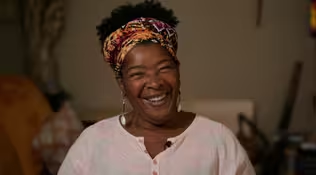
Turning Point: Raffini’s First Day
Video has Closed Captions
Clip: S5 Ep11 | 7m 30s | The story of a life-changing first day of school. (7m 30s)
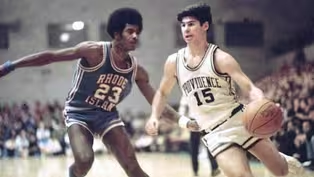
Video has Closed Captions
Clip: S5 Ep11 | 9m 25s | From North Providence hoopster to P-C star to NBA Rookie of the Year. The story of Ernie D (9m 25s)
Providing Support for PBS.org
Learn Moreabout PBS online sponsorship
- News and Public Affairs

Top journalists deliver compelling original analysis of the hour's headlines.

- News and Public Affairs

FRONTLINE is investigative journalism that questions, explains and changes our world.












Support for PBS provided by:
Rhode Island PBS Weekly is a local public television program presented by Ocean State Media