
Rhode Island PBS Weekly 3/5/2023
Season 4 Episode 10 | 27m 19sVideo has Closed Captions
In-depth looks at noise pollution and an enslaved couple’s journey to freedom.
Rhode Island PBS Weekly explores the issue of noise pollution, investigating the hidden costs of noisy neighborhoods. Then, an interview with Ilyon Woo about her new book, "Master Slave Husband Wife," which tells the story of an enslaved couple’s daring escape. Finally, a second look at the story of Sissieretta jones, a Black opera singer who broke barriers at the turn of the 20th century.
Problems playing video? | Closed Captioning Feedback
Problems playing video? | Closed Captioning Feedback
Rhode Island PBS Weekly is a local public television program presented by Ocean State Media
Rhode Island PBS Weekly 3/5/2023
Season 4 Episode 10 | 27m 19sVideo has Closed Captions
Rhode Island PBS Weekly explores the issue of noise pollution, investigating the hidden costs of noisy neighborhoods. Then, an interview with Ilyon Woo about her new book, "Master Slave Husband Wife," which tells the story of an enslaved couple’s daring escape. Finally, a second look at the story of Sissieretta jones, a Black opera singer who broke barriers at the turn of the 20th century.
Problems playing video? | Closed Captioning Feedback
How to Watch Rhode Island PBS Weekly
Rhode Island PBS Weekly is available to stream on pbs.org and the free PBS App, available on iPhone, Apple TV, Android TV, Android smartphones, Amazon Fire TV, Amazon Fire Tablet, Roku, Samsung Smart TV, and Vizio.
Providing Support for PBS.org
Learn Moreabout PBS online sponsorship(bright music) - [Announcer] Tonight on "Rhode Island PBS Weekly".
- This is a lot of noise.
There's a siren going off right now.
We can hear vehicle noise happening late at night when folks are making their liquor run.
- [Michelle] Noise is all around us, and it's more than just a nuisance.
Studies show it's also a public health issue.
- I've started developing tinnitus in my ears, like I hear ringing in my ears constantly.
- Of course, the key feature of her disguise was something she came by naturally, a light complexion.
So she's very light-skinned, partly because her master is her father, her biological father.
- Yes, her first enslaver was also her biological father, and so from him, she inherited this very light complexion, which so unnerved and upset his legal wife that she, at the soonest opportunity, wanted to get rid of Ellen.
- [April] She made $20,000 a year at that time, which made her the highest paid African-American entertainer at that moment.
- [Michelle] And how long was she doing that for?
- [April] About 20 years.
(bright music) - Good evening.
Welcome to "Rhode Island PBS Weekly".
I'm Michelle San Miguel.
- And I'm Pamela Watts.
Nightclubs, ATVs, wailing ambulance sirens.
The list of sounds we hear on a regular basis is seemingly endless.
- It's called noise pollution.
It was first declared a public health hazard in 1968, but experts say the problem has only gotten worse and little has been done to address it.
Here in Providence, researchers at Brown University found the biggest contributor to noise in the Capitol City is transportation.
So how does the noise here compare to other cities in the region?
The answers will likely surprise you.
This report is part of our continuing Green Seeker series.
- On the weekends, it legitimately sounds like I live next to a racetrack, and it's not the interstate, it's the cars on Dean and Atwells.
- [Michelle] Frank Broome knew it would be noisy when he moved to Providence's Federal Hill Neighborhood.
(music blasting) But he says the sounds he hears from his apartment are louder than he imagined.
- I really never expected this, but there are cars that have speakers on the outsides of their cars and it's shocking how I'll hear not just bass, but I can hear clear lyrics.
- [Michelle] Over on the northeast side of Providence, Sam Howard is also frustrated.
- This is a lot of noise.
There's a siren going off right now.
We can hear vehicle noise happening late at night when folks are making their liquor runs.
We have a liquor store nearby.
People are chatting and yelling and playing music.
- He lives in the city's summit neighborhood less than two blocks from Miriam Hospital.
But the siren sound that we're hearing right now, that's pretty common around here?
- That, I mean, that's all day.
- [Michelle] Howard says he feels discouraged by the constant barrage of noise.
- It's often loud that I don't really want to be outside, right?
I'd rather be inside.
And I think that causes harm to social fabric.
I'm not running into neighbors as much as I should be.
- [Michelle] Both Howard and Broome invited students from a brown University research lab to measure the noise level for themselves.
Nina Lee has collected dozens of noise samples in Providence.
She sets up monitors and backyards and front porches around the city and leaves them there for a week.
- I would never be able to hear what you're saying, but I can see that for example, at 8:00 PM, there was a high burst of sound at a specific frequency.
- [Michelle] Erica Walker is the founder of Brown University's Community Noise Lab and an assistant professor of epidemiology.
- Sound is basically anything that you can process through your auditory system, anything that you can hear.
But when we move from sound to noise, we go from things that we like to hear to things that we don't want to hear.
- Walker is interested in how noise affects a community's health.
Before she moved to Rhode Island, she spent years monitoring and studying disruptive noises in Boston.
How noisy is Rhode Island compared to other places you've been like Boston specifically?
- Providence in particular is really loud.
It's on the lines of what I measured when I was in Boston.
- You're saying that Providence is as loud as Boston?
- Yeah.
- Really?
- Yes.
- [Michelle] Walker says it's no surprise that the biggest contributor to noise in the city is transportation.
From bustling highways to rumbling trains.
Research shows the neighborhoods most affected by noise pollution in Providence and across the country are communities of color and low-income residents.
Walker students have scoured locations all over the Capitol City and the state.
Their findings are being shared with local and state agencies.
Findings like this noise map that Walker and her students created for Providence.
Their measurements found upper South Providence and South Elmwood are the loudest neighborhoods.
Walker says those areas average 69 decibels.
That's close to the sound of a hair dryer, and louder than the city's limit for residential areas.
As for the quietest neighborhoods, that distinction goes to Blackstone and College Hill, which average 53 and 56 decibels, like the hum of a refrigerator.
While the sound of traffic may be expected in a city, Walker says it shouldn't be an issue that disrupts people's quality of life.
- We have this sort of misconception about noise, that it's a first world problem, that it's a sacrifice that you make to live in the city, that it's a sign of progress.
- [Michelle] Noise is more than just a nuisance.
Walker says it's also a public health issue and can trigger a person's fight or flight response.
- And that flight or fight response is preparing you for battle.
And can you imagine that if you're in a community where you're being prepared for battle every day, 24 hours a day, 365 days a year, what that does to your health over the long term?
- I don't know the exact terminology for it, but the cars when they drive, it sounds like gunshots.
- [Michelle] Frank Broome says the excessive noise off of Dean and Atwells has taken a toll on his health.
He works from home and says it can be difficult to get things done.
- I've started developing tinnitus in my ears, like I hear ringing in my ears constantly.
At first, I didn't realize the noise was affecting me that much, but there's a strong correlation where the noisier it is the less I'm able to do my job or be productive in general.
- [Michelle] According to the Environmental Protection Agency, noise pollution affects millions of people.
Studies show it can lead to high blood pressure, hearing loss, and sleep disruption.
Brown University student Chelsea Wang has studied the noise levels outside of hospitals and clinics.
She wants to learn how all of that outside noise affects patients inside.
We followed along as Wang set up a noise monitor by Rhode Island Hospital.
She wants to find ways to mitigate loud noise.
- We can have softer waiting rooms, for example.
We can isolate the front desk work from the work that goes on in a hospital.
- We know the public health implications of noise pollution.
People who have PTSD, people who are just trying to enjoy peace and quiet shouldn't have to deal with loud altered mufflers.
- [Michelle] Nearly two years ago, the Providence City Council passed a resolution asking city administrators to look into solutions to deal with excessive noise, including noise barrier tax incentives and acoustic cameras.
- It's really about protecting public health.
We're ensuring that we're improving quality of life for everyone in the in the city.
And that was the impetus.
- [Michelle] Councilman John Goncalves says he plans to introduce the idea of installing acoustic cameras in the city similar to what's been put up in Knoxville, Tennessee.
It would snap a picture of a vehicle when a sensor detects that noise levels are over the legal limit.
But he stresses that if cameras are installed, they would need to be rolled out properly.
- I don't think we'd be solving the problem in the most effective way if we just say "well, you know what?
The communities that are experiencing the most noise should have practically all of the acoustic cameras in the city".
I don't think that's fair.
And I don't think that's equitable.
We can't control everything, but if we do something, we can improve people's quality of life.
- It really does feel like this is the route that many people take to get from car horns honking, right?
- [Michelle] It's something that Sam Howard thinks about.
He wants to grow his family and would like the city to find ways to lessen the impact of noise on everyone.
- Do we put up soundproofing barriers?
Do we change the surfaces to make the roads less noisy?
There are a lot of solutions, and especially if we're thinking about climate change, a lot of the things we would do for sustainability go hand in hand with reducing noise.
And so we can do both together.
It's just a matter of priorities.
- [Michelle] Over on Federal Hill, Frank Broome says noise is a priority for him and it may force him off the hill.
- It feels like a slow buildup of noise and it affects me and my general anxiety levels.
- What would you say to people who hear this and say "oh Frank, you knew you were moving to a big city.
You're right off the highway.
You know that's gonna be a noisy area, if you're so annoyed by this, just move".
- Of course.
Even if let's say if and when I move, someone else is gonna move here and they're gonna have the same issues that I'm gonna be facing.
So even if I have the ability to move out of here, someone else is gonna be in the exact same situation that I am, and it's not fair to them as well.
(gentle music) - Up next, a story of an enslaved couple who were household names in the mid 1800s.
Their flight to freedom, front page news.
William and Ellen Craft became stars of the abolitionist lecture circuit here in New England before they ultimately fled the country.
Their story, all but eclipsed by the Civil War that ultimately ended slavery, is now the focus of a new book.
David Wright recently sat down with the author, Ilyon Woo, to hear the couple's remarkable story.
- It took me a long time to get to the story.
Then what ended up happening is I started looking into the history.
And what I found in the archives was so revelatory about the crafts, but also yielding this bigger picture of our nation.
I think one that's very much relevant today that I felt compelled as an American scholar to tell this story.
- [David] Author Ilyon Woo's new book, "Master Slave Husband Wife" tells the story of William and Ellen Craft and their daring flight to freedom.
This is 1848, pre-Civil War, and this couple, a married couple, and slave to different masters sets out from Macon, Georgia.
- It's harrowing because the stakes are so high, right?
Because at any moment if they're caught, if they're captured, they will inevitably be separated, tortured, or killed.
They were not hiding.
They were not going underground.
They were traveling aboveground on actual railroads-- - This is not the Underground Railroad.
This is the overland normal railroad.
And she, Ellen Craft is passing not only as a white person, but as a white gentleman.
- As a white disabled man.
So she's going from being really at the bottom of the social hierarchy as an enslaved woman to the very top.
- [David] Disability was a crucial part of the disguise.
- She had her arm in a sling.
She doesn't have the poultices on her face here, but she's got her glasses, she's got her tie and her white shirt and everything.
- [David] Dressing as a privileged man staved off questions.
Her overall appearance of vulnerability bolstered her cover story of being a slave holder who needed help from his valet to travel.
What was the disability that she pretended to have?
- So it was a combination of different disabilities I think that could be improvised depending on where she was and what she needed.
But the general complaint was rheumatism.
I think this is also a time of a global pandemic, the cholera and people are afraid of getting different kinds of diseases.
So you need her to be sick, but not so much that you're afraid of getting sick from her.
- Of course the key feature of her disguise was something she came by naturally, a light complexion.
So she's very light-skinned, partly because her master is her father, her biological father.
- Yes, her first enslaver was also her biological father.
And so from him, she inherited this very light complexion, which so unnerved and upset his legal wife that she, at the soonest opportunity, wanted to get rid of Ellen.
- [David] Ellen Craft's enslaver, her biological father, gave her away as a wedding present to another of his daughters.
- Ellen becomes the slave of her biological half sister.
- And meanwhile she strikes up a relationship with William Craft, who was enslaved to a different master, and he is a skilled craftsman.
- So he is a cabinet maker and she is a seamstress.
- She was all of 22 when she and her husband set off from Macon.
But this escape, while out in the open, has no shortage of potential points of danger.
- Oh my gosh, no.
Yeah, right from the get-go.
I mean, there's danger at every turn.
- The cabinet maker shows up.
- Oh my gosh.
Yeah.
- [David] No sooner did the Crafts board the train that William Craft's employer turned up at the station looking for him.
- They arrive at the train station and William's in the negro car as it's called, Ellen has bought the tickets.
But then out the window, Ellen sees, and William also recognizes that this man has come out and he's got this kind of like a sixth sense, like this feeling that something is wrong and he acts on it.
But luckily he doesn't actually see William.
- Even after they've crossed into the north, they're not safe, are they?
- No matter where they go in the United States, they're not safe.
- [David] The north may have banned slavery, but it still had plenty of racism.
In fact, the phrase Jim Crow has its origins up north.
Jim Crow was a hugely popular minstrel show character at the time, performed in blackface by his creator, a white New Yorker named Thomas Dartmouth Rice.
- So it's not like they fly to paradise and they're university embraced.
They are heartily embraced, but they're still working against structures of racism in the north as well.
- [David] The Crafts joined the abolitionist lecture circuit, telling packed crowds in places like Boston's Faneuil Hall every detail of their daring escape.
- This is the thing that's so interesting is that their personal story ends up sort of hitting this incredibly powerful moment of national, really national crisis.
- They ran into some trouble here?
- They did.
They did with the passage of the Fugitive Slave Act of 1850.
So then the recapture of the Crafts becomes a test case for the nation.
- The Fugitive Slave Act required that all slaves who managed to escape be returned to their enslavers.
Citizens of free states were legally bound to cooperate, even if they believed slavery was wrong.
How close did they come to being caught?
- Again and again.
I mean so close, the Crafts have advertised themselves like in the Boston City directories.
I mean, that's how secure Boston was supposed to be.
- [David] But after the Fugitive Slave Act, their new home was no longer secure.
- So the slave hunters, as they're called in the time, end up at this hotel.
It's on one side of Boston Common.
It's like a 20 minute walk to cross the Common and claim the Crafts.
- Who are on Beacon Hill.
- Yes.
Should be easy, right?
Doesn't turn out to be that way.
- Boston turns out, Boston represents.
- Boston does, Boston stands up.
- [David] A proud moment.
The people of Boston tried to foil the slave hunters.
They even threatened to tar and feather them.
But official Boston was not so sympathetic.
- There were parts of Boston that stood up, but there were also people who were saying, yes, this is the test case.
We're gonna show the South that we are one country.
We will stand up with them and we will return these people to slavery.
It was a national effort to return them to bondage.
- Even famous statesmen like Daniel Webster favored returning the Crafts to their enslavers.
That forced the Crafts to flee again, first to Canada and ultimately to England, where they made their home until the Emancipation Proclamation and the 13th Amendment finally abolished slavery.
An astonishing bit of history summed up in a quote author Woo quotes in her book.
Could almost be a blurb for the back of the book.
It's from Wendell Phillips, the famous abolitionist who says "future historians and poets would tell this story as one of the most thrilling in the nation's annals.
And millions will read it with admiration for the hero and heroine of the story".
Why has it taken 175 years for it to become a bestseller?
- That's an excellent question.
I mean, in their times when Wendell Phillips was speaking to all these crowds, there's a huge excitement of the Crafts, but they don't have, let's say, the renown of Douglass or Tubman or Truth or others who are known really by just one name.
And I think the question is, this question of their legacy is really entwined with the question of whose stories have we chosen to tell over these generations in America, whose stories qualify as American history?
And I would argue that they are very much American heroes, and this is very much American history, but it's taken us some time to get here.
(gentle music) - Now we turn to a story about Matilda Sissieretta Joyner-Jones.
She was known simply as Sissieretta Jones and was revered by audiences and dignitaries around the world at the turn of the 19th century.
But Jones was largely shut out of performing at major venues around the United States because of the color of her skin.
Still, she was ultimately the highest paid African-American vocalist during a 28 year career in which she had to reinvent herself to survive and keep singing.
Tonight we take another look at her storied career with Rhode Island artist April Brown as our guide.
- [April] Sissieretta Jones was born in Portsmouth, Virginia in 1869, and this empty lot is where her family moved when she was seven years old, is 20 Congdon Street.
- What brought her family to Providence?
- Well, better economic opportunities.
There wasn't a lot of opportunities for the former enslaved, and her father, Jeremiah Joiner, he became the pastor of Pond Street Baptist Church, and her mother, Henrietta Beal, she sang in the church choir.
We think that Sissieretta Jones got her singing voice from her mom.
Let's go to Pond Street Baptist Church so you can see where her father pastored.
- Where exactly is the church?
- You see that highway over there?
That was where Pond Street Baptist Church was located.
- Wow.
Is that where Sissieretta Jones began her career?
- You know, she began singing in her father's church when she was 14, and then she went on to study music at Providence Academy of Music and later in Boston.
- Describe for me what her voice sounded like.
- So no one knows what her voice sounded like.
There are no recordings, but there are newspaper reviews that rave about her voice.
- What songs was she most famous for?
- She was mostly known for "Old Folks at Home" which we know is "Swanee River" and "Ave Maria".
- [Michelle] Did she mostly sing inside of the church?
- [April] No, actually she toured in Europe and sang before royalty.
They gave her 17 medals that she would proudly display on her gown whenever she performed.
- How did Europeans respond then to having this American singer abroad?
- European audiences refer to her as the Black Patti, named after Adelina Patti, the famed Italian soprano of the time.
She didn't care for that nickname too much.
She preferred to be called Madame Jones.
- It sounds like Sissieretta Jones was very loved in Europe.
How did people respond to her here in the United States?
- She faced severe racism.
She did perform for four US presidents, Harrison, McKinley, Cleveland, and Theodore Roosevelt.
But all but Roosevelt, she had to enter the White House through the back door.
- Was she barred from performing in other locations?
- Yes, in 1896, the Metropolitan Opera considered her for a lead role, but they denied her the role because of her race.
- [Michelle] That must have been devastating.
- [April] I suspect it was crushing for her.
- [Michelle] What other options did she have then?
- [April] Not many.
She ended up headlining a troupe called the Black Patto Troubadours.
- [Michelle] What kind of acts did they perform?
- [April] It was a minstrel show.
They had to perform in blackface, but there were singers, dancers, jugglers, acrobatic acts.
But the one thing that she was able to get out of it was she ended each show singing "Ave Maria".
She made $20,000 a year at that time, which made her the highest paid African-American entertainer at that moment.
- [Michelle] And how long was she doing that for?
- [April] About 20 years.
- [Michelle] Wow.
A long time.
When did she stop performing?
- Sissieretta Jones retired in 1915 because her mom became ill. And so she returned back here to Providence to take care of her.
And right around here, 7 Wheaton Street is the house where they lived in.
But the street and the house no longer exists.
- Once she retired, how was Sissieretta Jones able to support herself?
- Well she was the highest earning African-American performer at her time, and so she was able to live off of her earnings, but then times got hard and she had to sell three of the four houses that she owned, and then she had to sell some of her medals.
In 1933, Sissieretta Jones died penniless and she was buried here in Grace Church Cemetery in an unmarked grave.
And then, 85 years later, the Providence community raised money for her to have this beautiful headstone.
She was beautiful, wasn't she?
- She was a beautiful woman.
As you reflect on the life of Sissieretta Jones, what do you think her legacy is?
- I think without Sissieretta Jones, there would be no Marion Anderson, there would be no Jesse Norman, there would be no Kathleen Battle.
I believe that African-American opera singers owe their career to Madame Sissieretta Jones.
She once said "we come through the furnaces of affliction and persecution and become as gold, tried in a fire.
As the crushed rose admits the sweetest perfume, so the negro, bruised and beaten, sings the sweetest songs".
That's her true legacy.
(birds chirping) (gentle music) - And that's our broadcast this evening.
Thank you for joining us.
I'm Michelle San Miguel.
- And I'm Pamela Watts.
We'll be back next week with another edition of "Rhode Island PBS Weekly".
Until then, please follow us on Twitter and Facebook and visit us online to see all of our stories and past episodes at ripbs.org/weekly or listen to our podcast on your favorite audio streaming platform.
Thank you and good night.
(gentle music) (gentle music continues) (gentle music continues)
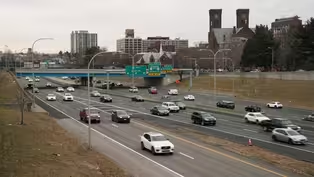
Video has Closed Captions
Clip: S4 Ep10 | 11m 1s | Noise pollution is more than just a nuisance. It’s also a public health issue. (11m 1s)
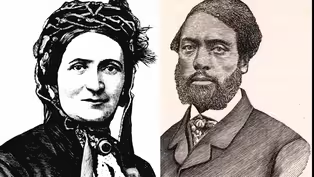
Video has Closed Captions
Clip: S4 Ep10 | 9m 51s | Slaves William and Ellen Craft’s dangerous journey to freedom in the mid-1800s. (9m 51s)

Video has Closed Captions
Clip: S4 Ep10 | 6m 57s | In-depth second look at iconic soprano Sissieretta Jones. (6m 57s)
Providing Support for PBS.org
Learn Moreabout PBS online sponsorship
- News and Public Affairs

Top journalists deliver compelling original analysis of the hour's headlines.

- News and Public Affairs

FRONTLINE is investigative journalism that questions, explains and changes our world.












Support for PBS provided by:
Rhode Island PBS Weekly is a local public television program presented by Ocean State Media