
Rhode Island PBS Weekly 4/2/2023
Season 4 Episode 14 | 26m 39sVideo has Closed Captions
In-depth look at how language deprivation can cause deaf children to fall behind.
Weekly's Pamela Watts takes an in-depth look at how language deprivation can cause deaf children to fall behind. Then, a second look with an excerpt from Breaking Good: Women and the War on Drugs, a Rhode Island PBS original documentary by producer/director Dorothy Dickie. Finally, we revisit toy designer Khipra Nichols, one of the designers behind Mr. Potato Head and My Little Pony.
Problems playing video? | Closed Captioning Feedback
Problems playing video? | Closed Captioning Feedback
Rhode Island PBS Weekly is a local public television program presented by Ocean State Media
Rhode Island PBS Weekly 4/2/2023
Season 4 Episode 14 | 26m 39sVideo has Closed Captions
Weekly's Pamela Watts takes an in-depth look at how language deprivation can cause deaf children to fall behind. Then, a second look with an excerpt from Breaking Good: Women and the War on Drugs, a Rhode Island PBS original documentary by producer/director Dorothy Dickie. Finally, we revisit toy designer Khipra Nichols, one of the designers behind Mr. Potato Head and My Little Pony.
Problems playing video? | Closed Captioning Feedback
How to Watch Rhode Island PBS Weekly
Rhode Island PBS Weekly is available to stream on pbs.org and the free PBS App, available on iPhone, Apple TV, Android TV, Android smartphones, Amazon Fire TV, Amazon Fire Tablet, Roku, Samsung Smart TV, and Vizio.
Providing Support for PBS.org
Learn Moreabout PBS online sponsorship(gentle music) - [Announcer] Tonight on "Rhode Island PBS Weekly".
- [Pamela] Another group of hearing parents meet to learn sign language from David Melowny, who is being interpreted aloud.
He signs the picture book "The Snowy Day".
- [Interpreter] So Peter was sleeping all light.
- [Host] So that they can sign bedtime stories to their children.
- He woke up?
He wake up.
He woke up?
He woke up?
Yep.
- [Narrator] We know that there are over 6,000 women that are serving life sentences.
And so we need to think about, for these women, what is the value of keeping them in prison forever?
What's lost in terms of for their family, for their community, but also what do we lose by incarcerating people at a very high expense as they go into their old age?
- [PAtricia] In FY21, the cost per offender in the female facility was about $187,000 a year.
- Mr. and Mrs.
Potato Head were very kind of plain, they were plastic like this, but they had very little personality.
And so we had the job of bringing freshness and more life and animation into the characters.
♪ Mr.
Potato Head, I made you ♪ (upbeat music) (upbeat music continues) - Good evening.
Welcome to "Rhode Island PBS Weekly".
I'm Pamela Watts.
- And I'm Michelle San Miguel.
30 years ago, Rhode Island's hearing assessment program for newborns became the first of its kind in the country, eventually creating a standard for the entire United States.
- However, once a parent learns their child is deaf, the path to language and learning is anything but standard.
Tonight we visit with local families trying to navigate the choices and the challenges.
- Who, who, here, here, here.
- [Pamela] Parents of young children gather at Rhode Island School for the Deaf.
- What are we doing next?
- Good job, good job.
- [Pamela] To learn American Sign Language or ASL together.
- A group hug is what this mouse needed.
- [Pamela] David Melowney is their teacher being interpreted aloud.
- This is the sign for I love you.
You'll see this a lot in American Sign language.
- [Pamela] They are starting early to make sure their deaf and heart of hearing children don't fall behind.
Nancy Maguire Heath has been director at Rhode Island School for the Deaf for the last 11 years.
- We frequently, especially the last few years, have had number of students referred to us who have no language or have little language.
They may have 50 to 100 spoken words when they should have thousands by that age.
- [Pamela] Most arrive never having learned any sign language.
And Maguire Heath is entrusted with helping them catch up after years of missing out on opportunities to learn.
- You and I, because we are hearing, we learn from our environment all the time.
We learn from mom on the telephone talking to the plumber.
A deaf child may not get any of that.
They're not getting that incidental learning that our brain grows from.
- [Pamela] That brain growth is the focus of extensive research by Dr. Wyatte Hall, assistant professor of Public Health Sciences at the University of Rochester Medical Center.
He says when it comes to language exposure, there's a ticking clock.
- [Wyatte] We've seen a lot of research that there appears to be a critical period or a sensitive period depending on who you talk with.
That period is a time where we are born biologically ready to acquire language.
- [Pamela] Studies estimate the window lasts from birth to ages three to five.
If children can't easily hear people talking or see people signing, they run the risk of developing what's known as language deprivation.
- Their thinking becomes locked in the concrete.
They can keep learning, but they don't do well in the abstract and they can't keep up.
(child howling) - Oh, you're a wolf now?
- No, I'm a werewolf.
- Oh, you're a werewolf?
- [Pamela] Emma White, a social worker in Rhode Island, is dedicated to ensuring her five-year-old son Luca is immersed in language.
- One, two, three, four, five, six.
- Okay, you gotta find a green square.
The first one?
- The first time.
- The first time.
- [Pamela] White found out Luca was profoundly deaf in both ears when he was just three weeks old.
- I'm just thinking like, is he ever going to be able to hear, will he ever be able to talk?
Am I gonna be able to communicate with him?
What did you make at grandma's today?
- Snow man.
- How many?
- Two.
- Two?
- [Pamela] Parents of deaf and hard of hearing children are usually given two main options.
- Should we be signing to him?
Should we be focusing on spoken language?
The advice that I was getting was at times conflicting of what I should do.
- That's the parents.
- Good job.
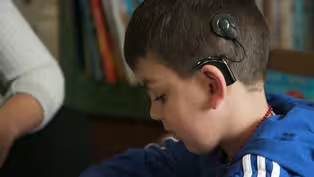
- [Pamela] The family started off by learning sign language and then at a year old, Luca received a cochlear implant.
Unlike a hearing aid, which amplifies sound, a cochlear implant is surgically connected to the hearing nerve in the brain.
The vast majority of infants born in the US today get the procedure.
What was it like the first time that you realized he could hear your voice?
- I remember it was the S sound, and he, I don't think had ever really been able to hear that with his hearing aids.
So when he heard that, he was just like looking around, and I was like, okay, it worked.
Now the work is really gonna start.
- [Pamela] And start it did.
- What color did you get?
- Purple.
- Purple?
- [Pamela] Appointments to calibrate the sounds Luca hears, speech therapy, and advocating for accessibility at school.
But for many families at her school, Maguire Heath says the money and time needed for these programs is out of their reach.
- The cochlear implant can be a very successful tool if the child can learn from it.
What's being left out is that it's not a magic bullet.
It becomes a class issue, a socioeconomic class issue.
I see many children who are implanted and parents are very excited about doing that, but they are parents who don't have the means or the ability, even if they have the desire to do the work, to get maximum benefit from that tool.
- Mouse sliding down the hill.
- These days, many deaf adults use a combination of sign language and hearing technology, but in our conversation with Dr. Hall, he notes that cochlear implants and ASL are often pitted against one another.
- [Wyatte] Some people think if you learn ASL first, it would somehow harm cochlear implant outcomes.
We actually have some research suggesting that signing children can do better with their cochlear implants and have better speaking abilities than non-signing children who are implanted.
- Does that message seem to be getting out though?
- [Wyatte] Well, no.
There is a very powerful, a very strong structure and system, both medical and education in our country that strongly support using spoken language only approaches.
So the best numbers that we have is roughly less than 10% of deaf children in America are getting early access to sign language.
- [Pamela] Jesus Flores was not diagnosed as deaf until he was three years old.
His mother, Marta Gomez, spent years trying to figure out why he wasn't communicating.
Doctors told her.
- If you put a cochlear implant, Jesus gonna talk, or you can leave it there and just do a sign language.
Of course, I'm gonna go to the side for he can talk, he can hear because all my family can be like good communication with him.
- [Pamela] Jesus went through three surgeries for his cochlear implants.
He also went to a specialty school in Rhode Island that exclusively focuses on spoken language.
After seven years at the school, Jesus wasn't showing much progress.
- And I'm asking for a second opinion.
And with the second opinion, they did tell us we got that wrong diagnosis.
- It turned out Jesus had an auditory nerve problem that the cochlear implant would never have been able to resolve.
And how did you feel when you heard that?
- Oh my God, my whole entire word is like, everything is I cry, I cry a lot, I cry a lot.
And then when I decide to thinking about something else and we talking about School of the Deaf in that moment.
- So up until that point, had he had much language development?
- No, he tried to say words, but basically, I never know if he can understand, fully understand that.
- So he was living in a pretty silent world for many years.
For children who rely solely on cochlear implants, not hearing enough during their formative years can be detrimental.
- [Wyatte] By the time the critical period is over, it's very difficult to go back and fill in the gaps for their language functioning and for their everyday use of language.
- [Pamela] Jesus didn't start learning ASL until he was 11 years old at Rhode Island School for the deaf.
Social worker Gerlany Mejia has been a support for both Gomez and Jesus.
- So Jesus is the one student who we know he will always support his peers.
If there's something going on, we know Jesus knows what's happening because he's so helpful and so kind and compassionate.
- He's 16.
And where would you say he's in school now?
- Way behind, elementary.
Like way, way, way, way behind.
- So he has to work harder?
- So hard.
- [Pamela] Dr. Hall says that language deprivation shouldn't happen to any child.
- [Wyatte] We already know how to prevent these problems.
You give deaf children sign language.
It's completely preventable.
I've seen problematic framings that options are framed as or, that you have to pick ASL or English, a spoken language.
What I've also seen is it does not have to be that way.
It can be and.
You can have ASL and English, you can give all the options.
- [Pamela] To prevent that language deprivation, more than 20 states across the country have passed laws to monitor deaf children's language development milestones.
Similar bills have been proposed in Rhode Island, but have not passed.
- [Interpreter] Good morning, good morning.
- [Pamela] Another group of hearing parents.
- [Interpreter] If you've made a snowman with your child, you can explain the buttons.
- [Pamela] Meet to learn sign language from David Melowny who is being interpreted aloud.
- [Interpreter] And there's snow.
He sees more snow, he's like, "yes, there's more snow".
And he's excited.
- [Pamela] He signs the picture book "The Snowy Day".
- [Interpreter] So Peter was sleeping all night.
- [Pamela] And teaches key vocabulary to parents.
- [Interpreter] Morning.
And then third, sliding.
He's walking along, he sees a tree.
He looks up and he's poking the tree, poking it again.
- [Pamela] So that they can sign bedtime stories to their children.
- Pete.
Pete, Pete got up.
He woke up?
He wake up.
He woke up?
He woke up?
Yep.
- [Interpreter] My parents were not strong signers at all, but they did sign.
They tried their best and I'm so thankful for them for being willing and able to learn how to communicate with me.
Keep that in the back of your head.
Keep communicating, keep trying to improve, keep working on it.
The fact that you are showing the effort is really great.
- [Pamela] It's a familiar road for Gomez who has been learning sign language for Jesus.
She says he helps her get better.
- Example, we cooking together, and I'm gonna ask Jesus, how I sign this, or how I say this, I try.
- He's teaching you?
- Yes, he's my teacher, and when I do it wrong, he laugh for me too.
- What do you say to him to keep him motivated?
- I just show how much I love him and doesn't matter what happened.
He always got all my support.
- [Pamela] And that's the approach Maguire Heath says all parents should take.
- You're the oil that connects things.
You're the link that connects things for your child.
There's no limit to what they can learn and what they can do, but they need you to help connect it to what's really happening in the world.
Accept your child as he is, she is.
Let them know that and to give them every tool in the book, including American Sign Language, and they will let you know what works for them and what doesn't work for them, and they will appreciate that you were open to all of that.
(gentle music) - Up next, almost 173,000 women and girls are incarcerated in prisons and jails in the United States, making it one of the world's highest rates of female imprisonment.
A major reason for that, the drug trade.
In the following excerpt, producer and director Dorothy Dickey explores in her documentary "Breaking Good: Women and the War on Drugs", the alarming escalation of women's incarceration since the War on Drugs was declared back in the 1980s.
- We made history this year, we launched our first subsidized housing program that housed 18 formerly incarcerated individuals and provided them housing vouchers to reunite with their families after incarceration.
(applause) Every time my phone rings, it's not good news.
This work is not easy to do, but when you have a chance to reunite a child, a mom, a dad, and put somebody who has been homeless for 10, 20 years, it makes it all work.
I grew up in Roxbury, Massachusetts.
I had a nice childhood, actually.
I grew up in a middle class family.
I can't complain.
We had a good upbringing.
I was an honor roll student.
I always had good grades, but my conduct was awful.
I ended up getting into fights in high school a lot, and me and my friends would all skip school.
We would go to my house and we would smoke weed and drink.
My first experience with drugs was when I was 13.
And so you experiment with things, very risky behavior when you're at that age.
Count to three, everyone say "new beginnings".
One, two, three.
- [Crowd] New beginnings.
- This is a long time coming, when women come back into communities that they actually have a home to come to, that they have the dignity and peace and love and support they deserve.
And that we are taking care of our people in our communities.
And so what we have today with the New Beginnings grand opening is a safe space for people to come to.
And we all owe our thanks and love and admiration to Miss Stacey Boyden.
(applause) - I'm the 11th child of 12.
Seven brothers, five girls.
Growing up was amazing.
It was just magical.
And on the other side, dysfunctional.
My two older brothers were drug addicted and in and out of trouble and police would always come.
And then there was me who was problematic, always high.
I was 11 when I first started smoking marijuana, and I wanna say 12 or 13 when I first sniffed cocaine.
My brothers were selling it.
It was more like the lifestyle I was suffering because it was a teacher.
And I remember sitting on her lap and I remember something happened and I blacked out.
I cannot recall what happened.
Back in hindsight now, I feel like something happened sexually.
I feel like that's where my early childhood trauma came from.
I started being a problematic child.
I was withdrawing, I really couldn't accelerate in school.
I just felt so incompetent and my comprehension level wasn't good.
And so once I got to JP High, it was drugs.
I started popping mescalin and microdots and sniffing Percocet.
All these years later, I never knew that I even existed.
And that's just how my life went.
Not feeling like I even existed.
I just floated.
And my senior year, I was sexually assaulted, and that took me over the edge.
I did know how to explain it to anybody.
I did know how to explain about the young childhood sexual assault or the young adolescent sexual assault.
I didn't know what mental illness was.
And so I started drugging heavily, and it was causing a lot of problems in the household.
And eventually I started running away and staying out and getting myself in trouble until my first incarceration.
That was in 1982.
- [Narrator] Right now in the United States, we know that there are over 6,000 women that are serving life sentences.
And so we need to think about for these women, what is the value of keeping them in prison forever?
What's lost in terms of for their family, for their community?
But also what do we lose by incarcerating people at a very high expense as they go into their old age?
- [Patricia] In FY21, the cost per offender in the female facility was about $187,000 a year.
Women have different issues that result in their incarceration.
They've had trauma in their lives that have contributed to their ultimate incarceration.
- Why did I deserve that, right?
And I didn't know how to process it.
- While women are incarcerated, they have a different experience.
- Because when I was in there, I held all that pain in because when you're incarcerated, there's so much drama going on inside the prison and that you're just trying to survive in there, right?
- Unfortunately, and it's something I'm working on very hard, resources, rehabilitative resources for the female population have not always been at the top of the page.
And so we're working very hard to change that.
- [Narrator] If the goal is to help a woman end her substance use problem and the consequences that she's imposing on her community because of her substance use problem and her role in the drug trade, if that's the goal, what else could we be doing to achieve that more effectively?
(gentle music) - Our thanks to Dorothy Dickey.
You can see the full documentary "Breaking Good: Women and the War on Drugs" anytime at ripbs.org.
Finally tonight in our continuing "My Take" series, we take another look at toys with the help of a longtime Rhode Island-based toy designer.
- So people have asked me, which toy of all the ones you've made is your favorite?
And I have to say, it's this one, the Snoopycopter.
My name is Khipra Nichols, and this is my take on toys.
I'm an industrial designer, and I'm also a professor at Rhode Island School of Design.
I designed toys at Hasbro for 20 years and two months exactly.
I think the most recognizable toy that I worked on for sure is my Little Pony.
♪ My little pony, my little pony ♪ ♪ Tie a ribbon to show how much I care ♪ - One of the fun things about doing a play set for My Little Pony is that you get to design all of the little accessories within the play set.
I came up with the idea of having a baby dragon.
- Wow, purple spiky things.
- And so Spike became the baby dragon friend of Majesty, who is the pony that comes in the My Little Pony Dream Castle.
So one of the fun aspects of the feature for Spike is that he gets to ride up and down in this little basket.
And I have to admit, the inspiration for this feature came from watching the movie "Rear Window".
(upbeat music) Another really fun toy to work on was Mr. And Mrs.
Potato Head.
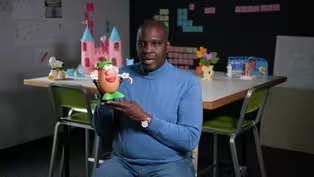
So before this character that we worked on, Mr. and Mrs.
Potato Head were very kind of plain, they were plastic like this, but they had very little personality.
And so we had the job of bringing freshness and more life and animation into the characters.
♪ Mr.
Potato Head, I made you ♪ - It was my idea to have this little hatch.
And it was inspired by the Dr. Denton onesies that toddlers wear that have a little flap in the back when they're learning how to potty train.
And so this just opens up, and it's plenty of room to put the parts in.
And we made sure the parts were flexible enough and soft enough that they could bend and flex and this can change.
♪ Put them all together, then take them all apart ♪ ♪ Put them all together, then take them all apart ♪ - One day, one of the GI Joe group guys came over and asked me if I would like to be a GI Joe character.
And I thought, "are you serious?"
Before you know it, I had my character.
This was Doc actually from the first series of the small GI Joe characters.
Probably in 1982 was when this came out.
Toys are important because this is how children start to understand the world that they're in.
So imagine a toddler sitting in a wading pool and you give them a block, a wooden block, and they kind of splash it in the water and it floats to the top.
And they get very excited about that.
And then when you hand them something that doesn't float, they put it in the water right away and they do the same thing and it doesn't come up to the top.
And so what looks like play, and it is play, is also discovery.
So one day I had a prototype for a toy and I had the opportunity to sit next to an eight month old who was going to teach me about the human factors of the toy.
Did I get the shapes right?
Did I get the size correct?
Is it gonna be fun for the child?
So I sat down next to the child and I took the toy out of the box and the child got very excited about the box.
Actually, the box was more interesting than the toy because the box was something that the child could put on their head and then they could put it down on the floor and then they could put something in the box, then they could dump something out of the box.
So yeah, sometimes the box is even more engaging than what's in the box.
I'm Khipra Nichols, and this has been my take on toys.
- That's our podcast this evening.
Thank you for joining us.
I'm Pamela Watts.
- And I'm Michelle San Miguel.
We'll be back next week with another edition of "Rhode Island PBS Weekly".
Until then, please follow us on Twitter and Facebook and visit us online to see all of our stories and past episodes at ripbs.org/weekly.
Or listen to our podcast on your favorite streaming platform.
Thank you and good night.
(gentle music) (gentle music continues) (gentle music continues)

Breaking Good: Women and the War on Drugs
Video has Closed Captions
Clip: S4 Ep14 | 7m 45s | Documentary exploration of the war on drugs and the high rate of women incarcerated. (7m 45s)
Video has Closed Captions
Clip: S4 Ep14 | 13m 12s | An in-depth look at how language deprivation can cause deaf children to fall behind. (13m 12s)
My Take: Khipra Nichols on Toys
Video has Closed Captions
Clip: S4 Ep14 | 4m 56s | A toy designer behind Mr. Potato Head and My Little Pony shares his perspective on toys. (4m 56s)
Providing Support for PBS.org
Learn Moreabout PBS online sponsorship
- News and Public Affairs

Top journalists deliver compelling original analysis of the hour's headlines.

- News and Public Affairs

FRONTLINE is investigative journalism that questions, explains and changes our world.












Support for PBS provided by:
Rhode Island PBS Weekly is a local public television program presented by Ocean State Media