
Rhode Island PBS Weekly 4/28/2024
Season 5 Episode 17 | 22m 25sVideo has Closed Captions
Author Javier Zamora recalls his journey from El Salvador to the U.S. when he was a child.
Isabella Jibilian has an in-depth interview with Solito author Javier Zamora about his long, harrowing journey from El Salvador to the U.S. when he was 9 years old. Then, Pamela Watts heads out to Newport for Daffodil Days. Finally, on Weekly Insight, Michelle San Miguel and WPRI 12’s politics editor, Ted Nesi, talk about Gina Raimondo.
Problems playing video? | Closed Captioning Feedback
Problems playing video? | Closed Captioning Feedback
Rhode Island PBS Weekly is a local public television program presented by Ocean State Media
Rhode Island PBS Weekly 4/28/2024
Season 5 Episode 17 | 22m 25sVideo has Closed Captions
Isabella Jibilian has an in-depth interview with Solito author Javier Zamora about his long, harrowing journey from El Salvador to the U.S. when he was 9 years old. Then, Pamela Watts heads out to Newport for Daffodil Days. Finally, on Weekly Insight, Michelle San Miguel and WPRI 12’s politics editor, Ted Nesi, talk about Gina Raimondo.
Problems playing video? | Closed Captioning Feedback
How to Watch Rhode Island PBS Weekly
Rhode Island PBS Weekly is available to stream on pbs.org and the free PBS App, available on iPhone, Apple TV, Android TV, Android smartphones, Amazon Fire TV, Amazon Fire Tablet, Roku, Samsung Smart TV, and Vizio.
Providing Support for PBS.org
Learn Moreabout PBS online sponsorship(light music) - [Pamela] Tonight, a migrant's harrowing journey.
- When you survive, you ask yourself, "Why me?"
- [Pamela] Then, goodbye yellow brick road.
See what's popping up in Newport.
- It's almost like seeing the sun come up.
I mean it's that electric.
- And here we are.
- [Michelle] And Ted Nesi on Gina Raimondo's moment in the national spotlight.
(light music) (light music continues) Good evening and welcome to "Rhode Island PBS Weekly."
I'm Michelle San Miguel.
- And I'm Pamela Watts.
In our first story, we take a look at immigration.
- In December, the US Border Patrol had almost 250,000 encounters with migrants crossing from Mexico into the United States.
That's a record high.
Tonight we explore the plight of a vulnerable group, child migrants.
It's the subject of the book "Solito," this year's Reading Across Rhode Island selection.
Producer Isabella Jibilian recently spoke with author Javier Zamora about his long and lonely journey.
- You have to put yourself into the minds of a 9-year-old.
So for me, it was this joyous adventure that I was embarking on.
I wasn't aware of the horror or how close to death I was.
- Javier Zamora was nine years old when he migrated to the United States alone without his parents.
(Javier speaking Spanish) In his memoir, "Solito," Zamora chronicles his more than 2,000 mile journey to reunite with his parents who had fled violence and a civil war in El Salvador.
- I wasn't the only kid in my town that didn't have at least one parent or two.
- Instead, his grandparents cared for him.
Was it difficult not having them there?
- Absolutely.
One of the scenes in the book, early scenes, is Mother's Day celebrations and Father's Day celebrations.
A lot of the children in my small rural town, we didn't have a mother's name to write on like a handkerchief to give to them.
- [Michelle] Zamora couldn't get a visa to the US and so his parents hired the coyote, or smuggler, who had brought his mom to the US four years earlier.
- I was a a smart kid in a lot of ways, but a very shy kid who didn't know how to tie his shoes.
- [Michelle] The coyote was supposed to be Zamora's protector, but then he abandoned the group to other smugglers.
- You take a 20, 22-hour boat ride to somewhere in Oaxaca.
It is cold.
You can't see any lights.
I was a kid who was afraid of the dark, who didn't know how to swim.
- [Michelle] And arriving only brought more perils.
- [Zamora] People in uniform back then were our biggest enemies.
The first time that I have a gun pointed at me, it is by a uniformed federal, who is pretty much like an Army Mexican person.
The cops would rob us all the time.
- [Michelle] After numerous checkpoints, they finally arrived on the border.
Zamora and three others crossed posing as a family.
- So that's Patricia, a mom, and her 12-year-old daughter, Carla.
And this 20 19-year-old young man named Chino.
- [Michelle] On their first crossing, they were caught by Border Control.
On their second, they face dehydration, which regularly takes the lives of many migrants.
- We were part of a much larger group, and during this try we were followed by a helicopter.
Their point is to scatter people and then trucks come and find them with horses, with dogs, with ATVs.
And so I suspect that because we were followed by a helicopter, that the coyote got lost out of the close to, I wanna say 60 people, a lot of 'em are probably still in the desert.
And so that could have happened to me.
And for 20 years, that was the little voice in my brain.
"Why didn't it happen to you?"
We almost ran outta water.
And I suspect that a lot of people that were with me died.
- [Michelle] Today he credits his closest companions for helping him survive.
- Chino became my protector.
When we get to the desert, he carries our water and he carries me on top of his back when I get tired.
He carries Carla when she gets tired.
He pulls Patricia by the hand when she's stumbling over.
And Patricia, as well, making sure that we're drinking water.
They were literally risking their lives for a stranger.
- Carla, Patricia, Chino, do you know where they are today?
- No, they still haven't reached out.
We stayed in contact for two months and then they changed their number and they never called back.
I've gotten so many offers by headhunters and journalists to be like, "I can look for them" and I will say "No," because I just remember that if Chino would've written a book or if Carla would've written a book and then reached out to me, that would've retraumatized me.
In my mind, I just envision them seeing the cover and opening page five and seeing the dedication to them.
That's it.
That's all I expect.
And because I'm deeply, deeply thankful that they were there and that they helped me to arrive.
- What do you consider the biggest changes between your experience in 1999 and today, about 25 years later?
- Cartels weren't into the business of smuggling people, now they are.
- [Michelle] And in turn, enforcement has changed.
- In 2024, the border has moved south to the Mexico-Guatemala border.
- [Michelle] And instability has brought migrants from across the globe to the Southern border.
- Where are they coming from?
- All over the world.
Central America, South America, Africa, Eastern Europe, China, India.
- [Michelle] The influx includes children.
- The surge in unaccompanied migrant children.
- [Michelle] In 2023, over 100,000 unaccompanied child migrants were taken into custody by the US Department of Health and Human Services.
Zamora's similar experience was inspiration for the title of his book, "Solito."
- The Word means alone.
And I have felt different levels of loneliness throughout my life.
I felt alone when my dad left.
I felt alone when my mom left.
And then I embarked on this 10 week trip.
And it was the first time of my life that I didn't know any family members.
But then there was this second family that sort of like adopts me and helps me survive.
When I got here, I never see these three individuals again.
And so the real loneliness I think happens after the book ends.
(Zamora speaking Spanish) - [Michelle] Today, 25 years since the ending of his journey, Zamora tours across the country, speaking about his book.
At signings, he's found he's not alone in feeling solito.
- 15 children, immigrants, who were in the desert in 1999 from El Salvador have come to my readings.
One of them was actually in the same patch of desert in she successfully crossed in June 8th.
I successfully crossed June 10th.
So we were there.
And what she told me is that she always felt like she was the only one.
I felt like I was the only one.
That's why it's also called "Solito" because we carry this trauma by ourselves.
If there's something that the book is doing it's showing people that we don't suffer inside and we don't suffer on our own.
(light music) - Well, the chilly weather here in Rhode Island belies the notion that spring is in the air.
The flowers tell a different story.
All this month, Newport is basking in the glow of mellow yellow.
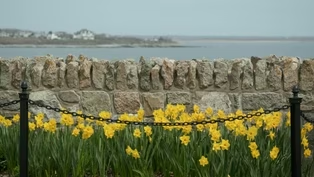
More than a million daffodils are blooming everywhere you look as the city by the sea vies for a new title, Daffodil Capital of New England.
Tonight we explore what's behind this golden explosion.
Newport is world famous for its seascapes, but now it's the landscape luring visitors to these shores.
There's flower power here, a pop of crayon yellow saturates the scenery, a virtual sea of daffodils.
- It's almost like seeing the sun come up.
I mean, it's that electric.
It brings joy, happiness throughout the city.
- John Hirschboeck, a retired advertising executive, is the director of Daffodil Days.
- In fact, downtown Newport, you'll see the Jane Pickens Theater.
She is a famous vaudeville actress.
- [Pamela] It is here on the former Bellevue Avenue estate of Golden Age star, Jane Pickens, where the idea for Daffodil Days first took root 15 years ago.
Hirschboeck, who is on the Newport Cliff Walk Commission, originally had a different plan in mind when he went to the city's director of Parks and Recreation.
- I said, "How about planting cherry trees up and down Cliff Walk?"
He said, "They're not gonna thrive because of the salt water, but you may wanna talk to Ron Fleming about daffodils."
- Ron Fleming, who lives in Florida this time of year, is chairman emeritus of the National Scenic America Program.
The Pickens' Estate is his summer home where he has amassed a daffodil garden of Eden.
As a beautification benefactor, he and Hirschboeck decided to team up to spruce up Newport.
Newport is naturally stunning.
So why would it need a beautification program?
- Every city, every town can look a little prettier.
It brings the city alive, which is really important.
After the doldrums of winter, there's this notorious mud season here in Newport, and this is a way to kind of fight that mud season.
- [Pamela] The daffodils enticed tourism, even for natives.
- The Chamber of Commerce and Discover Newport love the festival because it brings people, again, out of their homes to visit Newport.
Not in the crowded summer season, but in one of the shoulder seasons.
- [Pamela] Hirschboeck came up with a motto to help grow daffodil fever.
- Being the former ad guy that I am, I said, "Well, we need a catchphrase."
We said, "Let's call it Daffodillion."
We'll go for a million daffodils around town.
Little did I know that that might be fun to say, but it's more difficult to achieve.
- [Pamela] To reach the golden goal, Daffodil Days partnered with the garden group, Newport in Bloom, and the hybrid organization began giving away thousands of free bulbs in the fall to encourage blossoms in every front yard.
Two dozen per household, but it wasn't enough.
So, they fundraised to purchase a planting machine.
- Which plants 20,000 bulbs in an hour that would normally take two to three days of hand labor.
And that really accelerated our progress towards the million.
- [Pamela] They reached their goal in 2012.
Now it's a million and a half and counting, all this floral euphoria to capture a self-proclaimed title.
- We'd like to think we're the daffodil capital of New England.
Of course, everyone's familiar with Nantucket.
They've been planting and celebrating their Daffodil festival for well, going on 20 years now I think.
So, we're certainly catching up if not exceeding them.
- [Pamela] Paul Galluscio is one of the volunteers who helps with planting the public spaces.
He lives on Touro Street where his own daffodils from the bulb giveaway also blossom.
- Each year I plant them in the front and on the side.
And what I like about the daffodils is they're very easy.
They naturalize so they kind of spread on their own.
They don't require a lot of work.
- [Pamela] He says they are also deer and pest resistant because the bulbs are toxic.
Going by the botanical name, Narcissus, they're also known as jonquils.
Of the dozens of varieties, Newport uses the one known as Dutch Master.
Galluscio says, "The early spring buds provide a pleasurable pastime."
- A lot of times I'll enjoy a cigar and a martini while I'm puttering around the garden.
And for me, that's the best day, enjoying the garden.
- That'd be the best day for anybody.
- Yes, I think so, fFor me anyway.
- Daffodil Days, like the flowers, are spreading.
I see that you really get into the spirit of things.
- I've been called Daffy all my life, so I guess this is a completion of that stewardship, if you will.
No one can get upset with a flower as I keep telling people.
There's a lot of turmoil and frustration sometimes in the world and arguing back and forth.
But you go outside and take a look at the daffodil fields and everyone smiles.
- [Pamela] In fact, fun is the fertilizer for Daffodil Days.
It has grown into a month-long celebration of flower frivolity.
Many shops and restaurants decorate windows.
There's a 5K run for the daffodils, a Tour de Jonquil bike race, and... - One of my favorites is their doggy pawrade, P-A-W-R-A-D-E.
In fact, we'll have over 50 dogs and their doggy owners dress up in their best doggy outfits and parade from Banister's Wharf to Queen Anne Square.
- [Pamela] Then along Ocean Drive, visitors are treated to a Driving Miss Daffodil rally of classic cars, sponsored by the Audrain Automotive Museum.
And Hirschboeck says he plans to keep the annual Daffodil Days rolling.
- I love going out and seeing young children playing among the daffodils, parents with families shooting pictures to celebrate with their family.
It brings the city alive.
- And as poet William Wadsworth wrote.
"A host of golden daffodils beside the lake, beneath the trees, fluttering, dancing in the breeze."
- Well, it brings joy to my heart.
You look out over fields of hundreds of thousands of these, it's stunning, the magic involved in their creation.
And you realize that every small little thing that Mother Nature provides has its own story, history, and impact on our environment.
- In October, the Daffodil Days Committee will hand out 35,000 free bulbs and volunteers will plant an additional 70,000 in Newport Parks.
Finally, tonight on this episode of "Weekly Insight," Michelle and "WPRI 12's" politics editor, Ted Nesi, talk all things Gina Raimondo, from the former state treasurer's work on pension reform to the now secretary of commerce's recent response to a possible run for president.
- Ted, welcome back, it's good to have you.
US Commerce Secretary and former Rhode Island governor, Gina Raimondo, was recently in the national spotlight.
She was featured in what was a relatively positive piece on "60 Minutes."
You've been covering her for years.
I would imagine that Raimondo and her team were very happy to have that kind of publicity.
- They were very happy.
I spoke with some of her aides after the piece aired, and people have to remember, "60 Minutes" is still the highest rated news program on American television.
So having that kind of spotlight for Raimondo, it's only gonna raise her profile and her prominence even further in Washington.
And I do think Leslie Stahl, who did the piece on Raimondo, made a good point in there that Commerce Secretary has not historically been, you know, a top tier cabinet post that got that level of attention, which does speak to Raimondo's ability to sort of turn it into something more than it had been in the past.
- Yeah, and the "60 Minutes" report talked about the work that Raimondo and the Commerce Department are doing to bring advanced chip manufacturing to the United States.
Right now, about 90% of that work is being done in Taiwan and Raimondo says, "Look, this is a national security concern.
We cannot continue down this road."
The piece also talked about the work that Raimondo is doing.
It's called an Internet for All program, which involves expanding high speed internet, mostly to rural America.
I was surprised that about 24 million Americans still do not have access to high speed internet.
And then, you know, Leslie Stahl asked the question that we were all wondering.
- Of course, yes.
- Which is, Raimondo, what are your political ambitions?"
Let's take a listen to that exchange.
- So here comes the inevitable, obvious question that you know is coming your way.
You are on a list of future presidential candidates.
Does that sound good to you?
Is it appetizing?
- What sounds good to me is being the best commerce secretary there's ever been.
- Ted, I mean that's the kind of non-answer that people expect to hear from politicians.
- Yes, and it's not Michelle, the first time I've heard Raimondo give that kind of answer.
I was in Washington to interview her last year for a similar profile about her new life in Washington.
And I pressed her, "Are you interested in this?
Do you like this buzz?"
And she sort of gave me an in-between answer.
I said, "That's not a no."
She said, "Well, it's not a yes either."
So she likes this speculation.
- So let me pose the same question to you.
You've been covering her as long as she's been in public office.
Do you think that Gina Raimondo will someday run for president?
- I'm skeptical, and that's not to take anything away from Raimondo.
She achieved a great deal.
I mean, to go from Rhode Island governor into the cabinet is pretty rare.
She certainly had success there.
She has a lot of elite fans in Washington, people who think highly of her.
But running for president is, there's nothing like it.
And she doesn't have a strong political base geographically out in the country.
She's got problems with the left, which doesn't trust her 'cause of her sort of business mindedness and some of the policies she advocated in Rhode Island.
And there's just many, many other Democrats who also want to run, Vice President Harris, the governor of California, the governor of Michigan.
So I think in the end, it's not something she's gonna do, but I also don't think she's gonna rule it out until she has to.
- But even if she doesn't run, she's only 52 years old, she's still young, obviously she's not about to retire.
And people have said, "Look, if Biden does get reelected, he could appoint her as US Treasury Secretary."
- And that, I think, is much more plausible.
I'm sure she'll be looked at for that post whenever Secretary Janet Yellen moves on and I could see her getting it.
I also think further down the line, you know, maybe she'd look at something outta politics, being a university president, maybe going into the corporate sector in some kind of executive or board type of role, I think we're gonna be seeing her on the public stage for a long time.
- And also, let's keep in mind like her record here in Rhode Island, people are still very critical of the work that she did here.
Let's go back to 2011 when she engineered this massive pension overhaul.
Frankly, many retired state employees have not forgiven her for allowing lawmakers to freeze the cost of living adjustments in order to shrink the multi-billion dollar shortfall in the pension fund.
I mean, people still hold a grudge over that.
- And it's understandably so.
And I also think this has gotten even harder for retirees in recent years because of the high inflation that we've seen, which is eating into the value of their benefits even more than it was prior to the run up in inflation, which I think is part of why it's coming up so much right now.
- And the general treasurer, James Diossa, is revisiting that to see, "Look, will we have another pension overhaul?"
But right now the General Assembly ultimately has not decided what they will do.
- Yeah, and I don't know where that's gonna go.
I do think there's a lot more interest across the General Assembly in doing something they often say for the retirees.
What that will be is unclear to me.
And again, we've talked about this on the segment before, Michelle, money is tighter this year on Smith Hill as they finish writing the state budget for next year.
And Speaker Shekarchi often says, "There's a billion dollars in different asks."
So, I don't know whether retirees will sort of be one of the ones that makes it into the final product or if they're gonna be told they have to wait.
- Right, and compete with the Washington Bridge cost.
- Another big cost that's coming and that is still unknown.
- Absolutely, thanks so much for being here, Ted.
- Good to be here.
- And that's our broadcast this evening.
I'm Pamela Watts.
- And I'm Michelle San Miguel.
We'll be back next week with another edition of "Rhode Island PBS Weekly."
Until then, please follow us on Facebook and X and visit us online to see all of our stories and past episodes at ripbs.org/weekly.
Or listen to our podcast on your favorite streaming platform.
Goodnight.
(light music) (light music continues) (light music continues) (light music continues)
Video has Closed Captions
Clip: S5 Ep17 | 7m 38s | Floral Euphoria grows in Newport as it vies to become the Daffodil Capital of New England (7m 38s)

Video has Closed Captions
Clip: S5 Ep17 | 8m 59s | How Javier Zamora crossed the border at nine years old (8m 59s)

Video has Closed Captions
Clip: S5 Ep17 | 4m 53s | Ted Nesi delves into Gina Raimondo’s rise to national prominence. (4m 53s)
Providing Support for PBS.org
Learn Moreabout PBS online sponsorship
- News and Public Affairs

Top journalists deliver compelling original analysis of the hour's headlines.

- News and Public Affairs

FRONTLINE is investigative journalism that questions, explains and changes our world.












Support for PBS provided by:
Rhode Island PBS Weekly is a local public television program presented by Ocean State Media