
Rhode Island PBS Weekly 4/7/2024
Season 5 Episode 14 | 23m 43sVideo has Closed Captions
Housing Secretary Stefan Pryor and local potter Dwo Wen Chen on how clay becomes art.
Steph Machado has an in-depth interview with Rhode Island’s Secretary of Housing Stefan Pryor about the continuing affordable housing crisis in the Ocean State. Then producer Isabella Jibillian introduces us to local potter Dwo Wen Chen. Plus, Michelle San Miguel and WPRI 12’s Ted Nesi discuss the primary and the continuing forensic analysis of the Washington Bridge.
Problems playing video? | Closed Captioning Feedback
Problems playing video? | Closed Captioning Feedback
Rhode Island PBS Weekly is a local public television program presented by Ocean State Media
Rhode Island PBS Weekly 4/7/2024
Season 5 Episode 14 | 23m 43sVideo has Closed Captions
Steph Machado has an in-depth interview with Rhode Island’s Secretary of Housing Stefan Pryor about the continuing affordable housing crisis in the Ocean State. Then producer Isabella Jibillian introduces us to local potter Dwo Wen Chen. Plus, Michelle San Miguel and WPRI 12’s Ted Nesi discuss the primary and the continuing forensic analysis of the Washington Bridge.
Problems playing video? | Closed Captioning Feedback
How to Watch Rhode Island PBS Weekly
Rhode Island PBS Weekly is available to stream on pbs.org and the free PBS App, available on iPhone, Apple TV, Android TV, Android smartphones, Amazon Fire TV, Amazon Fire Tablet, Roku, Samsung Smart TV, and Vizio.
Providing Support for PBS.org
Learn Moreabout PBS online sponsorship(gentle music) - [Michelle] Tonight, the push to solve Rhode Island's housing crisis.
- It is a regional problem, but still, we don't want that dubious distinction.
We've gotta get out of it.
- [Pamela] Then a local potter's story.
- I was trying to disguise my Eastern heritage, trying to fit in, and then I learned not to fight it.
- [Michelle] And the Rhode Island primary and the latest on the Washington Bridge with Ted Nesi.
(upbeat music continues) (upbeat music) Good evening, and welcome to "Rhode Island PBS Weekly."
I'm Michelle San Miguel.
- And I'm Pamela Watts.
We begin tonight with a nationwide crisis that's hitting our area harder than most of the country: affordable housing.
- Here in Rhode Island, costs keep rising and many families are being priced out.
The state's housing secretary, Stefan Pryor, was brought into tackle the issue and its many hurdles early last year.
Contributor Steph Machado sat down with the secretary recently to find out what he's been doing and what his plans are to combat the crisis.
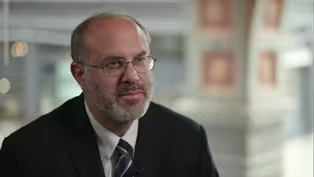
- Housing Secretary Stefan Pryor, thanks so much for joining me.
- Great to be with you, Steph.
- So I wanna start by asking you about the housing affordability crisis.
It's facing both, you know, renters and owners in Rhode Island.
Tell me what specific progress you have made so far as housing secretary on this front.
- Sure, mostly we're laying groundwork, because this is a problem that has accumulated over decades, but we're getting a lot going.
There are several aspects to the problem.
There's the problem of financing.
We've been under-financing compared to our fellow New England states, compared to the country, we've been under-financing housing.
So we're doing more around financing it.
We've been over-regulating housing, so there's been in the planning and zoning processes at the local level, there's really been some zigzag that has made it hard to comprehend and hard to navigate for project developers.
So we're working on making processes more efficient and developing partnerships with cities and towns.
And there's been very little leadership on housing in a coordinated way at the state level.
There wasn't a housing department until about nine months ago, fully and formally in the state of Rhode Island.
So we're getting that going too.
- So if we're under-financing housing, underfunding it, essentially, what is the dollar amount that we need to put a dent in the crisis?
- We're still estimating the dollar amounts that we think ought to be allocated over the longer term, but under Governor McKee, we've allocated well in excess of $300 million for the purpose.
- A lot of that from COVID relief funds, right?
- A lot of it from COVID-era funding, and that funding is flowing through the system.
You know, 98% of it is obligated or already being spent.
- So projects are moving, but has any of that money actually turned into housing that is available yet?
- Over a quarter is already under construction.
I think there may be a development that's moving towards completion or is being completed.
But Steph, it takes a couple of years to three years from the time you issue like a competitive solicitation all the way through to ribbon cutting and open the door.
- So gimme a ballpark.
Are we talking, is this a billion-dollar problem?
How much more money do you think we need?
- Well, it's something that should be measured over let's say a decade.
And we're working on those numbers, so I don't wanna put a dollar figure out today.
We need 2 to 3,000 units on an annual basis to tread water.
What our market is currently having introduced to it on an annual basis is 1,000 units.
- So we're way behind?
- So below status quo level of production.
- And that's just, you need 2 to 3,000 units a year just for the status quo.
But what about to meet the future demand?
We know that- - We need more.
- More people are moving into Rhode Island than are moving out.
- Yes, and to achieve greater affordability, you need more supply as compared to demand.
So we're not yet at that point.
So we've got a lot of work to do.
It's been decades in the making, this problem.
Now, are our leaders really at this problem?
Reason for optimism?
Very much so.
Yes, they are.
Governor McKee has proposed the largest-ever housing bond for Rhode Island out of general obligation bond funds, $100 million for the purpose, to get us further along than the federal funds have taken us, so we're not going off a cliff when the federal funds end.
- And tell me how far will that get us?
When will we get to the 2 to 3,000 units a year?
- It won't be enough.
It won't be enough.
And by the way, the dollars that the state spends mostly, mostly are dedicated to more affordable units.
But we need to unlock the market for all kinds of units, because at every price point, every income level of Rhode Islander, folks are having trouble.
They're struggling to find the kind of housing product that they are expecting out there.
Whether they're buying or they're renting, the prices are too high or they can't find what they're looking for.
So we need to yes, invest more, and I've emphasized that and we need to do that.
We also need to help cities and towns create the room for more housing.
- So one potential reform that we hear people talk about a lot is rent control or rent stabilization.
We're seeing rents continue to skyrocket.
The median price of an apartment in Providence is more than $2,000 now.
Do you support any sort of regulation on landlords in terms of how much they can raise the rent each year?
- Not as a first resort.
First of all, I understand the idea and understand what's behind it.
It makes a lot of sense that rents are rising too fast.
As a matter of fact, the Providence metro has the highest rate of growth in the country.
It's worth noting that Boston has the fourth highest rate of growth.
So there is something happening in New England, it is a regional problem, but still we don't want that dubious distinction.
We've gotta get out of it.
The main aspect to the solution to that problem is producing more housing.
- But as you said, that's gonna take years.
We're way behind where we need to be.
- And because it's been accumulating for decades, this problem.
But we need to be careful not to undertake solutions that can exacerbate the problem.
And what I mean by that is, for a long time there have been studies of rent control measures and of the precise types of rent control that have been undertaken in other places, frequently you see that landlords have a disincentive to invest in their properties.
So the conditions of these properties can deteriorate.
We don't want that either.
- I wanna ask you about the Superman building.
In your previous job as commerce secretary, you negotiated the deal for the Superman building to be developed by a private developer into apartments but using some taxpayer funds.
Construction has been delayed way beyond the initial estimates.
Are you concerned that this project isn't gonna happen?
- Concerned, yes.
Like most major projects in the United States, I'm concerned.
I care about the ones in Rhode Island.
I'm concerned they're all facing the interest rate volatility, the inflation challenges, the supply chain disruptions.
So they're not immune at the Superman building.
But I'm also optimistic in the sense that I know that the project team is working closely with us here in the state, working closely with the city of Providence, working with the building trades, and also together with the housing department helping, we've been reaching out to the feds to see whether any of the recent-vintage dollars that are being released from the federal government could be applicable to these changing market scenarios for a building like Superman.
- So is the original framework and the amount of private financing versus public financing, that is no longer going to happen?
- Well, like most projects, that's a good foundation.
So most projects are taking a look at their original project budget and saying, There's some good features of this budget, the framework still works, but we need to find some new sources of financing or we need to enhance our financing in some way, shape, or form."
So that's similar here.
- Another big project you, of course, were involved in was the Tidewater Landing soccer stadium in Pawtucket.
That project, the cost of that has soared since you left your job as commerce secretary, but it was also supposed to include some housing.
And there are questions about whether the housing portion of the project is going to go forward at all.
What do you know about that?
- We don't know much yet.
That's understandable, because the team, the Fortuitous organization, was focused on getting that stadium deal done.
So they've done that and put that behind us.
We've just, in essence, reconnected and started a conversation.
Nothing formal yet, nothing detailed yet.
Very, very, very preliminary.
But I know that they are moving in the direction of that next phase.
- Potentially more public funding could go into the Tidewater Landing?
- Could be some.
There could be some.
Obviously, they'd need to contribute equity, they'd need to seek private debt.
They'd need to put a whole pro forma together, a whole project budget together.
They'd have to have a credible developer.
Maybe Fortuitous would play that role.
Maybe they'd partner for that purpose.
All these things need to be discussed, need to be expressed, need to be shared.
- I wanna move on to homelessness.
Do we currently have enough shelter online to accommodate all of the homeless individuals in Rhode Island?
- It's very hard to precisely say how many beds you need for everyone who is experiencing homelessness.
I will say this, we set out for this winter compared to last winter, we set out to increase our number of shelter beds by 30%.
We looked at the conditions for Rhode Islanders experiencing homelessness.
We looked at the shelters as they were, and we thought we need to increase it by 30% We're up 338 beds, or 32% for the winter that has just been completed.
- Pryor said there are 1,300 shelter beds currently available for people experiencing homelessness.
That includes at the former Charles Gate Nursing Center, which the state is acquiring and is now housing 60 families.
Soon to come are 45 beds in these new experimental pallet shelters in Providence dubbed Echo Village.
But there are still more than 500 Rhode Islanders unsheltered, sleeping outside, according to the Rhode Island Coalition to End Homelessness.
Seems like every winter the state is scrambling to find emergency shelter ahead of the winter.
I mean, when will we get to a point where there's not a scramble?
- The honest answer is you'll never have zero scramble.
The reality is that we are being much more planful.
We have much more of a system.
But will there come a time when we're no longer looking for spaces for shelter?
I doubt that day will come.
The reason is that sometimes we use temporary spaces because they are inexpensive, they're cost-effective for the taxpayer.
So for example, we're at Zambarano Hospital in some cottages on the state Zambarano campus, where in Kingston, at a state-owned building that has been loaned to us, these particular structures have longer-term uses that are not with the housing department.
So we're going in because it's very cost-effective and we'll come back out and we'll open up in another location.
So that will be part of the process for a long time.
- Housing Secretary Stefan Pryor, thank you for the time.
- Thank you, Steph.
- Now, Secretary Pryor says that a new statewide housing plan is expected to be released in May.
And you can listen to an extended version of this interview, including Secretary Pryor's thoughts on several affordable housing proposals at the State House on the "Boston Globe's" "Rhode Island Report" podcast.
- And up next, pottery.
It's one of the oldest art forms in human history.
But these days, the craft has garnered new audiences from scores of likes on TikTok to television shows like "The Great Pottery Throw Down."
In light of this new-found interest, producer Isabella Jibilian recently met with a Rhode Island potter to hear his thoughts on how clay becomes art.
This is part of our continuing My Take series.
(gentle music) - From a lump of nothing, you can create this functional or a sculptural work, and I think it's magic.
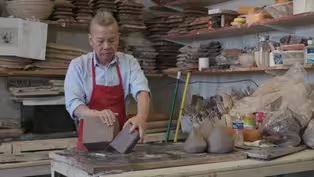
My name is Dwo Wen Chen and this is My Take on pottery.
I am a studio potter and I've been doing this for over 20 years now.
I grew up in Taiwan in a really small farming village.
We did not have any video games or toys to speak of.
We have to create our own toys.
And I remember one of the things we'd do is we pinch clay pots.
At that time, I did not know the clay pots, you know, just like mud from the rice field.
We pinch it and then we would slam it on the ground to see whose pot created the biggest hole.
So that's our game.
(laughs) I have always been a painter and I never had thought that I would become a potter.
- [Isabella] And why did you become a potter?
- Out of necessity.
I couldn't sell any of my paintings, but I managed to sell all of my, at that time, very rudimentary pinch pots.
This is one of my first pots.
There's just no technique to it.
(laughs) I just love the passion of it, I think.
I thought there was probably a little future in pottery making for me.
(gentle music) Being self-taught, you don't have all the restraints of all the disciplines, of all the rules.
I really got into the pottery making blindfolded, in a way.
And therefore I made a lot of mistakes.
I think I have to redo it.
I'm even tempted to say I make all the mistakes there is to make in potter making.
(laughing) But out of that, I came up with some pretty creative ways of having the final piece.
I'm gonna collapse the center to form a double wall.
I was cooperating with this chef to come up a piece for his restaurant to serve a little appetizer.
His inspiration is he wants me to mimic the shape of a cornerstone that's been indented by the dripping of the rainwater.
- [Isabella] How many times did you fail making this before you- - Oh, maybe more than 100, 200 times.
(laughs) And the more I fail, the more I wanna make it happen.
And there we have there base of a pillow bowl.
(whimsical music) The history of pottery making, it's, of course, born out of necessity.
People need vessels to use for their meals.
As you can see, this is a hand-pinched pinch pot.
But with the handle, they usually, they would rope it and hang it on an open fire.
It's close to 5,000 year old in the (speaks in foreign language) Chinese cultural period.
I remember at a younger age, being in the Western art education, I was trying to disguise my Eastern heritage, you know, trying to fit in.
In any of my creations, my heritage just naturally comes through and that's when I am most comfortable with my work.
And then I learn not to fight it and instead, trying to find a way to combine it, you know, to find a good balance between the two.
(gentle music) My understanding of pottery is we're creating something that people can use in their everyday life.
It's a small pleasure to enhance somebody's daily life.
And for me, that's art enough.
(Dwo Wen claps hands) My name is Dwo Wen Chen, and this is my take on pottery.
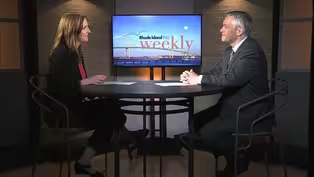
(upbeat music) - Finally, tonight on this episode of "Weekly Insight," Michelle and WPRI 12's politics editor Ted Nesi unpack last Tuesday's primary, and talk about the continuing forensic analysis being done on what went wrong with the Washington Bridge.
- Ted, welcome back.
I want to talk in a moment about what was a very quiet presidential primary here in Rhode Island.
But first, let's start with the latest change of plans surrounding the Washington Bridge.
- It does feel like almost every time we sit down here, Michelle, there's been another development in the Washington Bridge saga, and this week was no different.
- So Governor Dan McKee has promised this day of reckoning that he's talked about, that look, business owners who are affected by the shutdown want to see happen.
Of course, people who have been inconvenienced by the closure are also waiting for, but this day of reckoning will have to wait, because the governor's office has said that the consultants who are conducting this forensic analysis of the bridge need more time to do their work.
Meanwhile, the governor's office has also said that they plan to hire an outside legal firm to, quote, "Seek financial recovery from any responsible parties."
Your colleagues at Channel 12 recently talked with the governor about that decision.
Let's take a listen.
- I just think that we're open to any possibility, but I think that if we're bringing on a legal team, we do think there's accountability that will protect the taxpayers for, you know, what's going on right now.
And so yes, we're not, we're not gonna bring on a legal team if we don't think that there's some level of cause that we can act on.
- Ted, based on that response, that sounds like the governor's office is preparing for really significant litigation over the Bridge.
- Yeah, definitely something that has grown in its potential importance, I'd say, since this crisis began back in December.
And the comparison I'm hearing everyone make is to the 38 Studios crisis.
I'm sure most of remember, but just to refresh memories, that was the big $75 million guarantee that Rhode Island gave for bonds for Curt Shilling's video game company, which collapsed.
And when it collapsed, Governor Lincoln Chaffee decided he would file litigation against a host of banks and lawyers and consulting firms who all had worked on the deal.
Many people were skeptical at the time, Michelle, I covered that.
And they thought, you know, "How are you gonna disentangle the state approving this from these companies?"
Chaffee was right.
He got tens of millions of dollars from that litigation.
So I assume McKee's office is hoping they could run a similar strategy here and maybe get a bunch of money to put toward rebuilding the new bridge.
- Let's turn now to the presidential primary in Rhode Island.
No surprise, Joe Biden and Donald Trump won their respective party primaries, but the turnout was so low.
Only 5% of Rhode Islanders went to cast their ballots.
- And not a shock that it was so low, Michelle, though it's, you know, it's sad from kind of a civic perspective, but at the same time, I can't really blame voters who understood that the party nominations have basically been locked up by Joe Biden and Donald Trump already, and so many people have other things going on.
They didn't see a reason to troop to the polls, but it is interesting.
You know, the state made a change, people might remember, as late as 2008, Rhode Island voted on Super Tuesday in March, with Massachusetts.
And in 2008, Rhode Island was a bit of a battleground.
Hillary Clinton really fought hard to win the state, because she was trying to hold off Barack Obama at the time.
But in 2012, state leaders decided to push back Rhode Island's presidential primary into April, partly arguing that maybe Rhode Island would have more say in the process by going on the same day as Connecticut and all that.
It hasn't really worked out that way.
I mean, in 2016, you did see Hillary, Bernie, Donald Trump all come and campaign, but it was a very unusual year.
But I tend to think this is what it's gonna be more like as long as Rhode Island has its primary in April, things generally already decided by the time Rhode Islanders get to vote.
- I know that you weren't surprised by the low voter turnout, but was there anything that did surprise you about the primary.
In case people can't tell, you are a political junky.
- (laughing) I was just gonna say, I always love when I have new election returns to look through.
I thought there was something interesting on both sides.
On the Democratic side, of course, it was the uncommitted vote, I think about 14.5% at last check of Democratic primary voters voted uncommitted.
Progressives have been pushing for that as a protest against Biden's policy on the Israel/Hamas war, and you actually got 29% of Providence voters voted uncommitted, so a pretty big protest vote there.
And then the Republican side, you can call it a protest vote, too.
Nikki Haley got 10% of the vote statewide in Rhode Island.
Again, she's suspended her campaign, and we've seen that in other states too, sort of small but residual resistance to Donald Trump in his party from a small share of the GOP electorate.
- And further down the ballot, people were able to vote on delegates to send to the national conventions, which has really become a "Who's Who" of Rhode Island, some very familiar names there.
- Yeah.
And obviously, people go in with less information.
There's no TV ads for the delegate races.
I thought it was interesting on the Democratic side, Providence Mayor Brett Smiley came in number one for delegate.
No surprise, he had the highest name recognition.
But you had state Senator Sandra Cano, who ran for Congress last year, come in second, Central Falls Mayor Maria Rivera came in third.
And then on the Republican side, former state Rep. Justin Price, who has acknowledged he went to the January 6th rally, though he says he didn't go into the Capitol, he came in second as a Trump delegate.
So always interesting to see who comes out on top in those delegate fights.
- Good to see you.
Thanks for being here, Ted.
- Great to be here.
- And speaking of delegates, Republicans will host their national convention in mid-July, that will be in Milwaukee.
And then Democrats will have theirs in August in Chicago.
- Guaranteed to be quite the election year.
And that's our broadcast this evening.
I'm Pamela Watts.
- And I'm Michelle San Miguel.
We'll be back next week with another edition of "Rhode Island PBS Weekly."
Until then, please follow us on Facebook and X and visit us online to see our stories and past episodes at ripbs.org/weekly, or listen to our podcast on your favorite streaming platform.
Good night.
(upbeat music) (upbeat music continues) (upbeat music continues) (upbeat music concludes)
Video has Closed Captions
Clip: S5 Ep14 | 11m 22s | Steph Machado’s in-depth interview with Rhode Island Housing Secretary Stefan Pryor. (11m 22s)
Video has Closed Captions
Clip: S5 Ep14 | 6m 4s | Go behind the scenes at Dwo Wen Chen’s pottery studio. (6m 4s)
Video has Closed Captions
Clip: S5 Ep14 | 6m 8s | Ted Nesi and Michelle San Miguel discuss the presidential primary. (6m 8s)
Providing Support for PBS.org
Learn Moreabout PBS online sponsorship
- News and Public Affairs

Top journalists deliver compelling original analysis of the hour's headlines.

- News and Public Affairs

FRONTLINE is investigative journalism that questions, explains and changes our world.












Support for PBS provided by:
Rhode Island PBS Weekly is a local public television program presented by Ocean State Media