
Rhode Island PBS Weekly 4/9/2023
Season 4 Episode 15 | 27m 14sVideo has Closed Captions
An in-depth look at why hospitals have had to shelter the state’s homeless population.
Weekly producer Isabella Jibilian takes an in-depth look at why hospitals in Rhode Island have had to shelter the state’s homeless population. Then, Michelle San Miguel reports on why children, who should be getting a head start in their education, are at risk of falling behind for good. Finally, a second look at photographer Mike Cohea’s photos and his take on why Providence is such
Problems playing video? | Closed Captioning Feedback
Problems playing video? | Closed Captioning Feedback
Rhode Island PBS Weekly is a local public television program presented by Ocean State Media
Rhode Island PBS Weekly 4/9/2023
Season 4 Episode 15 | 27m 14sVideo has Closed Captions
Weekly producer Isabella Jibilian takes an in-depth look at why hospitals in Rhode Island have had to shelter the state’s homeless population. Then, Michelle San Miguel reports on why children, who should be getting a head start in their education, are at risk of falling behind for good. Finally, a second look at photographer Mike Cohea’s photos and his take on why Providence is such
Problems playing video? | Closed Captioning Feedback
How to Watch Rhode Island PBS Weekly
Rhode Island PBS Weekly is available to stream on pbs.org and the free PBS App, available on iPhone, Apple TV, Android TV, Android smartphones, Amazon Fire TV, Amazon Fire Tablet, Roku, Samsung Smart TV, and Vizio.
Providing Support for PBS.org
Learn Moreabout PBS online sponsorship(bright music) - [Announcer] Tonight on "Rhode Island PBS Weekly."
- We are trained to solve and treat medical emergency, right?
(laughs) So if you like have a heart attack or break a limb or, you know, have a gunshot wound, you can come in, and we are on it.
We've got it taken care of.
But if you come in because you don't have a home, we don't have the solution to that.
- [Michelle] Dozens of classrooms meant for some of the poorest children in Rhode Island are closed.
If nothing changes, administrators say children will pay the price.
- Just because of where they live and their income, they're gonna start kindergarten behind other children, and that's a lifetime of negative impacts, and that's the outcome of doing nothing.
- So as I took more and more photos of Providence, what I really got interested in is sharing Providence's beauty with the world.
If I see something, I know other people are in downtown Providence seeing it too, and we can share that moment together.
All I wanna do is take those photographs.
(inspiring music) (inspiring music continues) - Good evening.
Welcome to "Rhode Island PBS Weekly."
I'm Pamela Watts.
- And I'm Michelle San Miguel.
More than a decade ago, Rhode Island led the country as the first state to pass a homeless bill of rights.
It mandated that people cannot be discriminated against on the basis of their housing status.
- But today, those rights provide little comfort for the hundreds of Rhode Islanders who find themselves sleeping on the streets in often harsh weather conditions.
Amid rising rents and Covid's economic fallout, advocates are sounding the alarm.
Producer Isabella Jibilian reports on the shelter crisis and how an unlikely place has been forced to fill in the gap.
- We weren't born with a label on us saying this is what we wanna be when we grow up, you know?
And I know I certainly didn't, you know?
I didn't ask for it.
I didn't ask for addiction, I didn't ask for homelessness.
Even up here in the alleyway where this steam blowing, it's warm, very warm.
- [Isabella] Maureen Sumner was 41 years old when she became homeless.
She spent six years living on the streets in Rhode Island.
- Warmer months were easier, as you would imagine, but when it got colder, that's when I would start getting nervous, like, "Oh, what are we gonna do?"
- [Isabella] She says shelters were often not an option.
- They're not the safest.
They're not the cleanest.
They have 101 criteria that you have to meet.
So we just stopped trying.
We made our home a tent, and that's what we had to deal with for months and months and years and years.
- [Isabella] Sumner's story is not unique.
According to the Department of Housing and Urban Development, about 1200 people are currently experiencing homelessness in Rhode Island.
On this night in March, Dr. Rebecca Karb walks the streets trying to help people living outside.
Karb is an emergency room physician who's become acutely aware of the challenges facing Rhode Island's homeless population.
- Even folks that have Section 8 vouchers or other kinds of subsidies, like still can't find a place to rent with the resources that they have 'cause it's just too expensive.
There also aren't enough shelter beds in Rhode Island.
- [Isabella] But the problem is not exclusive to the streets.
Karb says it's in the emergency room too.
- So we see people experiencing homelessness every day or some form of housing insecurity.
- [Isabella] Many come in for medical treatment, but all too often, it's about simply finding a warm place.
- They might come in for shelter on a night when the weather's really bad, or, you know, it's particularly cold, and they don't have a safe place to go.
- There's a lot of like deep cubbies in these buildings, and depending on which buildings you go to, you're not really bothered as long as you're out of there, you know, at a decent time.
And decent time, I mean, 5:30, at 6:00 AM.
- [Isabella] When Maureen Sumner was living on the streets, she would spend endless nights in the cold with her partner.
- We were sleeping in a child's tent behind the region, Sea Sign, that's where we had our first tent.
And it was quite scary.
I mean, anything could happen.
- [Isabella] She was recovering from addiction, but Sumner said the conditions led her back to using heroin and crack cocaine.
- I wanted to get high to pretty much pass out and just make it to the next morning.
Nobody wants to live that way, you know?
And I don't give my addiction an excuse.
I'm not giving any of it an excuse.
- Did you ever go to the emergency department for shelter too?
- Oh yeah, of course we all have.
As long as you had a bracelet, that said, you know, you were being seen, but you had to leave at 6:00 AM, which was fine.
I'm like, "Okay, I was in here all night," you know?
- [Isabella] Under normal conditions, space comes at a premium in hospitals across Rhode Island.
Covid and staffing shortages have made the problem even worse.
- When you only have a handful of beds in a big ER, and you have 30, 40, 50, 60 people waiting in the emergency department, in the waiting room of our emergency department, that sometimes puts us in a bind regarding who we can keep there.
There's a beating heart at the center of what we all do.
- [Isabella] Jay Baruch is an emergency physician in Rhode Island and author of the book, "Tornado of Life: A Doctor's Journey Through Constraints and Creativity in the ER."
- Hypothermia is a terrible risk for them.
And dying from hypothermia is a tragedy.
- [Isabella] Baruch says that nearly every shift, someone comes into the ER for shelter, some twice a day, returning just hours after being discharged.
Some come after being turned away from shelters.
Others because they see the ER as a safer option.
It's a moral dilemma that Dr. Baruch struggles with regularly.
- You don't send that back out in the street at an ungodly hour and unconscionable weather, and then you look into the waiting room, and there are oftentimes very sick people who've been waiting for hours and hours and hours and hours.
So they don't get our compassion.
Compassion for this person means you're not compassionate to the other person.
And it's a zero sum game.
- [Isabella] A zero sum game that Baruch is obliged to play.
In addition to long waits, studies show that emergency room crowding can have dangerous consequences, like increased violence against hospital staff, increased risk of medical errors, and sometimes death.
- I mean, it's hard on a number of levels because we are the safety net for all of these kind of broken systems.
But we are a safety net that doesn't have the resources or tools to address the problem.
We are trained to solve and treat medical emergency, right?
(laughs) So if you like have a heart attack or break a limb, or, you know, have a gunshot wound, you can come in, and we are on it.
We've got it taken care of.
But if you come in because you don't have a home, we don't have the solution to that.
- Prior to Covid, we did have enough shelter beds, and now we have what's called a crisis assessment to allocate the shelter beds that we have.
We don't really understand how they can just say, "Well, it takes time."
Well, yeah.
But that's 'cause you have a roof over your head.
- [Isabella] Eric Hirsch is an activist and professor of sociology at Providence College.
For the past 30 years, he's been researching and working to end homelessness.
- We're still, I would say two or 300 beds short.
- [Isabella] When we asked him about people turning to the ER for shelter, he wasn't surprised.
- When you have no place to go, particularly if the weather is severe, our outreach workers tell people to go to emergency rooms because they're warm.
Generally you can stay there.
Although now we also are seeing that the ER doctors and other people, nurses and other people there are telling people to leave.
So now we're actually telling people if they're forced to leave, to go back in and say they have chest pain.
- Many others would say, "Hey, the ER is to address my emergency medical needs.
This isn't the appropriate place for that.
The crowding affects access to care."
- I totally agree with that.
The ER is not the right place for people who are homeless, but we're not providing an alternative.
This is a matter of survival.
- Do you have any, you know, idea, you know, how much that costs?
- You're talking about millions of dollars potentially even for one person over let's say a couple of years.
Not meeting the housing needs of people, turns out to be more expensive than meeting them.
All the taxpayers are paying for leaving people outside.
- [Stefan] Let's do that, can I just take a quick look?
- Yeah.
- [Isabella] Rhode Island's new Secretary of Housing, Stefan Pryor, is the latest person tasked with improving the housing situation.
We recently followed him on a visit to a shelter in Westerly.
- What's the most you could do?
- The most I most I could do outta here?
- The most on average.
- And average, 60 per meal, 65.
- Pryor's appointment followed the resignation of the state's first housing secretary, Josh Saul.
Saul was criticized for sitting on $250 million of federal aid that was earmarked for housing.
What is the status of housing and homelessness in Rhode Island right now?
- We are not building enough housing in Rhode Island.
If you look at the building permits for residential dwellings, we have one of the worst, if not the worst, on a per capita basis, housing-start scenario in the country.
- [Isabella] The impacts have been dramatic.
Housing Works Rhode Island has reported that more than a third of people in this state are burdened by housing costs.
And according to realtor.com, from 2021 to 2022, Providence area rents jumped nearly 24%, the fifth highest increase in the country.
- We need to move towards a world where there's permanent supportive housing and the vouchers for subsidies necessary to help vulnerable in individuals afford these homes.
- [Isabella] On Sunday mornings, Matthewson Street Church serves a hot breakfast for anyone who needs it.
Maureen Sumner is a regular.
It's a hub for most homeless people in the area.
In the basement, where clothes are given out for free, Sumner catches up with her friend who has been living at Harrington Hall's shelter for the past three years.
- Grateful for the roof over my head that they provide, but I would like my own bathroom.
- Right.
- [Isabella] In 2020, Sumner was in a car accident that shattered her hip.
After waking up from an induced coma, she found out she had finally gotten off the wait list for a housing voucher.
But many of her friends are still homeless.
- I usually have people come like couple nights a week.
I wish I could help everybody.
I wanna bring 'em all home, you know?
But it's not the reality of it.
- She's also working towards becoming a peer mentor to help her friends who are still out on the streets.
What's it like moving in here?
- Oh my goodness, I didn't care how much my hip hurt.
I was moving whatever I could up these stairs myself.
(laughs) I was just so excited.
And, you know, after everybody left and helped me set up a few things, I just kind of sat there and cried.
You know, 'cause I was grateful, you know, and I was proud.
(gentle music) (gentle music continues) - Up next, hundreds of children in Rhode Island who could be taking early childhood classes are not in school.
They're some of the poorest and most vulnerable children in the state.
And early childhood advocates say children who should be getting a head start in their education are at risk of falling behind for good.
- What is the monkey doing in the daytime here?
- Watering the plants.
- Good job.
- [Michelle] Krystal Beatty and her husband Joshua found themselves at a crossroads last year.
- And what's the monkey have in his hand?
- Banana.
- Banana.
- [Michelle] Beatty says her husband was spending his entire paycheck on daycare for his two children, four-year-old Emma and two-and-a-half-year-old Evan.
- The total amount for the family was almost $600.
If that's what you're making weekly, and that's what you're paying for daycare weekly.
I mean, where are you gonna survive?
- 5, 6, 7, 8.
- [Michelle] Beatty says, it wasn't long before she and her husband went through all of their savings, so they decided to send their kids to daycare two days a week instead of five.
- 15, 16, 17.
- [Michelle] In the meantime, they both took online classes and worked part-time, but not having affordable childcare kept them out of the workforce full-time.
- We've struggled, and luckily, yes, we had family.
I really fell highly back on my family, luckily.
But I mean, you can't expect them to give up things in their lives to help support you, like you're supporting your 30-year-old daughter.
Like that's just not realistic.
- [Michelle] Were you guys worried about having to leave this apartment?
- There were points that we did have to speak with Josh's family about going back home to them, yeah.
- [Michelle] In February, Beatty applied to enroll her two stepchildren in Headstart, a federal program that offers free early childcare to low income families.
- [Krystal] Good job, Emma.
- [Michelle] But it wasn't clear how long Emma and Evan would have to wait to start school there or if a spot would even be guaranteed.
♪ B is for bear, ba-ba-bear ♪ ♪ C is car ♪ - [Michelle] It's a waiting game that families across Rhode Island have experienced.
There are more children eligible for Headstart than there are spots available.
- Well, we've always had a waiting list for Headstart.
- [Michelle] Leanne Barrett is the senior policy analyst at Rhode Island Kids Count, a nonprofit organization that advocates for children.
- We've usually been able to serve about half the kids who are eligible, and that's true nationally.
We've never had enough funding at the federal or the state level to adequately meet the needs of families.
- Five and six-year-old children are inheritors of poverty's cursed.
- [Michelle[ President Lyndon Johnson launched Headstart in 1965 to help break the cycle of poverty.
- I believe that this is one of the most constructive and one of the most sensible and also one of the most exciting program that this nation has ever undertaken.
♪ Welcome back to school, my friends ♪ - [Michelle] Since then, 37 million children have gone through the program across the country.
In Rhode Island, there are seven Headstart programs.
Children's Friend is the biggest one in the state.
- You got a lot of different colors on here, huh?
- [Michelle] David Caprio is the organization's president and CEO - We describe, you know, who we serve in three different ways.
Children who are victims of abuse and neglect and may be involved in the child welfare system.
Children who lack permanency in their lives so they may be in foster care or awaiting an adoption.
By far, the vast majority of the the children that we serve are children who are living in poverty.
- [Group] 11, 12, 13, 14, 15, 14.
- [Michelle] But Caprio says, many children who live in poverty are not getting the education they deserve.
About 150 children are on the wait list at Children's Friend because there aren't enough teachers.
- Some of the teachers who have been in this field for a long time, because of Covid or other stress factors, have now retired or left, and there's nobody new coming in.
In Headstart, our teachers are making on average about $40,000.
And these are degreed early childhood teachers, and we know that the market rate in Rhode Island is around 60,000 for that.
- [Michelle] Throughout Rhode Island, 30 Headstart classrooms are closed because of the staffing shortage, shutting out more than 500 preschoolers.
♪ Z is for zebra, ze-ze-zebra ♪ - [Michelle] And that's not all.
11 early Headstart classrooms are also closed which means 88 babies and toddlers are out of school.
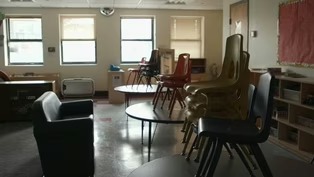
- We're in one of our classrooms, and, you know, you can see, it's a pretty bright and great classroom with lots of stuff in it.
The one thing that's missing though are the kids.
- [Michelle] In order to reopen classrooms, Caprio says teachers wages need to go up to attract qualified candidates.
- Just this year, we're giving a 1% cost of living increase.
So we are able to adjust wages, but again, and we're giving a 1% raise on top of $40,000, we're getting nowhere near the market.
- And as we well know, the cost of living has gone up by a lot more than just 1% over the last year.
- Yes, absolutely.
But again, Headstart funding in the state of Rhode Island has not gone up.
- [Michelle] Currently, the state of Rhode Island spends $1.2 million on Headstart annually, about $2 million less than it did before the Great Recession.
- We lost funding in 2008 for Headstart, and we've never gotten it back.
- The majority of funding for Headstart comes from the federal government.
Supporters of the program want the state of Rhode Island to invest $6.5 million in Headstart and early Headstart so they can open the 41 classrooms that are closed.
What's at risk if you do not get the funding that you want for Headstart?
- More classrooms are really, seem to be on the verge of permanent closure.
They're temporarily closed now, but we think they may never be able to reopen if we don't find additional funding.
- [Michelle] But getting the funding could be a challenge.
The state of Rhode Island is not required to fund Headstart agencies.
In his proposed budget.
Governor Dan McKee has set aside $7 million for RI pre-kindergarten, but Barrett says Headstart offers services that state pre-K does not.
- It's not just dropping your child off for the day and picking them up at 3:00.
It is also getting family support services, help with moms meeting their own goals, going back and finishing a high school or post-secondary training, housing issues.
They help with all kinds of wraparound issues for families.
- [Michelle] Barrett points to decades of research that show the long-term benefits of the program.
- Kids who go to early Headstart and Headstart are more likely to graduate from high school, more likely to get post-secondary education completed and more likely to be employed in a sustaining kind of job as an adult.
- [Michelle] One of Rhode Island's most vocal supporters of Headstart is former Providence mayor, Angel Taveras.
He attended the program in Providence back in the 1970s.
- I remember it being fun, being excited about going to school.
I remember graduation, having a cap and gown.
- [Michelle] The program made such an impression on him that when he ran for mayor in 2010, his campaign slogan was, "From Headstart to Harvard."
- When I was at Harvard, one of my roommates went to Headstart, and several of the minority kids students at Harvard went to Headstart, and we talked about it.
So even back in college, I realized that there was something special about it, that it wasn't a coincidence in some ways that we ended up at Harvard.
- A.
- A.
- A.
- A.
- Good job.
- [Michelle] Much like the families on the Headstart wait list, the programs administrators are also waiting.
They say getting more funding from the state would cause a ripple effect in the economy.
- It's possible that people who could be working are not working.
They're staying home with their kids.
We know that there are shortages of bus drivers.
There's shortages of people to work in nursing homes.
There's shortages of people to work in hospitals.
And all of that depends on having a stable and high-quality early care and education system.
- [Michelle] That's the case for Krystal Beatty in Woonsocket.
- My face again.
- [Krystal] Wiping your face again.
- [Michelle] She recently found out a spot opened up at her local Headstart for her step-daughter, Emma.
She says, getting Emma into Headstart five days a week allowed her to accept a full-time job.
- For them to offer me a spot for this year because they knew a child was moving instead of making me wait till next September, I mean, we would've been out of work, or at least I would've been out of work till next September, and who knows where we would've been financially then.
So it's a huge relief.
- He has wheels, right?
He can go.
- [Michelle] But Caprio says it's a relief that too many families don't have.
- If nothing changes, then we have kids who are on a wait list right now who are probably never gonna get served.
And just because of where they live and their income, they're gonna start kindergarten behind other children.
And that's a lifetime of negative impacts, and that's the outcome of doing nothing.
(gentle music) (gentle music continues) - Finally tonight, we revisit Rhode Island photographer, Mike Cohea, to give us his take on why Providence is such a special place, one beautiful frame at a time.
- A big motivator for me is just getting Providence out there to the world.
(calm music) Whether it's in a photograph or one of my time lapses.
(calm music continues) People should want to come and visit here, and I do everything I can to encourage it.
(claps) My name is Mike Cohea, and this is my take on capturing Providence's beauty.
I'm originally from the West Coast.
Grew up a little bit outside of Portland, Oregon, and in 2006, I loaded up my Subaru and rolled into Rhode Island.
(gentle music) When I first came to Providence, my first view of it was coming up Interstate 95 North, and just the skyline revealed itself to me.
And ever since that day, I've just had a complete fascination with it.
(gentle music continues) So as I took more and more photos of Providence, what I really got interested in is sharing Providence's beauty with the world.
(gentle music continues) Off of that spurred a whole bunch of opportunities to share Providence in one way, shape or another, and really try to help put Providence on the map.
A lot of elements can make up a good photograph, but the two that I really stick with is the city of Providence and a really unique event, whether that be a sunset or a thunderstorm or really any kind of weather or clouds that come in.
(gentle music continues) I feel it's really important that we can share what we see, and if I see something, I know other people are in downtown Providence seeing it too, and we can share that moment together.
(gentle music continues) So one of my favorite subjects of photographing all of Providence is the Independent Man.
(calm music) I've photographed him in so many different ways, from being covered in snow in his loin cloth to standing there bravely as a thunderstorm passes right behind him and lightning bolts are dropping everywhere.
He's just the perfect subject for any situation.
You can line him right up perfectly with the sun and have him silhouette it.
(calm music continues) I think I was always meant to be a photographer, perfectly suits my lifestyle and what brings me pleasure and really what drives me.
(bright music) The fact that there are photos out there that I have in my mind that I haven't taken yet, just keeps me up at night.
All I want to do is take those photographs.
But I know once I take those photographs, there'll be new photographs to replace 'em.
That really is what keeps me going.
Providence is beautiful.
Providence has been photographed very well for a really long time, and really I'm just the next person in line to document it's beauty until somebody comes and replaces me.
(claps) My name is Mike Cohea, and that was my take (camera clicking) on capturing Providence's Beauty.
- And that's our broadcast this evening.
Thank you for joining us.
I'm Michelle San Miguel.
- And I'm Pamela Watts.
We'll be back next week with another edition of "Rhode Island PBS Weekly."
Until then, follow us Twitter and Facebook and visit us online to see all of our stories and past episodes at ripbs.org/weekly.
Or listen to our podcast on your favorite streaming platform.
Thank you and goodnight.
(gentle music) (inspiring music) (inspiring music continues)
Video has Closed Captions
Clip: S4 Ep15 | 10m 19s | Dozens of classrooms meant for some of the poorest children in Rhode Island are closed. (10m 19s)

Video has Closed Captions
Clip: S4 Ep15 | 4m 26s | Rhode Island photographer Mike Cohea shares his take on capturing Providence’s beauty. (4m 26s)

Video has Closed Captions
Clip: S4 Ep15 | 11m 56s | How did homelessness become an emergency room problem? (11m 56s)
Providing Support for PBS.org
Learn Moreabout PBS online sponsorship
- News and Public Affairs

Top journalists deliver compelling original analysis of the hour's headlines.

- News and Public Affairs

FRONTLINE is investigative journalism that questions, explains and changes our world.












Support for PBS provided by:
Rhode Island PBS Weekly is a local public television program presented by Ocean State Media