
Rhode Island PBS Weekly 5/12/2024
Season 5 Episode 19 | 24m 50sVideo has Closed Captions
Interview with Senator Jack Reed on Israel’s leadership and his re-election bid.
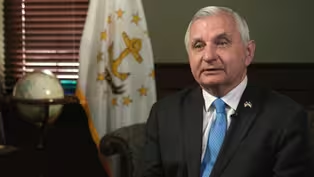
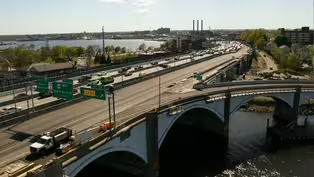
Steph Machado’s interview with Senator, Jack Reed, who says Israel needs new leadership amid the war in Gaza. Michelle San Miguel and WPRI 12’s politics editor Ted Nesi unpack the high cost of replacing the Washington Bridge. Window on Rhode Island: Producer Isabella Jibilian takes us inside Wolf E. Myrow, a bulk jewelry supplier in the heart of Providence.
Problems playing video? | Closed Captioning Feedback
Problems playing video? | Closed Captioning Feedback
Rhode Island PBS Weekly is a local public television program presented by Ocean State Media
Rhode Island PBS Weekly 5/12/2024
Season 5 Episode 19 | 24m 50sVideo has Closed Captions
Steph Machado’s interview with Senator, Jack Reed, who says Israel needs new leadership amid the war in Gaza. Michelle San Miguel and WPRI 12’s politics editor Ted Nesi unpack the high cost of replacing the Washington Bridge. Window on Rhode Island: Producer Isabella Jibilian takes us inside Wolf E. Myrow, a bulk jewelry supplier in the heart of Providence.
Problems playing video? | Closed Captioning Feedback
How to Watch Rhode Island PBS Weekly
Rhode Island PBS Weekly is available to stream on pbs.org and the free PBS App, available on iPhone, Apple TV, Android TV, Android smartphones, Amazon Fire TV, Amazon Fire Tablet, Roku, Samsung Smart TV, and Vizio.
Providing Support for PBS.org
Learn Moreabout PBS online sponsorship(gentle music) - [Announcer] Tonight, Senator Jack Reed on the Israel-Hamas War.
- Do you believe that what is happening in Gaza is a genocide?
- No, I don't.
- [Announcer] Then the rising costs of the Washington Bridge with Ted Nesi.
Millions of gems hidden in Providence.
- Somebody wanted to make kind of a statement.
(upbeat music) (upbeat music continues) - Good evening and welcome to "Rhode Island PBS Weekly".
I'm Michelle San Miguel.
- And I'm Pamela Watts.
With two wars raging overseas, last month, Congress finally passed a $95 billion aid package with about 26 billion supporting Israel and providing humanitarian relief for people in Gaza.
- As Chairman of the Senate Armed Services Committee, Rhode Island senior Senator Jack Reed was at the forefront of that bill.
Tonight our contributor, Steph Machado, has a wide-ranging interview with Reed who has spent more than 30 years in Washington representing the state.
- Senator Jack Reed, thank you so much for sitting down with us.
So you have been a strong supporter of Israel.
You're the Senate Armed Services Chairman, but you've also said that you believe the war in Gaza has in some ways veered off course.
You said in March, "Israel's strategy to defeat Hamas is in peril."
Would you at some point call for a ceasefire?
- I would hope there could be a ceasefire immediately.
We've been working very hard.
Secretary Blinken has been on the ground numerous times.
Bill Burns, our CIA director, has been involved.
There's negotiations between the Israelis, Hamas, facilitated by Qatar in many cases, but involving many other people.
There should be a ceasefire, and there should be the release of the hostages.
So I would do all we can to encourage such an agreement.
- And to be clear, are you talking about a temporary ceasefire or a permanent ceasefire?
- Well, I think the reality would be it's difficult to get a temporary ceasefire.
To get a permanent ceasefire would, I think, be politically very difficult for both sides.
So I think we have to hopefully use the ceasefire to get the hostages out, and then try to pursue some type of political solution, if possible, to get Hamas out of power in Gaza.
They're a destructive force as they've demonstrated.
And then further down the road, we have to think again about reconstituting a very vibrant two-state solution so that the Palestinian people and the Israeli people can live with stability and security.
- And do you think that solution requires the end of Prime Minister Netanyahu's government?
- I've called for Prime Minister Netanyahu's retirement on the floor of the Senate.
Netanyahu represents an obstacle to longterm peace in Israel.
My sense is that he did not realize the danger Hamas proved, presented to Israel, and in fact was using Hamas to destroy the Palestinian Authority and to enable a one-state solution, which he claims is the only solution he'll accept.
- Do you speak to Prime Minister Netanyahu, or when's the last time you spoke to him?
- The last time I spoke to him was about the middle of October after the attack.
We went on a delegation to Israel.
We understood the barbarity of the attack by Hamas.
And I think too many people are forgetting that now and shifting blame exclusively on or primarily on Israel.
This was a calculated barbaric attack by Hamas to create this dynamic of retaliation, and then to exploit the retaliation by saying, oh, look, they're killing innocent Palestinians.
This, we can't forget that, but I was there and I spoke to him.
And one of the things I tried to convey was that the way to conduct these operations requires precision, requires not brute force, but good intelligence, good operational techniques, and also you have to provide for the citizens who are caught up in this.
- Those have not been the techniques that we've seen.
Is that fair to say?
- Well, initially, I don't think they were at all prepared.
They were totally surprised, and they engaged out of, I think, the sense of fury and of existential terror that was created deliberately by the Hamas attack.
And they retaliated with airstrikes in areas without, I think, the most precise locations, because I think at that point that's all they really had.
And then they started a much more appropriate ground assault and try to go ahead, but they're dealing with an enemy that has no regard for the Palestinian people.
Hamas, you know, they're all about their own crazy ideology and also about destroying Israel.
- There have been protests at college campuses across the country, particularly in the Ivy League.
We had a protest at Brown University that did end peacefully.
We have not seen the same resolution at other colleges like Columbia.
What has been your reaction watching those protests in recent weeks?
- One of the fundamental rights in the United States is that you can express yourself, you can protest, but it has to be within the confines of the law.
It has to be respectful of other opinions.
And many times these protests go way beyond that.
They deliberately want to be provocative.
They deliberately want to damage facilities.
They put in danger other people, sometimes unwittingly.
For example, when you're occupying a critical space in a college, does that prevent fire and rescue apparatus to get to buildings that you have to have if you're trying to make sure everyone is protected?
So they have been excessive.
I must say, I think the Brown students conducted themselves in as thoughtful way as you can in that situation.
And President Paxson did a superb job of saying, I hear you.
Let's do something.
Let's do it orderly.
And again, I think that was a sign of very great leadership.
But the right to stand up and express yourself is part of what many people have given their life to defend.
- Some of the rhetoric that have been used at the protests, and there were also some picketers outside your office in Providence, have said that the US is aiding a genocide.
Do you believe that what is happening in Gaza is a genocide?
- No, I don't.
What I know is that Hamas in its original charter committed itself to destroy the Israeli people wherever they are.
So if there's genocidal impulses, it's certainly coming, I think, from Hamas.
I think as I've said repeatedly, that in order to conduct this operation that the Israelis have to be conscious of civilian casualties.
I think we've seen some improvements in their tactical operations.
So they understand they have to abide by the rules of warfare.
And they have to do much better in getting supplies into Gaza.
The United States is stepping forward.
We should, by the end of May, have a dock set up in northern Gaza and supplies coming by ship from Cypress, which would mean a significant influx of food and supplies.
We just passed in the Congress billions of dollars of the humanitarian assistance, which is gonna go out not just to Gaza, but also to Ukraine and other areas of the world.
- Closer to home, Reed has been involved in securing federal funding to demolish and rebuild the Washington Bridge on I-195 West, a key artery to Providence, which has been shut down since December due to a critical failure.
At a recent congressional hearing, Reed questioned US Transportation Secretary Pete Buttigieg about funding the project, as the estimated cost has soared to more than $400 million.
How much of this do you think the federal government will cover?
- As much as we can marshal, and that's our job, honestly.
The first step is to get this project under the auspices of the emergency funding for the Department of Transportation.
- Does that require an act of Congress?
- I think at this point we have to pursue that path.
There might be ways that we can look at administratively, and I know Secretary Buttigieg is looking at them right now, but we're preparing a multiple approach.
And then the question is getting the top line of the Department of Transportation, the budget number up as high as it can because then those funds become available.
In addition to that, we're looking at every federal program that's possible to help us out.
- Do you think the federal government could pay for all of it?
- I think we could try to get them, but right now, the federal government typically pays about 80% of every highway project.
So it's not a stretch to ask in this emergency for more than that.
But our highway funding formulas are very generous to the states, and we try to supplement those by specific funds that could go to Rhode Island.
- In an institution where seniority matters, Reed is the sixth longest serving US Senator, having been elected in 1996.
If he runs again in 2026, he would be 77 at the start of his new six-year term.
Do you think that you'll run for reelection?
- I work every day to prepare to run for reelection, yes.
That's the way I've always done it.
- When will you make the decision?
- At this point, I don't know.
I mean, my decision is to be the best senator I can be every day.
And I try.
It's just such a privilege to represent the people of Rhode Island.
And I say this very, I hope, humbly because I'm fortunate.
I have great colleagues.
I have people who understand, who care themselves, who will share with me their not just problems, but their suggestions.
And I feel very fortunate for that.
I'm a lucky person.
So, you know, I'm gonna keep charging around.
- Senator Jack Reed, thank you so much for the time.
- Thanks, Steph, very much.
- After our interview with the Senator, the news broke that President Biden would block the delivery of US weapons that could be fired into densely populated areas of Rafah, where more than a million Palestinians are sheltering.
In an extended version of tonight's interview with Senator Reed, Steph also spoke to him about Russia's war in Ukraine and his take on President Biden's reelection chances in November.
You can hear it all on The Boston Globe's Rhode Island Report podcast at globe.com/ri.
And now on this episode of "Weekly Insight", Michelle and WPRI 12's Politics Editor Ted Nesi unpack the new cost estimates to replace the Washington Bridge, and pick up the conversation about Jack Reed's future in the Senate.
- Ted, welcome back.
We just heard Steph Machado ask Senator Jack Reed if he plans to run for reelection.
That sounds like a yes to me.
What do you think?
- I'm certainly expecting Reed to run again in 2026, Michelle, with the caveat that we just had two surprise retirements in the congressional delegation.
First Jim Langevin, then David Cicilline.
So you never rule anything out.
But you know Reed.
I mean, I think as you heard in Steph's interview, he's still very engaged in the job.
His health seems to be good.
He loves the job.
And of course maybe most importantly for him, he has no political concerns because he's consistently ranked in the polls as the most popular politician in Rhode Island.
- Reed has been a longstanding fixture, as you mentioned, in Rhode Island politics.
He's been a member of the state's congressional delegation since 1991.
And if he does win reelection in two years, he is on track to tie Senator Claiborne Pell as the longest-serving senator from Rhode Island.
- Yeah, there has been remarkable stability in this Senate seat that Reed currently holds.
Since 1937, Michelle, only three people, all Democrats, have held this seat.
First, TF Green, namesake of the airport, then Claiborne Pell, and now Jack Reed.
So once you have a Senate seat in Rhode Island, you are very likely to hold it as long as you want to, barring some major catastrophe.
- What do you think has driven his political durability?
- Well, I think there's a bunch of different factors.
Obviously, first and foremost, he's a Democrat in a Democratic state.
That's the foundation of it all.
But then I think specific to Reed, I think his military service has always been a part of his biography that even appeals to some voters who maybe aren't party-line Democratic voters.
He's certainly a workhorse.
He's not showy.
I think he would admit that.
He's not, say, the most exciting, bombastic speaker on the stump.
I also think you can't underestimate the work that Reed and his staff put into making sure he's very present.
Every weekend I think that he's in Rhode Island and not in DC, he's got ribbon cuttings here and there.
He's in parades.
He's doing this, he's doing that.
And the other thing I'd point to, Michelle, is Reed serves on the Senate Appropriations Committee.
His office makes sure that every dime of federal money that reaches Rhode Island, there is some reminder out there that Senator Reed got that money.
Senator Reed's on appropriations.
They don't let us forget that.
- Know where the money came from.
Let's turn now to the Washington Bridge.
There were new estimates released recently talking about how much it's going to cost, not only to demolish the bridge, but ultimately to replace it.
The bottom line is it's gonna cost a lot more than state officials initially projected.
They say the higher estimate includes construction incentives, and also a change in scope like the on and off ramps and making the bridge wider.
But how did they not foresee that?
- Well, I think a lot of people are asking that question.
And in fairness to state officials, they were pretty clear when they put out that initial estimate that this project would cost 250 or $300 million.
This was a very back of the envelope estimate.
I remember asking, "Can I see sort of the worksheet that led to that?"
And they said there wasn't one, so they didn't have a lot behind that.
And now we have much harder numbers, and they say they're being conservative.
They're estimating that the demolition of the old bridge will cost $40 million.
Rebuilding the new bridge will cost $368 million.
And then emergency costs tied to the closure of the westbound bridge, they think are gonna total $46 million.
That's things like the police details and the 24/7 tow trucks and all of that.
So that's approaching, just total it all up, a half billion dollars for a situation that wasn't even on any of our radar screens six months ago.
- When you look at Governor McKee's financing plan, the bulk of this money will come from federal money.
State officials plan to apply for a $221 million grant called the Mega Grant, which essentially funds large transportation projects.
They hope to know by October if they'll get this money.
What do you think?
- This goes back to Senator Reed, right?
I think they are really banking on him in particular, again, 'cause of that seat on the Appropriations Committee as well as his seniority, that he can work some magic, especially with the Democratic presidential administration, at least for the balance of the year.
I do think state officials have to be realistic about how likely it is they get the full amount they want for this Mega Grant.
Late last year, Massachusetts asked for one for the Cape Cod bridges, a much larger project.
They only got 300-something million.
So I think that's why you see this contingency planning McKee has there with plans to borrow up to $334 million against future federal highway funding, borrowing $40 million against the gas tax, and then moving other money around.
- And we're starting to hear some skepticism around that, including from House Speaker Joe Shekarchi, who has a big say of course in the financing and how money is appropriated at the State House.
- There are a lot of questions about this, right?
You know, if you move all this money into the Washington Bridge project, what other bridge projects have to be delayed, or transportation projects?
What does it do to the overall DOT budget?
So I think those questions are gonna be raised a lot in the coming weeks as the budget process wraps up, and I think what we learn in those hearings is gonna be interesting.
- Something has to give at the end of the day.
- Money, there's only so much money to go around.
- Yeah.
Thanks so much, Ted.
- Good to be here.
- The jewelry industry, it touched families across Rhode Island for decades.
Producer Isabella Jibilian recently visited the Wolf E. Myrow Company in Providence, a bulk jewelry supplier that has stood the test of time.
For more than 60 years, the Antonelli family has kept their doors open while so many others were forced to close down.
How they did it is the subject of our final story tonight.
This is part of our continuing series, "Window on Rhode Island".
(relaxing music) - [Isabella] How many beads do you think are in this place?
- A billion.
I dare anybody to come count.
(relaxing music continues) My name is Tony Antonelli.
I am part of my family business, the Wolf E. Myrow Company.
We have all different kinds of glass beads, semi-precious beads, semi-precious rhinestones, brass chain, steel chain by the spool.
We have plastic beads, plastic stones.
We have charms.
We have bead caps.
We have clasps, we have pins.
We have hooks, we have connectors.
We have, you name it.
And if it's used in the jewelry business, we've got something here.
It started way back, just after the Second World War.
Wolf had a very good idea.
There's always excess, and there's always demand.
He would buy it at a very low price and then turn around, mark it up enough to make a profit, and resell it back to the other people in the industry for what they needed.
He started to look around for a partner.
He found my grandfather.
And evidently it worked because we're still here.
We're kind of old school here.
The workers here are responsible of certain areas.
(relaxing music continues) We do not use a computer at all.
We've had a lot of different clients here.
One that sticks out in my memory quite a bit was a woman that turned out to be a belly dancer, so she was here buying bells and trim for her costumes.
(bell jingling) She had kind of a built-up hairdo, and I'm looking and something started moving in her hair.
All of a sudden, I saw a snake poke its head out from her hair.
I don't know how she managed to keep it there, but she spent the entire time here with a snake in her hair.
These are some of our older stones.
Some of these are from the turn of the century, last century.
A lot of them were individually wrapped back then, and that would go into very fancy jewelry.
Somebody wanted to make kind of a statement.
(suave music) Rhode Island, for the longest time, was the costume jewelry capital of the world.
Everybody had somebody in their family, some way it was touched by the jewelry industry.
All the way back, a lot of the craftsmen came in from Europe.
They would make their fine jewelry for the rich and the famous of the time.
After the Depression, a lot of people couldn't afford anything pricey, but you have these craftspeople who needed to still provide for their family.
So very talented people who used to do very high-end work were now plying their trade with base materials.
Instead of gold and silver, it was brass, it was steel.
Instead of accenting it with emeralds and rubies and sapphires, they accented it with glass, with rhinestones, with plastic.
(gentle music) - [Isabella] What happened to the costume jewelry industry in Rhode Island?
- Well, unfortunately, manufacturing in China can be done a lot cheaper.
The early to mid-nineties, that's when it began to really steamroll.
And unfortunately a lot of the jewelry industry that thrived here for decades, it has withered and is no longer around.
(gentle music continues) My family works very hard.
(bright music) (bright music continues) The fact that we do have such a wide variety of merchandise, we still touch on a lot of different uses.
Our material has been on television and on the movies.
- Robert, come quickly.
- What is it?
- Apparently the oven's broken down.
- [Robert] It can't have done.
- [Tony] A gentleman came in who was a head costume designer for "Downton Abbey".
He needed to source rhinestones and parts to use in designing the jewelry that the cast would be wearing during filming.
- We can't just give up.
- Certainly not.
Oh, do you think I might have a drink?
- And we had a large stock of turn of the century rhinestones that he bought and he used to design around.
(relaxing music) Over here in this corner is our rhinestone chain stock.
All different sizes of spools of different types of rhinestone chain.
We had representatives from the Walt Disney World come in.
They were freshening up the original Pirates of the Caribbean, and they needed to freshen up the treasure chests full of jewels.
And they took back hundreds and hundreds of pounds of clear plastic beads and gold-plated chain and shiny rhinestones.
If you work in jewelry, or you work in arts and crafts or designing, there's something that's gonna catch your eye.
There's gonna be something here that you're gonna see.
It's all under one roof.
I would like it to keep going.
I think we provide something almost as a legacy now.
It almost works backwards now.
Where my grandfather wanted to provide for the future, we're almost like, we owe a legacy, a debt to my grandfather, and continue it, grow it, and keep moving it forward.
- It's really a cavernous place, and apparently they had to paint a line on the floor because people kept getting lost.
- And it's really cool to see their jewelry being featured on the big screen, very nice.
And that's our broadcast this evening.
I'm Michelle San Miguel.
- And I'm Pamela Watts.
We'll be back next week with another edition of "Rhode Island PBS Weekly".
Until then, please follow us on Facebook and X.
And you can visit us online to see all of our stories and past episodes at ripbs.org/weekly.
Or you can listen to our podcast on your favorite streaming platform.
Goodnight.
(upbeat music) (upbeat music continues) (upbeat music continues) (upbeat music continues)
Video has Closed Captions
Clip: S5 Ep19 | 11m 31s | Rhode Island’s Senator Jack Reed says Israel needs new leadership amid the Gaza war. (11m 31s)
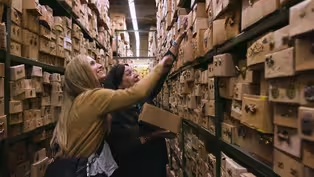
Window on Rhode Island: Wolf E. Myrow
Video has Closed Captions
Clip: S5 Ep19 | 7m 1s | Inside a bead lover’s paradise. (7m 1s)
Video has Closed Captions
Clip: S5 Ep19 | 4m 52s | Ted Nesi discusses Sen. Jack Reed’s future and the cost of rebuilding the Washington Bridge. (4m 52s)
Providing Support for PBS.org
Learn Moreabout PBS online sponsorship
- News and Public Affairs

Top journalists deliver compelling original analysis of the hour's headlines.

- News and Public Affairs

FRONTLINE is investigative journalism that questions, explains and changes our world.












Support for PBS provided by:
Rhode Island PBS Weekly is a local public television program presented by Ocean State Media