
Rhode Island PBS Weekly 5/5/2024
Season 5 Episode 18 | 21m 35sVideo has Closed Captions
Warm weather rise in the tick population and a visit to an Alpaca from in Little Compton.
Michelle San Miguel reports on the ever-growing tick populations and the devastating and sometimes deadly diseases they bring. Then, we visit with a local farmer in Little Compton who, along with his wife is raising a large herd of alpacas for their fiber. Finally, Michelle San Miguel and Ted Nesi talk about Sheldon Whitehouse’s fourth run for the U.S. Senate.
Problems playing video? | Closed Captioning Feedback
Problems playing video? | Closed Captioning Feedback
Rhode Island PBS Weekly is a local public television program presented by Ocean State Media
Rhode Island PBS Weekly 5/5/2024
Season 5 Episode 18 | 21m 35sVideo has Closed Captions
Michelle San Miguel reports on the ever-growing tick populations and the devastating and sometimes deadly diseases they bring. Then, we visit with a local farmer in Little Compton who, along with his wife is raising a large herd of alpacas for their fiber. Finally, Michelle San Miguel and Ted Nesi talk about Sheldon Whitehouse’s fourth run for the U.S. Senate.
Problems playing video? | Closed Captioning Feedback
How to Watch Rhode Island PBS Weekly
Rhode Island PBS Weekly is available to stream on pbs.org and the free PBS App, available on iPhone, Apple TV, Android TV, Android smartphones, Amazon Fire TV, Amazon Fire Tablet, Roku, Samsung Smart TV, and Vizio.
Providing Support for PBS.org
Learn Moreabout PBS online sponsorship- [Michelle] Tonight, as more ticks spread out of the woods and into neighborhoods, they're infecting thousands of Rhode Islanders.
- One time, my wife came in, and I said, "I think we need to be talking about funeral plans, 'cause I don't know where this thing is going."
- [Pamela] Then, an alpaca haven along the Rhode Island coast.
- When you're lucky enough to have things like this, you have to share it.
- And, what's next for Senator Sheldon Whitehouse, with Ted Nesi.
(bright music) (bright music continues) Good evening, and welcome to "Rhode Island PBS Weekly."
I'm Michelle San Miguel.
- And I'm Pamela Watts.
2023 was the hottest year since global records began back in 1850.
- And despite some very chilly days this spring, it's been a warm season on average, and ticks thrive in the warmer weather.
They can be as small as a poppy seed, and they're carrying serious diseases into more suburban areas.
As we first reported last September, many people suffer from the consequences of tickborne illnesses, unaware of why they're sick.
- I was in a fetal position for days.
I was having blinding headaches.
I was just in desperate condition and getting worse.
- [Michelle] Harvey Perry's love of nature nearly cost him his life.
18 years ago, he found a bullseye rash similar to this one on his arm, which is a classic symptom of Lyme disease.
- I felt like, whoa, I've got Lyme disease, it's about time I did, other people been getting it, and I'm out in the woods all the time.
So I went and got treated for that with doxycycline, and cleared it right up.
- [Michelle] But a few weeks later, he collapsed at his home in Westerly.
- I woke up on the kitchen floor.
I fainted without realizing I was faint.
I thought that was weird.
And it happened to me again the next morning.
And I went to the emergency room, and they said, "Oh, you must have babesiosis too."
- It turns out one tick bite had infected Perry with three diseases, including anaplasmosis, which kills your white blood cells.
It took two trips to the emergency room before his medical team realized the full extent of what was wrong.
Take me back to when you were in the hospital.
Did you have a moment amidst the hallucinations when you thought, I could die?
- Oh, absolutely.
I started, in fact, one time my wife came in, and I said, "I think we need to be talking about funeral plans, 'cause I don't know where this thing is going.
I mean, my liver's already shut down.
I don't know what else is gonna shut down."
And she cried, and we talked about it.
- [Michelle] Fortunately, a combination of antibiotics set Perry on a path to recovery.
He no longer deals with symptoms, but he's never forgotten how close he came to losing his life, all because of a tick bite.
- We're seeing the tick population increase here in Rhode Island because of the weather changes that we're experiencing.
- [Michelle] Dr. Philip Chan is an infectious diseases specialist at the Rhode Island Department of Health.
(phone rings) - This is Dr. Chan.
- [Michelle] He says warmer, wetter weather creates an environment more hospitable for ticks.
- In general, a tick has to be attached usually for longer than 48 hours in order to transmit a lot of these diseases, including Lyme disease.
So if you can find it soon and remove it, you are gonna really minimize your risk.
- [Michelle] While most people try to avoid ticks, Thomas Mather makes it his business to find them.
- That's a nymphal blacklegged tick.
- [Michelle] He's the director of the University of Rhode Island's Center for Vector-borne Disease and its TickEncounter resource center.
- [Thomas] Lovely.
- [Michelle] Now they're seeing how the tick population in Rhode Island has evolved throughout his three decades at URI.
- What's really changed here in Rhode Island and probably New England is that white-tailed deer have just become more of a backyard entity.
- [Michelle] Deer are the primary reproductive host for ticks, so as deer move to more suburban areas, ticks go with them.
- They take a blood meal, they grow a hundred times in size, they'd fall off, they lay thousands of eggs, those eggs hatch, and that's where the problem really starts.
- [Michelle] That problem includes a relatively new type of tick to Rhode Island called the lone star tick.
The adult female has a white dot or lone star on her back.
- This is a nymph lone star tick.
In the last few years, we've seen large increases along most of the coastal areas of the state.
- [Michelle] A bite from this blood-sucking lone star tick can cause people to develop an allergy to red meat called alpha-gal syndrome, and these ticks are spreading across the country.
- Today the Centers for Disease Control is warning about a potentially life-threatening red meat allergy caused by tick bites.
- [Michelle] Mather says nearly all lone star ticks are carrying the sugar molecule alpha-gal.
Meanwhile, he says, about one in four of the blacklegged ticks or deer ticks in Rhode Island is carrying the bacteria for Lyme disease during the nymphal stage.
Even more carry it as adults.
I followed along as Mather looked for ticks along the edge of a backyard in North Kingstown.
- When we show people what nymphal stage ticks look like, they don't have any idea.
- I was not expecting it to be that small.
- Most people would just completely dismiss that as a speck, right?
Well, that speck is a tick, and if you don't find it and it's attached for a day or a day and a half, it has a high likelihood of making you sick.
- [Michelle] Emily Levy knows that all too well.
She says her life was altered by a tick bite she never saw, a rash that never came, and a doctor who did not diagnose her properly.
- So some days I would have a migraine, other days it'd be a pain in my legs, some days it would be neuropathy, GI tract issues.
Chronic fatigue was pretty much throughout.
- [Michelle] She started to feel sick when she was in middle school.
She made numerous trips to the hospital throughout her senior year of high school and college.
It took seven years for her to get an accurate diagnosis.
She had Lyme disease and a number of other tickborne illnesses.
- That was really challenging as a young adult, because I knew something was wrong with me, but I also felt like my concerns weren't being taken seriously by the authority figures or medical professionals in my life.
- [Michelle] She says her symptoms are in remission, but she lived with a PICC line, a peripherally inserted central catheter, on and off for a few years to deliver medication into her bloodstream.
A nurse recommended she use a cut-off sock to cover it.
Levy later went on to have a port in her chest.
It inspired her and two of her friends to launch Mighty Well, a company that sells PICC covers and other medical products.
- The whole idea is a patient's external medical tubing can be kept secured, safe, sanitary.
- [Michelle] Levy's grateful for everything she's learned from her tickborne illnesses, but she says her health outcomes could have been different had she been tested for those diseases sooner.
- I think it could've been treated very quickly if the doctor just knew.
I mean, we lived on a lake, we had so many deer in our backyard.
None of that about the environment we lived in was ever questioned or taken into consideration.
- [Michelle] Entomologist Thomas Mather hopes he can spare many others from the devastating effects of ticks.
Using funding from the Centers for Disease Control and Prevention, he's involved in a New England study that's analyzing the best ways for people to protect themselves against ticks.
- If you have a residential yard where you see deer on a regular basis, you have chipmunks and mice running around, then you're probably a good candidate for doing tick management in your own backyard as well.
- [Michelle] Mather also recommends that people spray their shoes with an insecticide called permethrin to repel ticks.
- The nymphal ticks are down in the leaf litter, they get on your shoes, and then crawl up your legs.
So there's a good, easy to do, once a month, spray your shoes with permethrin spray.
- Back in Westerly, Harvey Perry says he's opposed to spraying his property because of the effect it has on the environment.
Instead, he wears clothes treated with permethrin when he's doing work outside.
At any point, did you think maybe it's worth moving and not living in a wooded area?
- That's my life, that's what I enjoy the most, is getting out in nature and managing nature for native plants and wildlife.
- [Michelle] Perry says this isn't a view he's willing to give up.
- I'm determined that I'm not gonna let them change my life that way.
I just protect myself so that I can do what I want to do.
(bright music) - We now bring you a story about a farm in Little Compton that's home to a herd of alpacas.
The animals are native to South America, not New England.
Still, the couple that's raising them has found a unique way to pay tribute to the Ocean State.
- It's satisfying knowing that you have something to take care of besides yourself.
- [Michelle] Nestled near the coast of Rhode Island sits Hope Alpaca Farm in Little Compton, home to a large herd of these gentle and social animals.
Bill Ryan and his wife, Hope, opened the farm in 2017.
He says they hadn't had any animals here for more than 25 years and wanted to change that.
- We were driving up in Vermont on a vacation and we went by an alpaca farm, and she goes, "Well, let's raise alpacas."
And then a year later, I had six of them.
(Bill laughs) - At the time, what did you know about alpacas?
- Nothing.
Not a thing.
- [Michelle] The learning curve was small for Bill Ryan.
He says Huacaya alpacas, native of the Andes Mountains in South America, are easy to raise.
They have soft padded feet, so they're gentle on pastures.
- They like second cut hay, which we buy out in New York 'cause it's very hard to make hay here.
There's no seed in it and no kind of, like, grass sticks.
We do give 'em grain once a day, and we graze 'em out in the fields out here.
- [Michelle] The farm started with six alpacas and has grown to 20, ranging in color from white and gray to brown and black.
- You do have to have at least three because they're a very social animal with the herd, they're a pack, you know, a pack animal.
And they like each other even though they spit at each other.
(laughs) - I quickly discovered these alpacas, which can average between 100 to 200 pounds, each have a unique personality.
Oh my goodness, you're so calm!
Hi!
Hi, oh, you don't wanna be touched.
- No, she- - Can I touch you?
Nope, don't wanna be touched.
You wanna smell me?
Hi!
(smooches) Oh, sorry, okay.
- But she's very, (chuckles) (Michelle chuckles) She's very gentle.
- Was it something I said?
(Michelle chuckles) Alpacas are known for their fiber.
It's hypoallergenic, and Ryan says it's less irritating on the skin than a sheep's wool.
- It's funny, you know, if you've ever worn wool and gotten it wet, it can itch on certain people.
You know, certain people don't, you know, it irritates them.
And it's funny, a lot of diabetics wear their socks because it's a lot more smoother on their feet.
- [Michelle] The alpacas are shorn once a year before the summer.
The Ryans then bring the fiber to a processing service in Fall River.
In return, they receive credits for products they sell in their farm store, including hats and gloves made from US-grown alpacas.
- These two have been born here.
And this one's Metacomet.
And then we named this fella here Blackstone, for the Blackstone River.
- [Michelle] All of the baby alpacas, known as crias, born on the farm are given Rhode-Island-based names, like Richmond and Prudence.
- This is Bristol.
She's one of my favorites.
- Why?
- Well, because I did help her come out when she was born, yeah.
Her foot was stuck.
- Wow.
- So I had to get her foot out for her.
- [Michelle] Ryan says it was important for him and his wife, both native Rhode Islanders, to name the alpacas with the Ocean State in mind.
- My wife is an old Rhode Islander, and her family goes back to Roger Williams.
And we just thought with the theme that we do something, like, in Rhode Island, you know?
It's a proud place to live, I love living here.
I mean, we're kind of off the beaten pad of the main Rhode Island, but we love it.
- [Michelle] The 20-acre farm has been in Bill Ryan's family since the late 1800s.
The family hosts open house events and offers private tours.
Ryan recalls one memorable visitor.
- So we had this child, and he was in a wheelchair, and he couldn't move his hands that much.
And he was, you know, active, but, so I finally just took him in a pen in his wheelchair, and I dumped grain on his lap.
And they all came in, and they were all in his face.
And this kid, I'll never forget it, and he was just so happy.
- Do you have moments where you come out here at night and just sit in awe of this land?
- Yes.
Yes, I have moments of you go out here and you ponder, sit on a stone wall and just take it in, take the moment in.
- [Michelle] Ryan says he and his wife are passionate about sharing this alpaca haven with others.
- It's something that we're very lucky to have.
And when you're lucky enough to have things like this, you have to share.
(bright music) (bright music continues) - Finally tonight, on this episode of "Weekly Insight," Michelle and WPRI 12's politics editor, Ted Nesi, talk about Senator Sheldon Whitehouse's reelection campaign.
- Ted, welcome back.
So here we are, it's early May, we're six months away from the November election.
- Hard to believe, yep.
- Right.
And we're starting to see more people announcing they're running for office.
- Yeah, and the biggest race on the ballot in Rhode Island this year, other than, of course, the presidential, is the U.S. Senate race, and, no surprise, Democratic Senator Sheldon Whitehouse is indeed running for a fourth term, he just kicked off his campaign officially.
- Yeah, so Whitehouse first had that position back in 2006 when he defeated Lincoln Chafee, a Republican at the time.
We should also keep in mind, there was a large national anti-Republican wave occurring.
It was a very close election between Whitehouse and Chafee.
Of course, ultimately Whitehouse won, and he's had a much easier time winning reelection since then.
- Yeah, I'm sure viewers will remember, Michelle, that was an epic battle in 2006 between Chafee and Whitehouse because control of the U.S. Senate was going to hinge in part on what happened in Rhode Island.
Since then, you know, Whitehouse, he has been a bit of a polarizing figure, at least compared with Jack Reed, Rhode Island's other senator, of course, another Democrat.
His approval ratings have always been a little lower than Reed's, but he still won reelection convincingly previously.
He won with over 60% of the vote in both 2012 and 2018.
And so I think, Michelle, that's a big reason he's seen as such a heavy favorite to win another term this fall.
- So Whitehouse will face two Republican challengers, State Representative Patricia Morgan and Warwick Republican Ray McKay.
They'll face off in a primary this September.
As you said, though, Whitehouse is the heavy favorite to win, and one of the reasons is because he already has $3.6 million in his campaign account.
Of course, his opponents don't have that kind of money.
So Ted Whitehouse was recently asked, look, why do you feel the need to raise that much money when clearly your opponents don't have that kind of cash in the bank?
What did he say?
- Yeah, his response was interesting, Michelle.
He said, quote, "There's always a possibility that some of the creepy out-of-state right wing billionaires who I've significantly irritated could throw money at Rhode Island out of revenge and punishment, so we need to be prepared."
- [Michelle] Do you see that happening?
- You know, I think, I do think it's possible, I will say, because Whitehouse has made some powerful enemies over the years.
You know, if you think of some of the big issues he's been very outspoken on, Supreme Court reform, climate change, money in politics, he's often pretty harshly criticizing some very rich people on the right who he argues are using their money to kind of shift the conversation on these issues in their own direction.
Now, Whitehouse has plenty of critics who argue that, you know, his sort of view that it's all about dark money, and that's what's causing this as kind of conspiratorial, and actually it's just conservatives view these issues differently from Whitehouse.
But Whitehouse, he does not see it that way.
He really believes money's at the root of all of this, and he thinks the people mad at him could try to use that money to make trouble for him this fall.
- Well, and that came to a head recently on the Senate Budget Committee, where Whitehouse sits as chairman.
Republicans, like Senator Mitt Romney, have repeatedly criticized Senator Whitehouse for devoting too much time on the Senate hearings talking about climate change.
He's already had more than a dozen hearings devoted strictly to climate change.
And Romney is saying, look, you need to spend more time talking about taxes and spending.
But Whitehouse is clearly not intimidated by Romney.
- No, I mean, he looked a little peeved listening to Romney's lecture in that committee hearing where Romney took aim at him, but Whitehouse argues that, you know, while yes, you know, this might at first glance seem like an issue for the Environmental Committee, for example, climate change is gonna have a huge effect on the federal budget over time due to more natural disasters, the costs of mitigation and all the rest of it.
And so he argues it is very much a budget issue, even though everyone knows also he just cares a lot about climate change regardless of which committee he's leading.
So it's been interesting to see him just sort of mix it up with the Republicans on that issue and, yeah, not back down at all.
- At the same time that he was having that pushback with Republicans, he also scored a major bipartisan win.
Talk with me about that.
- Yeah, Michelle, this got less attention than I expected, but people remember that big Ukraine, Israel, Taiwan aid bill that took months and months to get through Congress but finally recently passed the House and got signed into law.
Well, one of the ways that got passed was actually, included in it was a bill Whitehouse had coauthored with an Idaho Republican senator called the REPO Act.
And this bill would allow Western countries to seize the assets of Russians, sell them off, and give the proceeds to Ukrainians to help to fight the war.
It was a little controversial, but it also had some strong support in Congress.
And in the end, Republican House Speaker Mike Johnson actually added this REPO Act to the broader bill for Ukraine, Israel, and Taiwan because he thought it would win GOP votes and help to get it through Congress.
So just an example of how Whitehouse also at times does know how to strike a bipartisan deal even though he's very willing to be, you know, a partisan warrior on some of these other issues.
- Absolutely, thank you so much, Ted, this has been really insightful.
- Good to be here.
- That's our broadcast this evening.
I'm Michelle San Miguel.
- And I'm Pamela Watts.
We'll be back next week with another edition of "Rhode Island PBS Weekly."
Until then, please follow us on Facebook and X, and you can visit us online to see all of our stories and past episodes at ripbs.org/weekly, or listen to our podcast on your favorite streaming platform.
Goodnight.
(bright music) (bright music continues) (bright music continues) (bright music continues) (bright music continues)
Video has Closed Captions
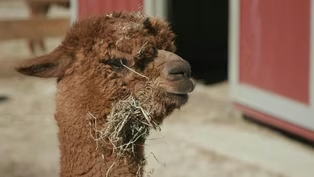
Clip: S5 Ep18 | 6m 46s | A couple in Little Compton raises a large herd of alpacas for their fiber. (6m 46s)

Video has Closed Captions
Clip: S5 Ep18 | 9m 25s | Michelle San Miguel reports on the ever-growing tick population in Rhode Island and the devastating (9m 25s)

Video has Closed Captions
Clip: S5 Ep18 | 4m 49s | Ted Nesi discusses Sheldon Whitehouse’s fourth run for the U.S. Senate. (4m 49s)
Providing Support for PBS.org
Learn Moreabout PBS online sponsorship
- News and Public Affairs

Top journalists deliver compelling original analysis of the hour's headlines.

- News and Public Affairs

FRONTLINE is investigative journalism that questions, explains and changes our world.












Support for PBS provided by:
Rhode Island PBS Weekly is a local public television program presented by Ocean State Media