
Rhode Island PBS Weekly 6/18/2023
Season 4 Episode 25 | 25m 35sVideo has Closed Captions
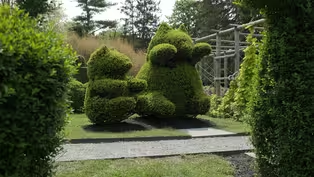
Where can you find a unicorn and a lion in the same garden? Take a peek at Green Animals!
Weekly's Pamela Watts visits Green Animals Topiary Garden in Portsmouth. It’s the oldest in the nation and the star attraction for children of all ages. Then, Weekly shares the Regional Emmy® -winning segment from our friends over at ART inc. Finally, in our continuing series Window on Rhode Island, producer Isabella Jibilian profiles a Federal Hill classic—The Old Canteen.
Problems playing video? | Closed Captioning Feedback
Problems playing video? | Closed Captioning Feedback
Rhode Island PBS Weekly is a local public television program presented by Ocean State Media
Rhode Island PBS Weekly 6/18/2023
Season 4 Episode 25 | 25m 35sVideo has Closed Captions
Weekly's Pamela Watts visits Green Animals Topiary Garden in Portsmouth. It’s the oldest in the nation and the star attraction for children of all ages. Then, Weekly shares the Regional Emmy® -winning segment from our friends over at ART inc. Finally, in our continuing series Window on Rhode Island, producer Isabella Jibilian profiles a Federal Hill classic—The Old Canteen.
Problems playing video? | Closed Captioning Feedback
How to Watch Rhode Island PBS Weekly
Rhode Island PBS Weekly is available to stream on pbs.org and the free PBS App, available on iPhone, Apple TV, Android TV, Android smartphones, Amazon Fire TV, Amazon Fire Tablet, Roku, Samsung Smart TV, and Vizio.
Providing Support for PBS.org
Learn Moreabout PBS online sponsorship(theme music) - [Announcer] Tonight, on Rhode Island PBS Weekly... - I don't like to play favorites because they all need care and attention, but as of right now the one I'm most partial to is the Rhode Island Red Rooster, it being the quintessential Rhode Island piece in the gardens.
(camera shutter clicking) - I'm really happy with the shots I ended up with.
I think some of 'em really did capture that joyful summer celebration (soft xylophone music begins) that I was going for.
And then, I got some surprising shots too.
- "Just remember, (symphonic music begins) the toe you step on today, may be connected to the ass you have to kiss tomorrow."
Typical Buddy Cianci quote.
(symphonic music continues) (symphonic music building) - Good evening.
(symphonic music fades) Welcome to Rhode Island PBS Weekly.
I'm Pamela Watts.
- And I'm Michelle San Miguel.
Surveys have found more than half of American households garden as a hobby.
But one Rhode Islander has yard work that keeps him busy all day, every day.
- His job is to ensure animals stay green and in tiptop shape for three seasons.
Tonight, we visit the oldest topiary garden in the country that's the star attraction for children of all ages.
- To be at a property like this, to come to a garden like this and spend my entire day here, putting in the time and effort that I've always put into gardens in the local community.
But to have this garden in particular under my thumb, it is a huge responsibility.
- [Pamela] A responsibility requiring a big green thumb to tame these large, "Green Animals."
That's the name of this Portsmouth property.
Evan Aten says there are 80 geometric hedges, including a menagerie of two dozen topiaries.
Aten is their caretaker.
- So I care for them as if they were my pets.
That's... Yeah.
- [Pamela] He says, these shrubs are not trained on frames.
They're made the old fashioned way by manipulating branches.
Some metal poles inside, stabilize them during storms.
Carved from Privet, U, and English Boxwood, Aten has his work cut out for him, snipping, (scissors snipping) clipping, (shears clipping) and then, (gas motor revving) comes the big guns.
- Now I'm just gonna add a little depth to the wing.
Clean it up a little bit.
So... How you start with it is, you're gonna take a look at it, you're gonna see the lines.
I'll take a walk around, make sure I'm seeing what it is I want to be cutting, the lines I want to create.
And then it's just slowly whittling away, it's...
I don't think it's much different from say, an artist who works in sculpting, clay, pottery.
You're chiseling away bits and pieces as you go, shaving it down, until you get it to where you want to be.
Generally, I'll work top down, so foliage can fall to the ground.
It takes time, (shears clipping) it takes a number of tools, a delicate touch, lot of control.
(children playing) - [Pamela] The result is a wild kingdom, both winsome and whimsical.
And there's more.
- One of the great things about peonies is that they last forever.
- [Pamela] Jim Donahue is curator of historic landscapes for the Preservation Society of Newport County.
Flowers, herbs and orchards abound at Green Animals.
So here we are, it's a zoo out here.
- Yeah, literally.
(chuckling) It's about seven acres of zoo, and it's been here since the turn of the 20th century so it has quite a history.
- [Pamela] A history, Donahue says, dating back to 1870.
Thomas Brayton, Treasurer of the Union Cotton Mill in Fall River, bought this pastoral farm in Portsmouth as his family's summer home.
- And they chose it because it was on the Fall River railroad line.
And they also could take their boat down from Fall River as well.
- [Pamela] The property holds a commanding view of Narragansett Bay.
Brayton wished it to be a self-sustaining farm, so he hired one of his mill workers, an immigrant from Portugal named, "Joe Carreiro."
- Thomas Brayton heard that he had family that worked in botanic gardens in the Azores.
And so, he offered him a job of being his gardener here at Green Animals, not knowing what his skills were beyond just gardening.
And over the course of four decades, Joe Carreiro created this garden really out of his mind.
There was no plan.
- [Pamela] However, Carreiro's design was firmly rooted in his homeland.
- And so, you think of an English garden or a French garden.
You have an image of order and of axial sight lines.
A Portuguese garden is much different in that you don't see the whole garden at once.
There are a series of very small garden rooms, all abutting each other that are all different.
So you move from an orchard space into a formal garden space, into a perennial garden space.
And they would mix plant material as well.
So there's annual, perennial, vegetable, fruit, all mixed together.
- [Pamela] Donahue notes, the concept comes from the Moors, who occupied the Iberian Peninsula for centuries.
- And the Muslim garden influence from Persia, never seeing the entire garden at once.
You were meant to walk through the garden and discover it as you walked, and not see it all in one expanse.
- So it's to draw you in?
- And also to make it a private inward looking experience.
You're not looking at the greater landscape.
You're having a contemplative walk through the gardens.
- [Pamela] Everywhere you meditate or meander through the gardens, you are greeted by green animals.
The art of topiary emerged in Portugal in ancient times.
Carreiro's daughter married George Mendonca, who became the next caretaker.
Carreiro and his son-in-law wanted to create the greatest show on earth.
- And at that time, circuses were considered very exotic.
And if you saw a camel or an elephant or a lion, I mean, you just didn't see those things.
And so, he based that formal garden on those exotic circus animals.
But then over time, I think, as people began to visit, they just widened out they're thinking on it and did things that people would love, like the teddy bear.
- [Pamela] And to make it a truly enchanted garden, there's a unicorn.
You'll also spy a reindeer, giraffe and birds.
Eventually, the property was left to Thomas Brayton's daughter.
- She was a character.
Alice Brayton inherited the property in 1940.
She had never married and she made this her primary residence, and she named it, "Green Animals."
And she lived until 1971 into her nineties.
And during that entire time, she entertained all the elite of Newport here in her gardens.
She had clam bakes and martini bars and Ferris wheels.
And she really became known in Newport as that lady out in Port Portsmouth with the topiary who has the parties.
And that was her entree into Newport Society.
- [Pamela] High society.
Brayden hosted a party at Green Animals for Jackie Bouvier Kennedy, the year she was Queen of the debutantes.
Later, she would bring her children, Caroline and John, here.
Another first lady also visited, Mamie Eisenhower.
Even singer, Bing Crosby, wandered through one summer day.
- So in the summer, if you were to come here you'd see these huge gourds hanging down above your head.
That also is a Portuguese tradition.
- And he planted grape barbers too?
- Yep.
Right across the way, there's a grape barber for wine and fresh eating.
That was the first thing they planted.
- [Pamela] The vegetable garden is planted just as it was at the turn of the century.
Last season, some 2000 pounds of food was grown.
- So all of that produce now gets donated to charity.
We've been giving it to Lucy's Hearth in Portsmouth or the King Center in Newport.
So it actually is a win-win situation.
We not only have brought back the productivity of the garden, but we've been able to help people out in the process.
- Oh, there we go.
It's who we were looking for!
(children playing) - [Pamela] Everyone seems to have a favorite green animal, even Aten, although reluctantly.
- I don't like to play favorites because they all need care and attention.
But as of right now, the one I'm most partial to is the Rhode Island Red Rooster, it being the quintessential Rhode Island piece in the gardens.
The Rhode Island red features the Barberry with those little sharp points and gives it that wonderful red color for the chest of the chicken.
- [Pamela] Aten says, he hopes to keep tweaking, maybe adding some colorful azaleas to the green animals, but for now, he's busy lopping a little off the top.
- So everyone needs their haircuts from time to time so... And a little bit like a barber in that, yes, I can make a mistake and it will grow back.
Being here at Green Animals, I get to experience that every single day, the joy that it creates for people and the sense of wonder and relaxation and peace that they have when they come here.
- [Pamela] And that peace extends to him.
- Yeah, it feels that in all this work.
It takes patience and time, and in that slow methodical time, taking respect.
I've heard it compared to the Garden of Eden or Gardens of Babylon.
And while it's neither of those, it is a very special place on this island.
(symphonic music begins) (symphonic music fades) - Up next, we here at Rhode Island PBS have some exciting news.
The station just won three Boston New England Regional Emmys last weekend.
Rhode Island PBS Weekly won for our piece on critical race theory.
And our friends over at Art Inc. won for Acorns to Becorns.
It tells the story of a toy designer who uses his backyard as both a muse and a canvas.
(quirky symphonic music begins) - I think I was always curious as a kid what it would be like to be a tiny little person going in through the woods.
I think that's pretty universal, really.
What kid doesn't like to get down on their knees and check things out?
(pencil sketching) (music fades) (air whooshing) Becorns are little characters I make out of acorns and sticks.
(symphonic music begins) I take 'em outside and I pose them in a little scene.
I wait for animals to come and then I take pictures of them interacting with wildlife.
(camera shutter clicking continuously) (camera shutter clicking faster) There's a wide variety of personalities in the Becorn world.
They tend to be gentle.
They're almost always curious and up to something.
There are warriors that are defending against squirrels.
They definitely are nurturers.
They feed the wildlife and care for them.
(symphonic music fades) My first job out of school was as a toy designer at Lego.
(air whooshing) The real beginning of Becorns was when I worked at Bionicle.
- [Announcer] Bionicle takes off with new wings, weapons and boosters.
- [David] Normally when you build with Legos, you try and build in a really structured way, but we would just hack 'em apart and hot glue 'em together to quickly arrive at a prototype.
Then we'd show them to kids (soft piano music begins) and get their feedback.
And I just loved hearing their thoughts.
I learned so much.
(broom sweeping) After five years, I left Lego.
And I was at home sweeping my mom's driveway thinking, "Wow!
What a great job that was and what am I doing now?"
And I looked down at all these sticks and acorns at my feet and I kind of realized like, "Oh my God!
Everything I did at Lego, (drill whirring) I can do with these sticks and acorns and kind of create a whole world with them."
(tools clacking) I was building the figures and I was like, "Okay, what do I do with 'em now?"
And sort of the clear first step was to take pictures and it sort of evolved from there.
(camera shutter clicking) (soft piano music continues) So every time I go for a walk, I'm always on the hunt (soft piano music fades) for good, good sticks and good acorns.
The perfect stick is about as the thickness of a barbecue skewer and it's got nobby parts.
(twig snapping) And I like 'em to have a slight bend in it, 'cause I've found if they're straight, then the characters don't really look alive.
But if they have like just a slight bend, then they look more alive.
And then the perfect acorn has a cap that goes most of the way around and then just has a perfect little circle, and the nose just sticks right out in the middle.
(soft piano music begins) A lot of times I have a pretty good idea about the scene I'm trying to go for when I build it.
And so, I'm trying to think of what the right pose should be.
And as I'm building, I'm kind of thinking about the mechanics and how they hold their weight.
And if they're running, they should be leaning forward, or if they're kind of scared, like are they leaning back?
So I kind of have a pretty good idea of what I'm going for.
And on the day when the light's good, there's no wind, (hammering stake) I'll go outside and I'll set up the scene.
I'll set up the camera and I use a remote control.
I stand way back, far enough that I can kind of see what's going on.
And then when the animals come, I push my little button and hope for the best.
(camera shutter clicking) Almost always, something different happens than what I expected.
(camera shutter clicking) Usually, there's a surprise that's great.
It'll jump on its head and suddenly, it tells this other story that I hadn't even imagined.
The pinnacle of Becorn lore, is when I built this character, it's holding a basket and I filled it with seeds.
I set it out and I was trying to get a cardinal to come eat from the basket.
Instead, a squirrel came (upbeat quirky music) and carried it away off into the woods.
I chased it into the woods.
I kind of felt like an idiot chasing it into the woods.
At some point I was like, "I'm not gonna catch this squirrel, what am I doing?"
So then I built another.
The first one that was taken was named, "Joonie," with two Os.
And then the second one was, "Joonie Junior."
And Joonie Junior also was carried away by a squirrel into the woods.
(camera shutter clicking) (gothic pipe organ music begins) So then, I really wanted the shot.
I'm not gonna give up on this shot.
So I built a third Joonie, (soft xylophone music begins) "Joonie the third," who still lives today.
I choose names that kind of speak to the personality.
One of my favorite characters is named, "Dink."
He has his arms in front of his face.
And anything you put in his hands, he's automatically excited about.
You put a berry in his hand and he is like really excited to eat it.
Or you put a flower in his hand, and he's really just in awe of this flower.
I have two characters named, "The John John Brothers."
And you can put anything in their hands to be carrying and they're always up to something.
They always have a plan.
So if they're carrying this squash, it's like, "What are they doing with this squash?"
I have them carrying a bunch of grapes and then they're offering the grapes to this sort of Elder Becorn.
(music fades) I was scrolling Instagram one day and I saw this picture of a bird splashing in a bird bath.
And it just looked so fun and lively and I just thought, "Wow!
That's a scene I want to get with a Becorn."
So I started sketching.
(upbeat quirky music begins) My favorite at first was to get a Becorn in a boat.
And the bird would be next to it kind of splashing it, getting it wet, 'cause I wanted some kind of interesting interaction.
And then I did this other sketch, which I think is so much more fun, where the two are just splashing and playing.
And it reminded me of being a kid in the summer, splashing with my friends in the water.
And this was the one I had to do.
(drill whirring) (twig snapping) (drill whirring continues) (water splashing, sand pouring) (upbeat quirky music continues) (upbeat quirky music fades) All right, let's see if the birds come.
(water splashing) (bird calling) (bird splashing) (camera shutter clicking) (bird splashing) (camera shutter clicking) I'm really happy with the shots I ended up with.
I think some of 'em really did capture that joyful summer celebration (soft xylophone music begins) that I was going for.
And then, I got some surprising shots too.
So as usual, I kind of started out with a plan and the birds took over and gave me stuff that's just better than I ever could have asked for.
Kind of the essence of Becorns is this wonder about the natural world and sort of experiencing nature and the wonder of nature in kind of a really pure way.
And a lot of people have said, "I haven't felt that since I was a kid.
And I didn't even realize that I was missing that feeling."
As an artist, that's, I don't know, that's the dream.
That's really a gift.
(heavenly symphonic music begins) (heavenly symphonic music fades) - Acorns to Becorns and all of Art Inc. stories are available on demand at ripbs.org/artinc.
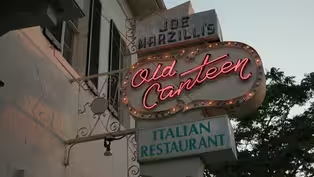
Finally, in our continuing, "Window on Rhode Island Series," we visit a Federal Hill classic, Joe Marzilli's Old Canteen restaurant.
Over the years, it has been a favorite among Rhode Islanders.
And has hosted both the famous and infamous, everyone from Hollywood stars to area mobsters.
Tonight, we meet the chef and owner as he fondly remembers the past and contemplates the Old Canteen's future.
- I'm Sal Marzilli, owner and head chef of the Old Canteen restaurant on Federal Hill.
Today, I'm gonna take you inside for a tour, and we'll take a look at what everybody's been talking about for 70 years.
(upbeat instrumental jazz music begins) Well, my father was a great restaurateur.
He opened this business in 1956.
This is the dining room and nothing has changed.
It remains the way it was in 1956.
My big question when I was young, when I asked my dad, "Why the color pink?"
With the pink lighting in the dining room and the pink walls, gives a reflection on people's skins and it makes their skin look a little healthier.
My dad was tough.
He was tough on me as his son learning the operation.
And until the day he died, it had to be his way, and I respect that.
On a Saturday night, a busy, busy Saturday night, the dining room in here is more or less, a play.
It's like going to the theater.
It's where everything has to be just perfect.
Once you get behind those doors in that kitchen, it's a whole 'nother world.
All right, order veal cacciatore.
'Cause that's where you hear sometimes the foul language.
That's where you hear a little bit of screaming and laughing and joking.
So it's like night and day between the two types of, the two things that are going on in this business, all trying to create this play.
It is pretty much organized chaos.
And I started working the dishwasher area, then I started making salads.
And then when I got to the hotline, they started letting me put pasta in a basket and dunking it in the water and putting it on a plate.
As the years went by, I became head chef.
I'm gonna just give you a little idea of the menu and and what the menu looked like back in the day, shrimp cocktail, 90 cents.
This dish right here, the broiled tenderloin steak with mushroom caps.
Now if you look at our menu today, it has, "Veal tenderloin steak a la Frank."
"(Saturday Night Is The Loneliest Night Of The Week)" ♪ Until I hear you at the door ♪ - And that was named after Frank Sinatra, 'cause he used to come here quite often after he did his shows at the Warwick Musical Theater or down at the Civic Center.
He used to come here for dinner.
♪ Saturday night is the loneliest night in the week ♪ (audience applauding) - All right, now we are at the bar of the lounge, and if these walls had ears...
There's been all kinds of characters, the politicians, some of the people from Federal Hill, there may be a little bit on the nefarious type.
Bookmakers have been here in the early days.
Raymond Pajaco was born next to my father.
They were born on the, right on the same block.
So they grew up together going through grade school together, they were friends.
And they'd be sitting next to the mayor or a judge.
When they're in the Old Canteen, they're here to have a good time, eat, drink, and be merry.
You know, we're Switzerland.
(instrumental jazz music begins) This is the table that Buddy Cianci and the chair that Buddy Cianci has, well sat in, pretty much right back to the middle 1960s.
He spent every night before every election just sitting in here alone, discussing things with my father, talking, doodling on the tablecloth.
As you can see, I mean, there's a picture of City Hall signed by him in the back of me, which has got a quote on it.
"Just remember, the toe you step on today, may be connected to the ass you have to kiss tomorrow."
Typical Buddy Cianci quote.
(music fades) For a couple of weeks after his funeral, we left this table empty with a candle burning on it, just in memory of him.
(instrumental jazz music begins) And this right here behind me is one of my favorite spots in the restaurant.
This is the spot that my father stood for almost 52 years and greeted every one of the customers every night of the week.
- [Interviewer] How often do you think about your dad when you're working?
- Every day.
(sighing) Every day.
This is his baby, this is what he created.
When I was younger, my father pushed me away from this life, but I won out.
I've been here, you know, 47 years.
I've been married almost 40 years now and I have two children.
When you put that much time into a business like this, there are other things in your life that you're not focusing on.
And I think he may have wanted me to have a life where I could juggle the both evenly.
This restaurant hasn't allowed me to do that, but I loved every minute of it.
So I'm gonna try to walk away when I do have a buyer.
Hopefully, somebody takes the restaurant and they run it the way it always has been.
Or maybe something else here, I don't know.
But I think the Old Canteen should remain here forever.
(music fades) - And that's our broadcast this evening.
Thank you for joining us.
I'm Pamela Watts.
- And I'm Michelle San Miguel.
We'll be back next week with another edition of Rhode Island PBS Weekly.
Until then, please follow us on Twitter and Facebook.
And visit us online to see all of our stories and past episodes at ripbs.org/weekly.
Or listen to our podcast on your favorite streaming platform.
Thank you and goodnight.
(theme music begins) (theme music continues) (theme music continues) (theme music continues) (theme music fades)
Video has Closed Captions
Clip: S4 Ep25 | 8m 48s | Where can you find a unicorn and a lion in the same garden? Take a peek at Green Animals! (8m 48s)
Window on Rhode Island: The Old Canteen
Video has Closed Captions
Clip: S4 Ep25 | 6m 54s | Go behind the scenes at Federal Hill’s famous Old Canteen Restaurant. (6m 54s)
Providing Support for PBS.org
Learn Moreabout PBS online sponsorship
- News and Public Affairs

Top journalists deliver compelling original analysis of the hour's headlines.

- News and Public Affairs

FRONTLINE is investigative journalism that questions, explains and changes our world.












Support for PBS provided by:
Rhode Island PBS Weekly is a local public television program presented by Ocean State Media