
Rhode Island PBS Weekly 6/2/2024
Season 5 Episode 22 | 25m 35sVideo has Closed Captions
Ian Donnis reports on the uncertain future of two cashed-strapped Rhode Island hospitals.
Ian Donnis reports on why financial stability has proved elusive for Roger Williams Medical Center and Our Lady of Fatima Hospital. Then, on Weekly Insight, Michelle San Miguel and WPRI 12’s Politics Editor Ted Nesi continue to focus on health care in Rhode Island. Finally, Pamela Watts reports on a daring raid in Warwick that may have sparked the American Revolution.
Problems playing video? | Closed Captioning Feedback
Problems playing video? | Closed Captioning Feedback
Rhode Island PBS Weekly is a local public television program presented by Ocean State Media
Rhode Island PBS Weekly 6/2/2024
Season 5 Episode 22 | 25m 35sVideo has Closed Captions
Ian Donnis reports on why financial stability has proved elusive for Roger Williams Medical Center and Our Lady of Fatima Hospital. Then, on Weekly Insight, Michelle San Miguel and WPRI 12’s Politics Editor Ted Nesi continue to focus on health care in Rhode Island. Finally, Pamela Watts reports on a daring raid in Warwick that may have sparked the American Revolution.
Problems playing video? | Closed Captioning Feedback
How to Watch Rhode Island PBS Weekly
Rhode Island PBS Weekly is available to stream on pbs.org and the free PBS App, available on iPhone, Apple TV, Android TV, Android smartphones, Amazon Fire TV, Amazon Fire Tablet, Roku, Samsung Smart TV, and Vizio.
Providing Support for PBS.org
Learn Moreabout PBS online sponsorship- [Pamela] Tonight, concerns over the survival of two Rhode Island hospitals.
- Well, you feel the stress 'cause you know you're going in at times and you're saying, "Am I gonna have everything I need?"
- [Michelle] Then, the future of Rhode Island healthcare with Ted Nesi.
- [Pamela] And did the burning of a British ship in Rhode Island waters ignite the American Revolution?
One man is going to court to prove it.
- We light the ship on fire, flames get down to the powder magazine, and kaboom!
The first fireworks ever on Narraganset Bay.
(playful music) (playful music continues) - Good evening and welcome to "Rhode Island PBS Weekly."
I'm Michelle San Miguel.
- And I'm Pamela Watts.
We begin tonight with the uncertain future of two cash strapped Rhode Island hospitals.
The owner, a California company, is looking to sell.
- The only buyer to submit a bid would return Roger Williams Medical Center and Our Lady of Fatima Hospital to nonprofit status.
But it's not clear that plan will put them on a better path for the future.
And as our Ian Donnis reports, what happens next has big implications for healthcare in the state.
(gentle chopping) - [Ian] Jo-Ellen Paterno lives with our family in Warwick.
- I am married to a wonderful man named Paul.
I have three children.
Beautiful.
Lucy is 11, Rosie is six, and Vincenzo is five.
And I'm a school teacher by trade.
I've been a physical education teacher for about 24 years.
- [Ian] Two years ago, during the summer of 2022, things took a turn for the worse and Paterno added a new title; cancer patient.
- I woke up one morning not feeling very well.
I had recently had a diagnosis of cancer, not knowing where it was or you what type - [Ian] Paterno considered her options among local hospitals.
- So I thought, just to make sure that we have all my files together and everything is accessible for everyone, we decided to go to Roger Williams.
- [Ian] Roger Williams Medical Center is located on Chalkstone Avenue in Providence.
It's one of the biggest employers and top taxpayers in Rhode Island's largest city.
It's owned by Prospect Medical Holdings, a private company owned by two senior executives who acquired the majority stake in the outfit from a private equity firm in 2021.
According to its website, Prospect operates 16 hospitals across the US.
In 2014, Prospect swooped in to buy CharterCARE, the parent company of Roger Williams and Our Lady of Fatima Hospital in north Providence.
Both hospitals faced a financial crisis at the time.
Jo-Ellen Paterno says hospital ownership didn't matter to her as a patient.
- Everyone was wonderful.
They were so good to me.
I remember right from getting into the room, the nurse came and greeted me and she said, "Oh, VIP is here!
Our important patient!"
And I was like, "What?"
And she's like, "Listen, we read the backstory of what you're here for, and this is a room we save when people we know are going through hard times."
- Paterno is still waging her fight with cancer and she now gets treated in Boston.
But she says having a well-regarded cancer center just up the road made a huge difference when her condition first developed.
Sounds like you really got what you most needed at at that time.
- Thank God I came to Roger Williams because this wouldn't have happened anywhere else.
- [Ian] Today, Roger Williams and Fatima confront another crisis.
Prospect Medical is trying to sell off its holdings after years of disinvesting in its national chain of hospitals.
The only buyer for Prospect's two Rhode Island hospitals is a nonprofit based in Atlanta, the Centurion Foundation.
- Good afternoon.
My name is Ben Mingle.
I'm the President of the Centurion Foundation.
Our mission today is only about changing the healthcare dynamics in this country.
- [Ian] During a public meeting at Rhode Island College in March, Mingle talked up the foundation's experience.
- To date, Centurion has assisted 13 different not-for-profit health systems across the country, in 25 different transactions, for 36 facilities.
Those facilities total a billion dollars in total financings.
- [Ian] Centurion says it can cut those costs by financing real estate transactions.
Mingle says that cost cutting delivers more than $30 million in annual savings for the foundation's clients.
And he says this strategy gives Centurion the ability to offer a brighter future for Roger Williams Medical Center and Our Lady of Fatima Hospital.
- Our proposal will return local control and independence to the existing management team under.
Centurion's confident in the ability of our management team to convert these hospitals into self-sustainable organizations, which is critical to their long term success.
- Long-term success has been elusive at CharterCARE's Rhode Island hospitals.
Under the management of Prospect Medical Holdings, some longtime employees have left, staffers complaint about the worsening quality of basic supplies like gloves, and Attorney General Peter Neronha last year sued Prospect Medical, accusing it of jeopardizing the financial health of Fatima and Roger Williams and patient care.
So the idea of changing control of local hospitals from a for-profit private equity model to a nonprofit might sound good.
- Well, you feel the stress 'cause you know you're going in at times and you're saying, "Am I gonna have everything I need?"
- [Ian] But Nurses and Allied Professionals, the union that represents hundreds of workers at Our Lady of Fatima and Roger Williams Medical Center opposes Centurion's plan to buy the two Rhode Island hospitals.
- We were optimistic at the beginning when Centurion came forward.
Then we read the business model and realized it's not worth the paper it's written on.
- [Ian] Lynn Blais is president of UNAP.
She's worked as a nurse at Fatima for 40 years.
Blais wants Fatima and Roger Williams to remain open for years to come, but she questions how Centurion can turn losses into profits, particularly since the foundation is not investing any of its own money into the proposed deal.
- Their business model is to come in and borrow money and put us into debt, create bonds.
And the concern is we haven't had a positive bottom line in probably at least six years or more.
We finished in the red every single one of those years.
So how are we gonna come in, borrow money, and then expect to be able to pay that money back plus interest and continue to get a positive bottom line?
So all that's gonna do is guarantee us to go into foreclosure or into receivership or some other way of locking the doors because we're not gonna be able to make those bond payments.
- If there's a worst case scenario and Fatima and Roger Williams, either or both were to close, what would the effect of that be for Rhode Island, for patients, for other healthcare institutions?
- To me, that would be catastrophic.
I don't think the state of Rhode Island can afford for those two hospitals to close.
So if you close the doors to those hospitals, you would send the healthcare system in Rhode Island into a spiral.
- [Ian] A CharterCARE spokesman declined our request for an interview with the head of the Centurion Foundation, Ben Mingle.
In a written statement, Centurion calls its financing plan a traditional method that it has received a so-called high confidence letter from Barclay's Capital.
Centurion says the bonds it plans to sell will provide ample funds to recapitalize the hospital's parent company.
With these and other changes, Centurion says it would be able to compete on a level field in Rhode Island's healthcare market.
- Their model is not to be taken seriously.
It's not credible.
- [Ian] Chris Callaci is the lawyer for United Nurses and Allied Professionals.
- It's not viable.
It won't work.
It doesn't even deserve to be called a business model.
You don't come to Rhode Island from Atlanta to hospitals that are losing $15 million a year and tell them the best way for you to correct the situation is to borrow $133 million from people in the bond market who may not even lend it to you in the first place.
And if they do, have the local hospitals take on that debt instead of Centurion when they can't pay it back.
- Callaci is not the only skeptic regarding the Centurion Foundation's proposal to buy Fatima and Roger Williams.
Rhode Island's Department of Health and Attorney General's Office have to approve the sale.
Through a public records request, we unearthed a letter from the Department of Health to Centurion.
It questioned how the nonprofit would make the Rhode Island hospitals sustainable and noted that it has no experience running healthcare facilities.
The company's response has not been made public.
Attorney General Peter Neronha has shown a willingness to play hardball when it comes to regulating healthcare.
In 2021, he conditioned the change in the ownership of CharterCARE's parent, Prospect Medical Holdings, on the creation of an $80 million escrow account.
Neronha criticized how Prospect Medical a few years earlier directed almost a half billion dollars in dividends from its national chain of hospitals to top executives and other investors.
And he says, even with Centurion's proposed takeover, Fatima and Roger Williams could still close.
- You have a proposed transaction, which may ultimately lead to an insolvency event, even if we were to approve it.
- [Ian] Last year, Prospect fell so far behind in paying vendors that a number of elective surgeries were canceled at its Rhode Island hospitals.
And Neronha's lawsuit against the company is still pending.
He says broader problems with healthcare in Rhode Island complicate the outlook.
- Unless something dramatically changes around the way Rhode Island healthcare is structured, the way reimbursements are done, Medicaid, Medicare, and commercial insurance, those are the three components of revenue.
If these hospitals can't make enough revenue to pay that debt financing and break even and reinvest back into themselves, then they're gonna be in a tough spot.
- [Ian] The Centurion Foundation is the only potential buyer right now of the CharterCARE hospitals, but Neronha says if a neutral third party was in charge of seeking offers rather than current owner Prospect Medical, there might be more interest.
- Look, my faith in Prospect is zero.
When I say that these hospitals would be closed, those aren't empty words.
This same company as closed hospitals where regulators haven't had the ability to stop them.
I, we, have been able to stop them by what is the crudest mechanism to do that.
We hold their money and they're not getting it back unless they keep them open.
- [Ian] Neronha and the Rhode Island Department of Health are slated to make their decision on Centurion's application by June 11th.
The Attorney General says he has serious concerns about Centurion's proposal to use $160 million in debt with half of that going to buy Fatima and Roger Williams.
- I can't say to the people of Rhode Island that these hospitals are gonna be in a good place.
I just can't.
I can't promise them that.
No matter what we do vis-a-vis this transaction, we're really choosing potentially between a really bad spot and one that may not hold great promise even if we were to approve it with conditions.
- And you can hear more of Ian Donnis' reporting on this story at our partner station, the Publix Radio.
Now on this episode of Weekly Insight, Michelle and WPRI 12's politics editor, Ted Nesi, will continue to focus on healthcare in Rhode Island and the long awaited appointment of a permanent state health director.
- Ted, welcome back.
Always good to see you.
We just saw Ian Donnis' story about the proposed sale of both Roger Williams Medical Center and Our Lady of Fatima Hospital.
The owner, Prospect Medical Holdings, is looking to sell.
And really when you take a step back, Prospect's situation is part of a broader set of challenges we're seeing as it pertains to healthcare in Rhode Island.
- Yeah, obviously Michelle, as people saw Ian's report, there are unique problems at Roger Williams and Fatima related to the private equity ownership and all the spillover effects from that, but all Rhode Island hospitals are challenged by some of the same forces.
Relatively low reimbursement rates, the patient mix and all of that, and just not having enough revenue.
And so that's something that would be true, regardless of who owns those two hospitals.
- And healthcare has always been top of mind for politicians, but this year it seems even more so.
Recently, House Speaker Joe Shekarchi held this high level healthcare summit where he invited policymakers, healthcare providers.
One of the speakers was US Senator Sheldon Whitehouse.
Let's take a listen to some of what he had to say.
- I remember when all the major bank headquarters left our state.
The economic ecosystem that those bank headquarters supported fell apart as the jobs and the professional support moved to where the new headquarters were.
Downtown hollowed out, downtown Providence.
Still has not recovered.
And a lot of civic leadership in Rhode Island was lost.
There was a lot of pain, and I don't wanna see that replicated with our hospitals.
We have to make sure that local control prevails.
- So you hear Senator Whitehouse making an explicit economic argument about why it's so important to stabilize these hospitals.
- Yeah, and I think it goes to, Michelle, why the entire healthcare discussion, and particularly the hospital aspect of it, it touches on so many different issues, right?
First and foremost, it's of course a care issue.
Can people find providers?
Can they get specialists if they need them?
Can they afford those providers?
Do the Rhode Island hospitals have the suite of services people want, or do they need to go to Boston?
There's all that around care.
Then it's an economic issue, as Whitehouse said.
They're a source of jobs, the hospitals, they're a source of research.
The hope is always to lead to big spinoff companies, the next Pfizer or something like that.
And then part of that is it's a budget issue, right?
The hospitals have said repeatedly, and you heard it at the summit, that they're not making enough money.
Their rates are too low, they're looking to the state government to increase how much Medicaid pays them, but that gets very expensive, very fast.
And I think that's part of why people are, it's easy to tick off the challenges here, but it's much harder to find solutions.
- And this comes as the state's Department of Health finally has a new permanent leader.
Let's keep in mind Dr. Nicole Alexander Scott, who was the last permanent leader, left more than two years ago.
Governor Dan McKee recently nominated Dr. Jerome Larkin to lead the agency.
So the timing really is interesting when you factor in everything else that you're talking about.
- Yeah, and it's gonna be very interesting to see how Dr. Larkin kind of defines his role, where he makes his voice heard.
The Health Department Director has a lot of different responsibilities from tracking immunizations, making sure that sort of thing is happening, to licensing and regulation, disciplining if a physician does something wrong, regulatory reviews of the hospitals and all that.
But then also the Health Director is a very important voice in these discussions, like we've been talking about, around the future of the hospitals, around the primary care shortage.
And so the Governor certainly, I would expect lawmakers as well, will be looking at Dr. Larkin for kind of, "What do you think we should do here?"
Trying to talk to everybody involved and see where he thinks things should be going.
So it's kind of up to him how big a role he wants to take in all of this.
- Thanks so much, Ted.
I appreciate it.
- [Ted] Good to be here.
- Finally tonight, this week, the city of Warwick is celebrating Gaspee Days, commemorating a clash with the Crown prior to the American Revolution.
But that event is rarely mentioned as every school child learns about the Boston Tea Party and the shot heard round the world.
So who really started the tiff with the British?
One local man believes he's got the answer.
- Well, all we have to do is look to good old Harvard up in Massachusetts where historians were writing the history of the American Revolution, and they didn't wanna travel very far and they found this story about hurling tea into the harbor and they made a big deal out of it.
- [Pamela] And that big deal up in Boston more than 250 years ago has been known ever since as the moment American colonists would begin to break away from the Empire.
But could they have gotten that all wrong?
(loud gunshots) (live marching band music) Was a small group of Rhode Islanders really responsible for sparking America's fight for freedom?
There are those who ardently believe so.
- Boston's not the first shot!
- Not the first shot!
- [Pamela] Every year, Warwick celebrates Gaspee Days, commemorating a naval assault by local colonists taking aim at the British custom schooner, The HMS Gaspee.
The annual parade runs right past the spot offshore where the first crack at freedom took place.
Most history books credit Massachusetts as the cradle of the American Revolution, but... - Just a minute, man!
Boston's not the first shot!
- [Pamela] That's the motto being engaged in a war of words with neighboring Massachusetts.
It's a campaign to drum up what some claim is a more accurate historical record.
The ring ringleader, Bob Burke, restaurateur, raconteur, and revolutionary?
- Total revolutionary, absolutely.
We're gonna create a revolution here in Rhode Island and we're going to take back our rightful claim to history.
So where are you all from?
- [Pamela] Burke is rallying support at his Pot au Feu restaurant in Providence, where he's added on a tavern as a visitor's center.
Tourists from around the country stop here to learn about the nation's history through food.
They sample colonial favorites, chowder and cod.
Also on the menu, a discussion of Burke's bold action to set the record straight.
- And what we have done is that we have actually sent out cease and desist orders to all those folks, Lexington, Concord, Boston, Massachusetts.
- [Pamela] Burke has even sent these legal documents to the Secretary of the Interior.
He believes it is a clear case of identity theft, and Massachusetts is reaping a huge economic benefit.
- The Gaspee really is disturbing because you go to Boston, and my gosh, they are earning, truly, billions of dollars from tourists from around the world who crave to hear the story of freedom.
There are laws against identity theft.
There's a law against defrauding people by telling them that you've got something, that it's authentic and genuine, and you sell it to them and they pay good money for that.
- Isn't this all just a tempest and a teapot?
- No, no, no.
Boston's a tempest in a teapot.
Rhode Island is the true beginnings of the Revolution.
- [Pamela] That first major act of armed rebellion and bloodshed took place on the night of June 9th, 1772, 18 months before the Boston Tea Party and three years before the Battle of Lexington and Concord.
Merchant ships of Rhode Island smugglers were being boarded and subjected to taxation without representation from the royal revenue ship, The HMS Gaspee.
- So you can imagine that Lieutenant William Duddingston, the captain of that ship, was not a well-liked man in the colony of Rhode Island.
They disliked him so much, they all decided that they would trick him into running aground.
- [Pamela] While stranded on a sandbar at low tide in the moonlight... - They row out right from that wharf eight long boats with muffled oar, being very quiet.
They get down off the tuckset to where he's run aground, they spread out, surround him, they call the captain out and comes out in his night shirt.
Joseph Bucklin takes a shot, hits him, he goes down, the 29 sailors panic, our sailors clamor board, take them prisoner.
We light the ship on fire, flames get down to the powder magazine, and kaboom!
The first fireworks ever on Narragansett Bay.
- [Pamela] A King's ransom was offered for the names of the raiders, yet even with the huge bounty, no one revealed the identities of the patriot perpetrators.
- And the reason that our own university, Brown, wasn't writing about it is because they didn't wanna put the names down and tell the story.
Who knew when the King might send his armies and navys back and take over the United States?
- [Pamela] Burke, a fourth generation Rhode Islander, is so passionate about local history, he created the Independence Trail, a three mile green line walking tour through Providence with 36 historic stops.
- Increasingly now people want to do it on their phone, so we are now adapting our app.
- For now, he's content to stir the pot, pitting Massachusetts' Minuteman against Rhode Island's Independent Man.
But after a few more letters to cease and desist, he says he's prepared to take his claim to federal court.
You're serious about this.
- I'm absolutely serious.
- [Pamela] He says, especially today, in a world confronting fake news and AI.
- There's a very, very serious side to this that addresses this issue of what information can freely be disseminated and what the obligations are for the people who are disseminating that information to make sure that that information is as accurate as possible.
And in America, thank God, our founding fathers established the courts and the courts are there to settle these kinds of differences between two states.
- You don't think the judge is gonna throw this out?
- I think that the judge is going to do exactly what any serious federal judge does.
He will, we hope, hear the evidence, listen to both sides of the case, argue it out.
- [Pamela] And he says the timing is right.
There may be a groundswell of interest in his case because 2026 marks the 250th anniversary of the American Revolution.
In the meantime, Burke is having a bit of fun lighting up what he hopes will be a battle royal for first dibs in American History books.
- If we can engender that pride for generations of Rhode Islanders to come, think of what we can do with that confidence, think of what this state can become with the confidence that it has in its heritage, in its grounding, in its foundation.
Look at this white hair.
I'm not gonna be on this planet forever, and if I can leave that as a legacy to the people of Rhode Island, a belief in themselves, a belief in what they did and how they did it, then I think that that will be something worthwhile to have left behind.
- By the way, the 250th anniversary of the American Revolution is called the Semi Quincentennial.
- That's a nice piece of trivia to know.
- And we're gonna have to start practicing that word!
And that's our broadcast this evening.
I'm Pamela Watts.
- I'm Michelle San Miguel.
We'll be back next week with another edition of "Rhode Island PBS Weekly."
Until then, please follow us on Facebook and X and visit us online to see all of our stories and past episodes ripbs.org/weekly or listen to our podcast on your favorite streaming platform.
Goodnight.
(playful music) (playful music continues) (playful music continues) (playful music continues) (playful music continues) (playful music continues) (playful music fades)
Video has Closed Captions
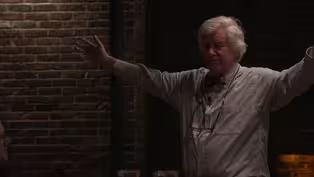
Clip: S5 Ep22 | 8m 32s | Did a daring raid in Warwick spark the American Revolution? One man files suit to prove it. (8m 32s)
Video has Closed Captions
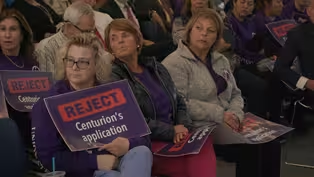
Clip: S5 Ep22 | 12m 9s | Why the uncertainty facing two Rhode Island hospitals is a statewide concern. (12m 9s)
Video has Closed Captions
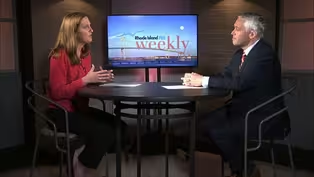
Clip: S5 Ep22 | 3m 50s | Ted Nesi describes the growing healthcare challenges in Rhode Island. (3m 50s)
Providing Support for PBS.org
Learn Moreabout PBS online sponsorship
- News and Public Affairs

Top journalists deliver compelling original analysis of the hour's headlines.

- News and Public Affairs

FRONTLINE is investigative journalism that questions, explains and changes our world.












Support for PBS provided by:
Rhode Island PBS Weekly is a local public television program presented by Ocean State Media