
Rhode Island PBS Weekly 6/25/2023
Season 4 Episode 26 | 25mVideo has Closed Captions
The untold stories of Latinos in RI and High School speed runner Sophia Gorriaran.
Weekly's Michelle San Miguel interviews local historian Marta Martinez about her work documenting the often-forgotten wide and varied history of Latinos in Rhode Island. Then Pamela Watts interviews Sophia Gorriaran, a recent grad from Moses Brown High School who is on track to become one of the fastest middle-distance runners in the world. Finally, Isabella Jibilian profiles two booksellers.
Problems playing video? | Closed Captioning Feedback
Problems playing video? | Closed Captioning Feedback
Rhode Island PBS Weekly is a local public television program presented by Ocean State Media
Rhode Island PBS Weekly 6/25/2023
Season 4 Episode 26 | 25mVideo has Closed Captions
Weekly's Michelle San Miguel interviews local historian Marta Martinez about her work documenting the often-forgotten wide and varied history of Latinos in Rhode Island. Then Pamela Watts interviews Sophia Gorriaran, a recent grad from Moses Brown High School who is on track to become one of the fastest middle-distance runners in the world. Finally, Isabella Jibilian profiles two booksellers.
Problems playing video? | Closed Captioning Feedback
How to Watch Rhode Island PBS Weekly
Rhode Island PBS Weekly is available to stream on pbs.org and the free PBS App, available on iPhone, Apple TV, Android TV, Android smartphones, Amazon Fire TV, Amazon Fire Tablet, Roku, Samsung Smart TV, and Vizio.
Providing Support for PBS.org
Learn Moreabout PBS online sponsorship(bright music) - [Announcer] Tonight on "Rhode Island PBS Weekly."
- I'm gonna do the interview in two languages.
- [Michelle] Marta Martinez knows everyone has a story.
She spent decades making sure the story of Rhode Island's Latinos are well-documented.
- When you read about Latino history in your book and it's a paragraph, and then you move on.
And I just felt that that wasn't right and the young people needed to know about the Latino history here.
- [Announcer] Sophia Goran makes the pass into the turn, she gets to the rail, will she hold off Shawnti Jackson?
Endurance versus speed.
It's Sophia Gorriaran to the line.
She runs 1:11.
(bright music) - We do get a lot of dads who come up to the bookmobile and they're like, what year is this thing?
Because it's an old Chevy van.
They're like hey, how many cylinders you got on that thing?
(bright music continues) (bright music continues) - Good evening and welcome to "Rhode Island PBS Weekly."
I'm Michelle San Miguel.
- And I'm Pamela Watts.
Latinos are the largest minority group in Rhode Island, making up 17% of the state's population.
- Whether it was Guatemalans who arrived as refugees or Puerto Ricans in search of agricultural work, the stories of Latinos are wide and varied.
But much about their lives here is not known.
Tonight we introduce you to one Rhode Islander who's trying to change that.
It's one of Rhode Island's most well-known neighborhoods - Have a good one.
- [Michelle] Broad Street in Providence, also known as La Broa, is packed with Dominican restaurants.
- This is Mi Sueno, the owner is Dominican, and he likes to welcome everybody, which is why you see all the flags.
- [Michelle] And all kinds of Dominican-owned businesses.
- This is a bodega.
This is one of the many bodegas.
- [Michelle] Marta Martinez loves to give people tours of La Broa.
- My first entry to the Rhode Island Latino community was here and it was like my senses exploded.
It's like I'm home.
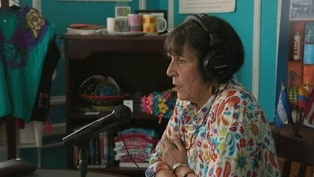
- [Michelle] She's been studying the history of Latinos in Rhode Island for more than 30 years.
- This is Juan Paolo Duarte, and he is one of the founders of the Dominican Republic.
- [Michelle] To understand why communities like La Broa are shaped the way they are, Martinez says you have to study the past and learn about a woman named Josefina Rosario, better known as Dona Fefa.
Who was Dona Fefa?
- Dona Fefa was, if I can just define her in one sentence, she's the mother of the Latino community.
She and her husband Tony moved to Rhode Island.
They opened the first bodega.
She was looking for her food and she wanted platanos and (indistinct) she couldn't find it.
So she says "Well, I'm gonna open a bodega.
And she did.
- [Michelle] Fefa's market opened on Broad Street in the early 1960s.
It went on to become a welcome site for Dominicans who left an impoverished country.
Martinez says Dona Fefa offered new immigrants more than a taste of their homeland.
- She would first help them find apartments or housing or jobs or schools for their kids, driver's license.
She was like an informal social worker.
And the bodega became the place where you went to ask Fefa, I need a job, my kids need aa place to live.
We're going to hear from Dona Fefa.
It's my very first interview.
- [Michelle] Martinez sat down with Fefa in 1991 to document her story.
Listening back to the crackled audio, Martinez recalls asking Fefa about her early memories of life in Rhode Island.
- She's describing the house, their first house where they kept all the Dominicans.
- Fefa later died in 2018.
She's one of about 110 Latinos in Rhode Island whom Martinez has interviewed for the Latino Oral History Project of Rhode Island.
What sparked your interest in collecting the history of Latinos in Rhode Island?
- Yeah, so I didn't set out to do just that.
I went to school here and I left, and then I came back.
I was hired to work for a Latino organization, a Hispanic organization at the time.
And I thought, well, if I'm gonna be working representing this group, I wanna know who they are.
And so I went out to look for them if I may put it that way.
- [Michelle] Martinez found a welcoming community of Latinos on Broad Street and was eager to see what else she could learn.
- Outside of walking Broad Street, I went to the library and looked in newspapers and tried to find information and there was nothing.
The only thing I could find were newspaper articles that were negative, Latinos arrested, Latinos in poverty, and it just didn't seem right to me.
And I just felt that it was important that people got to see a positive side of the Latino community.
- [Michelle] That positive side includes telling people about what Martinez describes as the state's Latino pioneers.
- This is Roberto Gonzalez.
He did a lot.
- A time when the Latino community was just starting to come to Rhode Island.
- [Michelle] In 2004, Gonzalez, who's from Puerto Rico, was sworn into the Providence Housing Court, making him the first Latino judge in the state.
Martinez asked him about it during an interview she recorded back in 2015.
- I was used to going in the courtroom and being asked if I was the interpreter.
So here's an opportunity now to be addressed as Your Honor.
- [Michelle] Martinez says another Latino pioneer in the Ocean State is Miriam Salabert Gorriaran.
- There were all kinds of rumors that children were going to be taken from their homes and they would be put out in the fields to cut cane.
- She left Cuba with her siblings in 1961 as part of Operation Peter Pan, a program that helped 14,000 children come to the United States to escape Fidel Castro's Communist regime.
In the three decades you've been doing this, what has most surprised you about what you've learned from these interviews?
- How similar their stories are and the hidden stories behind the individuals.
Most people think, well, I just did what I did, I'm nobody special, but I remind them, you know, what you did was huge.
I'm gonna do the interview in two languages.
- [Michelle] On this day, Martinez sat down with Socolo Gano and her daughter Sesi.
They came to Rhode Island from Columbia in 1969.
Sesi's father had moved there the year before for work.
(family speaking foreign language) Sesi became emotional remembering what those early years were like as immigrants.
(family speaking foreign language) (family speaking foreign language) Like the Gano family, Martinez says there are countless stories of sacrifices.
These are the stories she wants students to learn about.
Too often she says Latino history is only briefly mentioned in history books.
- I just felt that that wasn't right, that people needed to know more about the Latino children and the young people needed to know about the Latino history here and who were the important people.
So she does it until it becomes transparent.
- [Michelle] Martinez wants to not only make sure that these stories are recorded in history.
- [Marta] So we're waiting for it to just melt, and it's nice and hot so it will, it's just like butter.
- [Michelle] But also that traditions continue to get passed down to the next generation.
- Okay, everybody, if you can all come up to her.
- [Michelle] She recently hosted what's known as a tamalada.
- [Marta] It's like, yeah, like wrapping a gift.
- [Michelle] People were invited to the Rhode Island Latino Arts office in Central Falls to learn how to make a type of Peruvian tamale.
- [Marta] Everybody have two so far?
- Martinez is committed to preserving cultural identity through food.
(Marta speaking foreign language) And you're passionate about not only collecting the history of Latinos in Rhode Island, but also the customs, making sure that that does not get lost.
- Some people told me that I should call myself a cultural preservationist because that's basically what it is when you retain your language, when you retain the dance of a Bomba, when you play flamenco guitar, all of those things, it's a way of preserving your culture.
So the bodega was this whole area here.
There were buildings.
- [Michelle] Martinez showed me the site where Fefa's market once stood.
The building was demolished decades ago.
- We're heading towards this temporary piece of art.
- [Michelle] Martinez hopes that an art piece can be erected at the site of the former bodega.
- [Marta] And this is a image of Dona Fefa that was taken more recently.
- For now, a mural of Dona Fefa was painted over this utility box, honoring a woman who Martinez says paved the way for future Latinos.
If not for the work that you've been doing for so many decades, how would people know about the influence that Latinos have had in Rhode Island?
- I don't know, that's exactly, I do sit back and think about that and I'm very conscious because aside from the oral histories, I'm trying to create the narrative and I spend a lot of time in our archives and libraries because I think there's gotta be stuff here, and I do locate it but it's always buried, and my job I feel is to bring it to the surface and to share it.
(gentle music) - About this time next year, we will be watching the summer Olympic Games in Paris where a Providence teenager could be running after gold.
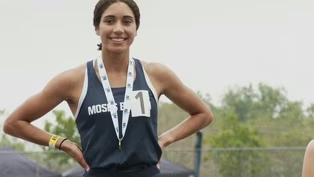
Sophia Gorriaran, a recent graduate of Moses Brown High School, just won the national high school 800 meter race, and is on track to become one of the fastest middle distance runners in the world.
- [Announcer] Nine competitors in the seated section of the girls 1500 meters.
(crowd cheering) - [Pamela] At barely 18 years old, Sophia Gorriaran has had a good run so far, setting world, national, and state records in multiple track events.
At the recent state high school track championships, she set a new record in the 800 meters and captured the top spot in the 1500 meters and the four by 400 relay, which she anchored.
- [Crowd] There we go, Sophia.
- [Announcer] And your 2023 1500 meter champion from Moses Brown, Sophia Gorriaran.
- Right after you win a race, it's a really good feeling.
I love to compete whatever it is.
So yeah, like to test how fast I am, and how I compare to other people.
I just like the challenge.
- [Announcer] Sophia Gorriaran on from Rhode Island, she can run anything from the 200 all the way up to the 3K and has set all time bests every single time she pretty much steps onto the track.
- Do you remember the first time when you said to yourself "Wow, I'm fast"?
- The first time was probably like in seventh or eighth grade when I was competing in the national championships for outdoor track winning in the 800 and 1500 meters indoors and then the 800 outdoors and the 1500 meter, I came in second, so then I was like, oh yeah, that's that's pretty good.
And going into high school I was pretty confident that I'm able to do pretty well.
- [Pamela] Sophia Gorriaran makes the pass, into the turn, she gets to the rail, will she hold off Shawnti Jackson?
Endurance versus speed, it is Sophia Gorriaran to the line.
She runs 1:11.
- [Announcer] That's insane.
- [Announcer] 1:11:35.
- Is it something that always felt natural to you?
- Yeah, I would say, I mean I started running since I was like three and a half and it's always just felt like second nature pretty much.
- Three and a half?
- Yeah, like three and a half or four years old.
- You could barely walk.
You're a toddler.
How did that happen?
- Well my siblings were running track at Hope High School for the Providence Cobras and I was asking my dad if I could run with them and he'd be like, no, not yet.
And then finally he let me run.
- [Pamela] So you were trying to keep up with your siblings?
- You could tell she could run right from the beginning.
Like she had pretty good speed and natural endurance where she could just keep running.
- [Announcer] And we're off.
- [Steven] I entered her in the NCAA last chance race at BU, but she was eight years old so anybody can run in it.
And I said well, she'll ride.
- [Announcer] I gotta say Sophia Gorriaran on the outside lane, she was out hard.
- [Steven] So that was pretty exciting.
She raced her sister and there was another woman there, a woman who was coming back from an injury and she was trying to win.
- [Announcer] It's starting to get heated down the back.
But look at that.
Sophia Gorriaran responds to the surge on the back stretch.
Are you serious right now?
I'm very impressed.
- [Steven] And at the end of the race she actually pulled ahead of Sophia by a hair.
- [Announcer] Can she hold on?
- [Steven] And and then if you watch the race, you see in the last 15 meters all of a sudden Sophia goes really fast and just goes boom.
And just finishes back in front of her by at like 100th.
- [Announcer] I think she took it.
- Was just that competitiveness, it's funny, if you watch the people in the crowd where the race is going on, they're all laughing, you know look at the little kid run.
- [Announcer] Wow, an eight year old just ran a 70 second 400.
I am incredibly impressed right now.
- [Steven] But then the BU coaches came over to me afterwards and they said, look, we appreciate it.
It was a great race, it was fun, everything like that.
But don't bring her back to the NCAA last chance qualifier when she's eight years old, let's wait a few years.
- Where do you get that competitive spirit?
- I think it just like runs in my family I guess.
- I think we come from a family of athletes.
My grandfather, her great-grandfather was a big wrestler at MIT and rower and managed to succeed the Olympic Wrestling Team in Mexico City and he's in the International Wrestling Hall of Fame.
- [Pamela] Steven Gorriaran played football and ran track at Brown University.
He acts as coach manager for his daughter.
- Was gonna have you run a 235 or something too.
- [Pamela] Sophia's older brother Max and Sister Natasha are college athletes.
Mom Corrine is a pediatrician who runs recreationally.
With that pedigree, it's no wonder at 16, Sophia Gorriaran qualified as the youngest female athlete in track and field to ever compete in the US Olympic Trials.
- [Sophia] It was a very cool amazing experience.
I was just really happy to be there and happy that my family was there with me supporting me.
- [Pamela] Despite being able to run like the wind, it has hardly been a breeze.
The road to becoming an elite athlete is grueling.
- Sometimes when you're running it's really painful, like in practice it'll be painful, but the reward after it is like amazing.
I usually train six days a week, I'll have three to four, usually four hard days unless I have a meet then it'll be three.
And then in between that I'll usually go on easier runs, longer runs just to kind of shake out my legs after a hard practice.
And then I also go to the gym like twice a week, sometimes three.
- In addition to her athletic success, there's academics where Gorriaran has again taken the lead.
I think everybody would like to know what the secret sauce is on that.
- I mean it's definitely tough.
Time management is a big thing and kind of just making sure you also get enough sleep, which I struggle with a lot.
I tend to go to bed pretty late.
- [Pamela] Even lack of sleep has not deterred her from the next step.
instead of going pro as you might have already guessed, she's going to Harvard where Gorriaran will continue to run track.
- The NCAA really helps athletes develop because you get a lot more support in the NCAA, like your coaches and everything and you have more resources available to you sometimes than when you're a pro.
And it helps you just grow.
- [Pamela] Growing up, Gorriaran has received advice from the pros and coaches around Rhode Island, but it is her father who practices by her side.
- Always practice with her just because I felt like she needed someone to practice with, or I would help her set the pace.
So I would start with her a lot.
Like if she was gonna run 800 meters, I might go 200 on, 200 off, 200 on, 200 off.
And then as she got faster, I'm like wait a second, I used to get a 42 second rest because it would take her that long to do a lap.
Now I get a 40, then I get a 38, I get a 35.
I'm like, you're killing me.
I'm getting older and you're giving me less rest.
- [Pamela] While she's now outpacing him, he never ceases to marvel at her speed.
- Just we'd be out there on the weekend and just seeing her run through the turn, I always used to think to myself that it was like watching Secretariat, the horse run, she looks so beautiful when the turn just running, just her mechanics and just flowing and very naturally.
I trust Sophia and her knowledge of track and field and I've told her I don't care if I'm screaming something to you or another coach is yelling something to you for what you should be doing or make this move or do this, if you know that's not the right thing to do, you do what you think is best.
I trust you more than I trust me to tell you what to do.
- I think I'm a pretty strong runner.
I can hold a fast pace for a while.
So I think that's one of my strengths, and I usually tend to stay pretty calm before races, like not get nervous and stuff.
I know many runners struggle with that.
So I think that's also another one of my strengths.
- [Pamela] Her Moses Brown track coach Matty Bennett says in addition to physical skill, Gorriaran has an amazing mental ability to pull away from the pack.
- That she's just continually wanting to be better and and I think that drive and that fire and that desire is really what sets her apart of just kind of never being satisfied and always wanting to achieve the next goal.
- Do you dream of Olympic Gold?
- I do.
I have since I was very young.
I've always wanted that so I'm really hoping that I get the chance to accomplish that.
- What do you think of the 24 Olympics in Paris?
- Yeah, I would love to be there.
- [Pamela] And what will it take to get an Olympic medal?
- Whew, luck.
No, what's it gonna take for anybody?
I think we're in a renaissance now of the 800 meters in the United States.
- [Announcer] Ajee Wilson, the 2022 World indoor champion in the 800.
- I think we're gonna have four or five, six of the top eight 10 women in the world will be American.
- [Announcer] And then on the outside is Athing Mu, 2021 Olympic champion and American record holder in the 800.
- That was never like that in the past.
And so I think that all of them could come down to separation of tents.
We could say it's gonna take hard work, it's gonna take this, it's probably gonna take strategy, brains.
People always think of it being a physical thing, but it's probably gonna take mental ability too, mental toughness and making the right decision at the right time.
- Obviously we've seen her have incredible success at the world level.
So yeah, I think it's totally possible.
- [Announcer] We are off.
Gorriaran, Henderson, Goule, Wilson, Mu, Akins, and Baker, this is what the people came to see.
- You just have to fight and push as hard as you can.
You can't give up.
Every time I'm out there I'm like I don't really have anything to lose because I'm pretty young.
I still have a long way to go.
Big thing about track is just sticking with it because you definitely have your bad days or sometimes a whole season will go your way.
So you just have to stick with it and keep putting in the work and eventually it'll come around and you'll end up running what you want run or better.
- [Announcer] Sophia Gorriaran, the high schooler runs for a fourth place finish in this absolutely loaded field.
- So I think that's a big thing, perseverance.
(gentle music) - And finally tonight, we meet a Rhode Island couple who has taken their love of reading to the streets.
Producer Isabella Jibilian has the story.
(upbeat music) (upbeat music continues) - I'm Emory Harkins and I'm one of the owners of Twenty Stories.
- And I'm Alexa Trembly, and I'm also one of the owners of Twenty Stories.
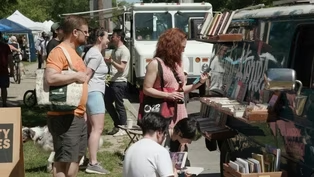
We started as a bookmobile out in Los Angeles.
We run out of a 1987 Chevy van.
Springtime through the end of summer is like when we call it van season.
We're doing our first wedding this year, which is really fun.
- We do get a lot of dads who come up to the bookmobile and they're like, what year is this thing?
Because it's an old Chevy van.
They're like, hey, how many cylinders you got on that thing?
- [Interviewer] Have you guys always been bookish?
- I mean I remember getting in trouble in school, I'd be reading books in math class and I would walk down to Kennedy Plaza to catch the bus from high school and I'd read all the way there.
- I read a lot of detective books growing up and I then would do my own detective work based off of the books.
- [Interviewer] What sort of mysteries did you solve?
- So many, so many family mysteries.
Like go around and be like dad's watching the History Channel again.
It felt like the big stuff then, felt like the big time.
Put a bookmark in there for you.
- And we took a vacation to Portugal and while we were there we saw a bookmobile on the street that sold translated literature.
- There's a really rich history of bookmobiles.
A lot of times bookmobiles went to what we like to call book deserts.
- [Announcer] To help get books into the hands of children who have no books of their own.
- A lot of times they were operating through the library system.
They would go to these destinations so people had access.
It's been fun to have our iteration of what that could look like.
Just being able to stumble upon us kind of hearkens back to that older time.
- I think I'm gonna get this.
- You're gonna go with that one?
Cool.
And then it slowly grew into also a brick and mortar space which is where we are now.
- This is a really fun short story collection.
And look at that beautiful cover, right?
- Why it's called Twenty Stories, the Bookmobile only had so much space and we wanted everything to be intentional.
It's 12 fiction, four poetry, four nonfiction.
Always more books to read, so it's hard to keep up.
And we've had people come back who haven't been reading for like 10 years and they're like, I'm a reader now.
And they start regularly reading books again.
And that's probably probably just one of the most fulfilling parts of our job.
Thanks for coming in.
Have a good one.
(gentle music) - And that's our broadcast this evening.
Thank you for joining us.
I'm Michelle San Miguel.
- And I'm Pamela Watts.
We'll be back next week with another edition of "Rhode Island PBS Weekly."
Until then, please follow us on Twitter and Facebook and visit us online to see all of our stories and past episode sat ripbs.org/weekly, or listen to our podcast on your favorite streaming platform.
Thank you and goodnight.
(gentle music) (gentle music continues) (gentle music continues)
Video has Closed Captions
Clip: S4 Ep26 | 11m 6s | A local teen may be the fastest woman in the world. Sophia Gorriaran is on the fast track. (11m 6s)
Video has Closed Captions
Clip: S4 Ep26 | 9m 43s | A local historian has spent decades documenting what brought Latinos to Rhode Island. (9m 43s)
Video has Closed Captions
Clip: S4 Ep26 | 3m 54s | Two booksellers take their show on the road. (3m 54s)
Providing Support for PBS.org
Learn Moreabout PBS online sponsorship
- News and Public Affairs

Top journalists deliver compelling original analysis of the hour's headlines.

- News and Public Affairs

FRONTLINE is investigative journalism that questions, explains and changes our world.












Support for PBS provided by:
Rhode Island PBS Weekly is a local public television program presented by Ocean State Media