
Rhode Island PBS Weekly 7/21/2024
Season 5 Episode 29 | 25m 14sVideo has Closed Captions
In-depth interviews with older workers who are enjoying their second acts.
Pamela Watts introduces us to middle-aged workers who gave up their steady jobs to follow their dreams. Then, contributor Dorothy Dickie introduces us to an Iranian-born artist who puts the oppression of women at the center of her art. Finally, a second look at Michelle San Miguel’s visit with a local farmer in Little Compton who is raising a large herd of alpacas for their fiber.
Problems playing video? | Closed Captioning Feedback
Problems playing video? | Closed Captioning Feedback
Rhode Island PBS Weekly is a local public television program presented by Ocean State Media
Rhode Island PBS Weekly 7/21/2024
Season 5 Episode 29 | 25m 14sVideo has Closed Captions
Pamela Watts introduces us to middle-aged workers who gave up their steady jobs to follow their dreams. Then, contributor Dorothy Dickie introduces us to an Iranian-born artist who puts the oppression of women at the center of her art. Finally, a second look at Michelle San Miguel’s visit with a local farmer in Little Compton who is raising a large herd of alpacas for their fiber.
Problems playing video? | Closed Captioning Feedback
How to Watch Rhode Island PBS Weekly
Rhode Island PBS Weekly is available to stream on pbs.org and the free PBS App, available on iPhone, Apple TV, Android TV, Android smartphones, Amazon Fire TV, Amazon Fire Tablet, Roku, Samsung Smart TV, and Vizio.
Providing Support for PBS.org
Learn Moreabout PBS online sponsorship- Tonight, middle-aged workers switching horses midstream.
Why walk away from a career after so many years?
- I wasn't fulfilled.
I wasn't really happy.
- [Michelle San Miguel] Then, a look at the work of an Iranian artist whose paintings inspire cultural transformation.
- [Arghavan] I didn't want to depict women as victims that don't have any agency, but still they were trapped in some unpleasant situation.
- [Pamela] Finally, we visit an alpaca haven along the Rhode Island coast.
- [Bill] When you're lucky enough to have things like this, you have to share.
(lighthearted music) (lighthearted music continues) - Good evening.
Welcome to "Rhode Island PBS Weekly."
I'm Pamela Watts.
- And I'm Michelle San Miguel.
The workforce is changing, and it's a trend that predates the pandemic thanks in large part to Millennials and Gen Zers.
- And as we first reported last December, for them, moving from job to job in short order, rather than staying with one company for life, has become the norm.
But for more mature workers, there is another growing trend: starting a second act.
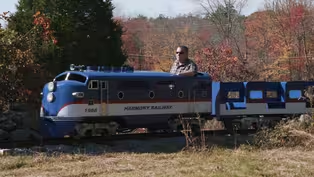
(engine rumbling) (bell ringing) Russ Gross has been working on the railroad.
In this case, an amusement ride version called the Harmony Express.
- The old saying about find a job that you like and you'll never work a day in your life, I haven't worked since we broke ground here.
It's been great.
- Gross's old fashioned roadside attraction, along with his local food and craft shop, is named for the small village of Harmony in Glocester.
He says being a conductor is quite a kick.
Yet for 25 years prior, he worked for the Providence Fire Department.
In his early 50s, Gross decided to switch from fire engines to a locomotive engine because he says he had to answer another call.
What made you take the U-turn to this?
- I don't know if it was a U-turn (sighs) so much as a side road, you know?
I didn't really reverse direction because we're still performing public service of a kind.
You know the smiles that you see when you pull a train back in and we can turn people's days around.
- [Pamela] Gross says it was now or never.
- If I don't do this now, I'll be sitting in the chair in the living room when I'm 65 or 70 and, you know, "Oh boy, I wish I'd have tried that," because you never know if you don't try.
This was an orchard because it was too rough to be hay.
- [Pamela] Gross also says he wanted to return to his roots.
His business is set on the 70-acre farm his great-grandfather bought after the Civil War.
- I didn't wanna sell the land.
You know, I didn't wanna do solar panels.
I didn't wanna put a strip mall in the field.
There's no commute.
It's clean, it's beautiful.
No two days are ever the same.
I drive a train.
I mean, and did I mention I drive a train?
- [Pamela] Gross is one of the growing number of middle-aged Americans who have an itch to change gears mid-career.
A recent national survey found 40% of workers over 50 are considering such a move, and many of those are starting new businesses.
Gross was willing to take the risk.
- I was confident but apprehensive, if that makes any sense, because I felt that I could do it, I felt that it would be successful.
- At some point in life, you are going to go through something.
- [Pamela] Bryant organizational behavior and management professor Dr. Eileen Kwesiga says there's a reason for that fearless attitude.
Mature workers are taking a page out of Gen X and Gen Z's notebooks regarding lifestyle.
- I think they want a balance.
Yes, I do want to make money, but at what cost?
- Why aren't they afraid to take the risk?
- They are not because they have learned something.
Over time, the last, I wanna say, 15 to 20 years, we have seen corporations are not as loyal as they were before.
That generation, the 40s and the 50-year-old, they have learned that, hey, I have to take care of myself too.
So I'm gonna go in there, learn as much as I can, but if I get an opportunity where I can jump ship and do my own thing, I don't have to feel guilty about it.
- [Pamela] Kwesiga says age 50+ workers have more opportunity and advantages than ever before.
- When you work over a long time, there are things that change.
You become secure in your knowledge.
You build assets, right?
- Skills.
- You have money, you build skills, you build capital, you build networks.
So now you are not just taking a blind risk, it's a calculated risk.
- [Pamela] With deep experience and transferable skills, Kwesiga points out the internet has made second acts easier, especially when establishing small businesses.
- I could be doing business globally with other companies or I could have customers.
And if I'm artistic, I start my own designs.
I can post it on Instagram or whatever social media and I'm able to get clients actually just sewing and crocheting in my bedroom.
I'm able to sell my products online.
- [Pamela] And Kwesiga says the pandemic had a profound impact on many employees.
- I think also that just brought us in touch with what is important, pursuing passions, pursuing what we care about.
- Kwesiga says she herself launched what she calls a second gig.
Her career started in IT, but years later, she swapped computers for the classroom.
What was the reason?
Because it afforded you what?
- It afforded me time, freedom, and also flexibility.
- [Pamela] Kwesiga uses those newfound hours to volunteer for nonprofits.
- I know that I benefit my student more when I'm out there in the community, either serving on boards or trying out this concept I'm trying to teach them.
- [Pamela] And she adds her students in turn are educating her.
- Maybe the content is the same, but how I am teaching it is very different.
I've moved from being the sage on the stage to more being a coach on the side.
- Finn!
(claps) Right here, baby.
- [Pamela] Michelle Ziemba was a school teacher who transferred from classroom to canines.
Her farm in Foster is home to The Country Mutt, a dog daycare and boarding facility.
- [Michelle Ziemba] Come here, come here.
- [Pamela] Recess has taken on a whole new meaning for this former educator.
She's now teaching agility and obstacle training and some manners.
Ziemba has fond memories of her students from the years she taught, most of the time middle-school science.
- That was a very secure job.
It was a very good paying job with benefits, a lot of stability.
Really loved working with kids in that 12 to 13 age group.
- Why walk away from a career after so many years?
- I wasn't fulfilled.
I wasn't really happy.
It was a very stressful job.
There were endless, endless deadlines, endless demands.
I just felt like I could put the same amount of effort into something I was creating for myself without the frustration and constraints of systems around me.
- But wasn't it scary to make this decision?
- It was very scary to say to my husband, "How about if I don't make any money for a while 'cause I wanna have a business?"
It became a profitable business that I can now make a living out of.
But it was not easy.
- [Pamela] In addition to minding 30 to 40 dogs a day, Ziemba cares for her own animals: two horses, four goats, and 15 chickens, plus several pets.
- It's a hobby farm, but we have animals with purpose.
Everybody has a purpose and not just decorations.
- [Pamela] Ziemba says she's noticed many of her contemporaries' priorities and work culture changed because of COVID.
- I think from the pandemic may have have shifted back to, well, what about my happiness?
Does that matter?
And what about being there for my children?
And what about being there for my aging parents?
And how can I make life work for me instead of just work for life?
I have no regrets.
But there were days that I did.
There were days when I would sit there and silently cry to myself and say, well, I could have the summer off right now.
I'll work seven days a week for months on end.
I worked seven days a week for the last two years.
It's just sweat equity.
- [Pamela] Despite the blood, sweat, and tears Russ Gross has put into his farm, he's on track to expand.
- I guess it's heart.
That's what the old folks would call it, heart.
You gotta have heart.
- [Pamela] For Michelle Ziemba, like Gross, leaving a long-time career for a long-held dream seems the right path to take.
- We wanna be here on the farm.
So, you know, working here and living here, it's a blessing.
- Contributor Dorothy Dickie brought us a story about an Iranian-born artist who puts women at the center of her art.
Since her time as a grad student at the Rhode Island School of Design, Arghavan Khosravi has used powerful imagery to challenge the fairly restrictive society she herself grew up in.
And as we first reported last October, her work would take on a new sense of urgency seven years ago when she went home to see her family.
- I had a short travel back home in December 2016.
And only a week after I came back to the States, the previous president had been inaugurated, and one of his first acts was signing an executive order, the so-called Muslim ban or travel ban.
- Donald J. Trump is calling for a total and complete shutdown of Muslims entering the United States.
- So if I had stayed in Iran a week longer, I couldn't come back and finish my studies.
So my first reaction to this was anger.
Like so many other Iranians in the States and non-Iranians, I decided to protest to this Muslim ban in my own way.
I wanted to start painting on the pages of my expired passport from Iran.
For me, the travel ban was the starting point, but the more I worked on this series, the work became less about, like, that specific political moment and it started to be more about my memories from Iran, because at this point I wasn't sure when I could go back to Iran.
I still haven't been able to travel outside the US.
(soft music) The bars don't seem aligned.
- They are not.
- This one is- - OK, so that one's probably- - Oh, a bit left 'cause it should be same wide as the tape.
In Iran, we have to decide about, like, our major in high school at the age of 15.
I thought that art is leisure, so I should pursue something that my 15-year-old mind thought that can rely on as a job.
So I decided to become an engineer.
So I decided math in high school.
But when I wanted to apply to college, I thought that I live only once and I really liked art and I was doing some art classes when I was at high school.
Flash forward 10 years later, when I decided to go to grad school in the States, I decided to apply for painting.
For me, that was my ambition.
(light music) Like any immigrant, immigration is the start.
And I thought that it's the start in my career too.
When I came to RISD, my work really changed.
And also I started to think about what I want to say in my work.
I'm interested in exploring concepts around gender, power dynamics, censorship.
My work is a reflection on my life experiences from Iran, and censorship and restrictions are part of our everyday life.
These are a little bit like traumatic memories.
So when I came here, I was sitting in my studio in Providence and I didn't know what to paint, and suddenly all these memories rushed to my mind.
And the geographical distance and the, like, psychological distance helped me to look at those memories from a slightly different perspective.
And I thought, this is what I want to say.
My work is figurative and also has some surrealistic elements because of a lot of symbolism that I have in my work.
And it's mostly reflecting on my life experiences and memories from Iran.
So it's a lot about women rights issues.
I didn't want to depict women as victims that don't have any agency, but still they were trapped in some unpleasant situation.
And I used different symbols to show those restrictions, like ropes, ball and chain, which is an obvious symbol of lack of freedom.
(tense music) I'm always inspired by Persian miniature paintings.
I appropriated some battlefield scenes from miniature paintings and combined them, juxtaposed them, with figures of women.
And in my mind, those battlefield scenes of those soldiers attacking the women, which were, by the way, like, proportionally smaller than the women, I was thinking of them as a symbol of misogyny or patriarchy.
(uneasy music) (uneasy music fades) After the uprisings in Iran that happened less than a year ago, the Woman, Life, Freedom movement, (protestors chanting and clapping) I was inspired by the courageous acts of Iranian women and men that took to the streets and protest to achieve more equality.
(protestors shouting) Because women had stood up against the suppression, I really wanted to have that change in my work too.
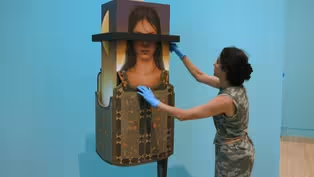
So I decided to appropriate those, like, the armors that the soldiers in previous works were wearing that were attacking women so that the women now are wearing those armors.
So I made these free-standing pieces with, like, the helmet.
Now the women are wearing those armors.
There were a lot of imagery of quiver and arrows in those miniature paintings that I also appropriated in my own work, and I replaced the feathers at the end of the arrows with human hair.
In my mind, it was like a symbol of this resistance.
'Cause after the movement, I see a lot of images and videos coming from Iran that women defy the compulsory hijab and stopped wearing hijab in public, and they risked their lives by doing that.
They can get arrested or even death.
So for me, that became like a symbol of resistance, so I incorporated that element in my work.
It makes me feel better when I, like, talk about these issues in my work.
I want to have some elements of my own cultural heritage and cultural identity, but also I want to share the story with others.
And I don't want the paintings to be limited to my own experience.
And because of the symbolic approach I have, I hope that audience that are coming from different cultures, different life experiences, they can find their own selves in the works.
(soft music) Although I'm talking about human right issues, women right issues, but maybe someone, for example, in the States that has experienced, I don't know, domestic violence can also relate to the pieces.
And I think, like, women rights issues is something universal.
Like even in more progressive countries, there is still a really long path ahead of women to achieve equality.
(gentle music) Because my work is a lot about the idea of contradiction, so I try to experiment with this contradiction in different ways.
One of them is to have visual elements that's coming from different cultures, different times, contemporary past, or like religious, secular, all these contrasting elements.
Because for me, it's like a visual translation of my life in Iran and most of the people who think freely and they can wear whatever they want and do whatever they want, but when they go in public, they have to adhere to some Islamic regulations that is imposed by the government.
So that contrast, for me, is like the main component in my practice.
(light music) (melancholy music) I feel good when I create something.
If I don't paint for a few days, I feel down, I feel depressed.
With images, I can express myself, I can tell my stories and share it with different people.
Like if I make an art that no one sees, I'm not satisfied.
Sharing it with the audience is also a very big part of it.
- Finally tonight, we bring you a story about a farm in Little Compton that's home to a herd of alpacas.
The animals are native to South America, not New England.
Still, as we first reported in May, the couple that's raising them has found a unique way to pay tribute to the Ocean State.
- It's satisfying knowing that you have something to take care of besides yourself.
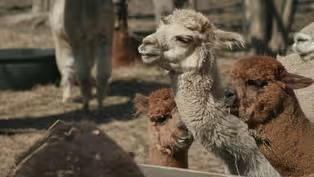
- [Michelle San Miguel] Nestled near the coast of Rhode Island sits Hope Alpaca Farm in Little Compton, home to a large herd of these gentle and social animals.
Bill Ryan and his wife, Hope, opened the farm in 2017.
He says they hadn't had any animals here for more than 25 years and wanted to change that.
- We were driving up in Vermont on a vacation and we went by an alpaca farm.
And she goes, "Well, let's raise alpacas."
And then a year later, I had six of them.
(both laughing) - [Michelle San Miguel] At the time, what did you know about alpacas?
- Nothing.
Not a thing.
- [Michelle San Miguel] The learning curve was small for Bill Ryan.
He says Huacaya alpacas, native of the Andes mountains in South America, are easy to raise.
They have soft padded feet, so they're gentle on pastures.
- They like 2nd cut hay, which we buy out of New York 'cause it's very hard to make hay here.
And there's no seed in it and no kind of like grass sticks.
We do give 'em grain once a day and we graze 'em out in the fields out here.
- [Michelle San Miguel] The farm started with six alpacas and has grown to 20, ranging in color from white and gray to brown and black.
- You do have to have at least three because they're a very social animal with the herd.
They're a pack, you know, a pack animal, and they like each other, even though they spit at each other.
(laughs) - I quickly discovered these alpacas, which can average between 100 to 200 pounds, each have a unique personality.
Oh my goodness, you're so calm.
Hi, hi, oh, you don't wanna be touched.
- No, she's- - Can I touch you?
Nope, don't wanna be touched.
Do you wanna smell me?
Hi.
(smooches) Oh, sorry, okay.
- But she's very, (laughs) she's very gentle.
- Was it something I said?
(laughs) Alpacas are known for their fiber.
It's hypoallergenic, and Ryan says it's less irritating on the skin than a sheep's wool.
- It's funny, you know, if you've ever worn wool and gotten it wet, it can itch on certain people.
You know, certain people don't, you know, it irritates them.
And it's funny that a lot of diabetics wear their socks because it's a lot more smoother on their feet.
- [Michelle San Miguel] The alpacas are shorn once a year before the summer.
The Ryans then bring the fiber to a processing service in Fall River.
In return, they receive credits for products they sell in their farm store, including hats and gloves made from US-grown alpacas.
- These two have been born here, and this one's Metacomet.
And then we named this fella here Blackstone, for the Blackstone River.
- [Michelle San Miguel] All of the baby alpacas, known as crias, born on the farm are given Rhode Island-based names, like Richmond and Prudence.
- This is Bristol.
She's one of my favorites.
- Why?
- Well, because I did help her come out when she was born.
Yeah, her foot was stuck.
- Wow.
- So I had to get her foot out for her.
- Wow.
Ryan says it was important for him and his wife, both native Rhode Islanders, to name the alpacas with the Ocean State in mind.
- My wife is an old Rhode Islander, and her family goes back to Roger Williams.
And we just thought with a theme that we do something, like, in Rhode Island, you know?
It's a proud place to live.
I love living here.
I mean, we're kind of off the beaten pad of the main Rhode Island, but we love it.
- [Michelle San Miguel] The 20-acre farm has been in Bill Ryan's family since the late 1800s.
The family hosts open house events and offers private tours.
Ryan recalls one memorable visitor.
- We had this child, and he was in a wheelchair, and he couldn't move his hands that much.
And he was, you know, active, but...
So I finally just took him in a pen in his wheelchair and I dumped grain on his lap.
And they all came in and they were all in his face.
And this kid, I'll never forget it.
I mean, he was just so happy.
- Do you have moments where you come out here at night and just sit in awe of this land?
- Yes.
Yes, I have moments of you go out here and you ponder, sit on a stone wall and just take it in, take the moment in.
- [Michelle San Miguel] Ryan says he and his wife are passionate about sharing this alpaca haven with others.
- It's something that we're very lucky to have.
And when you're lucky enough to have things like this, you have to share it.
- And since the story first aired, the alpacas' fiber has been shorn, they've had their annual haircuts, so they're gonna look different if you go to the farm now.
- I think I'm still gonna recognize them.
- I think you will.
(both laughing) And that's our broadcast this evening.
Thank you for joining us.
I'm Michelle San Miguel.
- And I'm Pamela Watts.
We'll be back next week with another edition of "Rhode Island PBS Weekly."
Until then, please follow us on Facebook and X.
And you can visit us online to see all of our stories and past episodes at ripbs.org/weekly or listen to our podcast on your favorite streaming platform.
Goodnight.
(lighthearted music) (lighthearted music continues) (lighthearted music continues) (lighthearted music continues) (lighthearted music continues)
Video has Closed Captions
Clip: S5 Ep29 | 6m 36s | A couple in Little Compton raises a large herd of alpacas for their fiber. (6m 36s)
Video has Closed Captions
Clip: S5 Ep29 | 9m 55s | Iranian-born artist puts the oppression of women at the center of her art. (9m 55s)
Video has Closed Captions
Clip: S5 Ep29 | 9m 8s | Trending in the workforce: folks fifty-plus leaving a long-time career for a new dream job. (9m 8s)
Providing Support for PBS.org
Learn Moreabout PBS online sponsorship
- News and Public Affairs

Top journalists deliver compelling original analysis of the hour's headlines.

- News and Public Affairs

FRONTLINE is investigative journalism that questions, explains and changes our world.












Support for PBS provided by:
Rhode Island PBS Weekly is a local public television program presented by Ocean State Media