
Rhode Island PBS Weekly 7/2/2023
Season 4 Episode 27 | 26m 55sVideo has Closed Captions
The building of barriers to suicide and new treatments for Alopecia Areata.
Rhode Island PBS Weekly takes a second look at the story of a man who survived a jump from the Newport Bridge, and is now looking to save lives from the threat of suicide. Then, we revisit stories of living with Alopecia. Finally, we return to Linden Place, a historic home museum in Bristol that is taking a hard look at its relationship with racial justice.
Problems playing video? | Closed Captioning Feedback
Problems playing video? | Closed Captioning Feedback
Rhode Island PBS Weekly is a local public television program presented by Ocean State Media
Rhode Island PBS Weekly 7/2/2023
Season 4 Episode 27 | 26m 55sVideo has Closed Captions
Rhode Island PBS Weekly takes a second look at the story of a man who survived a jump from the Newport Bridge, and is now looking to save lives from the threat of suicide. Then, we revisit stories of living with Alopecia. Finally, we return to Linden Place, a historic home museum in Bristol that is taking a hard look at its relationship with racial justice.
Problems playing video? | Closed Captioning Feedback
How to Watch Rhode Island PBS Weekly
Rhode Island PBS Weekly is available to stream on pbs.org and the free PBS App, available on iPhone, Apple TV, Android TV, Android smartphones, Amazon Fire TV, Amazon Fire Tablet, Roku, Samsung Smart TV, and Vizio.
Providing Support for PBS.org
Learn Moreabout PBS online sponsorship(gentle upbeat music begins) - [Announcer] Tonight, on Rhode Island PBS Weekly.
- They estimate it's going to be 5 million per bridge.
A lot of people will say, "That's a lot of money for this."
- How much is a life worth?
Is 5 lives not worth 5 million?
- Losing your hair is like losing a part of you.
It's losing a part of your identity.
- [Pamela] Those who suffer from a rare autoimmune disease often deal with frequent stares and questions.
- Not everybody who doesn't have hair is sick.
And we get a lot of, "Oh, is she sick?"
You know, "We'll pray for her.
How are her treatments going?"
(music building) - Good evening.
Welcome to Rhode Island PBS Weekly.
I'm Pamela Watts.
- And I'm Michelle San Miguel.
Every day thousands of Rhode Islanders pass over our area's bridges, Newport, Jamestown, Mount Hope and others.
- And for most they are just a means to get from point A to point B.
But as we first reported last September, for some people and their loved ones, they are a site of no return and pain.
When you look over at the Newport Bridge, right now, what do you think?
- I think of what other people think of when they're going through dark moments as I was that, you know, night.
- That night in June 2015, Mark Gonsalves jumped from the peak of the Newport Pell Bridge, plunging into Narragansett Bay.
Do you remember anything?
- I remember everything, everything but impact.
There was a lot of pain going through my heart that night.
I got some more bad news about employment, which kind of just topped everything off that I was already going through.
I waited for my girlfriend to go to sleep.
I took the keys, I emptied everything outta my pockets, got in the car and tried to make a few phone calls.
After that, I just punched the gas and drove about a hundred miles per hour.
And got to the top and slung the door open.
And it was easy to jump on top of the railing.
The railing's less than 48 inches.
- So you went there knowing that it was low enough for you to gain access to the edge.
- Oh yeah.
Yeah.
- You are a miracle.
You jumped and lived to tell the tail.
How was that possible?
- Every detail of how it went was a miracle.
From how I hit the water feet first.
The discs in my back down my spine burst out as everything is pushed down.
And Rhode Island Hospital being the only hospital in New England that has the only machine that could have saved me at that time.
- He was also lucky, because two pleasure boaters happened to be nearby when he jumped and fished him from the waters.
Do you feel like you were saved for a purpose?
- I do.
I definitely do.
- That purpose brought Gonsalves to the Rhode Island State House to testify in favor of Bill 7383, calling for a design study of suicide barriers and safety nets on all four of Rhode Island's major bridges.
- I'm a suicide survivor by way of Newport Bridge.
I had no weapon that I thought could do the job.
I had no pills to OD on.
I had a car to get into and less than a quarter mile to drive to the top of the Newport Bridge.
And because the railing's so low, that's why I chose the Newport Bridge.
In Rhode Island, there's a lot of money put into repairing potholes so we don't damage our cars, but I'm here to ask that we put some money into these bridges so we don't damage anymore lives.
- My name's Melissa Cotta.
- [Pamela] Melissa Cotta also testified at the hearing.
She witnessed a man's fatal jump from the Mount Hope bridge as she was driving by.
- That was a moment that I will see his face forever.
I can't believe it was six years ago, because it is so real to me and it matters that I do something about it.
- [Pamela] What she did about it was become Co-Founder of Bridging the Gap for Safety & Healing.
The group's advocacy helped pass that bill providing a million dollars from the American Rescue Plan Act for a barrier engineering study.
But she says, it was just the first step.
- We are advocating to put up temporary barriers while they complete the study and before the permanent barriers go up.
We need to put something up because the longer we wait, the more people that are gonna continue to jump.
And the current study is going to probably be completed somewhere at the beginning of 2024.
So we're looking at about 18 months or so, and that is an awful long time to keep our bridges unsafe.
From November, 2020 to November, 2021, we had 13 total jumps from our 4 bridges, so that's a significant amount.
The ripple effect is it impacts families, it impacts our community, it impacts the coworkers.
It impacts all the children growing up.
- [Pamela] Gonsalves believes the impact of safety barriers will be significant.
- Most of the times, it's done through impulse.
It's an impulsive thing.
If there's barriers, it will be just what it says the word is, "Barrier."
And then, the few minutes that they step back, they might have gotten a phone call of support.
They might have had just a second thought.
- What else needs to be done to put a barrier between people and suicide?
- The main thing is decreasing the stigma behind mental health.
A lot of people are afraid to come forward.
They're afraid to talk about it.
And people that need help are afraid to reach out because they might not get the help that they need.
- I would like to talk today about a health epidemic that is claiming the lives of tens of thousands of Americans each year.
I'm speaking about the epidemic of suicide.
- [Pamela] It was Rhode Island Senator, Jack Reed, who co-sponsored new legislation creating the National 988 Suicide Prevention Lifeline.
The simple three digit number connects callers in crisis to local mental health professionals 24/7.
(phone ringing) - Hello, you've reached BH Link.
This is Matt speaking, how can I help you?
- [Pamela] The 988 number went live in July.
- The idea that we're changing a number from a 1-800 number to 988, makes it that much easier to memorize and that much easier to reach out for help.
- [Pamela] Joe Ash is the Co-Director of BH Link, Rhode Island's hub for behavioral health.
He says the new three digit number works for people experiencing a mental health crisis the same way 911 is there in general emergencies.
Do you see any parallels between the push for barriers on our state bridges and 988?
- Absolutely.
And the idea of the 988 call line being a barrier is, (phone chirping) it gives the person in crisis the opportunity to step back for even a moment and really contemplate the impact of what their thoughts really mean and what executing those thoughts means.
One of the things that's special about our call center, specifically, is we are paired with a 24/7 walk-in triage center.
Our ability to not only respond to crises over the phone, but also to invite people into our doors and say, "Come get the help in person that you need."
- Now, let's talk about you possibly coming into the BH Link.
- So if anyone's looking for a comprehensive assessment with a master's level clinician, a nurse, a peer recovery specialist, they can come in, receive an assessment and referral to the appropriate level of care.
To keep them out of emergency rooms, to keep them out of inpatient hospital settings, we're really trying to divert calls from 911 that don't need to be going into 911.
Also, we have the ability to dispatch mobile crisis into the community and provide that consultation and assessment in the community.
And so, being able to have someone come to your home and check in with you is really a big step and a step in the right direction.
- You talked about trying to reach someone the night that you went off the bridge.
- Yeah.
- Do you think 988 would've helped?
- Maybe.
It's a voice on the other end.
- Hello, this is BH Link.
How can I help you?
- That has a Rolodex of resources and you know, somebody just to listen.
- [Pamela] Meantime, once the design study on safety fencing for the state's bridges is complete, there may be another barrier, cost.
They estimate it's going to be 5 million per bridge.
A lot of people will say, "That's a lot of money for this."
- How much is a life worth?
Is 5 lives not worth 5 million?
Because 5 people have died this year alone in Rhode Island on Rhode Island bridges; 5 people.
- Do you truly believe that these barriers are going to prevent suicides?
- Without a doubt, without a doubt they will.
It's too easy to jump these bridges and people are doing it.
It's a no-brainer.
These bridges need barriers.
Bridges that are built now get barriers.
Barriers will prevent people from dying.
- Some people, they already been through enough pain.
They've already suffered enough pain in their life.
And they just, they just want it to end, you know?
And that's what I wanted.
That to me was solving my problems.
- Now, when you look at the bridge, how do you feel?
- I feel like I succeeded in getting through times in my life that are meant to be.
Now I just hope that I could prevent someone else from making decisions like that and just keep it as a beautiful structure instead of using it for something so tragic and you know, dark.
- More than $700,000 had been earmarked for the 2024 state budget to complete a feasibility study on safety barriers for the Newport Pell and Sakonnet River Bridges.
Up next... How much time do you spend on your hair?
Getting it cut, washing, brushing, styling, it's a part of your self-expression.
Well, what if your hair suddenly and rapidly fell out?
It can feel like losing a part of your identity.
That's the reality for some 6 million Americans who suffer from this disease.
Their hair loss can range from small patches to total baldness.
But as we first reported last September, while it's not life-threatening, those who have it say it is life altering.
- It's a hard world.
And I didn't want her to have to have any extra battles to fight that she doesn't need to fight, and this is a big one.
- [Pamela] Chelsea Silveira remembers feeling confused as she watched her daughter, Riley, gradually lose all of her hair as a baby.
Soon after Riley turned one, her hair began growing back in patches.
That's when Chelsea took Riley back to the doctor.
- He said, "Well, let's rule out some of the scary stuff."
They did some blood work, all of that was normal.
So that's when we went to see a dermatologist.
And then we went from one dermatologist to the next.
And they all confirmed it's alopecia, which is rare under the age of two.
- Come on.
Wanna come on?
- [Pamela] Alopecia areata is an autoimmune condition that causes hair to fall out from the scalp and other parts of the body.
Scientists aren't sure what causes the immune system to attack the hair follicles.
What was your thought when you hear your daughter is diagnosed with Alopecia areata?
- Gut wrenching.
- Because?
- She's my little girl.
You know, you want your girl to have long beautiful hair and you don't wanna have to accept that there's something different, you know?
- [Pamela] Most of the people who have the condition don't have a family history.
That's the case for this 11-year-old from Bristol.
Riley doesn't remember life with hair, but she's also not one to dwell on what-ifs.
Instead, much of her time is spent doing gymnastics.
She dreams of someday competing in the Olympics.
Do you ever wish you had hair?
Or are you glad that you don't have hair?
- I'm glad that I don't have hair 'cause at gymnastics, if you wear a ponytail and then you have long hair, and if you do a back handspring, you could like get your hand on your hair and then you can mess up and it would hurt.
- So it's an advantage to you not to have hair.
Do people, can I ask, ever say anything hurtful because you don't have hair?
No?
- [Pamela] But over the years it has taken a toll on Riley.
- [Riley's Dad] You're the most special girl in the whole world.
Hair doesn't matter.
Okay?
- [Pamela] When she was just six years old, her mom recorded this video of Riley and her dad talking after Riley said she didn't love herself because she's bald.
- [Riley's Dad] It doesn't matter if you're bald or if you have hair.
(background television) That doesn't make any difference, sweetie.
You want Daddy to shave his head?
I'm gonna shave my head.
Want me to do it right now?
Okay, let's go.
(razor buzzing) We'll get it nice and short just like Riley, nice and bald (indistinct).
- People who have any type of differences get looked at.
You're worried about, are they gonna get made fun of?
Are they gonna find love one day?
What is her life gonna look like?
Is she gonna be okay, emotionally?
- [Pamela] Dr. Lynne Goldberg has seen firsthand the emotional rollercoaster that comes with hair loss.
- Some patients tell you that they wake up every day and just have to put on this armor just to go out and face the world.
- [Pamela] Dr. Goldberg is a Professor of Dermatology at Boston University School of Medicine.
She also directs the hair clinic at Boston Medical Center.
- People think they're sick, people assume they have cancer.
People say terrible things to younger patients.
They compare them to, you know, figures like without hair like it's terrible, it's terrible.
A lot of bullying, things like that.
So it is a terrible, terrible burden for some patients.
And some people deal with it better than others.
- Oh yeah, king me.
- [Pamela] Carissa Casales knows what it's like to be stared at and made fun of.
- Years ago, we went on a family trip and I had a guy who gave me a hard time about not having hair.
He, you know, thought it was funny that I was always wearing hats to protect my head.
- [Pamela] Casales lives in Walpole, Massachusetts with her husband and three kids.
She began losing her hair when she was 23.
For several years she would get corticosteroids injected into the bald patches of her scalp.
- Here, even on your wedding day, you were already experiencing alopecia.
- Yes.
So... - But you had so much hair, you were able to cover the hair loss.
- So much hair that I was really able to cover certain patches of the hair loss.
- [Pamela] After years of injections and seeing her hair regrow only to find more bald patches, Casales asked her husband to shave her head for good.
That was nearly two decades ago.
- Do you remember that moment pretty vividly when your husband shaved her head?
- I do.
I do.
I remember feeling, I wasn't sure if I was going to laugh or cry at the time.
Because it was just such a hard, you know, I was so relieved in a way, but at the same time, wasn't really sure what the future was gonna bring, now being totally bald.
It definitely remains tough because of the fact that people just aren't aware of what alopecia is and automatically assuming other things.
I like to educate people.
When someone asks me, "Are you sick?"
Or they say, "God bless you, your journey's gonna be great."
And I just, I now just take a step back and I say, "Thank you.
It is gonna be great."
- [Pamela] Casales knows everyone's journey with alopecia is different, including that of Massachusetts Congresswoman, Ayanna Pressley.
- For the very first time, Massachusetts Congresswoman, Ayanna Pressley, is publicly revealing a personal battle she is facing.
- This is my official public revealing.
I'm ready now because I wanna be freed from the secret.
- I'm so proud of Ayanna, because her journey was so quick with having alopecia.
It wasn't something I experienced, but something that she experienced.
And many other people in my alopecia support group that I speak to have experienced hair loss almost overnight, within a matter of days, weeks, that they've literally lost all of their hair.
- [Pamela] Casales was excited to share news with her support group over the summer that the FDA approved for the first time, a treatment for alopecia that targets the whole body.
It's an oral tablet called, "Olumiant."
Here you have been waiting decades, - Yes.
for a drug to come on the market that has the FDA's approval.
And yet you're telling me that you can't use this.
- So as I understand, it really works more efficiently for someone who has alopecia for less than 10 years.
And for someone like me who has had alopecia for over 25 years now, or coming on to 25 years now, this is, it's not for me.
- It is true that when you have severe loss, the longer it goes on, the lesser the chances you have of regrowing.
So for patients with recent loss, if they're interested in the drug, the time is now, right?
The sooner that you try the better.
- [Pamela] Casales isn't losing hope that another treatment will work for her, but she says, she doesn't mind being bald.
- It's definitely a different look.
- Yeah.
How do you feel wearing it?
- I feel good.
I feel good.
- [Pamela] Most of the time, Casales doesn't wear a wig.
She says, she prefers to use it when it's cold outside or when she's in an uncomfortable situation, like a job interview.
- I would definitely consider wearing my wig as opposed to not wearing my wig, because I think that people would often judge and look at me as having an illness and being sick because I don't have hair.
- Do you wanna wear a wig?
Or would you rather not wear a wig?
- I don't wanna wear a wig.
- You don't wanna wear a wig?
- Mm (affirmative).
- Why not?
- I don't know.
It itches my head sometimes.
(laughing maniacally) I got your jack, mommy.
- [Pamela] Riley has also tried topical steroids, but it wasn't effective.
- Nooo!
This one's a good one.
- [Pamela] She finds strength in other friends who have alopecia, including model and dancer, Christie Valdiserri.
She's the first bald Sports Illustrated model.
- What does Christie always say?
"Bald is beautiful.
You can do anything.
It doesn't matter if you have hair or not."
- [Pamela] Chelsea says, she works hard to help her daughter feel confident as a bald girl.
- I think the biggest thing is, teach your kids that not everybody is the same.
She's doing so well, but I know we'll have some difficult moments and I hope they're few and far between.
But we've got a good group of friends and family that'll get us through that.
- The US Food and Drug Administration recently approved the first and only medication for children ages 12 and older with severe alopecia areata.
The drug is called, "Ritlecitinib."
This makes it the second FDA-approved treatment for the disease.
Finally tonight, in our continuing series, "Window on Rhode Island," we visit Linden Place in Bristol, once the home of the DeWolfs.
They were the largest slave trading family in US history.
As we first reported in April of 2021, institutions across the country have begun to take a hard look at their relationships with racial justice, and so too has Linden Place.
(gentle music begins) - Behind me is Linden Place Mansion.
It's a federal style home built in 1810 by George DeWolf.
George and Charlotte DeWolf both came from very prominent wealthy families here in Bristol.
George was very much a wheeler-dealer opportunist, here in town in terms of business.
We always like to think of the northern states being sort of the liberators, the ones who sort of worked against slavery, the abolitionist societies, when in reality, the transatlantic slave trade involved every bit of the Rhode Island economy in the 18th and early 19th centuries.
The DeWolf family owned many ships and they also owned the town banks.
They would take these ships, they would load them up with rum, which was made here in Bristol, and they would sail to Africa, specifically Ghana, what they called, "The Gold Coast."
And they would take that rum and they would trade for enslaved peoples to be brought on their ships to plantations in Cuba.
It was a very brutal journey.
Rum was in very high demand.
Rhode Island rum, in particular, was very sought after.
This was a huge moneymaker for the DeWolf family.
In 1825, George had a rush of some really bad luck, financially.
He was left basically bankrupt.
But because the entire town's fortunes were invested in the DeWolf business ventures, the entire town of Bristol basically went bankrupt.
And so, George with his wife, Charlotte, and their children fled from Linden Place.
And they rode to Boston where they caught the first ship to Cuba, and they went and lived out the rest of their lives at that Cuban sugar plantation.
People woke up the next day and the banks were closed and they wanted an explanation of where their money was.
This led the town of Bristol into a financial depression that lasted decades.
Linden Place has been operating as a historic house museum for about 30 years.
So when COVID took place in late winter last year, it really gave us at Linden Place a chance to step back, look at our story, think about what we're doing well, but more importantly, what are we not doing well?
What are we not talking about?
We are not talking about the contributions of African-Americans to Bristol history into the history of this house.
So we really set off investigating and researching stories that we weren't aware of before.
- My name is Lynn Smith, and I'm a volunteer here at Linden Place.
So I do a little historical research through the census, through birth records, through marriage records.
We started to build a little bit more robust story.
Daniel Tanner was an entrepreneurial black man, free black man, who ran a business right here in the conservatory of Linden Place, a barbershop.
In some of the southern plantations, it was quite common for the wealthy plantation owners to have what was known as a, "Waiting man."
It was a black slave, a man servant, who was sort of his personal valet.
Made sure that his clothes were perfect, his coiffure was perfect.
That tradition sort of migrated north and barbers became well-known, black barbers, for the excellence of their skill.
So we know that Daniel Tanner was probably the great grandson of a local slave, Scipio Tanner, but interestingly, he was much more than just a black barber.
We found a story in the local Bristol Phoenix, for example, that he started the Excelsior Cornet Band.
And was quite proud that he and his band marched in the very famous Bristol 4th of July parade every year.
(gentle music begins) - This whole adventure of delving into, not only Daniel Tanner's history, but that of his family and their connections to Bristol, their connections to Newport, we feel will open up a whole new side of this mansion's history that no one knew about.
- Further research at Linden Place has now found that Daniel Tanner's barbershop was not in the house, but in a building across the street.
And that's our broadcast this evening.
Thank you for joining us.
I'm Pamela Watts.
- And I'm Michelle San Miguel.
We'll be back next week with another edition of Rhode Island PBS Weekly.
Until then, you can visit us online to see all of our stories and past episodes at ripbs.org/weekly or listen to our podcast available on all your favorite audio streaming platforms.
Thank you and goodnight.
(gentle music begins) (gentle music continues) (gentle music continues) (gentle music fades)
Video has Closed Captions
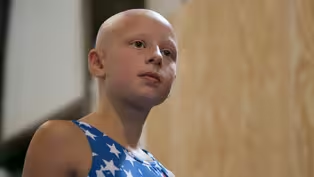
Clip: S4 Ep27 | 9m 55s | New medication for those who suffer from Alopecia. (9m 55s)

Video has Closed Captions
Clip: S4 Ep27 | 10m 17s | A man who jumped off the Newport Bridge and lived is now a leading advocate for change. (10m 17s)

Window on Rhode Island: Linden Place
Video has Closed Captions
Clip: S4 Ep27 | 5m 41s | Rhode Island PBS Weekly revisits Linden Place and explores its troubled past. (5m 41s)
Providing Support for PBS.org
Learn Moreabout PBS online sponsorship
- News and Public Affairs

Top journalists deliver compelling original analysis of the hour's headlines.

- News and Public Affairs

FRONTLINE is investigative journalism that questions, explains and changes our world.












Support for PBS provided by:
Rhode Island PBS Weekly is a local public television program presented by Ocean State Media