
Rhode Island PBS Weekly 7/23/2023
Season 4 Episode 30 | 27m 19sVideo has Closed Captions
An in-depth look at how language deprivation can cause children to fall behind.
Weekly's Pamela Watts takes an in-depth look at how language deprivation can cause deaf children to fall behind. Then, producer Isabella Jibilian takes a look at the trend of thrift shopping, which has become popular among young, environmentally conscious Americans. And finally, Michelle San Miguel has an intriguing story about a world where some people not only hear music but also see it.
Problems playing video? | Closed Captioning Feedback
Problems playing video? | Closed Captioning Feedback
Rhode Island PBS Weekly is a local public television program presented by Ocean State Media
Rhode Island PBS Weekly 7/23/2023
Season 4 Episode 30 | 27m 19sVideo has Closed Captions
Weekly's Pamela Watts takes an in-depth look at how language deprivation can cause deaf children to fall behind. Then, producer Isabella Jibilian takes a look at the trend of thrift shopping, which has become popular among young, environmentally conscious Americans. And finally, Michelle San Miguel has an intriguing story about a world where some people not only hear music but also see it.
Problems playing video? | Closed Captioning Feedback
How to Watch Rhode Island PBS Weekly
Rhode Island PBS Weekly is available to stream on pbs.org and the free PBS App, available on iPhone, Apple TV, Android TV, Android smartphones, Amazon Fire TV, Amazon Fire Tablet, Roku, Samsung Smart TV, and Vizio.
Providing Support for PBS.org
Learn Moreabout PBS online sponsorship(bright music) - [Announcer] Tonight on "Rhode Island PBS Weekly".
- [Host] Another group of hearing parents meet to learn sign language from David Mullowney, who is being interpreted aloud.
He signs the picture book "The Snowy Day".
- [Interpreter] So Peter was sleeping, all night.
- [Host] So that they can sign bedtime stories to their children.
- You woke up?
You wake up.
- I wake up.
- You woke up, yep.
- One of the things that's happened over the last 25 years really is that garments have become more difficult to recycle.
And that's where you start seeing large amounts of textile waste.
- It's almost like saying, you wish the sky wasn't blue.
There's nothing I can do about it.
It's part of my life.
- [Host] The way they see the world isn't like most people.
- Artists tend to be very often looked at as flaky or not part of society.
It's just accepting that part of me that yeah, we aren't like everybody else.
This is a little weird.
(bright music) - Good evening.
Welcome to "Rhode Island PBS Weekly".
I'm Pamela Watts.
- And I'm Michelle San Miguel.
In America, more than 90% of deaf children are born to hearing parents.
For them, the path forward is not just difficult, it's controversial.
- As we first reported in April, with the advent of cochlear implants, technology has the opportunity to change lives.
Yet many deaf advocates say ruling out sign language is a risky proposition.
Tonight we take a look at the stark choices some parents face.
- Ready again.
(all clapping) - Who, who?
Here, here, here.
- [Host] Parents of young children gather at Rhode Island School for the Deaf.
- [Parent] What are we doing next?
- Yay, good job, good job.
(Parent laughing) - [Host] To learn American Sign Language, or ASL, together.
- [Interpreter] A group hug is what this mouse needed.
- [Host] David Mullowney is their teacher being interpreted aloud.
- [Interpreter] This is the sign for I love you.
You'll see this a lot in American Sign Language.
- [Host] They are starting early to make sure their deaf and hard of hearing children don't fall behind.
Nancy Maguire Heath has been Director at Rhode Island School for the Deaf for the last 11 years.
- We frequently, especially the last few years, have had number of students referred to us who have no language, or have little language.
They may have 50 to 100 spoken words, when they should have thousands by that age.
- [Host] Most arrive never having learned any sign language.
And Maguire Heath is entrusted with helping them catch up after years of missing out on opportunities to learn.
- You and I, because we're hearing, we learn from our environment all the time.
We learn from mom on the telephone talking to the plumber.
A deaf child may not get any of that.
They're not getting that incidental learning that our brain grows from.
- [Host] That brain growth is the focus of extensive research by Dr. Wyatte Hall, Assistant Professor of Public Health Sciences at the University of Rochester Medical Center.
He says when it comes to language exposure, there's a ticking clock.
- [Interpreter] We've seen a lot of research that there appears to be a critical period or a sensitive period depending on who you talk with.
That period is a time where we are born biologically ready to acquire language.
- [Host] Studies estimate the window lasts from birth to ages three to five.
If children can't easily hear people talking or see people signing, they run the risk of developing what's known as language deprivation.
- Their thinking becomes locked in the concrete.
They can keep learning, but they don't do well in the abstract and they can't keep up.
(child howling) - Oh, you're a wolf now?
- No, I'm a werewolf.
- Oh, you're a werewolf.
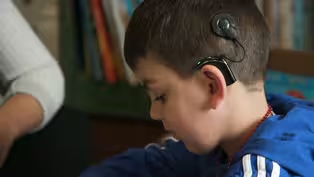
- [Host] Emma White, a social worker in Rhode Island, is dedicated to ensuring her five-year-old son Luca is immersed in language.
- One, two, three, four, five, six.
- Okay, you gotta find a green square.
No, the first one.
- The first time.
- The first time?
- [Host] White found out Luca was profoundly deaf in both ears when he was just three weeks old.
- I'm just thinking like, is he ever going to be able to hear, will he ever be able to talk?
Am I gonna be able to communicate with him?
What did you make at Grandma's today?
- Snow man.
- How many?
- Two.
- Two?
- [Host] Parents of deaf and hard of hearing children are usually given two main options.
- Should we be signing to him?
Should we be focusing on spoken language?
The advice that I was getting was at times conflicting of what I should do.
- Get the pants.
- [Emma White] Good job.
- The family started off by learning sign language and then at a year old, Luca received a cochlear implant.
Unlike a hearing aid, which amplifies sound, a cochlear implant is surgically connected to the hearing nerve in the brain.
The vast majority of infants born in the US today get the procedure.
What was it like the first time that you realized he could hear your voice?
- I remember it was the S sound this, and he, I don't think had ever really been able to hear that with his hearing aids.
So when he heard that, he was just like looking around and I was like, okay, it worked.
Now the work is really gonna start.
- [Host] And start it did.
- [Emma White] What color did you get?
- [Luca] Purple.
- [Emma White] Purple - [Host] Appointments to calibrate the sounds Luca hears, speech therapy, and advocating for accessibility at school.
But for many families at her school, McGuire Heath says the money and time needed for these programs is out of their reach.
- The cochlear implant can be a very successful tool if the child can learn from it.
What's being left out is that it's not a magic bullet.
It becomes a class issue, a socioeconomic class issue.
I see many children who are implanted and parents are very excited about doing that but they are parents who don't have the means or the ability, even if they have the desire to do the work to get maximum benefit from that tool.
- [Interpreter] Mouse sliding down the hill.
- [Host] These days, many deaf adults use a combination of sign language and hearing technology but in our conversation with Dr. Hall, he notes that cochlear implants and ASL are often pitted against one another.
- [Interpreter] Some people think if you learn ASL first it would somehow harm cochlear implant outcomes.
We actually have some research suggesting that signing children can do better with their cochlear implants and have better speaking abilities than non-signing children who are implanted.
- Does that message seem to be getting out though?
- [Interpreter] Well, no.
There is a very powerful, a very strong structure and system, both medical and education in our country that strongly support using spoken language only approaches.
So, the best numbers that we have is roughly less than 10% of deaf children in America are getting early access to sign language.
- [Host] Jesus Flores was not diagnosed as deaf until he was three years old.
His mother, Marta Gomez, spent years trying to figure out why he wasn't communicating.
Doctors told her.
- If you put a cochlear implant, Jesus can heard, Jesus wouldn't talk or you can leave it there and just do a sign language.
Of course, I wanna go to the side where he can talk, he can hear because all my family can be like good communication with him.
- [Host] Jesus went through three surgeries for his cochlear implants.
He also went to a specialty school in Rhode Island that exclusively focuses on spoken language.
After seven years at the school, Jesus wasn't showing much progress.
- And I'm asking for a second opinion and with the second opinion, they did tell us we got the wrong diagnosis.
- It turned out Jesus had an auditory nerve problem that the cochlear implant would never have been able to resolve.
And how did you feel when you heard that?
- Oh my God, my whole entire body is like, everything is I cry, I cry a lot.
I cry a lot.
And then when I decide to thinking about something else and we talking about school of the deaf in that moment.
- So up until that point, had he had much language development?
- No, he tried to say words but, basically, I never know he can understand, fully understand that.
- So he was living in a pretty silent world for many years.
For children who rely solely on cochlear implants, not hearing enough during their formative years can be detrimental.
- [Interpreter] By the time the critical period is over, it's very difficult to go back and fill in the gaps for their language functioning and for their everyday use of language.
- [Host] Jesus didn't start learning ASL until he was 11 years old at Rhode Island School for the Deaf.
Social worker, Gerlany Mejia has been a support for both Gomez and Jesus.
- So Jesus is the one student who we know he will always support his peers.
If there's something going on, we know he Jesus knows what's happening because he's so helpful and so kind and compassionate.
- He's 16.
And where would you say he's in school now, what?
- Mm, way behind elementary.
Like way, way, way, way behind.
- So he has to work harder - So hard.
- [Host] Dr. Hall says that language deprivation shouldn't happen to any child.
- [Interpreter] We already know how to prevent these problems.
You give deaf children sign language.
It's completely preventable.
I've seen problematic framings that options are framed as or that you have to pick ASL or English spoken language.
What I've also seen is it does not have to be that way.
It can be and, you can have ASL and English.
You can give all the options.
- [Host] To prevent that language deprivation.
More than 20 states across the country have passed laws to monitor deaf children's language development milestones.
Similar bills have been proposed in Rhode Island but have not passed.
- Good morning, good morning.
- [Host] Another group of hearing parents- - [Interpreter] You know, if you've made a snowman with your child, you can explain the buttons.
- [Host] Meet to learn sign language from David Mullowney who is being interpreted aloud.
- [Interpreter] And there's more snow.
He sees more snow, he's like, yes, there's more snow.
And he's excited.
- [Host] He signs the picture book, "The Snowy Day".
- [Interpreter] So Peter was sleeping all night.
- [Host] And teaches key vocabulary to parents.
- [Interpreter] Morning.
And then third, sliding, he's walking along, he sees a tree.
Hmm, he looks up and he's poking the tree, poking again.
- [Host] So that they can sign bedtime stories to their children.
- Pete, Pete, Pete got up, he woke up, he wake up, he woke up.
- He woke up.
- [Interpreter] My parents were not strong signers at all but they did sign.
They tried their best and I'm so thankful for them for being willing and able to learn how to communicate with me.
You know, keep that in the back of your head.
Keep communicating, keep trying to improve, keep working on it.
The fact that you're showing the effort is really great.
- [Host] It's a familiar road for Gomez who has been learning sign language for Jesus.
She says he helps her get better.
- A example, we cooking together and I ask Jesus how I sign this or how I say this.
Like I try.
- So he's teaching you.
- Yes, he is my teacher.
And when I do it wrong, he laugh at me too.
- What do you say to him to get him, to keep him motivated?
- I just show how much I love him and doesn't matter what happen.
He always got all my support.
- [Host] And that's the approach McGuire Heath says all parents should take.
- You are the oil that connects things.
You know, you're the link that connects things for your child.
There's no limit to what they can learn and what they can do, but they need you to help connect it to what's really happening in the world.
Accept your child as he is, she is.
Let them know that and to give them every tool in the book, including American Sign Language.
And they will let you know what works for them and what doesn't work for them and they will appreciate that you were open to all of that.
- Up next, Americans generated 13 million tons of clothing and footwear waste in 2018, according to the Environmental Protection Agency.
Cutting down those numbers is a daunting task.
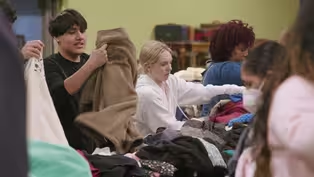
But as producer Isabella Gebilian first reported in June of 2022, some young people are turning to thrift shopping to help the environment and their wallets.
This story is part of our continuing Green Seeker series.
(sewing machine purrs) - [Host] Imagine what it would be like to not buy any new clothes.
- So in 2017, I got a striped shirt that was like I said like this is my last new thing I'm ever gonna get.
- That was the goal for Han Ray Yon, a student at Rhode Island School of Design.
He went nearly two years without buying a single new item of clothing.
What did you do instead?
- One like buying used.
So going through thrift stores, finding things, it's more based on like need rather than want.
So buying less and getting less.
- [Host] He also learned how to sew his own clothes, darn socks, and make his own repairs.
- I think you can see in the pocket here, like originally there's no bottom in the pocket so, - [Host] Jan says his new approach to shopping began when he saw how clothes were made and how it affects the environment.
- Huge amounts of water are used to like produce a single yard of fabric or especially in dyes and processing and agriculture too, like cotton is a pretty like water hungry plant.
- [Host] And he says not too many people know that polyester comes from drilling oil and synthetics shed.
- Fabrics make fuzz.
It's the lint that comes out in your dryer and from synthetic fabrics that's microplastics.
- [Host] One study found that a polyester garment can cast off more than 1900 fibers in a single wash, which then make their way through sewers and into waterways.
And Jan really reached a tipping point after seeing reports about the frequent human rights abuses when making fast cheap clothes.
In Bangladesh, environmental and labor laws are frequently ignored in the $1 billion export leather industry.
Wastewater with harmful chemicals is dumped into neighborhood streams.
The water seen here is actually dyed blue because of the process.
Workers process skins without protective gear, exposing them to known cancer causing agents like chromium.
And child workers are frequently seen operating heavy machinery.
Fast fashion also causes problems long after it's been made.
Author and journalist, Adam Minter has written about the global recycling industry for the past two decades.
- I mean, one of the things that's happened over the last 25 years really is that garments have become more difficult to recycle.
And that's where you start seeing large amounts of textile waste.
- [Host] And Minter says, this is why, in part, we're seeing a thrifting trend.
- Because of the development of, you know, of apps, the Poshmarks, the Thread Ups, you know, various other apps, eBay, people are able to post for sale their old garments straight out of their closet and they're purchased that way.
- If we have something and we love it, we'll wear it a couple times and then we'll sell it.
- [Host] 24 year old Jacqueline Jutriss uses Depop, a resale app that's a favorite among Gen Z.
- A lot of people selling clothing online starts with like the closet clean out, like for sure, that's where it starts.
You can put a towel over it and then just iron it quick, quick.
- [Host] Jutriss recently made her 700th sale on the platform.
- That's very sustainable in that, you know, it's all being purchased secondhand - [Host] Offline, Jutriss hunts for deals at the Goodwill Outlet in Hamden, Connecticut.
She calls it the bins.
Here, they sell by the pound and the more you buy the cheaper it is.
Every half hour, new bins roll onto the floor.
It's serious business for their main clientele.
Pickers, people who buy in bulk and resell.
- There should be no hands on the tables until the rotation is complete.
- [Host] Everyone has to wait for a signal before they can compete for the best clothes - All set?
- [Host] The leftover clothes head through the doors to Goodwill's Recycling Center.
They're tipped onto a conveyor belt, compressed into a thousand pound bales, and then stacked.
They might be shredded and used to stuffed cushions, cut into rags, or get exported abroad.
It's just a small slice of a global secondhand market.
- And there's all kinds of consumer survey data showing that younger consumers, Gen Z, starting with Gen Z, primarily, are open to this idea of use and reuse.
- [Host] But he says their excitement hasn't made a dent in the massive market for new clothes.
But some retailers like Patagonia and superstore, Walmart are listening.
They now offer secondhand on their websites.
- This is part of, you know, a massive consumer shift that's not necessarily going to happen overnight but I do think we are seeing a change where you are going to have secondhand used clothing as a bigger part of the overall apparel retail chain.
- What's your short take on what's the most responsible way to be a consumer of clothes.
- Buy secondhand, but when you buy new stuff, buy durability, stuff that can be reused that can feed that secondhand economy.
- [Host] Back at Rhode Island School of Design, Henri Jan continues to sew and thrift, but after nearly two years his strict, no new clothes streak came to an end.
- I think I broke it for dress socks actually.
- [Host] And socks weren't the only challenge.
- Underwear I, that was one of the things that did end the buying new clothes thing is getting new underwear.
- I don't think anyone blames me for that one.
- Yeah, so I'm definitely not so strict anymore.
Every once in a while, if I need something and I can't make it, or don't have the time to make it and can't find it and fit it and repair it, then I'll go and get something new.
So it's kind of like getting something new is the last resort if all my other things don't work out.
- Finally tonight, imagine living in a world where music is not only heard but also seen, where words have flavors, and colors have a smell.
That is a reality for some people with the rare neurological condition called synesthesia.
And some artists are using it to expand their creative limits.
- I think that we're all lucky that it exists, because without it, there would not be the magnificent art that we get to have all around us.
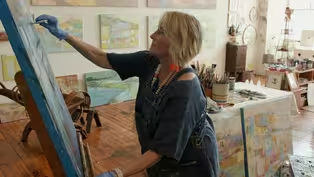
- [Host] Artist Alyn Carlson has a neurological condition that she says makes her life and her artwork more interesting.
- I was probably five and I started seeing numbers in color.
Three was yellow, five was red, zero was white.
Seven was sort of a purplely blue.
- Not only does Carlson see numbers in color but she says she can also hear them and smell them.
You've been open about the fact that you feel self-conscious somewhat even talking about this.
- Yeah, a little.
- Why is that?
- Well, it's kind of because other people can't really relate to it.
(classical music) - [Host] Artist and musician Lenny Peterson certainly can.
- [Lenny Peterson] So when I hear music, I see shapes.
- [Host] What kind of shapes?
- They are, well, they're in my art and they're anywhere from a straight line depending on the note to all kinds of atmosphere within squares and circles - [Host] Both Lenny Peterson and Alyn Carlson have synesthesia, a rare condition where a person's senses, including the sense of smell and sound, get mixed together.
We asked a neurologist, Dr. Richard Cytowic, to explain just what synesthesia is.
- It's pretty easy.
Everybody knows the word anesthesia which means no sensation.
So synesthesia means joined or coupled sensation.
And there are kids who are born with two, three, or all five of their senses hooked together.
So that my voice, for example, is not only something that they hear but something that they might also see, or taste, or feel as a physical touch.
- [Host] Carlson says, the artwork featured in her studio was created in large part thanks to her synesthesia.
Take for instance, this abstract painting.
Carlson says she painted it by mixing colors that smelled like one of her favorite things, a low tide.
- So I started to be able to pull in the whole family of those colors that smelled that way to me.
It was like an undercurrent in the whole palette.
And so from that I was, I painted a, you know, 80 inch wide abstract landscape just from the smell of those two colors that came together and that happened.
Boom, that was so fast.
- [Host] Synesthesia is more common than some might think.
Dr. Cytowic says 4% of the population has this union of the senses, including Lady Gaga.
♪ Poker face ♪ - [Host] And Billy Joel.
♪ We didn't start the fire ♪ - [Host] Russian writer Vladimir Nabokov, who wrote "Lolita" also had it.
(big band music) So did Composer and pianist, Duke Ellington.
Is synesthesia more common among artists and musicians?
- Well, you know, we're more familiar with famous artists who happen to be synesthetes than we are famous synesthetes who happen to be artists.
And it's a chicken and egg question of are they artistic because they're synesthetic or are they synesthetic because they're artistic?
But I think it's the former that and they're used to unusual things going together.
- It's those unusual things that inspire the work of artist Lenny Peterson.
He listens to music as he works and draws the shapes that he sees.
Now these shapes appear three dimensional in front of you?
They're floating in the air?
- They are being created in front of me.
They're not like in the, they're not in the room.
They're forming in front of me as I listen to music.
And the more I concentrate on it, the more they're gonna form and the clearer they're gonna form.
- [Host] Peterson's paintings are heavily influenced by the music he listens to.
(gentle music) - So this is specifically around a Miles Davis song, actually, called "In a Silent Way", and it's a very mystical kind of setting for this song.
Then the synesthesia kicks in here.
I start in the top left hand corner and my hand, I let my hand go.
And it's just a free flow of while the music's playing.
- Is it hereditary?
- Oh yes, absolutely, very strongly so.
It runs strongly in families.
Either sex parent can pass it down to either sex child and you'll see it in multiple generations.
- [Host] Colorful experiences can also evoke pleasant sounds.
For Alyn Carlson, this combination of blue has a distinct pitch.
- Every time I started to put them together, I would hear cello.
I would hear cello music.
Just a long note.
Just a long note, it's not a complicated piece of music.
- [Host] As the paint is being mixed.
- Yeah, as the paint is being mixed when I would get still with it, I would just hear it.
- What would a world without synesthesia look like for you?
- I don't know.
I probably wouldn't be, obviously doing what I do, making what I make.
I'd be lost.
I'd be really lost, I think.
- That's our broadcast this evening.
Thank you for joining us.
I'm Michelle San Miguel.
- And I'm Pamela Watts.
We'll be back next week with another edition of "Rhode Island PBS Weekly".
Until then, you can visit us online to see all of our stories and past episodes at RIPBS.org/weekly or listen to our podcast available on all your favorite audio streaming platforms.
Thank you and goodnight.
(gentle music) (gentle music continues)
Green Seeker: Thrifty Business
Video has Closed Captions
Clip: S4 Ep30 | 6m 57s | Thrift shopping is back in style—especially among the eco-conscious. (6m 57s)
Video has Closed Captions
Clip: S4 Ep30 | 13m 5s | An in-depth look at how language deprivation can cause deaf children to fall behind. (13m 5s)
Video has Closed Captions
Clip: S4 Ep30 | 6m 46s | Those who have synesthesia say the way they view the world is unlike most people. (6m 46s)
Providing Support for PBS.org
Learn Moreabout PBS online sponsorship
- News and Public Affairs

Top journalists deliver compelling original analysis of the hour's headlines.

- News and Public Affairs

FRONTLINE is investigative journalism that questions, explains and changes our world.












Support for PBS provided by:
Rhode Island PBS Weekly is a local public television program presented by Ocean State Media