
Rhode Island PBS Weekly 7/28/2024
Season 5 Episode 30 | 24m 45sVideo has Closed Captions
An in-depth look at the importance of media literacy in an ever-changing media landscape.
We revisit Michelle San Miguel’s deep dive into the importance of understanding media and staying informed. Then, we take another look at the issue of critical race theory. The term has become a catchall for the debate over what, and if, we teach about race in schools.
Problems playing video? | Closed Captioning Feedback
Problems playing video? | Closed Captioning Feedback
Rhode Island PBS Weekly is a local public television program presented by Ocean State Media
Rhode Island PBS Weekly 7/28/2024
Season 5 Episode 30 | 24m 45sVideo has Closed Captions
We revisit Michelle San Miguel’s deep dive into the importance of understanding media and staying informed. Then, we take another look at the issue of critical race theory. The term has become a catchall for the debate over what, and if, we teach about race in schools.
Problems playing video? | Closed Captioning Feedback
How to Watch Rhode Island PBS Weekly
Rhode Island PBS Weekly is available to stream on pbs.org and the free PBS App, available on iPhone, Apple TV, Android TV, Android smartphones, Amazon Fire TV, Amazon Fire Tablet, Roku, Samsung Smart TV, and Vizio.
Providing Support for PBS.org
Learn Moreabout PBS online sponsorship- [Announcer] Tonight, some Rhode Island students are getting an early start in the fight against misinformation.
- The sooner they can understand the concepts and then the creation that goes behind it, the better they are.
- [Announcer] And the battle around teaching race in local schools.
- What has come into classrooms is activist literature.
- I get death threats over it.
(gentle, cheerful music) (gentle, cheerful music continues) - Good evening, and welcome to Rhode Island PBS Weekly.
I'm Michelle San Miguel.
- And I'm Pamela Watts.
We begin tonight with the ever-changing media landscape and an informed public.
- As more Americans rely on social media for news, studies have found we are less likely to get the facts right about COVID and politics, and are more likely to hear about some unproven claims.
As we first reported in May of 2023, educators here in Rhode Island are trying to turn the tide on misinformation.
They maintain our democracy's survival depends on it.
Screens are everywhere, and with countless news sources at our fingertips.
- Well, there are new concerns about the spread of misinformation on TikTok ahead of the midterm elections.
- [Michelle] Figuring out whether something is true can be difficult.
- [Reporter] Even before the announcement of an indictment, purported images appearing to be former President Trump, surrounded by NYPD officers, went viral on social media last week.
The problem, they weren't real.
- [Michelle] Research shows false rumors spread faster than the truth.
- Viral vaccine misinformation is infecting social media.
This time it's on TikTok.
- Start the camera and then you let us know it started, you say, "Rolling."
- [Michelle] Teachers across Rhode Island want to make sure students from a young age learn to think critically about the messages they're consuming.
- When she says, "Rolling," you.
(teacher imitates clapperboard) - Rolling.
(clapperboard clacks) - Well, for one, being physically fit can help you fight off illness.
- [Michelle] These fourth graders at Narragansett Elementary School are learning about media by creating it.
- Rolling.
(clapperboard clacks) - Hey you, yeah, you front of the television.
Get up off your couch, get ready to get physically fit.
- [Michelle] They're recording a public service announcement about the importance of exercise with the help of Brien Jennings.
He's the school's library media specialist.
- [Students] Not so bad, it's way better than that.
- We come up with a concept, we assign roles, we assign jobs, they write a script, and then once we've got the script finished, we go into production.
- [Michelle] Jennings spent years working in television news as a photographer.
- That was awesome.
Wow!
- [Michelle] That inspired him to want to teach children how media can change how they perceive the world.
- Just the concept of how a green screen works is beyond some of them.
Some of them get it, but one of the kids there, Nick, was wondering, okay, are we gonna hang a picture behind us.
So when he sees what we do with a green screen, that's gonna be a light bulb.
- Ah, but that takes too long.
I wanna play video games.
- What is the larger lesson that you want them to take from that?
- I just want 'em to understand that everything is a construct and they have the power.
If they have the power to make it, then that gives them the power to understand it.
- [Michelle] Children are spending more time on screens than ever before.
According to a survey published by Common Sense Media, a nonprofit research organization, kids between eight and 12 years old spend about five and a half hours a day using screens for non-school purposes, including social media.
- So Nick, you're gonna do this.
(clapperboard clacks) Okay?
When Nick does this, Ella, you are the floor director for this one.
- Why is it important, from a very young age, to teach students about the ways that media are all around them?
- People don't even realize how much they're consuming.
The adults in their life don't realize how much they're consuming.
So kids are born into it from day one, and if they're gonna be surrounded by it, the sooner they can understand the concepts and then the creation that goes behind it, the better they are.
- Sometimes people don't appreciate how teaching about propaganda takes you in all kinds of directions.
- [Michelle] Renee Hobbs has spent three decades studying media literacy.
She's the director of the Media Education Lab at the University of Rhode Island.
- [Renee] Memes can be beneficial or harmful.
I think this is a harmful meme.
- How would you describe the media landscape that we're living in right now?
- Oh, what does Charles Dickens say?
"It was the best of times, it was the worst of times."
(Renee laughing) Media right now sets up a kind of reward system where I'll get more visibility for my opinion when I'm at my worst.
That's the worst of times that we're trying to disrupt with Courageous RI.
- [Michelle] Courageous RI is a media literacy project, created by Hobbs and her colleagues at URI.
It's funded by a $700,000 grant from the US Department of Homeland Security.
- We are thrilled to be welcoming newcomers to the Courageous Conversation series.
- [Michelle] Hobbs leads online forums where she talks with people, including teachers, about how to have constructive conversations.
The goal is to reduce the hate that leads to violence and extremism and to help people identify misinformation.
- We are living in a climate right now where there's a lot of stress and anxiety.
Our instinct is to feel hopeless and helpless, like there's nothing we can do.
And this is very dangerous for democracy.
So in order for us to be citizens, we have to overcome our fear.
Conflict is generative.
When it's productive, it leads to learning.
But when it's unproductive, it leads to harm.
- [Crowd] USA!
USA!
- [Michelle] She says adults need to take responsibility for the us versus them mentality that contributes to political divisions like we saw on January 6th.
(crowd yelling) - If we don't help people understand how the tools of communication and expression that we're using as everyday things are like shaping our attitudes about what it means to be in a democracy, to be a citizen, and what our responsibilities are as citizens, then I think the risk that we lose our democracy is very real.
We're gonna work in small groups to practice the skill called looping for understanding, which is a listening technique that helps reduce harmful conflict.
- [Michelle] Hobbs says helping people hone their listening skills is critical to building a less polarized society.
- Listening is the cure to many of the communication woes we have.
In order to reduce conflict, we have to make sure that people feel understood, that they feel that they have, that their views have been heard.
- [Michelle] But research nationwide shows many adults did not learn media literacy skills.
- What are different types of media?
Things that you can watch, see, read, view.
- [Michelle] Jen Robinson is working to change that.
She's an English teacher at Rogers High School in Newport.
- Often when people hear the term media literacy, the first thing they think of is news, fake news, misinformation.
Media literacy is a field that is so broad, and so vast, and so wide.
Fiction is media literacy too.
- Parting is such sweet sorrow that I shall say goodnight 'til it be morrow.
- [Michelle] Robinson showed her students a stage adaptation of William Shakespeare's "Romeo and Juliet," and then had them compare it to the 1996 film version by director Baz Luhrmann.
- Romeo, oh Romeo.
(Romeo gasping) Wherefore are thou Romeo?
- Do you think the Baz Luhrmann version is for you?
Do you think you are the intended audience?
Teenagers?
Baz Luhrmann's version of "Romeo and Juliet" is very shiny and flashy and features very famous actors at the time, Leonardo DiCaprio, Claire Danes.
It has fast cars and guns and the action is just so fast paced.
So we talk about pacing.
How does pacing change things?
How does the music impact you?
They're critical analyzers of what they see, and that can take them to the next step.
- [Michelle] For many students, it's a new way of thinking about the information they're consuming.
- I never think of it.
I kind of just watch the movie, and I don't ever think of what goes on behind the movie.
- [Michelle] Robinson hopes students take the skills they're learning in her classroom and use them when they get older and vote.
- We hope that they've started to critically analyze messages that come to them in a way that will say, "I don't just wanna watch this message and assume it's true because it's on my phone, on my screen.
I want to think.
Who made this message?
Am I the audience for this message?
Why am I the target audience for this message?
Are they trying to manipulate me?"
- [Michelle] Freshman Madelyn Plowden says she sees the value in learning how to analyze media platforms.
- You could spread misinformation.
I mean, you could spread a lot of rumors, 'cause I mean, I wouldn't want to do that.
- What's at stake if students do not become media literate?
- Then they become people that are easily manipulated.
Then they are just passive consumers and they can be taken advantage of.
They can be fooled.
They can lose their money.
They can vote only for a candidate and not think about the other candidate at all, because this is all they hear in their algorithm.
They can be lost in an algorithm bubble and not ever escape from it.
And then they will not become consumers that are active.
- Keep rolling, keep rolling, let's try it again.
- We jinxed it.
- Three, two.
- [Students] Oh, no it doesn't.
- [Michelle] Jennings wants to help his students think about all of the media platforms that are vying for their attention.
- [Brien] And three, two.
- [Students] Make fitness your choice and get moving.
- The people who are creating media are learning at every step of the way how to fine tune and hone in on grabbing people's attention.
And their attention's gonna be the only asset they have left.
So if they don't know how to dedicate in the right spots, they're lost.
- Up next, since January of 2021, over 44 states across the country have introduced bills or taken other steps to restrict how teachers can discuss racism and sexism.
The buzzword in this debate is critical race theory.
It's an academic theory traditionally taught in law schools, but today the term is a catchall for lessons on race, especially in K through 12 education.
School board meetings have become battlegrounds.
Conservatives accuse teachers of brainwashing kids.
Progressives accuse conservatives of wanting to whitewash the curriculum.
As contributor David Wright found when we aired this story in May of 2022, it's a fight for the hearts and minds of young people, taking place across the country, and here in Rhode Island.
- [Nikole] Sherry, come in please.
- [David] At Gilbert Stuart Middle School in the west end of Providence, Principal Nikole Onye has her hands full.
- Do you have the application?
- No.
- Go in the guidance office and get it now, fast.
- [David] 92% of her students are economically disadvantaged.
- Yeah.
Can you complete as much as you can tomorrow?
- [David] 96% are minorities.
- I'm proud of you.
- [David] Gilbert Stuart has long been one of the lowest performing schools in the state.
Dr. Onye is trying to change that.
(hands clapping) - Love you.
This is a one-star school, and our goal is to make this a two or three-star school in the next couple of years.
And to do that, we have to stay super focused.
- It's an uphill battle.
- So this is really important.
- [David] The building itself, crumbling after decades of neglect.
The students say when it rains, that hole in the ceiling of the auditorium drips water.
- Does conflict have to become violence?
- [David] On the day we recently visited, a group of student leaders in that auditorium were taking part in a training session, the topic, nonviolent conflict resolution, based on the works of Dr. Martin Luther King, Jr. - Two different people wanted two different things, but they still worked together to get what they both wanted.
- Let's shake it up for that.
- [David] This program is one of several ways.
Gilbert Stuart's trying to re-engage students by inviting them into a deeper conversation about diversity, equity, and inclusion.
- It helps to solve conflict, 'cause when you go out in the real world, you're going to see different people, and to tell kids that, "Hey, it's okay that you see different people.
That's okay that you don't get along with them right away."
- [David] Dr. Onye is diversifying the faculty.
She's added 20 new teachers of color.
The school also offers social justice classes in every grade.
- We started off as an eighth grade class, but now we have one at every grade level.
It's a place where kids can talk about what's going on in the community and what they would do differently.
You know, we wanna hear from them.
What do they think the solutions are?
A lot of the things that adults talk about, if you listen to the kids, a lot of times they have some of the greatest solutions to things that adults are fighting over.
- I think that our schools are going really far off course.
- [David] Rhode Island Representative Patricia Morgan takes a very different view.
- And at this time we will hear House Bill 7539 by Representative Morgan.
Representative Morgan, welcome.
- [David] Morgan has introduced a series of bills at the Rhode Island State House, designed to steer Rhode Island public schools away from what she sees as an obsessive focus on race and racism.
- No child should be accused of being inherently racist, or sexist, or oppressed, or oppressive because of their race, because of their skin color.
We've forgotten what the purpose of education is.
And to me, that's preparing children for successful adult lives - In a diverse society.
- Absolutely.
- A multicultural society.
- But the building blocks are the same, right?
Reading, writing, comprehension, knowledge base.
- [David] Morgan says since state standards changed in 2019, schools across the state are adopting misguided curricula.
- What they've developed is one that is racially and sexually biased.
And by that I mean all of the old textbooks, they're gone.
And instead, what has come into classrooms is activist literature.
It's not literature that gives children the full spectrum of what American society is.
It is centered on Black and Hispanic culture or experience.
So that's what makes it activist.
- [David] She insists these new curricula, among other things, shame white kids and patronize minority kids by focusing too much on the history of racism in America.
- I'm a Black child.
I get up in the morning, I look in the mirror, and say, "Oh, I'm Black."
I can never get ahead because I'm a victim.
It's the skin color, no matter how hard I work.
If I look at you and I say, "You're an oppressor," is that fair?
- No, absolutely not.
- Who are you oppressing?
Who are you oppressing?
Tell me.
And is a little 9-year-old a victim, just by his very presence?
They're to be judged and respected as individuals, not members of an identity group.
- [David] Morgan, a Republican, has plenty of firepower in her corner.
- If you object in any way to the current obsession with race, the one subject no normal person really wants to obsess over, then you yourself are obsessed with race, and you must be stopped because you're dangerous.
(Tucker cackling) That's what they're saying.
- [David] Conservatives, including cable news personality Tucker Carlson, have been sounding alarm bells ahead of the midterms.
- Why?
- Well, it contradicts everything that Martin Luther King fought for.
It's hatred, Marxist ideology, and it places the child in a loophole of oppression, making them feel as a victim, I can't stand for that.
- [David] Denouncing so-called critical race theory, what they consider to be woke ideology invading schools.
- What does critical race theory mean?
What is it?
- Senator, my understanding is that critical race theory is, it is an academic theory that is about the ways in which race interacts with various institutions.
- I get death threats over it.
Yes.
- [David] Jennifer Bergevine teaches at Barrington High School.
- I did 9th and 11th, and the 11th grade course is Advanced Placement Language and Composition.
- How does race factor into your teaching curriculum?
- Well, heavily in language and composition.
It's a rhetoric study, so everything we read is nonfiction.
We stick with what's happening in the world.
The whole curriculum is designed around four social justice topics, and one is race.
- It's a very different population of kids than at Gilbert Stuart Middle, and that's not just because they're older, in high school.
But Barrington is not the most diverse community in the world.
- Not exactly what we're known for.
- Is critical race theory a factor in what you teach?
- It's not necessarily, I wouldn't say it's a factor.
I think there's critical.
- Is it an approach that you use?
- I didn't know what critical race theory was until people started talking about it being bad.
And then I realized that, I guess I kind of teach critical race theory, I just, but it's really more about multiple perspectives.
So when we get into the race unit, we start by what are our own personal experiences with race, as individual.
The students talk about it, they do some reflection.
We watch Ted Talks.
- [David] Ted Talks like this one.
- I went through a mental shift in my perception of literature.
I realized that people like me, girls with skin the color of chocolate whose kinky hair could not form ponytails, could also exist in literature.
- And I give them sets of texts that they pick from.
They could choose to read "A Hope in the Unseen," which is about a young man growing up in D.C. who's a young man of color in a really rough school and he wants to go to Brown University, and it's his story.
And the kids love it because he gets to Brown, and they hear about Thayer Street and all those things.
And what they then come back to the table with is a reading journal where they keep track of what stands out to them, what they're confused by, what they wanna learn more about, and they meet in groups to talk about what they've learned.
- It doesn't sound that different from English class when I was in high school.
- Right.
- Eons ago.
I mean, I remember reading "Invisible Man" by Ralph Ellison, which, - Amazing book.
- who's a Harlem Renaissance writer, amazing writer, who's writing about race, and identity, and how he feels invisible.
- Correct.
- So why are people freaking out?
- I think the shift into actually naming systemic racism and saying like, "This is a part of our history as a country," makes people uncomfortable.
(pages rustling) - [David] There's a sense that at least part of what people object to is the idea that teachers are presenting an unflattering view of America, unpatriotic.
Pop quiz.
- Hmm.
- Thomas Jefferson, what's the most important thing for our kids to understand about him?
- He was a founding father.
He was there at the beginning of our country, and he set it on the course for us to be a democracy.
There was never before then a democracy in the world.
- The fact that he was a slave owner, relevant or not relevant in your view?
- You know, listen, he was a slave owner.
Was that the only thing he is?
Is that why we should be disparaging his memory?
- No, but when somebody.
- And his contributions?
- I'm not saying disparaging, but understanding that his vision had limits, didn't it?
- Okay, we can defame his memory, and that's fine, if that's what's important.
And I guess that's what I think is destructive because he did so much more.
- Ask that same question to Jennifer Bergevine.
What is it important to teach our kids about Thomas Jefferson?
- The facts.
You know, I mean, we can't, you can't take a person and just say, "Okay, I'm only gonna look at this part of him, or her, or them."
We need to look at the whole person.
- Warts and all.
- Yes.
- We are focusing on warts and not on the goodness of America.
- If you constantly give kids these larger than life figures who never made a mistake, that's not real.
The half of life is learning to kind of rectify the good with the bad.
- Unfortunately, with that group of people who want to push this ideology, this narrative, they give us no redemption.
There's no redemption for America.
- Just as you are concerned about that ideology infecting the curriculum, isn't it possible that the reaction to it also politicizes the curriculum in an unhealthy way for our kids?
I mean, our kids are caught in the middle, right?
- So what you would suggest, that I allow this racialized and sexualized curriculum to go unchallenged?
- If that bill, the latest bill passed, I don't know, we would have to completely restructure Advanced Placement Language and Literature, and pull out whole units of instruction.
If we can't talk about race, that's a unit of study.
So we would have to reframe the whole thing, which can be done, but it will be to the detriment of the students.
- I don't think anybody's wrong or right in this conversation.
I think everybody has their own perspective.
I can only speak from my perspective, having been in schools for many, many years.
It's our job to empower our students, no matter what color they are, whether they're Black, white, Spanish, male, female, doesn't matter.
We don't want any student to feel that they're victimized.
- [David] One thing both sides agree on is that a good education is the best way to give kids of all races the opportunities they need to succeed.
And that if we, as a society, share Dr. King's dream, we still have some work to do.
- I think it's really important, and I think people don't stress this enough, that if we keep doing what we've been doing, the same result's gonna happen.
- [David] Eighth grader Naya Ossamagossier told us the future depends on getting this right.
- I think that Gilbert Stuart is doing good things, and we need to shine light on that, and we need more help.
- And that's our broadcast this evening.
Thank you for joining us.
I'm Pamela Watts.
- And I'm Michelle San Miguel.
We'll be back next week with another edition of "Rhode Island PBS Weekly."
Until then, please follow us on Facebook and X, and visit us online to see all of our stories and past episodes at ripbs.org/weekly.
Or listen to our podcast on your favorite streaming platform.
Goodnight.
(gentle, cheerful music) (gentle, cheerful music continues) (gentle, cheerful music continues) (gentle, cheerful music continues) (gentle, cheerful music continues)
Video has Closed Captions
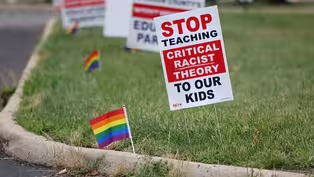
Clip: S5 Ep30 | 13m 29s | An in-depth report on the continuing debate over teaching about race in schools. (13m 29s)
Video has Closed Captions
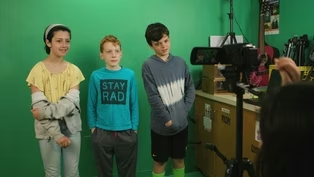
Clip: S5 Ep30 | 10m 29s | Teachers in Rhode Island are helping students think critically about media messages. (10m 29s)
Providing Support for PBS.org
Learn Moreabout PBS online sponsorship
- News and Public Affairs

Top journalists deliver compelling original analysis of the hour's headlines.

- News and Public Affairs

FRONTLINE is investigative journalism that questions, explains and changes our world.












Support for PBS provided by:
Rhode Island PBS Weekly is a local public television program presented by Ocean State Media