
Rhode Island PBS Weekly 7/30/2023
Season 4 Episode 31 | 24m 59sVideo has Closed Captions
Guitar maker inspired by the environment and the clean-up of the Blackstone River.
Rhode Island PBS Weekly's Michelle San Miguel follows up on an environmentally conscious guitar maker who uses mushrooms and honeycombs to make instruments that reduce her environmental impact. Then, we take another look at the cleanup of the Blackstone River 50 years ago and the efforts being done today. All three segments are part of our continuing Greenseeker series.
Problems playing video? | Closed Captioning Feedback
Problems playing video? | Closed Captioning Feedback
Rhode Island PBS Weekly is a local public television program presented by Ocean State Media
Rhode Island PBS Weekly 7/30/2023
Season 4 Episode 31 | 24m 59sVideo has Closed Captions
Rhode Island PBS Weekly's Michelle San Miguel follows up on an environmentally conscious guitar maker who uses mushrooms and honeycombs to make instruments that reduce her environmental impact. Then, we take another look at the cleanup of the Blackstone River 50 years ago and the efforts being done today. All three segments are part of our continuing Greenseeker series.
Problems playing video? | Closed Captioning Feedback
How to Watch Rhode Island PBS Weekly
Rhode Island PBS Weekly is available to stream on pbs.org and the free PBS App, available on iPhone, Apple TV, Android TV, Android smartphones, Amazon Fire TV, Amazon Fire Tablet, Roku, Samsung Smart TV, and Vizio.
Providing Support for PBS.org
Learn Moreabout PBS online sponsorship(upbeat music) - [Announcer] Tonight on Rhode Island PBS Weekly.
- [Michelle] A local guitar maker is re-imagining how instruments are made.
- It's not like a hippie solution, it's actually like tangible solutions with actual everyday application now - [David] The Blackstone is our river of life in this area.
It meanders past 30 communities for 51 miles.
It's a big, beautiful flowing river.
But this river has problems.
- [John] In 1990, the Environmental Protection Agency or EPA, designated the Blackstone as the most polluted river in the United States.
But unlike the visible debris of the past, that distinction came from the unseen pollutants.
(upbeat music) - Good evening, welcome to Rhode Island PBS Weekly.
I'm Michelle San Miguel.
- And I'm Pamela Watts.
Tonight we revisit stories that explore environmental issues in our continuing "Green Seekers" series.
- First up, as awareness of climate change grows, more and more people are trying to reduce their impact on the environment.
Some choose to ride their bicycles or carpool to work, others get solar panels installed on their roofs.
One local artist we first introduced you to last October is reducing her footprint through music.
- That was very quickly disenchanted just by the mass production.
Things that were inventory on the shelves often could end up in the trash.
- [Michelle] Rachel Rosenkrantz had established herself as a furniture maker and an industrial designer, both in her native France and in Rhode Island.
But about a decade ago, she decided it was time to explore something new.
- I missed working with my hands, that was the bottom line.
And I started to play music again.
So that really like propelled everything.
- [Michelle] Rosenkrantz first came to Rhode Island as an exchange student at RISD, the Rhode Island School of Design.
She had an internship with a company in Providence before heading back to her home near Paris.
- The company where I did my internship called me back and said, hey, we need a designer, we enjoyed working with you, would you like to work with us again?
I said, you know what, eight months in Providence was a bit too short, I will give it another two, three years.
And 18 years later, here I am.
- What do you love about Providence?
- It's small enough, you feel part of it, but it's big enough, there's always something going on.
It's great to be an artist here, if you are a visual artist or a musician, it is a good place to be.
You're not far from Boston, you're next to New York.
I mean, it's a good place for creative people.
There you go.
- And over the years, Rosenkrantz says, her own creative process faced some inner struggles.
- If it wiggles a bit, yeah.
- She felt torn between being a musician and a visual artist, and dreamed of combining her two passions.
Was there a moment when you realized, gosh, I can make a living making guitars?
- Yes and no.
Yes, other people do it, so why not me?
And I've been thinking about it for too long to not do it.
And no, because it was scary, it's like it's a drastic change, it was worth the risk, though.
- Worth the risk because she believes she has an obligation to handcraft guitars sustainably.
I think you have a different respect for nature and the way trees are being harvested, the way trees are being cut down, versus somebody who's just buying a guitar at a store.
They're not thinking about where these materials coming from.
- That's true, that's true.
And most people don't know even the woods that are in their guitar, and most people don't even know the type of structure that's going on inside their guitar.
- Rosenkrantz says, the environmental impact of making guitars has been well known for decades.
Much of the timber used for guitars comes from old rare trees that produce good acoustics, like Ebony, Mahogany and Rosewood.
Excessive harvesting of Brazilian Rosewood in particular, has contributed to its extreme endangerment.
It's one of the reasons why she's selective about where she buys her wood.
- My Rosewood is from India, my maple is from the states.
I have some cedar from Spain, I have some cedar from California.
- Rosenkrantz puts in long hours in her guitar studio in Cranston, which sits right below her apartment.
She has a two year wait list for customers looking to buy one of her handmade guitars.
But when the pandemic hit, she says business came to a halt.
- Musicians are my clients, musicians, were not working.
If they are not working, I'm not working.
So it was a phone call, an email, text message saying like, oh, this guitar, can we put the construction on hold, my tour got canceled, and things like that leading one to another.
Like, okay, so now what?
I'm like, well, now I have all the time in the world to finally build the things I always wanted to build and experiment with that I never had the time to do.
- Because you had no business.
- Because that year the business went from building like eight guitars to zero.
- She used that time to experiment with making instruments from other materials while working part-time at RISD.
Take for instance, the body of her guitars, they're not carved, they're grown.
Rosenkrantz packs her molds with mushroom spores as well as organic waste, like corn husk.
- That whole bag might do the trick.
Actually growing a body in mushroom is cheaper than cutting a tree across the world.
That's just the bottom line.
It doesn't look as good as figured maple, it looks like a granola bar.
But there's kind of a brutalist aesthetic to it.
- The growth of the mushrooms fills any remaining spaces and binds it all together in the shape of the mold.
Then once it's dry, Rosenkrantz is left with a solid board.
Her friend Mark Milloff stopped by her studio to try it out.
- Pretty close, because it's mushroom, I think of really delicious porcini soup or something like that.
But yeah, there's definitely a distinctive sound.
It is absolutely not a wooden guitar, a wooden resonance.
There's something that is, I find very pleasing.
(guitar playing) - She's not the first to see the potential in mycelium, the thread-like branches that grow beneath mushrooms.
- See, this guitar encourages that kind of music.
It doesn't encourage, (playing tune) Oh, maybe it does.
I just love the sound.
- Many industries are taking note.
For instance, these Adidas sneakers were made from it, and Ikea has been using it as an alternative to styrofoam.
- It's not like a hippie solution, it's actually tangible solutions with actual everyday application now.
But I saw that, well, nobody's looking at the acoustics of those.
What if maybe there's some solution there too?
So I gave the bees a soundboard to build from.
- Rosenkrantz not only proved mycelium can be used to make guitars, but she also built one from honeycombs.
- The humming of the bees is within the range of the guitar, is 309 hertz.
That's close to like the A string on a guitar.
So I'm like, okay, so that should diffuse a guitar.
- She knew honeycomb was resonant, she designed a bracing structure and watched as the bees built their comb along it.
But then she found herself with a honey-filled guitar that couldn't resonate.
- So I had to leave it a whole winter, but for them to eat, 'cause it's cruel to like take all their food, they work hard and now they're gonna starve, no, I can't do that.
So, well, they had food for the winter, and they return in early April, I had a perfectly cleaned up guitar that was like empty of honey that could resonate.
(guitar tuning) - Rosenkrantz admits strumming a guitar made from honeycomb isn't practical, but she says it's helped her better understand how biomaterials can diffuse sound.
What drives you to explore these biomaterials to make instruments?
- It's just fun.
It's just like I'm having a blast.
I'm learning so much, as I'm working on one, I start to have like five other ideas.
There's so much curiosity, that the learning curve is exponential - And she clearly likes a challenge.
While she's working more with biomaterials, she still uses wood to make guitars including woods that crafters once overlooked.
- I see a lot of people now are using local woods.
We see the use of Osage orange around Illinois a bit more.
Osage orange behaves almost like Ebony, and people thought it was like trash wood in their yard, and now it's treasure.
So it's just to look at things differently and really having like some figured maple is just for the prestige of it.
If you close your eyes and you listen, actually Popper does a pretty good damn job for like the same density.
(guitar playing) - I mean, I'm curious, you're someone who goes to bed every night and you feel better about the way you're leaving the world than you found it.
- I do.
I mean, I'm still worried, but the state of the affair as far as pollution and the consequences that we can feel already, just temperature wise and.
But I feel better that I am trying not to contribute to that and that I educate myself on that, and I can also educate others though.
So, I feel, yeah, I feel better than 10 years ago.
- Rosenkrantz continues to experiment with new materials.
She's currently making a guitar using basalt fiber.
It's a type of volcanic rock with bioplastics made from plants.
Next up, a little more than 50 years ago, Rhode Island rallied for an event nicknamed, "The Woodstock of Environmental Cleanups."
Thousands of volunteers gathered to clean up what was then, one of the dirtiest rivers in America, the Blackstone.
Tonight we take another look at their monumental effort.
- The whole Blackstone River was referred to as probably the hardest working river in America, because it was lined from Worcester to Pawtucket, with factories of many different kinds, starting with the Slater Mill in 1793.
(sheep bleating) My name is Irene Zebiker.
I'm a resident of North Smithfield, Rhode Island, and I and my co-leaders took part in Operation Zap, 50 years ago.
- My name is Dave Quinn, I'm 75 years old now.
So going back in 50 years, I think I have a pretty good memory, but 50 years, eh, you know, because of industrialization, that was the only dumping ground they had.
So it poisoned the birthplace, the Industrial Revolution.
- [David] The Blackstone is our river of life in this area.
It meanders past 30 communities for 51 miles.
It's a big, beautiful flowing river, but this river has problems.
(birds chirping) The river is strewn with debris, thousands and thousands of truckloads of debris in the wetlands, and in the floodplains all along its 51 miles.
And the question arises as to what we're going to do about these problems.
- Project Zap is a dramatic one day effort to clean up the banks of the Blackstone River by using the volunteer effort of the people who live and work along its banks.
This wheatfield is only a first step, and a spectacular step.
We're not kidding ourselves, we know that this isn't a one day problem.
We know that this is a one year, two year, four year, five year, in some cases, maybe even a 10 year project before the Blackstone River is again the kind of a river it was 60, 70, 80 years ago.
We hope we can do it, and we're sure gonna try.
- On behalf of the 85 member companies of the Rhode Island Road Builders Association, we're pleased to pledge support of over 250 pieces of equipment, and from 250 to 300 skilled operators.
- [David] The community response has been very positive.
Each community will take full responsibility for all debris in its area.
Operation Zap is ready to go.
- Broadcasting live at WICE with Bob Hollands here at 2:30, and we're broadcasting from the banks of the Blackstone River in Pawtucket, we'd like you to come on down.
- So we had been assigned a kind of backwater off the main river to work on there cleaning the edges of it and so forth.
They were rather dark, and forbidding and oily, you know, they looked gross.
And there were a lot of things kind of protruding from them.
You know, it was not a place that you would go unless you had to.
- I think it's going very well, considering that we have so many volunteers at 11 o'clock, I think we're in very good shape.
There's a lot less confusion than I had really anticipated.
At this point, I'm pretty happy.
- We are all doing a good job, I think.
We're trying hard anyway.
We have about 15 girls and their children with us.
It's a little exhausting, but we just think it needs to be done.
- I worked a lot down that way and I helped pull that stuff out of the water.
Like we pulled this great, big, huge, I don't know what it was, it was a piece of a door, like a size me and two the door was huge.
- [Interviewer] Would you guys rather been out playing baseball today or what?
- I'd rather do this.
- I'd rather do this.
- The guy in the middle is me, 50 years ago.
Because there were people all over the place, now I was busy running around from place to place.
But I finally went to where they were dumping all this stuff up in Cumberland.
And there were military machines there moving things around.
There were tens of thousands of tires that they were moving around people got from the river.
There was a helicopter flying overhead up and down the river to check what was going on.
It was unbelievable, to me anyhow, you know.
I never seen anything like that.
It was like a little mini invasion of something.
- [David] The response was overwhelming.
More than 10,000 volunteers showed up for work, bringing rakes at shoves.
Stretched out over 10 miles of riverbanks, this constituted a virtual army of school kids, housewives, engineers, truck drivers, factory workers, and a multitude of others, all working together.
- This was the time when you had a lot of your folk music and so forth that was leading you to think of your environment.
(guitar music) Pete Seeger had been active, so this was a huge draw.
He was giving a concert in the evening, and all of those who had participated in the cleanup during the day were invited down to this big field where the Autopark is now.
And there was a big flatbed in there, bring your chairs.
And Pete Seeger stood on that flatbed and just played and sang.
It was absolutely the most wonderful ending for an effort that we had put in to making the world a cleaner, better place.
- Finally, tonight, after learning about that historic effort five decades ago, we went back to the river last September to see what's changed.
Contributing reporter John Smith has our story.
- [John] Amazingly, nearly 20 years after Project Zap, things got considerably worse.
In 1990, the Environmental Protection Agency, or EPA, designated the Blackstone as the most polluted river in the United States.
But unlike the visible debris of the past, that distinction came from the unseen pollutants.
- Things that we're still working on today are other pollutants in the water that shouldn't be there.
- [John] Jane Sawyers is a supervising environmental scientist at the Rhode Island Department of Environmental Management, or DEM for short.
- So it's the metals, it's bacteria, it's other pollutants that are on the waterway.
It can even be just sediment itself.
- [John] And the contamination wasn't just from the Blackstone's industrial past, the river was getting a fresh supply of sewage from poorly regulated treatment facilities.
- The Blackstone River and other rivers were seen as conveyances.
That's where you put your waste.
And it could be that you knew what the factory upstream was doing because of the color of the water today was this color.
So that's not gonna be healthy for the fish, it's not gonna be something people want to recreate in.
- [John] At the Woonsocket Wastewater plant, those efforts are evident.
Here, sewage is treated through a 10-step process before as much as 7 million gallons goes into the Blackstone every day.
- We issue permits to the wastewater treatment facilities.
We've continually worked on those with the regulated community, and as we've moved those permit limits down and the treatment plants have been able to build and remove some further pollutants from the water body.
That permitting effort has continued to keep the Blackstone clean, and it allows the fish and the aquatic life to thrive in the water.
- Now, the Rhode Island DEM is investigating the discharge of partly treated sewage wastewater from a Woonsocket treatment plant facility on Cumberland Hill road.
- [John] But there still have been problems at this site, although it has been reported that they have been addressed.
The plant declined to comment.
For Sawyers and others, however, sewage isn't the only source of contamination to worry about.
- Stormwater is a big problem.
Sidewalks, parking lots, rooftops, they're not going to hold and trap the water.
So they're gonna move everything directly into the water body.
It's not gonna infiltrate and remove those pollutants.
- [John] And she says, one of the greatest issues with storm water comes from our front yards.
- The same nutrients that we use to fertilize our lawns that are in pet waste, human waste, they can feed algae and aquatic plants and they can overgrow.
And that's not easy to recreate in, it's not easy for the aquatic life to live in.
And if that dies off, it can really drop the dissolved oxygen levels.
You could have a fish kill, you could have other kind of aquatic life not living.
- [John] To ensure specific water quality standards are met, the Department of Environmental Management adheres to a rigorous schedule of sample collection and reporting.
- We test for bacteria, we test for metal, we compare it to our water quality regulations and decide whether or not the waters are meeting our regulations and our goals.
And if they are, then that's great, and if they're not, if they have some kind of pollution in them, we put them on a list that we report to EPA and to the public.
- [John] Sawyers says that while many contaminants have been added to the list, recent testing has yielded some successes.
- Some of the pollutants that were an issue that we've been working on for decades, we're able to start to take those off the list, the data showing that we are meeting our goals for those pollutants, and that's very exciting news.
- [John] Over the past two testing cycles, pollutants such as total phosphorus, dissolved oxygen, and dissolved lead have all been removed from the EPA's list.
But while progress has been made in addressing known pollutants, a new challenge is emerging.
First introduced in the 1940s, forever chemicals, otherwise known as PFAS have been used in many consumer and industrial products including food packaging, water repellents, and cosmetics.
According to the EPA, they contaminate soil, water, air and aquatic life around the globe.
And studies have shown that these chemicals are even found in most human bloodstreams.
- There's a lot of challenges with testing for PFAS, and it's cutting edge research.
EPA has a roadmap to try to walk through those steps of how do you even collect a sample?
PFAS is in everything, it's in people, so how do you collect a sample without contaminating that sample?
- [John] Although PFAS present new challenges, Sawyer says she and others still have their eyes on the same prize as the pioneering Project Zap volunteers 50 years ago.
- To see the progress that people are making is very exciting.
In the original Operation Zap Blackstone, they had to rally support to get this going, and they were able to get a whole huge community going.
And I think that has just kept going.
50 years later, the new generation of people are coming on board.
- Zap Blackstone.
- That's our broadcast this evening.
Thank you for joining us, I'm Michelle San Miguel.
- And I'm Pamela Watts.
We'll be back next week with another edition of Rhode Island PBS Weekly.
Until then, you can visit us online to see all of our stories and past episodes at ripbs.org/weekly, or listen to our podcast, available on all your favorite audio streaming platforms.
Thank you and goodnight.
(upbeat music) (upbeat music continues) (upbeat music continues)
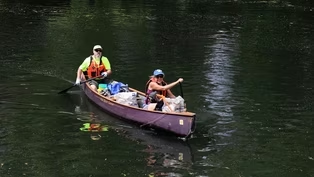
Green Seeker: Blackstone Today
Video has Closed Captions
Clip: S4 Ep31 | 6m 8s | While some of the pollutants are gone, the Blackstone River today is far from clean. (6m 8s)
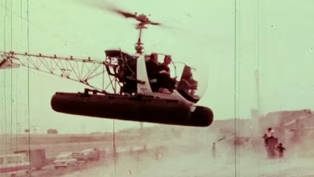
Video has Closed Captions
Clip: S4 Ep31 | 7m 39s | A second look at an event nicknamed "the Woodstock of environmental cleanups." (7m 39s)
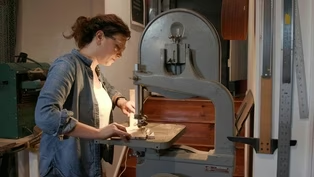
Video has Closed Captions
Clip: S4 Ep31 | 10m 38s | A musician draws inspiration from the environment to make guitars. (10m 38s)
Providing Support for PBS.org
Learn Moreabout PBS online sponsorship
- News and Public Affairs

Top journalists deliver compelling original analysis of the hour's headlines.

- News and Public Affairs

FRONTLINE is investigative journalism that questions, explains and changes our world.












Support for PBS provided by:
Rhode Island PBS Weekly is a local public television program presented by Ocean State Media