
Rhode Island PBS Weekly 7/9/2023
Season 4 Episode 28 | 26m 29sVideo has Closed Captions
Rhode Island’s relationship with R&B and efforts to make it the state’s official music.
Contributing producer Elena Mannes explores Rhode Island’s enduring love affair with Rhythm and Blues. For many, it broke down barriers and brought people together. Now, a group of musicians are on a mission to make the genre the Ocean State’s official music. Then, a second look at Rhode Island’s supervised drug injection sites. Finally, we revisit Keeping Kids Fishing.
Problems playing video? | Closed Captioning Feedback
Problems playing video? | Closed Captioning Feedback
Rhode Island PBS Weekly is a local public television program presented by Ocean State Media
Rhode Island PBS Weekly 7/9/2023
Season 4 Episode 28 | 26m 29sVideo has Closed Captions
Contributing producer Elena Mannes explores Rhode Island’s enduring love affair with Rhythm and Blues. For many, it broke down barriers and brought people together. Now, a group of musicians are on a mission to make the genre the Ocean State’s official music. Then, a second look at Rhode Island’s supervised drug injection sites. Finally, we revisit Keeping Kids Fishing.
Problems playing video? | Closed Captioning Feedback
How to Watch Rhode Island PBS Weekly
Rhode Island PBS Weekly is available to stream on pbs.org and the free PBS App, available on iPhone, Apple TV, Android TV, Android smartphones, Amazon Fire TV, Amazon Fire Tablet, Roku, Samsung Smart TV, and Vizio.
Providing Support for PBS.org
Learn Moreabout PBS online sponsorship(upbeat background music) - [Narrator] Tonight on "Rhode Island PBS Weekly".
(upbeat background music) - I think that Rhythm and Blues and Rhode Island go together, they belong together.
- Just tell us how you're doing, we need to know how to help you.
- [Reporter] It's a scene that has become increasingly common in Providence and around Rhode Island.
- It's a confirmed overdose.
He's gotten six milligrams of Narcan but he still goes in and outta consciousness.
- [Reporter] A person overdosing on fentanyl.
- Things are different nowadays, so the kids are usually on the phone, so it's nice to have the kids outside doing things and not on their phones, right Sam?
(upbeat background music) - Good evening, welcome to "Rhode Island PBS Weekly."
I'm Pamela Watts.
- And I'm Michelle San Miguel.
Rhode Island has a special relationship with music and some say one genre stands above the rest.
- In the late 1940s, rhythm and blues came north with the great migration of African-Americans leaving the south.
In the ocean state, still a segregated society, it captivated both black and white audiences.
Tonight, contributing producer Elena Manis introduces us to one group that's on a mission to make R&B the state's official music.
(upbeat background music) - When I was a kid, all my cousins were musicians and I started picking up the guitar and then the terminology R&B became out.
(upbeat background music) And it just affected me, you know, it affected me a lot because I felt like is it some sort of magic, you know?
I mean, really, you know, is it some sort of magic that they got that they can do this?
And no, it's not magic, you're just around it all the time where it's just natural.
(upbeat background music) (audience cheering) - What grabbed me most about R&B is, I guess the feeling.
Everybody always said, "Well, it's the feeling, it's the feeling, it's the feeling."
I don't really know.
It's in my blood somehow.
My name is Cleveland Kurtz.
I'm the president of the Rhode Island Rhythm and Blues Preservation Society.
We are doing what we can to preserve the music, doing what we can to celebrate the music and to record the history of the music.
I think that rhythm and blues and Rhode Island go together, they belong together.
Rhode Island was the place where freedom of religion originated, one of the places, probably the most important place.
And what that did was that destroyed boundaries between people.
Rhythm and blues does the same thing, right?
And so that's why I think they belong together.
(upbeat background music) The thing that is very unique about rhythm and blues is it brings people together.
People who are not ordinarily going to hang out together, when you start piping out the music they will show up, they will sing, play and dance together.
An art form that destroys barriers like they don't even exist.
(upbeat background music) - It's not white music, per se, It's African-American music.
And it really, the rhythm and blues was a term that was coined, really, I think by the record industry.
It's two types of music, good and bad.
It was really good.
And then people heard it and didn't matter what color you were, you liked it.
- Rhythm and blues started in the forties according to most people.
(upbeat background music) - I guess one of the premier tunes was Louie Jordan singing "Jump Blues" with his seven piece band.
(upbeat background music) You had Little Richard.
Later on Elvis Presley showed up.
(upbeat background music) It snuck across the English channel and groups like The Beatles and the Rolling Stones started to practice on it.
In Rhode Island, we had a club called The Celebrity Club and that was the place where most people, I think, that the races started to mingle and people started to get along because the music lend itself to that.
People from everywhere came to see the club, came to the club, white and blacks and everybody else in between and the music was the heart of it.
People came there because they love hearing the music.
Nothing could suit that kind of thing better if we're gonna select a music for our state as rhythm and blues, because it's the one that people go to to hear the most, people play live the most.
We contacted Representative Bennett and told him that we thought it was a wonderful idea, and he agreed with us.
- The way I got into rhythm and blues was through Cleveland Kurts, and he called me and started talking to me about, you know, the history of rhythm and blues and how it brought people together.
You know, I guess somebody told him I was a musician at one time, you know, and he wanted me to run a bill to see if we could get this to be the state music.
And I said, sure, I'd do that because it makes sense.
You want to blend in what's gonna capture all of Rhode Island.
(upbeat background music) Rhythm and blues is the blend of cultures and a blend of styles.
You know, you have your jazz, you have your blues, you have your rock.
Well, there's all touches to that in rhythm and blues.
It's kind of a dance kind of music and it appeals.
You know, Spanish, you know, the blacks, the whites, they all like that kind of music.
(upbeat background music) Paul Philippe, he started the Celebrity Club back in the forties.
(upbeat background music) He had some great people play there.
Louis Armstrong, Ella Fitzgerald.
People would go there to listen to music and because it attracted the different races they would blend in and have a good time.
And you know, back in 1940, 1950 that wasn't too much heard of.
- I mean, you name it, he was bringing in rhythm and blue stuff that you, you wouldn't believe.
But Paul lives as a legend in the Rhode Island, especially in the colored community.
The colored community tends to see him as someone who actually integrated the clubs here.
- You have to thank Mr. Philippi for doing this for Rhode Island, bringing that kind of music into our state.
And that's why I feel it should be, you know, the state music, because it crosses so many genres.
(upbeat background music) You want to blend in what you're gonna capture all of Rhode Island - The story is that because of the music, people from everywhere came to see the club, came to the club.
White and blacks and everybody else in between.
And that was happened long before, that was a common thing in Rhode Island.
And so the music overcame the barriers and I think that that's the thing that is significant.
And I believe that you can credit rhythm and blues with doing that on a worldwide basis.
R&B is everywhere.
It's sneaky in the sense that right now one of the world's favorite rhythm and blues singers is Adele from England.
(upbeat background music) So it's everywhere and everybody is doing it.
(upbeat background music) So rhythm and blues is here to stay, it's always gonna sneak in there, it's always gonna tear down barriers, and it's always gonna sound good.
(upbeat background music) - The bill to make R&B Rhode Island's official music genre did not make it out of committee this legislative session but will be reintroduced in the next session.
Now we turn to the opioid crisis.
here in Rhode Island it's fueled by fentanyl, a synthetic opioid used to treat patients with severe pain.
It's about 100 times stronger than morphine.
More than 860 people in Rhode Island died of a drug overdose over the past two years.
Health officials say drug overdose deaths remain at crisis levels in the state.
As we first reported in April of 2022, public health experts point to supervised drug injection sites as a way to reduce the number of overdoses.
Rhode Island is the first state in the country to legalize these centers.
- What did you?
- How old are you?
- You do some Fentanyl today?
- No.
- Alright, what'd you do then?
Just tell us what you doing, we need to know how to help you.
- [Reporter] It's a scene that has become increasingly common in Providence and around Rhode Island.
- It's a confirmed overdose.
He's gotten six milligrams of Narcan but he still goes in and outta consciousness.
- [Reporter] A person overdosing on fentanyl.
- We've reduced opioid prescriptions dramatically in the state, we've expanded access to recovery programs and it's still not enough.
- Brandon Marshall says Rhode Island needs to do more to tackle the state's growing opioid crisis.
He's an associate professor in epidemiology at Brown University.
Marshall says the pandemic contributed to a spike in overdoses.
- People have mental health conditions who are experiencing anxiety, depression, for example, have very, very high rates of overdose.
And of course, people with economic instability.
People who are experiencing homelessness or job loss during the pandemic were at very high risk for returning to substance use or, you know, increasing overdose risk.
- [Reporter] Marshall believes supervised drug injection sites, also known as harm reduction centers, can help curb overdoses.
A Rhode Island law that took effect in March allows those facilities to operate in the state during a two-year pilot program.
- Typically, these centers, at least in the United States, would be funded privately so by donations or from other sources.
As far as I'm aware, there are no plans to provide state or local dollars to operate these facilities.
- When first someone enters, they're gonna come up to this registration desk just- - [Reporter] No sites have opened in Rhode Island yet.
Celine Means, an advocacy coordinator at Rhode Island Communities for Addiction Recovery efforts gave us a tour of a mock harm reduction center at the organization's downtown Providence office.
- They will write in their initials or a client ID and what substance and method they will be using.
It's all anonymous.
- [Reporter] People will bring their own drugs to the clinic and use them under the supervision of trained staff.
Employees and volunteers will be able to administer Naloxone to reverse overdoses and can provide drug users with resources for getting clean.
- These are all Rhode Island based resources around recovery, treatment, safe streets, housing, food, shelter.
- There are more than 120 harm reduction centers around the world.
Professor Marshall has spent nearly two decades studying their impact.
- There has actually never been an overdose death at any harm reduction center anywhere in the world because overdoses can be effectively managed on site.
No, we got it, we got it.
Just let it hit the ground.
All right, go all the way down.
All right, that's it, you got it?
- [Reporter] Many overdoses are being treated at hospitals.
Patients who experience an opioid overdose account for 1.9 billion in annual hospital costs nationwide according to the Pew Charitable Trusts.
Not only would harm reduction centers reduce those healthcare costs but Marshall says they would also help get users into treatment.
He points to the first supervised drug injection site to open in Canada back in 2003.
- After about two years of operation, more than 40% of people using the site had entered into some form of treatment, and that's because of those referrals and those pathways that are being provided by connecting people to treatment and recovery in the site itself.
- So once a person's turn has been called, they come over here to a table to grab their supplies.
We give out these supplies such as clean cookers, clean needles, clean water, and fentanyl test strips, all so that you can make sure that your use is safe and clean.
- [Reporter] Rich Holcomb knows firsthand what it's like to be in the throes of addiction.
He's overdosed more than a dozen times.
- He loaded up the needle for me and injected me and within seconds I had completely blacked out.
- [Reporter] Holcomb has walked the road from overdose to recovery.
As the program manager for Project Weber in Providence, he helps men who've engaged in sex work, oftentimes to pay for drugs.
It's a life that he once lived.
Holcomb says the last time he used drugs several years ago, he overdosed.
- I was getting high with a friend of mine.
We were in his apartment, you know, after several years clean and directing the Project Weber program, I relapsed.
I woke up to paramedics around me and didn't know what had just happened and they just said, "You just overdosed."
- [Reporter] In 2020, three in four fatal overdoses in Rhode Island involved fentanyl.
Proponents of injection sites say users would be able to test their substances for fentanyl at those facilities.
- If harm reduction centers existed when you were using, would you have gone to one?
- That's an interesting question and I want to give an honest answer.
I genuinely don't know.
If it was a facility that was run by peers and I trusted those peers, then I think that the chances of me going in a facility like that would be pretty high.
- [Reporter] But not everyone is embracing the concept of regulated injection sites.
State Representative David Place is among the lawmakers who voted against them.
- The worst thing that we could do, in my opinion, for these addicts, which is give them a warm, safe place to shoot up.
- [Reporter] Place represents parts of Gloucester and Burville.
He knows of people in his community who've died of drug overdose, but he doesn't think harm reduction centers are the answer to the opioid crisis.
- It's not me saying, I don't care about addicts.
It's not me saying, I don't want addicts to survive.
It's me saying, we're going about out the wrong way.
- [Reporter] Instead, he says, the conversation should focus on decriminalizing drugs and de-stigmatizing addiction along with reaching out to people who are using drugs.
- Everything that I've seen about treating somebody with addiction, the only way you get them is when they're at rock bottom.
And a lot of those times, unfortunately, unfortunately comes when they've experienced overdose, whether themselves personally or their friends.
- But that rock bottom could be death for some people.
- Yes, it could be.
- [Reporter] While federal law makes it illegal to open a place for the purpose of using a controlled substance, Professor Marshall says he's not worried about the federal government closing future facilities in Rhode Island.
He notes that the first two authorized drug injection sites in the country opened last November in New York City.
- Honestly, we've seen a pretty sudden and dramatic shift in the federal response under the Biden administration.
They've been actively supporting harm reduction, generally, including syringe service programs and Narcan distribution.
They haven't made a formal stance on harm reduction centers yet.
But I haven't seen any indication that they would try to interfere with facilities that will be legal here in Rhode Island under our state law.
- But under federal law would still be illegal.
- That's right, that's right.
But we have other examples where state and federal laws conflict.
A classic example would be cannabis, right, which is legal in many states, but which remains illegal Federally.
- They find bodies in the alley, they find bodies in the abandoned houses and people don't lose no sleep.
- [Reporter] Kevin Montero is a peer recovery specialist.
He works with people who've battled addiction.
He believes injection sites will reduce the number of people who use drugs alone.
- What's wrong with our society?
We accepted the fact that people are gonna die.
We accepted the fact they might die in Kennedy Plaza or they might die behind a store.
- [Reporter] Montero spent 30 years in a Colorado prison for second degree murder that he says centered around drugs.
- The reason why I'm sitting here today is because I actually was guilty of the crime, and once I accepted that and I accepted the fact that I was guilty, I accepted the fact my behavior while I was in solitary confinement, regardless of the time period I was in there, I took responsibility and once I took responsibility, my life changed.
- [Reporter] He believes safe injection sites will be a lifeline for those suffering from addiction.
- Most people that have, and I'm speaking for myself now that have substance use disorder, the primary cause was a broken heart, broken family, just everything in your life.
When you don't have the tools to do what you need and to make decisions, man, you always, most of the time you're going to fall off.
- So far, the Department of Health hasn't received any applications to open a harm reduction site, but two community groups have received funding to open a center in the near future.
Finally, tonight, we meet a man from Coventry who five years ago was fishing in a local pond when a group of kids approached him and asked if they could borrow one of his fishing poles.
As we first reported last October, that encounter helped start a program that has had an impact on the lives of hundreds of young people, not to mention his own.
(upbeat background music) - My name is John Graichen, I'm the founder of Keeping Kids Fishing.
(upbeat background music) What we do is each Sunday, I usually choose a lake in Coventry because it's a big shoreline.
I set up a a table, I put fishing poles out, I put worms out, gear, doers, sinkers, anything the kids would need.
I advertise it and the kids come and I show them how to fish.
And towards the end of the day, if they are into it, you know, they take their fishing poles home with them.
(upbeat background music) - I caught seven fish, eight around there.
- I taught myself at four years old.
My dad worked a couple of jobs and my mom would bring my brother to softball.
I wasn't really into sports at four so I would play along the shoreline.
There was a pond nearby and I taught myself, like I said.
I found some string, I put a hook, I found a hook and then I dug up some worms and I was on my way.
And I realized that there's a lot of kids that they don't have anyone to show them.
(upbeat background music) - Things are different nowadays so the kids are usually on the phone so it's nice to have the kids outside doing things and not on their phones, right Sam?
- One person brought her son, he was a gamer, he was always in his room playing on his tablets and playing the games on the computer and she said she had to drag him out of the the house to come to the event and he had a t-shirt on that said "I paused my game for this."
And she brought him back, he had a good day and he came back the next week with a friend.
And then the following week he came back with two friends and now he's no longer in his room playing in the games, he's out fishing with his new friends.
This helps me because I have severe neuro Lyme disease and it causes anxiety and manic depressive disorder and when you see the child catch their fist fish it just takes it all away.
- Favorite part about fishing is catching fish 'cause you get to see what kind of fish you caught.
- And how many did you catch today?
- One.
- Last year we had a fundraiser at Camp Westwood in Coventry and a little girl had won her first fish, the first fish trophy, and she came up to me with her mom and she asked me if she could give me a hug.
And I look at the mom and the mom nods and so I gave her a hug.
I said, "Thank you."
I said, "Why would you give me a hug?"
And she says, "Well, you see this trophy?"
And I said, "Yes, you won the first fish."
And she goes, "No, you got this for me."
So I asked her, "Well, how did I get that trophy for you?"
She said, "You gave me a fishing pole, "you showed me how to use it, "you showed me how to cast and how to reel it in "and how to put the bait on "and I caught a first fish.
"You did this, you caught me that first fish."
And I was really, really touched.
So this gives me a good feeling knowing that I'm, you know, giving them some education and hopefully some memories to carry on with them.
There you go, that's all set.
- Keeping Kids Fishing Founder, John Graichen, reports that his organization has now donated more than 2100 fishing kits to area youth.
That's our broadcast this evening.
Thank you for joining us.
I'm Michelle San Miguel.
- And I'm Pamela Watts.
We'll be back next week with another edition of "Rhode Island PBS Weekly".
Until then, you can visit us online to see all of our stories and past episodes at ripbs.org/weekly, or listen to our podcast available on your favorite audio streaming platforms.
Thank you and goodnight.
(gentle background music) (gentle background music continues) (gentle background music continues)
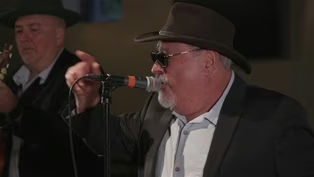
Video has Closed Captions
Clip: S4 Ep28 | 10m 12s | Rhode Island’s relationship with R&B and efforts to make it the state’s official music. (10m 12s)
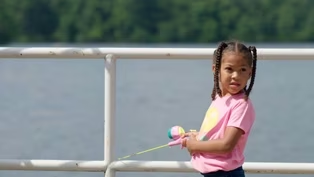
Video has Closed Captions
Clip: S4 Ep28 | 4m 30s | A man from Coventry is getting kids outdoors by teaching them to fish. (4m 30s)
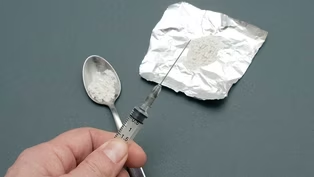
Video has Closed Captions
Clip: S4 Ep28 | 10m 33s | Public health experts say supervised drug injection sites can reduce overdoses. (10m 33s)
Providing Support for PBS.org
Learn Moreabout PBS online sponsorship
- News and Public Affairs

Top journalists deliver compelling original analysis of the hour's headlines.

- News and Public Affairs

FRONTLINE is investigative journalism that questions, explains and changes our world.












Support for PBS provided by:
Rhode Island PBS Weekly is a local public television program presented by Ocean State Media