
Rhode Island PBS Weekly 8/11/2024
Season 5 Episode 32 | 23m 35sVideo has Closed Captions
Special surfers in Little Compton, Lighthouses across the state and Urban Exploration.
Surfers out on Little Compton are performing miracles. Then, a story about a photographer cataloging lighthouses up and down the east coast. Finally, producer Isabella Jibilian introduces us to Rhode Island filmmaker and urban explorer Jason Allard who gives us his take on why the State’s iconic, but abandoned buildings, should not be forgotten.
Problems playing video? | Closed Captioning Feedback
Problems playing video? | Closed Captioning Feedback
Rhode Island PBS Weekly is a local public television program presented by Ocean State Media
Rhode Island PBS Weekly 8/11/2024
Season 5 Episode 32 | 23m 35sVideo has Closed Captions
Surfers out on Little Compton are performing miracles. Then, a story about a photographer cataloging lighthouses up and down the east coast. Finally, producer Isabella Jibilian introduces us to Rhode Island filmmaker and urban explorer Jason Allard who gives us his take on why the State’s iconic, but abandoned buildings, should not be forgotten.
Problems playing video? | Closed Captioning Feedback
How to Watch Rhode Island PBS Weekly
Rhode Island PBS Weekly is available to stream on pbs.org and the free PBS App, available on iPhone, Apple TV, Android TV, Android smartphones, Amazon Fire TV, Amazon Fire Tablet, Roku, Samsung Smart TV, and Vizio.
Providing Support for PBS.org
Learn Moreabout PBS online sponsorship(gentle music) - [Pamela] Tonight, wonders on the waves in Little Compton.
- How do you not get emotional when you have a child who is nonverbal and all he can do is smile from ear to ear because he's just so happy?
- [Pamela] And spotlighting the lighthouses of Rhode Island and beyond.
- [David] Oh, we got stars.
That's a good thing.
- [Pamela] Then exploring our area's abandoned places.
- This bustling social center that's now just left to rot above the tracks.
(lively rhythmic music) (lively rhythmic music continues) - Good evening, welcome to "Rhode Island PBS Weekly."
I'm Pamela Watts.
- And I'm Michelle San Miguel.
We begin tonight at a beach in Little Compton - where some say surfers are performing miracles with children and others who are often left behind.
Senior producer Justin Kenny first brought us this story in September of 2022.
(waves swishing) - [Surf Instructor] Go, Gabby.
(waves swishing) - At Gnome Surf, we surf with over 3,000 athletes and families.
What we do is surf therapy.
Our athletes at Gnome Surf are typically neurodivergent.
We're for all kids, we've built our program on inclusion, but I'd say over 95% of our athletes either have autism, Down syndrome, ADHD, depression, or anxiety.
(waves swishing) My name is Christopher Antao, I am the executive director and founder of Gnome Surf.
(waves swishing) - My name's Mackenzie Palumbo, and I'm Cash and Hollis's mom.
Cash and Hollis are 13 years old, they're twin boys.
They were diagnosed at 15 months of age with autism and a handful of other diagnoses.
Both of my boys are pretty much nonverbal.
Hollis is nonverbal, Cash has some language.
These are kids that typically do not get invited to birthday parties or sleepovers.
To see them having fun, doing something that typical kiddos do, it's a feeling like no other.
Every time I stand on that shore and I watch my kids out on the board, I always think to myself, "This is what parents of typically developing children must feel like, when they watch their kids play baseball, or football, or soccer," and you just feel so proud.
(waves swishing) - My name's Geo Mattram.
I'm the lead instructor here at Gnome Surf.
So I was born brain damaged, It's led to, like, brain aneurysms, scattered bleeding spots.
It's led to a whole host of different challenges for me.
The most prominent has been sensory regulatory, and then social situations.
Couldn't speak till I was, like, six, and then it's been a long journey to this point of verbalization.
I've also had seizures, general motor skill challenges, so to say, Luckily, Gnome has helped me recover from that, amazingly, because when you have a lot of this stuff, you have super-low self-esteem, super-low confidence.
It's helped my balance, my social skills, and has overall turned me into a more well-rounded human and athlete, I would say.
I started surfing with Chris seven years ago, and I started teaching three to four years ago.
I've seen Gnome from all different angles.
I've seen what the surf therapy does, and how amazing of an impact it has, and the true healing potential and amazingness that it gives off, and I can also see it from the instructor side, and how what I do and how I can teach can then heal kids and their certain challenges.
(youngsters laughing and shouting) - I'm Heidi MacCurtain, I'm Abby's mom.
Abby wasn't meeting milestones, so eventually, around six months, her pediatrician suggested that we look at an MRI to maybe see if there's anything else going on.
On that MRI, it showed that she had lesions on her brain, and then elevated lactate, which were consistent with Leigh's, so at that point, what they knew about Leigh's disease, which is a mitochondrial disease, they said she had about two years to live.
That has since changed.
She's 11, she's been in a drug study, and we're just trying to do as much as we can to live a full life for our whole family, and Abby getting out doing stuff like surfing and horseback riding.
We try to do what we can.
Abby loves adventure and she loves water.
That's one thing, any type of water play, water activity, always brings her to life.
When we had the opportunity to try surfing, I was like, "We'll try it."
I was a little nervous of how they would support her, since she's 100% reliant on somebody to hold her up, she can't sit up on her own, she can't walk, so I just saw some videos, and I said, "Well, they seem to have a good handle on it."
And the first time I came, they're like, "Mom, don't worry, we've got it."
And I was like, "Okay."
Even just pushing her across the sand, I was like, I'm so used to doing this stuff, so to give all the control away and watch it, it was so enjoyable.
Her smile, her laughter, and everybody around her, it was awesome, and we couldn't wait to have another opportunity to do it.
- [Surf Instructor] Do you like surfing?
- Yeah.
(surf instructor laughing) - Gnome Surf has, you know, saved my life.
I've struggled with ADHD, depression, anxiety, and when I'm out there on the waves with these kids, everything slows down, it calms down for me, and I truly get my medicine, so to say, just like these kids.
It's made my life a thousand times better.
You know, I'm lucky enough to know what my purpose on earth is.
When I started, I was an executive banker, made well over six figures, a very successful, lucrative career, and Gnome Surf just kept growing and growing, and one day came where I needed to make the decision whether it was to grow the surf school for children or to continue to be an executive banker, and for me, that decision was extremely easy.
When I look out in the water and see the smiles of these children that depend on me, I knew that I only had one choice to make, so I decided to go Gnome Surf full time, and also became a firefighter in the city of Fall River, and so now I change lives and save lives (laughs).
Do I ever cry?
Yeah, absolutely, I cry.
I try to, you know, shelter the tears a little bit from the families, because I know it's pretty emotional for those parents too.
It makes me quite emotional to know that we're delivering something to this family that normally they don't have the opportunity to partake in, and to see the parents smile and to tear up, and to see their child breaking barriers, or proving, you know, the scholars wrong, is something that, you know, is truly meaningful and deep for me.
- How do you not get emotional?
How do you not get emotional when you have a child who is nonverbal and all he can do is smile from ear to ear because he's just so happy?
How do you get emotional when you have a child who's wheelchair-bound or medically fragile, and you see them out on the board?
Those are things that you just never picture for your own kid, and you see them doing something that makes them find joy, and it's, it's emotional.
- She could be feeling crabby at home, or even in the hospital, when she starts to perk up just sitting her by the sea, getting her playing with water just, I don't know, makes her happy, so I think just being out there when you're surrounded by it, she's in her element, right?
Are you a surfer girl?
Yeah.
Can you say thank you?
How may you know thank you?
Thank you.
- To date, Gnome Surf has provided surfing experiences to nearly 15,000 families.
We now turn to a story about some of the country's most iconic beacons, lighthouses.
For centuries, they've guided ships in and out of harbors, warning of shallow waters and rocky coasts.
For several years now, a photographer in North Kingstown has turned his camera on lighthouses up and down the east coast, but as we first reported back in 2021, while countless photos have been taken of these majestic, often life-saving pillars of light during the day, he takes the images long after the sun has gone down.
- If you think of a lighthouse, it does its work at night, primarily.
To not have that recorded in history is a shame.
- [Michelle] David Zapatka has been recording history for more than three decades.
He's an award-winning videographer, but his biggest project yet has him picking up his still camera.
- And I didn't realize that this was a project till I was 15 or 20 lighthouses in, and that's when I was doing more research on more lighthouses, realizing, wow, there's no pictures of this lighthouse - [Michelle] Zapatka is the president of the Friends of Plum Beach Lighthouse, in North Kingstown.
He's long been mesmerized by lighthouses, not just by how they look, but by their history.
- But there are so many others with these great stories behind them.
- [Michelle] Since 2013, he's photographed more than 175 lighthouses in the United States, including many on the eastern seaboard.
- [David] Oh, we got stars.
That's a good thing.
- [Michelle] His goal, to capture every working lighthouse around the country at night.
The idea came to him while he was out boating with his wife on Narraganset Bay.
- So we're anchored off Dutch Island, and I said to my wife, "Wouldn't it be cool to see if I can get shots of the Dutch Island lighthouse at night, under the stars?"
- [Michelle] Zapatka says it's a photography project that hasn't been done before.
- What the digital camera has allowed us to do was to open up to photographers this whole new field of shooting when the sun goes down.
These are the slick ones.
They're not too bad, 'cause the tide is on the way in, so they're a little bit dry.
- [Michelle] What you can't see in Zapata's photos are the great lengths he goes to in order to capture these images.
It's not a stretch to say you're putting your life at risk on some of these shoots.
- Early on, I realized that it's dangerous at night.
Almost there.
A little bit further out, then we get the reflection.
That's always the bonus.
- [Michelle] Zapatka often weighs knee-deep into water to take a photo.
On the night we went with him, it was this one, the Ned's Point Lighthouse in Massachusetts.
Other lighthouses are only accessible by boat.
To get an image like this, Zapatka put his 20-foot tripod in the water.
- So I can launch it off a boat, stick it down in the water, and get a shot of the lighthouse from the water that you couldn't normally get, 'cause your camera has to be completely steady for 20 seconds during new moon phase.
- [Michelle] Arriving at night to these lighthouses is not for the faint of heart.
Zapatka and his friend, Sean, found that out on a trip to Thacher Island to capture twin lighthouses.
- We're, like, right by the lighthouses, they're, like, right there.
It's like, there they are, let's keep going, let's shoot it.
So we tie the boat off at a mooring, and now we're facing to the wind, and now waves are coming over the bow of my 15-foot Boston Whaler, and it's, all hell's breaking loose.
The water's coming over, it's filling the back of the boat.
We're getting hit by wind, I'm at the bow of the boat, like, getting slammed, and I'm like, "You know what, Sean?
We gotta go."
And he was like, "Dave, you know, I'm with you, man."
- [Michelle] Never one to give up, he came back another night and captured the twins in all their glory.
Behind every photo are a host of safety measures, from a helmet with a headlamp to a personal radio beacon in the event of an emergency.
- [David] Nope, that's slick.
(laughs) Just when you think you're done.
- [Michelle] Even though he puts himself in some precarious situations, Zapatka says he is not a reckless risk-taker.
- But the thrill is I'm creating this history right in front of my eyes that no one's ever done before, and it's all going to be available through the United States Lighthouse Society.
- [Michelle] Whether it's the Borden Flats lighthouse in Massachusetts or Sankaty Head Lighthouse in Nantucket, photographing a lighthouse at night requires more than a skilled photographer and a good camera.
Zapatka times his photo shoots around the lunar calendar.
- So now here's what you need, new moon, or close to it, low tide, slack tide, which means that the tide has stopped, and no clouds, so- - Anything else?
- So why do you think it's taken me eight years to do only 175 lighthouses, roughly?
Because some of those conditions are so specific that you have to be patient to get that shot.
- [Michelle] And when it comes to patience, Zapatka has plenty of it.
- When I first started, I was self-teaching myself night photography, and I knew there was a thing called light painting.
We just use a flashlight.
So if you show up at Beavertail Lighthouse and it's dark, and it's night, you can light the lighthouse just with using a flashlight by waving it back and forth.
And I did that originally at Beavertail.
- [Michelle] He had already shot about a dozen lighthouses when he realized he could also use his battery-powered television lights.
- I use those dimmed down to almost nothing.
You could barely read by these lights, but over the sensitivity and the long exposure that I've created within the camera sensor, that light goes a long way.
- [Michelle] Your eyes are not deceiving you.
Still, don't expect this starry sky to look quite like this in person.
- The camera sees more than our eyes can see, so when you're standing here looking at Beavertail Lighthouse in the middle of the night, the Milky Way is there, and you can barely see it with your eyes, but the camera can see it better than you can, because it's seeing in this long exposure.
- [Michelle] Zapatka's photography collection was published in his first book, in 2017, "Stars and Lights: Darkest of Dark Nights."
Last year, he released the sequel, "Portraits from the Dark."
The project has been adopted by the United States Lighthouse Society and will live in their archives.
But you're hoping to take this RV to Michigan, to Florida, Ohio, all over the country.
- Yeah, farther and farther away.
- [Michelle] Zapatka has driven up and down the East Coast in this RV, photographing lighthouses, but he says the effects of climate change with rising tides present a real and present danger.
The work you're doing is really a race against time.
- Totally, and on many different levels.
The levels, talk about levels, the levels of the Great Lakes, last year, were higher than they've ever been.
They're down again this year, but if it gets higher again, there are several lighthouse that are threatened, because the foundations will just start crumbling, and potentially, those lighthouses could just fall into the lake.
- [Michelle] It's with that sense of urgency, that Zapatka approaches his work.
- To me, it has called out and said this needs to be done, and so I guess I'm the person to do it.
- Finally, urban explorers, men and women who often go where many do not dare, buildings forgotten and often deemed too dangerous to enter.
In March, we first introduced you to Rhode Island filmmaker and urban explorer, Jason Allard, who gave us his take on why we should never forget these iconic sites.
- Rhode Island is a great place to be an urban explorer, because we have a little bit of everything.
(chiming music) You have the haunted Ram Tail Mill remains in Foster, Rhode Island, that goes back to 1822.
It's the only place actually designated as haunted in a state census.
We have an abandoned Gilded Age mansion in Newport that's just rotting away on the coast.
It's actually currently being demolished right now, so that history is being erased.
We have a milk can from the 1930s that was a crazy example of roadside vernacular architecture, which is when people would build these, like, huge, gaudy structures to try to attract people to come in and spend their money.
(rhythmic music) (Jason claps) My name is Jason Allard, and this is my take on urban exploration.
I've been an urban explorer for about 13 years now.
(chiming music) Urban exploration is the exploration of, or documentation of, hidden components or off-limit areas of the manmade environment, so picture almost anywhere that has a No Trespassing sign out front, chances are you can do some urban exploration there.
There was a huge boom of this after the recession in 2008, where a lot of businesses shut down, there were a lot of places that were abandoned, and then when social media came around, it just absolutely exploded.
(quirky music) There was a group of urban explorers who got into the Superman Building.
It's the tallest building in Rhode Island.
(birds squawking) It's like a famous picture in the urbex community of these guys at the very top of the Superman Building overlooking the city of Providence, and they've still never had their identities revealed.
Police don't know who they are.
So there are actually rules to urban exploration that every urban explorer should follow, and probably the biggest one, especially with social media, right now, is don't share locations online, because that attracts, oftentimes, the wrong type of crowd, vandals, arsonists, and it's happened time and time again.
There was a drive-in theater on Route 146 in Sutton, Mass.
It was actually the biggest drive-in movie screen in New England.
I'd gone there several times to shoot video and just, you know, take in the sights, because it's just, you know, it was left the way it was in 1994, but in 2022, someone went there and lit the screen on fire, and it just burned to the ground, and now it's just gone, so that's why, you know, we keep locations close to us, because we're afraid that something like that will happen again.
A lot of what I do, I document in my web series, "Abandoned from Above," which is on my YouTube channel, where I show the history of abandoned places throughout Rhode Island, and show people why they deserve our respect and attention.
(suspenseful music) Before I even step foot into a place, I'm looking at blueprints to figure out exactly where we wanna go, what we wanna shoot, how we wanna shoot it, and researching what the risks are associated with it.
For example, the abandoned train station in Central Falls, Pawtucket, it was built in 1916, abandoned in the 1950s, and it's just a beautiful example of architecture that's been left to decay.
(solemn music) My concern was, are the floors safe to walk on, because if you fall through a floor in there, you're falling 40 feet onto the tracks below, which are live.
Here comes a train.
There's still hints of the beauty that it once had, this bustling social center that's now just left to rot above the tracks.
I try to give people a new appreciation for the history around us.
I at least want to let people know why they were important and why they mattered, and give them a new appreciation for it.
(Jason claps) My name is Jason Allard, and this was my take on urban exploration.
- That's our broadcast this evening.
Thank you for joining us.
I'm Michelle San Miguel.
- And I'm Pamela Watts.
We'll be back next week with another edition of "Rhode Island PBS Weekly."
Until then, please follow us on Facebook and X, and you can visit us online to see all of our stories and past episodes at ripbs.org/weekly, or listen to our podcast on your favorite streaming platform.
Goodnight.
(lively rhythmic music) (lively rhythmic music continues) (lively rhythmic music continues) (lively rhythmic music continues) (lively rhythmic music continues)
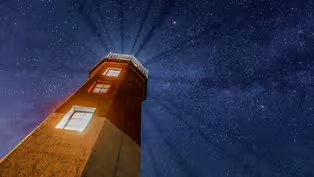
Video has Closed Captions
Clip: S5 Ep32 | 8m 48s | Photographer captures lighthouses at night under star-studded sky. (8m 48s)
Video has Closed Captions
Clip: S5 Ep32 | 5m 38s | Filmmaker explores Rhode Island’s abandoned buildings. (5m 38s)
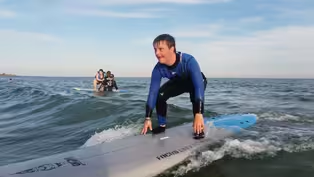
Video has Closed Captions
Clip: S5 Ep32 | 9m 31s | Surfers performing miracles with neurodivergent and non-ambulatory teens. (9m 31s)
Providing Support for PBS.org
Learn Moreabout PBS online sponsorship
- News and Public Affairs

Top journalists deliver compelling original analysis of the hour's headlines.

- News and Public Affairs

FRONTLINE is investigative journalism that questions, explains and changes our world.












Support for PBS provided by:
Rhode Island PBS Weekly is a local public television program presented by Ocean State Media