
Rhode Island PBS Weekly 8/18/2024
Season 5 Episode 33 | 24m 40sVideo has Closed Captions
Forging new hiking paths in Rhode Island and inside a bulk jewelry supplier in Providence.
Pamela Watts interviews former Providence Journal columnist and editor as he forges a new path hiking in Rhode Island. Producer Isabella Jibilian takes us inside Wolf E. Myrow, a bulk jewelry supplier in the heart of Providence. Plus, William Crisp, is an announcer who is helping elevate polo competitions to new heights.
Problems playing video? | Closed Captioning Feedback
Problems playing video? | Closed Captioning Feedback
Rhode Island PBS Weekly is a local public television program presented by Ocean State Media
Rhode Island PBS Weekly 8/18/2024
Season 5 Episode 33 | 24m 40sVideo has Closed Captions
Pamela Watts interviews former Providence Journal columnist and editor as he forges a new path hiking in Rhode Island. Producer Isabella Jibilian takes us inside Wolf E. Myrow, a bulk jewelry supplier in the heart of Providence. Plus, William Crisp, is an announcer who is helping elevate polo competitions to new heights.
Problems playing video? | Closed Captioning Feedback
How to Watch Rhode Island PBS Weekly
Rhode Island PBS Weekly is available to stream on pbs.org and the free PBS App, available on iPhone, Apple TV, Android TV, Android smartphones, Amazon Fire TV, Amazon Fire Tablet, Roku, Samsung Smart TV, and Vizio.
Providing Support for PBS.org
Learn Moreabout PBS online sponsorship(relaxed music) - So I approached the editors of the Journal and they said "You want to do what?"
(laughs) And I said "I want to write a column about hiking."
- [Pamela] Tonight, a veteran newspaper columnist takes us on the often-unseen paths of Rhode Island.
Then, millions of gems hidden in Providence.
(paper crinkles) - [Tony] Somebody wanted to make kind of a statement.
- Runs over the top, there goes.
- [Pamela] And one Englishman brings his love of polo to Newport.
- As he's running through.
That's my real aim is to get enjoyment to the fans that come.
(relaxed music) (relaxed music continues) - Welcome to "Rhode Island PBS Weekly," I'm Pamela Watts.
- And I'm Michelle San Miguel.
We begin tonight with a story about a recreational activity that takes many twists and turns, literally.
- Yeah, hiking first gained traction after World War II and spiked here in Rhode Island during the COVID pandemic.
But as we reported in May, one journalist was ahead of the curve when finding The Right Path.
- That's the most surprising, interesting part.
Whenever you set out with a new trail I've never been on before, it's intriguing because you really don't know what you're gonna find and what you're gonna see.
It's eye-opening.
- [Pamela] Taking in the exquisite views and exploring beautiful byways is a new calling for veteran newspaper man John Kostrzewa.
He is hiking and riding his way along Rhode Island's most breathtaking trails and discovering a bend in the road is not the end of the road.
- It was not an easy, straight path.
When I left the Providence Journal in 2017, I didn't really have a clear idea of what I wanted to do next or whether I'd ever work again.
- Kostrzewa worked more than four decades as a print journalist and spent the majority at The Providence Journal as a business columnist and editor.
What was it like to go from the world of high finance to forests?
- It was probably the furthest thing from my mind.
I think like a lot of people who retire, they're not quite sure what the next chapter is gonna be, though they know they want to contribute something and so you find your way and luckily, I found the path to hiking.
- [Pamela] Kostrzewa says he did a bit of recreational hiking years ago, especially when his sons were Boy Scouts.
He took it up again after retiring as a way to improve his health and sharpen his mind and spirit.
It was during the pandemic quarantine when he noticed an uptick on the trails.
- When I went in the woods, who are all these people?
Some of the Land Trust folks will tell you that three times as many people were hiking during COVID than before COVID.
Don't forget, we had a Governor who said "Take it outside" and we literally did.
- [Pamela] So he did something outside the box.
- I approached the editors of the Journal and they said "You want to do what?"
(laughs) And I said "I want to write a column about hiking."
I said "Look, it's pretty simple.
All I want to do is take people where they haven't been before.
If they've been there before, show them something different about the history or the geology or the wildlife."
- [Pamela] And he says.
- There were a lot of readers who were never gonna hike.
They were never gonna go in the woods.
But in the middle of that first COVID winter, they really just wanted something good to read about Rhode Island.
- [Pamela] Instead of telling him to go take a hike, the Journal editors brought Kostrzewa's career full circle.
Three years and 150 columns later, what started out as a trial run is now a regular route.
Kostrzewa's Sunday column is called "Walking Rhode Island."
He's compiled 40 of the feature stories in his new guidebook by the same name and while the topic is far from his former beat, he says The essential skills are similar.
- I'm not a trained historian, I'm not a trained geologist, I'm not a trained birder but what I have been trained in in 42 years is to observe, to look to the right, look to the left and see things and then try to figure it out and then if I can't figure it out myself, then find those experts to talk to that explain it to me.
- [Pamela] In the book, there are nature walks for families, challenging hikes for the experienced, even urban explorations.
- There's a wonderful hike through West Warwick along the bike path, which you walk right through this old industrial area and as you're walking on a trestle along the bike path, you smell this sweet smell, this fragrance and aroma and I said "What could this possibly be?"
Well, that's the Bradford Soap Works.
- [Pamela] Also in his guidebook, Kostrzewa includes coastal climbs along Ocean State shorelines such as Black Point in Narragansett.
- A lot of historical sites along the trail always fascinate me 'cause it really shows you how we lived two, 300 years ago and you'll see foundations right along the trail.
You'll see sluiceways built to speed up the water to run lumber mills or gristmills and I'm always interested to find out, well, who built those, how long ago and why?
And you put that all together and then you decide, okay, well what story do I want to tell now?
- [Pamela] The stories start with reading online sources about the area, then stuffing basic supplies in his backpack, first aid kit, rain gear, compass and GPS, insect repellent, water and energy bar and because he says he's old school, he carries a map where he makes notations and writes questions to research later and then he sets off, usually twice a week following the blaze, these numbered markings that point out the trail.
Kostrzewa says he hasn't run into any dangerous wild animals but he has encountered some fascinating lore and legends.
For instance, in Cumberland, the locals speak of the supernatural surrounding the newly-opened Catamint Brook Preserve off Tower Road.
- They've seen children along the road, they've seen ghosts along the road and then they've seen a creature they call Monkey Man, which I have never seen and never heard of.
- Like Bigfoot?
- Yeah, I guess some type of monkey-like, apelike creature that somebody had seen at one point and for some reason, it caught into the imagination of the folks there.
- Do you imagine that we'll run into Rhode Island's Bigfoot out here?
- Well, I certainly hope not.
- [Pamela] During a walkthrough of the Preserve, we didn't see the Ocean State's Sasquatch but we did observe rambling stone walls, the remains of a one-room schoolhouse from the 1800s that burned to the ground.
We also trekked through colonial farmland.
- If you look back to the late 1700s, there was a census done and 2/3rds of Rhode Island, 66% of all the land had been cleared of trees.
250 years after the farmers left, this is all what we call second growth forest.
- [Pamela] And amid all the trees, there is a sound of silence.
- You have to be a little bit quiet in the woods.
Certainly nothing wrong with talking to each other and sharing stories but the louder you are, the less of the wildlife you're gonna see, the less of those great bird tweets you're gonna hear.
You're not gonna hear those waterfalls you walk by.
- [Pamela] With that advice, Kostrzewa is following in the footsteps of his former Providence Journal colleague, the late Ken Weber, a noted columnist and outdoorsman who also wrote about rambles in Rhode Island.
Kostrzewa pays tribute to his mentor in this excerpt from his book.
- "Hiking should not be a race through the woods but a chance to pause along the way, explore and think.
I don't consider walking a competitive sport or endurance event," he wrote.
For a guy who was always racing on deadlines to the newspaper, that is wise sage advice.
- [Pamela] And so Kostrzewa says he takes that to heart on all his journeys until he reaches the end of the trail.
- When I come out of the woods, if I'm hiking with a friend, we'll each do a tick check with each other to make sure we're not bringing anything home and then when I do get home, I'll go to the backyard, set up a lawn chair and strip down right there.
- How do the neighbors feel about that?
(John laughs) - I haven't heard, but no complaints as of yet either.
- Oh good.
(laughs) But all kidding aside.
What do you love the most about wandering?
- Well, wandering is a good term.
I was just reading a book from Thoreau going way back and he would never call it walking or hiking.
He called it "sauntering" because he said the idea, almost like what Ken Weber said, is that you don't go to rush through the woods, you go to explore the woods and experience the woods.
Which is why I say I hope to continue to hike and to continue to write until somebody tells me to stop.
- The biggest question John Kostrzewa gets asked is if he will run out of areas to explore and he says definitely not.
New trails open all the time and readers keep suggesting ones he's never heard of.
We now turn to the jewelry industry here in Rhode Island.
It touched families across the state for decades.
Last May, Producer Isabella Jibilian visited the Wolf E. Myrow Company in Providence, a jewelry retailer that has stood the test of time.
For more than 60 years, the Antonelli family has kept their doors open while so many others were forced to close.
How they did it is the subject of our next story.
This is part of our continuing series, "Window on Rhode Island."
(upbeat music) - [Isabella] How many beads do you think are in this place?
- A billion, I dare anybody to come count.
(upbeat music) My name is Tony Antonelli.
I'm part of my family business, the Wolf E. Myrow Company.
We have all different kinds of glass beads, semi-precious beads, semi-precious rhinestones, brass chain, steel chain by the spool.
We have plastic beads, plastic stones, we have charms, we have bead caps, we have clasps, we have pins, we have hooks, we have connectors, we have, you name it.
If it's used in the jewelry business, we've got something here.
It started way back just after the second World War.
Wolf had a very good idea.
There's always excess and there's always demand.
He would buy it at a very low price and then turn around, mark it up enough to make a profit and resell it back to the other people in the industry for what they needed.
He started to look around for a partner.
He found my grandfather and evidently it worked because we're still here.
We're kind of old school here.
The workers here are responsible for certain areas.
(upbeat music) We do not use a computer at all.
We've had a lot of different clients here.
One that sticks out in my memory quite a bit was a woman that turned out to be a belly dancer.
So she was here buying bells and trim for her costumes.
(bells ringing) She had kind of a built-up hairdo and I'm looking and something started moving in her hair.
All of a sudden I saw a little, a snake poke its head out from her hair.
I don't know how she managed to keep it there but she spent the entire time here with a snake in her hair.
These are some of our older stones.
Some of these are from the turn of the century, the last century.
A lot of them were individually wrapped back then and that would go into very fancy jewelry if somebody wanted to make kind of a statement.
Rhode Island for the longest time was the costume jewelry capital of the world.
(jazzy music) Everybody had somebody in their family some way that was touched by the jewelry industry.
All the way back, a lot of the craftsmen came in from Europe.
They would make their fine jewelry for the rich and the famous of the time.
After the Depression, a lot of people couldn't afford anything pricey.
But you have these craftspeople who needed to still provide for their family.
So very talented people who used to do very high-end work were now plying their trade with base materials.
Instead of gold and silver, it was brass, it was steel.
Instead of accenting it with emeralds and rubies and sapphires, they accented it with glass, with rhinestones, with plastic.
(relaxed music) - [Isabella] What happened to the costume jewelry industry in Rhode Island?
- Well unfortunately, manufacturing in China can be done a lot cheaper.
The early to mid-90s, that's when it began to really steamroll and unfortunately a lot of the jewelry industry that thrived here for decades, it has withered and is no longer around.
My family works very hard.
(upbeat jazzy music) (electronic beeps) The fact that we do have such a wide variety of merchandise, we still touch on a lot of different uses.
Our material has been on television and on the movies.
- Robert, come quickly.
- What is it?
- Apparently the oven's broken down.
- [Robert] It can't have done.
- [Tony] A gentleman came in who was a head costume designer for "Downton Abbey."
He needed to source rhinestones and parts to use in designing the jewelry that the cast would be wearing during filming.
- We can't just give up.
- Certainly not.
Do you think I might have a drink?
- And we had a large stock of turn of the century rhinestones that he bought and he used to design around.
(upbeat jazzy music) Over here in this corner is our rhinestone chain stock.
All different sizes of spools of different types of rhinestone chain.
We had representatives from the Walt Disney World come in.
They were freshening up the original Pirates of the Caribbean and they needed to freshen up the treasure chests full of jewels and they took back hundreds and hundreds of pounds of clear plastic beads and gold-plated chain and shiny rhinestones.
If you work in jewelry and you work in arts and crafts or designing, there's something that's gonna catch your eye.
There's gonna be something here that you're gonna see.
It's all under one roof.
I would like it to keep going.
I think we provide something almost as a legacy now.
It almost works backwards now.
Where my grandfather wanted to provide for the future, we're almost like we owe a legacy, a debt to my grandfather to continue it, grow it and keep moving it forward.
- Finally tonight, we take you to Aquidneck Island where we heard that one Englishman is flying the flag for a lively and ancient team sport.
Back in June of 2022, Senior Producer Justin Kenny spent several weekends in the commentators booth at the Newport International Polo Grounds to capture one man's mission through passion and sarcasm to elevate the equestrian competition to new heights.
- Just tapping it 'round.
Dan Keating waiting to try and get to him.
Stuart trying to run past him.
He's got past him, he's got control of this ball as he run it through the goal.
Wow, talk about control.
I'm William Crisp and I'm the announcer for the Newport International Polo Series.
(horse neighs) (colleague chuckles) It's not that funny.
Backhand Auskie, oh, it's a miss.
A rare miss from Auskie, Chris couldn't get it.
Rory Tory picks it up.
Stuart on the gray pony goes to cover him.
Polo is this most amazing sport that requires horses.
You can play indoors, so an arena polo, which is three a side or outdoors, which is four a side and each person rides a horse and you try and hit a little white ball with a bamboo stick that's like 50 inches long with a wooden head and the ball is made of a hard plastic.
It's about three and 1/2 inches in diameter.
So not the biggest thing to hit when you're galloping along on a horse and then the opposition are allowed to bump into you on their horses and they're allowed to hook your stick too.
So it's quite active and you've gotta get your horse to the ball and once you get there, you've gotta hit it.
Chris tries to overcut it, runs over the top of the ball.
Minnie trying to get to it, she's pushing hard.
Put your stick down, Minnie, there we go.
Unfortunately comes off.
Bullis, stop the appealing, get the hitting going on.
Roger Soto misses the backhand.
Chris Ragameni, are you kidding me?
He's got a tough pony he's on.
Oh, Lucio gets in the way, it's there.
Marguerite, oh, she was looking at the goal, not at the ball and missed the ball.
I was lucky enough to be playing in England and somebody said to me, "Hey William, you wanna go to Newport?
They've asked for a team from England."
"Well yeah, sure."
So I ended up captaining or bringing the team from England in the very first year.
So that was 1991, 1992 and I fell in love with Newport, as you can imagine.
I'm still in love with Newport, I still call it my hometown.
I fell in love with one of the local ladies and basically never left.
Sends a lovely shot towards the goal.
It's left there for someone.
Dan Keating gonna try and clear it, he doesn't.
Rory Tory does.
I think it's got a bad rap, the name polo.
I think a lot of people, polo is like this, you know, the kings play it or something.
It's got a posh wrap.
But you come to Newport, it's not posh at all.
It's really down to earth.
The people who are playing, one of our players is a waiter.
We've got all sorts, one is a general contractor.
Get your stick down, hook it.
There we go, pressure.
Chris Ragameni, nice backhand, anybody onto that?
Stuart Campbell.
Minnie's got the right, Minnie's got it and Minnie's gonna unload this ball if she can.
So we have a lot of women play polo, a lot of ladies.
Two weeks ago, three weeks ago, we had the ladies versus the men and the ladies won.
You're on a half-ton horse and so the difference in weight between a male and a female when they're on a half-ton horse is negligible 'cause it's a half-ton horse and if you can ride a horse, you've got the game down.
Sure, there's a little bit of a strength issue in hitting the ball but as long as you've got timing and you can, you know, they play just as hard as the men and there's some really good women players out there in the world.
I mean, it's really good.
I mean, they're better than a lot of the men.
Runs over the top, there goes the 7:30 bell ending the first chucker.
The teams will go off and change their ponies.
If you can imagine that each pony runs probably one to two miles every chucker.
They're very fit, they're very well looked after.
So they'll go off for a break and then a pony is well capable of doing a second chucker.
Each player has a minimum of three horses and many of them will have six.
I'm really conscious of trying to bring the spectators into the game.
It's hard because it's polo.
So a lot of people don't know the rules and like in polo, they change ends after every goal, not after each quarter or halftime.
So people will be watching and go "Whoa, I thought we were going that way.
What's going on here?"
So I try really hard to make polo as simple as possible for people to understand the game and really be able to get into it and so they get into the supporting of a team and so that's my real aim is to get enjoyment to the fans that come.
Not even a grass stain to wash off.
- Okay, where are you going?
- We'll hope for better falls later on.
They're always interesting.
Yeah, Rory, you had to go across the line about four times there.
I know you don't think you did but you did and guess what?
The whistle goes, the clock will stop and we'll hang around for another 10 minutes while they make up their mind what they're gonna do.
We're gonna need headlights on the cars if we don't get this game over with soon.
I was really looking forward to this last chucker.
I thought it was gonna go absolutely flat out.
Just shows that I know absolutely nothing.
(electronic beep) (commentator laughs) Did somebody mention a certain examination?
Really, another whistle.
I have no idea for what this time.
I think people enjoy my type of commentating.
I think I'm quite dry.
I have probably a Monty Python-esque sort of weird humor, which amazingly, thank you, Monty Python people get and so yeah, I enjoy my weirdness.
My mother called me Thumper when I was younger after the rabbit in "Bambi" where she says "Thumper, if you can't say anything nice, don't say anything at all."
And I still probably should be called Thumper 'cause I still say what I think.
Is impeded, Rory Tory's trying to turn it.
Leo does well to stop him.
Can Campbell get on this ball?
It's under there, unlucky for him, it gets popped out.
Minnie tries to turn it the other way and in comes Sam Clements and the whistle goes.
This is when the F-bomb goes.
(commentator laughs) Oh, that was terrible.
He's lost control of it again.
- [Justin] You're commentating is a bit biting towards some of the players.
Do you ever get any reactions to that?
- What do you mean a bit biting?
I only say what I see.
It might needle the players a little bit or even the umpire a little bit.
But the spectators see what I'm saying and they enjoy a little giggle laugh maybe.
Freeman, Cole's turning it.
Runs over the top.
(bell rings) There goes the 7:30 bell ending the first chucker.
You know, polo came to Newport in 1876.
So it's almost three years to its 150th anniversary.
So I think my goal is to stay alive that long before maybe somebody will take me out.
I'm not gonna be rude to Putin or anything 'cause I don't want no assassins coming.
So as long as nobody takes me out before then, I'm gonna go on for another three years at least.
I enjoy it, so while I can still see, I'll carry on doing it.
Right, sweaty hand-slapping time, gentlemen.
Ladies and gentlemen, if you want to get sweated on by a smelly polo player, now's your opportunity and I can't believe how many of you line up for this torture.
But here comes Dan Keating to show his appreciation for your support and thank you so much everybody for coming.
(spectators clapping) Sorry it was a slow game.
- The Newport polo season runs until Saturday, September 28th and that's our broadcast this evening.
Thank you for joining us, I'm Pamela Watts.
- And I'm Michelle San Miguel.
We'll be back next week with another edition of "Rhode Island PBS Weekly."
Until then, please follow us on Facebook and X and visit us online to see all of our stories and past episodes at ripbs.org/weekly or listen to our podcast on your favorite streaming platform.
Goodnight.
(playful music) (playful music continues) (playful music continues) (playful music continues)

Video has Closed Captions
Clip: S5 Ep33 | 8m 52s | Polo matches Crisply delivered in Newport, RI. (8m 52s)
Video has Closed Captions
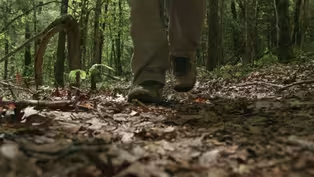
Clip: S5 Ep33 | 8m 47s | A former Providence Journal columnist and editor is forging a new path hiking Rhode Island. (8m 47s)
Window on Rhode Island: Wolf E. Myrow
Video has Closed Captions
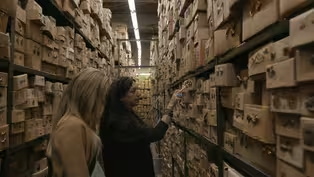
Clip: S5 Ep33 | 7m | Inside a bead lover’s paradise. (7m)
Providing Support for PBS.org
Learn Moreabout PBS online sponsorship
- News and Public Affairs

Top journalists deliver compelling original analysis of the hour's headlines.

- News and Public Affairs

FRONTLINE is investigative journalism that questions, explains and changes our world.












Support for PBS provided by:
Rhode Island PBS Weekly is a local public television program presented by Ocean State Media