
Rhode Island PBS Weekly 8/20/2023
Season 4 Episode 34 | 26m 59sVideo has Closed Captions
Transgender teenager searching for her true identity and local surfers changing lives.
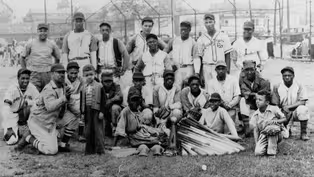
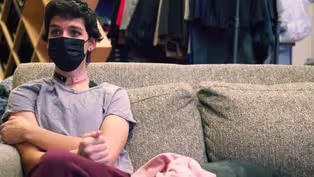
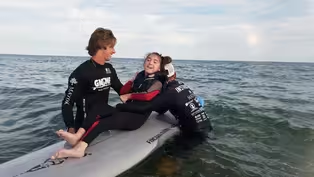
A second look at Pamela Watts' in-depth interview with a transgender teenager looking to become her true self. Then, we revisit a story about surfers out in Little Compton who many say are performing miracles. Finally, we take another look at the history of Black Baseball, featuring the Providence Colored Giants, who played integrated baseball before Jackie Robinson broke the color barrier.
Problems playing video? | Closed Captioning Feedback
Problems playing video? | Closed Captioning Feedback
Rhode Island PBS Weekly is a local public television program presented by Ocean State Media
Rhode Island PBS Weekly 8/20/2023
Season 4 Episode 34 | 26m 59sVideo has Closed Captions
A second look at Pamela Watts' in-depth interview with a transgender teenager looking to become her true self. Then, we revisit a story about surfers out in Little Compton who many say are performing miracles. Finally, we take another look at the history of Black Baseball, featuring the Providence Colored Giants, who played integrated baseball before Jackie Robinson broke the color barrier.
Problems playing video? | Closed Captioning Feedback
How to Watch Rhode Island PBS Weekly
Rhode Island PBS Weekly is available to stream on pbs.org and the free PBS App, available on iPhone, Apple TV, Android TV, Android smartphones, Amazon Fire TV, Amazon Fire Tablet, Roku, Samsung Smart TV, and Vizio.
Providing Support for PBS.org
Learn Moreabout PBS online sponsorship(upbeat symphonic music begins) - [Announcer] Tonight on Rhode Island PBS Weekly.
- It's been nine months since Katie Adams began her transformation from male to female.
Are you happy about going down this road?
- Deep down, I used to feel very hollow.
I used to feel like there was always some part of me missing.
I finally feel like I'm myself, and despite I'd feel like that sometimes I'd be an alien, at least I know who I am.
- These are kids that, typically, do not get invited to birthday parties or sleepovers.
To see them having fun, doing something that typical kiddos do, it's a feeling like no other.
- For the first time, really, (stadium chatter) Providence has a Black professional baseball team in '31.
Their home field is Kinsley.
And they pack Kinsley, and they showcase some of the best baseball talent, period, Black or White.
(upbeat symphonic music continues) (upbeat symphonic music fades) - Good evening.
Welcome to Rhode Island PBS Weekly.
I'm Pamela Watts.
- And I'm Michelle San Miguel.
Last year as part of our story on mental health challenges for Rhode Islanders, we profiled someone going through gender transition.
- We first met this teenager on the brink of changing from male to female.
In January of this year, we met her again to get an update on her transformation several months on.
We begin our story with a brief look back to when we first met Katie Adams.
- I brought a girl out on a date in freshman year and I had no type of sexual attraction to her at all.
I found her very pretty.
I wish I was her.
I couldn't get myself to realize that thought, and I wouldn't believe it until much, much more later on.
- Welcome to Gender Spectrum.
We're be here for about an hour, talk about whatever we wanna do with... - Back then, "Katie Adams," as she now calls herself, was attending Gender Spectrum sessions at Youth Pride, a nonprofit serving the LGBTQ community, and she was living at home.
Oh, tell me about this picture here.
- Oh, this is a picture of when we went to Comic-Con.
- And so, you're a big Star Wars fan?
- Yeah, I really, I really did enjoy, I still do.
I still enjoy comic books and Star Wars.
- Typical kid.
- Yeah, typical kid.
- So you didn't know you were transgender?
- No, I did not know.
Discovering it was very rocky.
It was very, very rocky.
(music playing on phone) - Adams says, she took the first step on that rocky road by doing the most masculine thing she could think of, enlisting in the Marines.
- However, it did not work because no matter how hard you try, it's not going to go away.
I am just a trans woman.
I've pushed this back my entire life.
It's a feeling that repeatedly shows up.
I feel that I should be a girl.
I feel that I should be looked at as one because I am one.
- When we first met Adams, who is now 19, had just started hormone replacement therapy, HRT.
Well, it's been nine months since you've been on the journey.
That's when we last spoke to you.
Can you tell us how these last nine months have been for you?
- It's been, it's been pretty rough.
It's like a second puberty.
It's hard, it's really hard.
And sometimes, a lot of people who are transitioning don't have that support and you need to find it.
- Adam's support from her family eroded so she had to move out.
She now lives at Haus of Codec, a shelter in Providence for the LGBTQ community.
- What happens with people who normally try to transition is a family can see somebody who you used to be, compared to who you wanted to be, and it can really separate the two.
Perfect example is, this Christmas I went to go receive gifts and a lot of the gifts weren't the name that I wanted to have.
- And what is that name?
What do you call that name?
- That would be a dead name.
That's a name that is, was given to you and doesn't match what, how you felt inside.
- What else have you noticed about changes within?
Despite the emotional toll, Adams is encouraged by the physical changes she's beginning to see.
- It definitely does feel like something that I wish I could have done when I was younger.
So it's, it's very euphoric.
- Your hair has, you've grown out your hair since last we saw you.
What other physical changes has the medication brought?
- I've had a lot of fat distribution.
That is for sure.
It's been a lot in the chest as well with the waist and a lot of, and sometimes reconstructing the face a little bit.
I remember my doctor (traffic whoosing) talking to me about the changes that I'll go through.
- Adams also says her skin is getting softer.
She's had electrolysis to remove her facial hair and is beginning to dress more feminine.
Katie, a lot of people would say, you're awfully young to have made these decisions and to be so committed.
What do you say?
- So, am I really young?
Or am I just being who I've been keep on saying I am?
And I've just been keep on getting turned down.
- [Pamela] Reliable data is hard to come by, but anecdotally, many mental health providers report more teenagers are coming out as transgender than ever before.
Some say they are inspired by those now in the spotlight, celebrities such as Caitlyn Jenner and Laverne Cox.
In our initial report, we asked Dr. Jason Rafferty about the numbers.
He's a local pediatrician and child psychologist.
- We see evolving sort of identities, people who are non-binary, people who are gender fluid, people who are all these different sort of labels that are starting to emerge to describe diverse experiences.
- [Pamela] Dr. Rafferty also noted the societal shift to be more inclusive has some staunch critics.
At least 20 states have introduced anti-trans gender legislation aimed at everything from restrooms to sports.
- I think we've seen this before, whether it's with issues of race or sexual orientation, that as we try to become a more accepting culture, there's always some resistance.
- [Pamela] Rhode Island has been fairly accepting.
It has a comprehensive anti-discrimination law concerning sexual orientation.
And in 2001, gender identity was added to protections in housing, credit and employment.
Adams is currently job hunting after, she says, harassment while working at a local cinema complex became overwhelming.
- A lot of it came from customers because there's no type of like barriers customers have to how they speak to you.
- What would they say?
- They would say a lot of hurtful types of words.
Specifically, words towards trans community in general or the LGBTQ community.
A lot of just asking me to go back to where I came from.
- How do you find the resolve within yourself to go forward?
- I guess I have to admit there's some part of me that wants to prove people wrong.
I really do wanna prove to my family that of who I am and despite them telling me of who I always am going to be.
- Are you happy about going down this road?
- Deep down, I used to feel very hollow.
I finally feel like that I am, I'm myself.
And despite I'd feel like that sometimes I'd be an alien, at least I know who I am.
- Adams is currently taking courses at CCRI, Community College of Rhode Island, and says, she'd someday like a profession protecting wildlife.
Do you feel an affinity for animals?
For Creatures?
- Yeah.
Yeah, actually.
They... And the best part about animals is that they're, they don't judge, they're not biased.
And as they say, "A dog is a man's best friend."
- And could be a woman's best friend too.
- Yeah, it could be a woman's best friend too.
- Up next, we head out to a beach in Little Compton where some say surfers are performing miracles with children and others who are often left behind.
Senior producer, Justin Kenny, first brought us this story last September.
(waves crashing) - Go Gabby.
(Gabby laughing) - At Gnome Surf, we surf with over 3000 athletes and families.
What we do is surf therapy.
Our athletes at Gnome Surf are typically neurodivergent.
We're for all kids.
We've built our program on inclusion, but I'd say, over 95% of our athletes either have autism, Down syndrome, ADHD, depression or anxiety.
(surf splashing) My name's Christopher Antao.
I am the Executive Director and Founder of, "Gnome Surf."
(waves crashing) - My name's Mackenzie Palumbo and I'm Cash and Hollis's mom.
Cash and Hollis are 13 years old.
They're twin boys.
They were diagnosed at 15 months of age with autism and a handful of other diagnoses.
Both of my boys are pretty much non-verbal.
Hollis is non-verbal.
Cash has some language.
These are kids that, typically, do not get invited to birthday parties or sleepovers.
To see them having fun, doing something that typical kiddos do, it's a feeling like no other.
Every time I stand on that shore and I watch my kids out on the board, I always think to myself, "This is what parents of typically developing children must feel like when they watch their kids play baseball, or football or soccer," and you just feel so proud.
(waves crashing) - My name's, "Geo Mottram."
I'm the lead instructor here at Gnome Surf.
So I was born with brain damage.
It's led to brain aneurysms, scattered bleeding spots.
It's led to a whole host of different challenges for me.
The most prominent has been sensory regulatory and then social situations.
Couldn't speak till I was like six.
And then, it's been a long journey to this point of verbalization.
I've also had seizures, general motor skill challenges, so to say.
Luckily, Gnome has helped me recover from that, amazingly.
Because when you have a lot of the stuff, you have super low self-esteem, super low confidence.
It's helped my balance, my social skills, and has overall turned me into a more well-rounded human and athlete, I would say.
I started surfing with Chris seven years ago, and I started teaching three to four years ago.
I've seen Gnome from all different angles.
I've seen what the surf therapy does and how amazing of an impact it has and the true healing potential and amazingness that it gives off.
And I can also see it from the instructor side and how what I do and how I can teach can then heal kids and their certain challenges.
(Abby laughing) - I'm Heidi MacCurtain.
I'm Abby's mom.
Abby wasn't meeting milestones, so eventually around six months, her pediatrician suggested that we look at an MRI to maybe see if there's anything else going on.
On that MRI it showed that she had lesions on her brain and then elevated lactate, which were consistent with Leigh's.
So at that point, what they knew about Leigh's disease, which is a mitochondrial disease, they said she had about two years to live.
That has since changed.
She's 11, she's been in a drug study.
And we're just trying to do as much as we can to live a full life for our whole family.
And Abby getting out doing stuff, like surfing and horseback riding.
We try to do what we can.
Abby loves adventure and she loves water.
That's one thing... Any type of water play, water activity, always brings her to life.
When we had the opportunity to try surfing I was like, "We'll try it."
I was a little nervous of how they would support her since she's a hundred percent reliant on somebody to hold her up.
She can't sit up on her own, she can't walk.
So...
I just saw some videos and I said, "Well, they seem to have a good handle on it."
And the first time I came, they're like, "Mom, don't worry we've got it."
And I was like, "Okay."
Even just pushing her across the sand, I was like, I'm so used to doing this stuff.
So to give all the control away and watch it, it was so enjoyable.
Her smile, her laughter, and everybody around her, it was awesome.
And we couldn't wait to have another opportunity to do it.
(waves crashing) - Do you like surfing?
- Yeah.
- Gnome Surf has saved my life.
I've struggled with ADHD, depression, anxiety.
And when I'm out there on the waves with these kids, everything slows down, it calms down for me, and I truly get my medicine so to say, just like these kids.
It's made my life a thousand times better.
I'm lucky enough to know what my purpose on earth is.
When I started, I was an executive banker.
Made well over six figures, very successful, lucrative career.
And Gnome Surf just kept growing and growing.
And one day came to where I needed to make the decision, whether it was to grow this surf school for children or to continue to be an executive banker.
And for me, that decision was extremely easy.
- Now!
- When I look out in the water and see the smiles of these children that depend on me, I knew that I only had one choice to make.
So I decided to go Gnome Surf full time and also became a firefighter in the city of Fall River.
And so now, I change lives and save lives.
(chuckling) Do I ever cry?
Yeah, absolutely, I cry.
I try to, you know, shelter the tears a little bit from the families because I know it's pretty emotional for those parents too.
It makes me quite emotional to know that we're delivering something to this family that normally they don't have the opportunity to partake in.
And to see the parents smile and to tear up and to see their child breaking barriers or proving, you know, the scholars wrong is something that, you know, is truly meaningful and deep for me.
- How do you not get emotional?
How do you not get emotional when you have a child who is nonverbal and all he can do is smile from ear-to-ear because he's just so happy?
How do you get emotional when you have a child who's wheelchair bound (waves crashing) or medically fragile and you see them out on the board?
Those are things that you just never picture for your own kid.
And you see them doing something that makes them find joy and it's, it's emotional.
- She could be feeling crappy at home or even in the hospital when she starts to perk up.
Just sitting her by the sink and her playing with water just, I don't know, makes her happy.
So I think just being out there when you're surrounded by it, she's in her element.
Right?
Are you a surfer girl?
Yeah.
Can you say, "Thank you?"
You know, "Thank you."
Thank you.
- To date, Gnome Surf has surfed with 5,000 families.
This year, the group expanded its camps to four area beaches.
Finally tonight, a new documentary exploring the long and often overlooked history of Black baseball players in the Negro Leagues is gaining attention as it hits theaters.
The film is called, "The League."
- Are a part of a movement (chill hip-hop music begins) before we coined the term, "Civil Rights Movement."
(dramatic chord) - Man, they didn't care about making no history.
They just wanted to play ball.
(gentle music begins) But the pride, the passion, the courage in the face of adversity, that's the real story.
(chill hip-hop music begins then fades) - Here in Rhode Island, we have our own history of Black baseball.
Long before the integration of Major League baseball, the Ocean State was home to the, "Providence Colored Giants."
Back in July of 2021, contributing producer, "Dorothy Dickey," asked Rhode Island artist, "April Brown," to take us on a tour of the team's home, "Kinsley Field."
(traffic whoosing) - So here we are at Kinsley and Acorn Street.
Imagine in 1919, this was a huge field.
- What was this field used for back then?
- So this was the place where community could come and see fireworks and see boxing, soccer, and football.
(air whooshing) - And what about baseball?
- In the 1920s, this location was where you could see amateur and professional baseball events.
This was the location you could see Black teams playing against White teams.
And in 1931, this became the home field of the Providence Colored Giants, Rhode Island's first professional Black baseball team.
(gentle acoustic guitar begins) - Kinsley Park was built in the early 1920s.
The geographic significance really rests with an old trope in sports history which is, there's a lot of ballparks which are built on railroad property, large pieces of property which railroads no longer used, and they become ball fields.
(train chugging) Kinsley Park is probably synonymous with Rhode Island's featured minor league baseball team, "The Grays."
And really, the park is built with The Grays in mind.
And that's where you see (crowd cheering) incredible professional teams coming in and out.
Babe Ruth and Lou Gehrig played there in an exhibition game.
Kinsley Park had always been an enclosed stadium, which was what made it so special.
Professional teams, or semi-professional teams, (crowd cheering) almost exclusively sought out stadiums where people had to pay to enter.
Daniel Whitehead, or Big Dan Whitehead, is oftentimes referred to as, "The Father of Black Baseball," in Rhode Island.
He's referred to that because in 1905 he establishes the original Providence Colored Giants.
In 1908, he incorporates the team, and it becomes Rhode Island's first moneymaking, African-American team.
Arthur "Daddy" Black comes to Rhode Island in the early 1880s from South Carolina.
He becomes involved in what was then called, "The Numbers."
This is as early as 1924.
The numbers racket was an illegal gambling scheme based on lottery numbers, and he's incredibly successful at that.
So that by the early 1930s, he is, "The Numbers King of Rhode Island."
So he has a significant amount of income.
And one of the things (music fades) that Arthur Black became involved in very early, in fact, as early as 1924, is supporting African American baseball teams.
(baseball bat striking ball) And then in 1931, (crowd cheering) full owner of the Providence Colored Giants.
Arthur Black, was very much interested in creating a professional team with professional players.
In 1931, there are players who were scrambling for contracts.
"The Professional Negro Leagues," as they were called back then, went under, because of the Great Depression and because of the death of Rube Foster, who had organized the league back in 1920.
Arthur "Daddy" Black is able to sign some of the most incredible Black baseball talent along the East Coast to play up in Providence, again, because he can promise them a weekly check.
And those payments, from what I gather, were pretty good.
And for the first time, really, Providence has a Black professional baseball team in '31.
Their home field is Kinsley and they pack Kinsley, and they showcase some of the best baseball talent, period, Black or White.
(crowd cheering) One of the most (down home music begins) talented players that Arthur Black was able to sign for the Providence Colored Giants was, "Oliver Marcell."
Marcell had established himself as the premier third baseman in Black baseball, to the point where in 2006 he was shortlisted for induction into the National Baseball Hall of Fame.
But one of the interesting (music fades) things about African American baseball in Rhode Island during this time is the way in which African Americans negotiated segregation or the racial barrier.
In baseball, (indistinct chatter) you see integration occurring much sooner (baseball bat striking ball) than you see it occurring in other walks of life.
(crowd cheering) The White teams were happy to have the Black team because the Black team was always a draw.
People came to see the incredible Black talent.
It also opened up a fan base to African American fans.
Folks would go to church and then they would come back from church, and they would go right to the game.
Sometimes, wouldn't even change out of their Sunday clothes.
It was a wonderful sort of social and cultural event for the community.
When we're talking about the 1920s, baseball and money sort of go hand-in-hand and integration and money go hand-in-hand.
So essentially, what happens in 1931 is that Daddy Black's professional team doesn't do as well as he had expected.
In fact, he has a major disappointment at the Polo Grounds in New York when his team doesn't do all that well against Bill Bojangles' team, "The Harlem Stars," which would later become, "The New York Black Yankees."
And Arthur Black walks away from that team in '31.
And Dan Whitehead comes in to take over the Providence Colored Giants in 1932.
Arthur Black was very much in favor of a contract in which players were paid regularly.
Daniel Whitehead had always agreed that the players should split the gate.
And when Daniel Whitehead informs the players that they're no longer getting a regular paycheck, as they did under Daddy Black, in fact, they're gonna have to split the gate, the players mutiny, they refuse to play.
And as a result of that, the team falls apart.
The fans want their money back.
For Black, the game was important, (somber music begins) but the game was a business opportunity.
But for Whitehead, that was his life.
Whitehead was a player.
Whitehead, back in 1905, shared time on first base or right field and very close to his players.
Very different sort of relationship than the business relationship that Black had.
So when the players mutiny in '32, Whitehead walks away from the game and dies a year later, pretty much broken hearted really, in a boarding house, penniless, separated from the game that I think he loved so much.
And in 1932, prohibition is coming to an end and money streams for organized crime are drying up.
(glass bottles clinking) And as a result of that, people are looking to take over territories and Black is murdered (gunfire) for his territory.
(siren wailing) Whitehead passes, Daddy Black is murdered.
And Kinsley Park, this sacred ground is torn down and it all ends by the early 1930s.
(baseball bat striking ball) (crowd cheering) Sports is oftentimes an avenue, which can not just mirror what's going on in the broader society, but can also change what's going on in the broader society.
Rhode Island does experience integration, at least in baseball, a lot sooner or a lot quicker than its neighboring states.
Baseball has always been a local game, enjoyed by local fans as much as integration is needed and desired and fought for.
It's bittersweet, because all Black baseball games on a Sunday afternoon had meant so much to the community.
That celebratory event and the men who lived in those communities and played that local game who no longer existed, (crowd cheering) but Kinsley Park was the place where they showcased their talent.
(baseball bat striking ball) - That's our broadcast this evening.
Thank you for joining us.
I'm Michelle San Miguel.
- And I'm Pamela Watts.
We'll be back next week with another edition of Rhode Island PBS Weekly.
Until then, please follow us on Twitter and Facebook and visit us online to see all of our stories and past episodes at ripbs.org/weekly.
Or you can listen to our podcast on your favorite streaming platform.
(gentle music begins) Thank you and goodnight.
(gentle music continues) (gentle music fades)
Video has Closed Captions
Clip: S4 Ep34 | 8m 26s | An in-depth look at the often-forgotten history of Black baseball in Rhode Island. (8m 26s)
Video has Closed Captions
Clip: S4 Ep34 | 8m 10s | An in-depth profile of a transgender teenager who talks about her new life. (8m 10s)
Video has Closed Captions
Clip: S4 Ep34 | 9m 12s | Surfers use surf therapy to help neurodivergent and non-ambulatory teens. (9m 12s)
Providing Support for PBS.org
Learn Moreabout PBS online sponsorship
- News and Public Affairs

Top journalists deliver compelling original analysis of the hour's headlines.

- News and Public Affairs

FRONTLINE is investigative journalism that questions, explains and changes our world.












Support for PBS provided by:
Rhode Island PBS Weekly is a local public television program presented by Ocean State Media