
Rhode Island PBS Weekly 8/25/2024
Season 5 Episode 34 | 22m 15sVideo has Closed Captions
Local artist who puts art in your hands and people who have synesthesia.
A second look at local artist and handbag designer, Kent Stetson. who took his pop art paintings off the wall and put them in people’s hands. Michelle San Miguel’s report on people with synesthesia, and how they view the world. Rose Island’s manager Mike Healey gives us a tour of the spectacular island and its colorful history.
Problems playing video? | Closed Captioning Feedback
Problems playing video? | Closed Captioning Feedback
Rhode Island PBS Weekly is a local public television program presented by Ocean State Media
Rhode Island PBS Weekly 8/25/2024
Season 5 Episode 34 | 22m 15sVideo has Closed Captions
A second look at local artist and handbag designer, Kent Stetson. who took his pop art paintings off the wall and put them in people’s hands. Michelle San Miguel’s report on people with synesthesia, and how they view the world. Rose Island’s manager Mike Healey gives us a tour of the spectacular island and its colorful history.
Problems playing video? | Closed Captioning Feedback
How to Watch Rhode Island PBS Weekly
Rhode Island PBS Weekly is available to stream on pbs.org and the free PBS App, available on iPhone, Apple TV, Android TV, Android smartphones, Amazon Fire TV, Amazon Fire Tablet, Roku, Samsung Smart TV, and Vizio.
Providing Support for PBS.org
Learn Moreabout PBS online sponsorship(calming music) - [Pamela Watts] Tonight, from a Pawtucket workshop, extreme art as accessory and icebreaker.
- If you wanna be left alone, if you want a chill, low-key evening, do not carry one of my pieces.
(Kent and Pamela laughing) - [Michelle San Miguel] Then we meet local artists who can smell colors and taste words.
- We aren't like everybody else.
This is a little weird.
- [Pamela Watts] And a visit to Historic Rose Island.
(lighthearted relaxing music) (lighthearted relaxing music continues) Welcome to Rhode Island PBS Weekly.
I'm Pamela Watts.
- And I'm Michelle San Miguel.
We begin tonight with a story about designer handbags - And how one Rhode Island artist has taken purses to a whole new level by transforming accessories into artwork.
And as we first reported back in April, instead of his creations hanging on the wall, he decided to put them right in your hand.
(machine whirring) - 22 years ago, if someone had told me I would be making purses from my artwork, I don't know if I would've been happy hearing that.
Now I'm living the dream.
- [Pamela Watts] The dream for Rhode Island artist Kent Stetson is being a designer of handbags; whimsical, colorful, topical.
They are all made by hand in his mill workshop and sold in hundreds of boutiques worldwide.
The purses are clutched by celebrities such as Martha Stewart, Sarah Jessica Parker, and Meghan Thee Stallion.
Not only do his bags star on the red carpet, they fly down the runway.
These are not your mother's pocketbooks; they are a fusion of art and accessory.
- I think, in terms of art, it's interactive.
It's modular.
I think it speaks in kind of an interesting way.
- [Pamela Watts] And an interesting twist carried Stetson into the world of high-fashion accessories.
Stetson grew up in this cabin on a working horse farm in New Hampshire.
He studied studio art and philosophy at Brown University and started out creating these digital hybrid paintings.
- So, computer generated paintings, at the time, we called it new media.
Today, I think it's just called digital art.
And so, these are very colorful, abstract pieces.
- [Pamela Watts] But Stetson admits he was unsuccessful selling his modern art, so he pivoted.
His plan B translated to "In the bag."
- I worked at a shoe store at the time, though, and I had a gift for convincing people to buy shoes and handbags that they didn't particularly need.
And so, I connected the dots.
- How did you land on purses as the frame for your artwork, of all things you could have picked?
- It was a way to package my art in a format that had some use.
A handbag gave me much more license to be fun than I ever felt I had permission to do with a piece hanging on the wall.
And so, almost instantly, I made pieces that were a little bit irreverent, and tongue-in-cheek, and funny.
- [Pamela Watts] Funny as in notoriously tasteful.
Stetson's popular confections feature donuts, animal crackers, sushi, and even Rhode Island's famous New York System wieners - [Kent Stetson] Three all the way.
New York System is an iconic Rhode Island comfort food, and so we had to translate it into a bag.
- Stetson says, when you carry one of his designer handbags, it starts a conversation and might make a friend, whether it's one of his doggy bags or a selection from his bar cart of popular cocktails.
they're a statement piece.
- It's an exclamation point on your outfit.
I mean, it does not get the silent treatment.
When you carry one of my pieces, it gets acknowledged.
- [Pamela Watts] Kent Stetson's signature handbags, which sell for between 150 and $300, support a number of charitable causes.
One style references the laced collar of late Supreme Court Justice Ruth Bader Ginsburg.
- When she passed, Mariska Hargitay used this bag on "Law and Order: Special Victims Unit".
- I just got an alert.
Irena's building.
- Okay, Kat, you and I will go up.
- The sales for this piece sort of went haywire.
And so, we donate the proceeds to the ACLU.
- [Pamela Watts] Others may tote an alligator handbag, supporting Everglades preservation.
- Everything start to finish is done right here.
- Stetson says making each purse takes 50 steps and three days to complete.
First, he creates an image, formats it on his computer, prints and laminates the canvas.
But while the process begins with high-tech innovation, the rest is old-world craftsmanship; hand-tracing and hand-sewing.
In general, Stetson's signature bags are slim envelope styles.
A lot of people look at it and say, "I can't get anything in this bag."
What do you say?
- It's a fun little going out bag.
Listen, if I made a larger bag, I'd have to leave Rhode Island.
We're the smallest state in the country.
I gotta be making small bags.
- Describe what it is you want people to see in this form of art.
- Well, I think I want people to know that I made this with love and a sense of joy, and I know that it's going to make an outing just that much more fun.
It's come from my hands, my studio.
I sign inside each piece as we sew them up.
And so, I want people to feel like they have a real connection to the creation of this piece, where it came from.
And I think this is sort of like the farm-to-table version of personal accessories.
- [Pamela Watts] Stetson says his customer's personality pops when they carry his fun-sized handbags.
And because of the artist's perseverance, these accessories will do all the talking for you.
- People are gonna say something.
You're gonna light up the room.
So, if you wanna be left alone, if you want chill, low-key evening, do not carry one of my pieces.
(Kent and Pamela laughing) - Up next, imagine living in a world where music is not only heard, but also seen.
Words have flavors and colors have a smell.
It is not a hallucination or a metaphor, and it can't be taught; it's a neurological condition.
And as we first reported back in 2022, those who have this crossover of the senses say it's dramatically changed how they perceive the world.
- I think that we're all lucky that it exists, because without it, there would not be the magnificent art that we get to have all around us.
- [Michelle San Miguel] Artist Alyn Carlson has a neurological condition that she says makes her life and her artwork more interesting.
- I was probably five, and I started seeing numbers in color.
Three was yellow.
Five was red.
Zero was white.
Seven was sort of a purpley-blue.
- Not only does Carlson see numbers in color, but she says she can also hear them and smell them.
You've been open about the fact that you feel self-conscious, somewhat, even talking about this.
- I know.
Yeah, a little.
- Why is that?
- Well, it's kind of... because other people can't really relate to it.
(serene music) - [Michelle San Miguel] Artist and musician Lennie Peterson certainly can.
- So, when I hear music, I see shapes, - [Michelle San Miguel] What kind of shapes?
- Well, they're in my art, and they're anywhere from a straight line, depending on the note, to all kinds of atmosphere within squares and circles, - [Michelle San Miguel] Both Lenny Peterson and Alyn Carlson have synesthesia, a rare condition where a person's senses, including the sense of smell and sound, get mixed together.
We asked neurologist Dr. Richard Cytowic to explain just what synesthesia is.
- It's pretty easy.
Everybody knows the word "anesthesia," which means no sensation, so synesthesia means joined or coupled sensation.
And there are kids who are born with two, three, or all five of their senses hooked together, so that my voice, for example, is not only something that they hear, but something that they might also see or taste or feel as a physical touch.
- [Michelle San Miguel] Dr. Cytowic is credited with bringing synesthesia back to mainstream science.
He's written six books on the phenomenon.
He says colleagues initially dismissed it as too weird and new age.
- What happened is that, you know, I caused a paradigm shift in how we think about how the brain is organized.
If we don't have five senses traveling down five tubes that never intermingle, there are huge numbers of cross connections in the brain all the time.
(tool scraping) - Carlson says the artwork featured in her new Bedford studio was created, in large part, thanks to her synesthesia.
- If I'm working, and two colors seem to come together and I smell them, they kind of lead me into an area to continue.
And because my work is abstract, very often what I'm doing is I'm reacting to a color combination.
- [Michelle San Miguel] Take, for instance, this abstract painting.
Carlson says she painted it by mixing colors that smelled like one of her favorite things, a low tide.
- So, I started to be able to pull in whole family of those colors that smelled that way to me.
It was like an undercurrent in the whole palette.
And so, from that, I painted a, you know, 80-inch wide abstract landscape just from the smell, those two colors that came together.
And that happened.
Boom.
That was so fast.
- [Michelle San Miguel] Synesthesia is more common than some might think.
Dr. Cytowic says 4% of the population has this union of the senses, including Lady Gaga.
♪ Poker face ♪ ♪ She got me like nobody ♪ - [Michelle San Miguel] And Billy Joel.
♪ We didn't start the fire ♪ ♪ It was always burning, since the world's been turning ♪ - [Michelle San Miguel] Russian writer Vladimir Nabokov, who wrote "Lolita" also had it.
(chilled jazz music) So did Composer and pianist Duke Ellington.
Is anesthesia more common among artists and musicians?
- Well, you know, we're more familiar with famous artists who happen to be synesthetes than we are famous synesthetes who happen to be artists.
And it's a chicken and egg question of "Are they artistic because they're synesthetic, or are they synesthetic because they're artistic?"
But I think it's the former, and they're used to unusual things going together.
(relaxing orchestral music) - [Michelle San Miguel] It's those unusual things that inspire the work of Newport-based artist Lennie Peterson.
He listens to music as he works and draws the shapes that he sees.
Now, these shapes appear three dimensional in front of you.
They're floating in the air.
- They are being created in front of me.
They're not in the room, they're forming in front of me as I listen to music.
And the more I concentrate on it, the more they're gonna form, and the clearer they're gonna form.
(relaxing notes) - [Michelle San Miguel] Peterson was in his late twenties, teaching at the Berkeley College of Music, when he realized the way he experiences the world isn't like most people.
- I was producing a student's project of music, and we were tracking keyboards.
And I said, I got on the, you know, the talk mic, and I said, "Can you make that chord more round?"
And I just got this stunned silence, you know, like, "Wait, what?"
So, I turned to the engineer and he said to me, "What?"
I said, "I want 'em to make it more round?"
He said, "You must have synesthesia."
- [Michelle San Miguel] Peterson's paintings are heavily influenced by the music he listens to.
(calming jazz music) - So, this is specifically around a Miles Davis song, actually, called "In a Silent Way", and it's a very mystical kind of setting for this song.
Then the synesthesia kicks in here.
I start in the top left-hand corner, and I let my hand go, and it's just a free flow of while the music's playing.
(calming jazz music) - [Michelle San Miguel] At times, Peterson says it feels like an overload of the senses, which he says isn't a bad thing.
- If I get extremely sick, like high fever, a lot of people have hallucinations when they get really super sick.
But ever since I was a little kid, I would hear these gigantic symphonies in my head that would just like crazy huge, like, (indistinct), Mahler type symphonies.
- Do you ever wish you didn't have synesthesia?
- No, never.
Never.
It's almost like saying you wish the sky wasn't blue.
There's nothing I can do about it, and it's there, you know, and it's part of my life.
- [Michelle San Miguel] Is it hereditary?
- Oh, yes, absolutely, very strongly so.
It runs strongly in families.
Either sex parent can pass it down to either sex child, and you'll see it in multiple generations.
So, the most I have is four living generations with synesthesia.
But historically, we've been able to trace it back even more so.
- [Michelle San Miguel] According to the National Institutes of Health, some researchers think people with synesthesia have extra connections between brain cells in some areas of the brain.
Others think the direction that information can flow between brain cells might be different.
Dr. Cytowic says synesthesia is a left brain phenomenon.
- There's a difference between actually viewing colors and seeing synesthetic colors.
And it's as if synesthesia has hijacked a normal brain function that is viewing colors by connecting it with other senses in the left hemisphere.
- [Michelle San Miguel] Colorful experiences can also evoke pleasant sounds.
For Alyn Carlson, this combination of blue has a distinct pitch.
- Every time I started to put them together, I would hear cello.
I would hear cello music, just a long note.
Just a long note.
It's not a complicated piece of music.
- [Michelle San Miguel] As the paint is being mixed.
- Yeah, as the paint is being mixed.
When I would get still with it, I would just hear it.
- [Michelle San Miguel] And sometimes, she can smell it too.
- I would hold her and, of course, smell her.
- [Michelle San Miguel] Carlson says this painting captures the smell of her youngest granddaughter when she was a baby.
- And I just wanted to replicate it somehow.
And these colors came to mind.
It wasn't hard at all; they just popped in.
And that's where this came from.
- Can you smell your granddaughter when you look at this?
- Well, she's three and a half now, but I can smell a baby.
- You can?
- Yeah.
- For Carlson, Synesthesia allows her to hold on to precious memories.
What would a world without synesthesia look like for you?
- I don't know.
I probably wouldn't be, obviously, doing what I do, making what I make.
I'd be lost.
I'd be really lost, I think.
- Finally tonight, although the Newport Bridge provides a spectacular view of a small landmass called Rose Island, most people in the ocean state know little about its storied past.
In September of 2022, as part of our continuing series "Window on Rhode Island", Rose Island's manager gave us a tour to learn about its colorful history.
(waves rushing) (boat horn honking) (waves rushing) (calming piano) - Hi, I'm Mike Healy.
Welcome to Rose Island on a beautiful day.
We are located on the East passage of Narraganset Bay.
We don't actually know how Rose Island got its name, but what we do know is that the Indians called it Conockonoquit.
And in Indian, Conockonoquit means the island with the long stem.
And if you were to come over the Newport Bridge at low tide, you would see a strip of about 200 yards of beach that appears only at low tide, and the island.
So, from that perspective, it does look like a rose with a stem.
(calming piano continues) We're gonna start at one of the oldest structures on the island, which is the Barracks.
The Barracks was built around 1798 and was designed to hold up to 200 troops in nine rooms; that's 33 troops to a room.
Let's go inside and take a look.
Okay, so here we are in the Barracks, room number one.
And this is a very interesting structure.
This was the first structure in America to be cannonball-proof.
So, as you can see behind me here, the walls are three to four feet thick.
Today, though, you can stay in this room just for fun.
(calming music continues) At the other end of the Barracks, I'd like to share with you another piece of the history here, which is that the barracks was part of Naval Torpedo Station Newport in the first and second world wars.
They actually designated that the explosive for the torpedoes would be stored in the barracks, because remember, it's such a solid structure.
The torpedoes were manufactured on Goat Island.
They were brought out to Rose Island by barge.
And then, the train tracks that you see here were used to bring the torpedoes up here, marry the explosives to the torpedoes, and then they were test-fired out of Gould Island.
But right now, let's head up to the jewel in the crown, the lighthouse on Rose Island.
(waves rushing) (birds calling) In 1869, the government spent $7,000 to put a lighthouse here, and it ran for 100 years until they built the Claiborne Pell Bridge.
It made the lighthouse obsolete because the lights from the bridge were able to light up the island adequately, so it was no longer a hazard to navigation.
But here we are on the ground floor of the lighthouse was determined to try and replicate what it looked like at the turn of the 20th century.
So, one of the things we found, ironically, was the actual coal stove that was used here was in Newport, and we found it and brought it out here.
The old washboard that they used; of course, that was your washing machine.
We also had... this was your dryer back then.
Have you ever heard the expression being put through the ringer?
That's what this was.
Okay, so now we're coming into the museum room, having left the kitchen and dining area.
The hurricane of 1938, which, of course, was the worst hurricane to ever hit the northeast.
But the remarkable story here at this lighthouse, Rose Island, was that the Lighthouse keeper's daughter strapped herself to the flagpole in 1938 and took these photographs, these actual photographs behind us.
One of the things you can see in the photographs is that there was a boathouse there before the hurricane.
And after the hurricane, the boathouse was gone, along with tons and tons of coal.
The life of a lighthouse keeper back in around 1900.
So, they had what's called a fresnel lens, and that was run by kerosene and a wick.
So, what that meant is that the lighthouse keeper had to tend to that light all night long to make sure that it was working properly.
So, it entailed running all the way up to the light, checking that it had enough oil, tending to the wick.
But one clever lighthouse keeper decided that he could make his life a little bit easier by putting his bed here, putting a mirror on the railing outside, and angling it up towards the light, so that all he had to do was sit up, look out, and see if the light was working.
So, that saved him a lot of trips back and forth.
(calming music continues) (steps tapping) When you're standing at the top of the lighthouse, the views really are quite stunning.
You can see all the way over to Jamestown.
You can see Castle Hill.
You can see Aquidneck Island, Fort Adams, Goat Island.
It brings images and memories of so many happy times out here, you know?
I always look over the bridge at it, you know, to see if it's at low tide with the little stem coming out.
And, you know, you just fall in love with the place.
It charms you.
(laughs) (calming music continues) - That's our broadcast this evening.
Thank you for joining us.
I'm Michelle San Miguel.
- And I'm Pamela Watts.
We'll be back next week with another edition of Rhode Island PBS Weekly.
Until then, please follow us on Facebook and X, and visit us online to see all of our stories and past episodes at ripbs.org/weekly, or listen to our podcast on your favorite streaming platform.
Goodnight.
(lighthearted relaxing music) (lighthearted relaxing music continues) (lighthearted relaxing music continues) (lighthearted relaxing music continues) (lighthearted relaxing music continues)
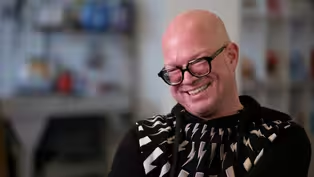
Video has Closed Captions
Clip: S5 Ep34 | 6m 16s | A special look at local artist and handbag designer, Kent Stetson. (6m 16s)
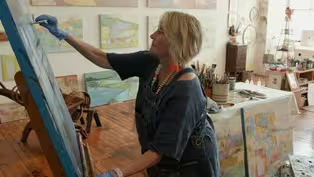
Video has Closed Captions
Clip: S5 Ep34 | 10m 35s | Michelle San Miguel’s report on people who have synesthesia, and the way they view the world. (10m 35s)
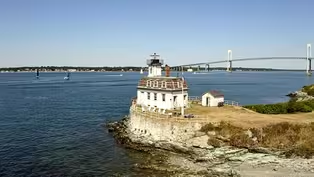
Window on Rhode Island: Rose Island
Video has Closed Captions
Clip: S5 Ep34 | 6m | Tour around Rose Island and learn it's history. (6m)
Providing Support for PBS.org
Learn Moreabout PBS online sponsorship
- News and Public Affairs

Top journalists deliver compelling original analysis of the hour's headlines.

- News and Public Affairs

FRONTLINE is investigative journalism that questions, explains and changes our world.












Support for PBS provided by:
Rhode Island PBS Weekly is a local public television program presented by Ocean State Media